
📖 Table of Contents
- 🌱 The Japanese Phrase You Hear Before Almost Any Challenge
- 🔎 What Does Ganbatte Really Mean?
- 📜 The Interesting History Behind Ganbaru
- 🗣️ Why Is Ganbatte Used in So Many Different Situations?
- 🎓 From School Exams to Everyday Responsibilities
- 🤝 A Way to Show Support Without Saying Very Much
- 🌍 Ganbatte and Encouragement in Other Languages
- 💼 What Ganbatte Means at Work
- 💗 The Warmth Behind the Phrase
- ⚖️ When Encouragement Becomes Pressure
- 🧠 Why Effort Can Be Recognized Before the Result
- 🗨️ What Can You Say Instead of Ganbatte?
- 🌿 How to Understand Ganbatte When You Hear It
- 🇯🇵 Is Ganbatte Uniquely Japanese?
- 🌏 The Deeper Meaning of Ganbatte
🌱 The Japanese Phrase You Hear Before Almost Any Challenge
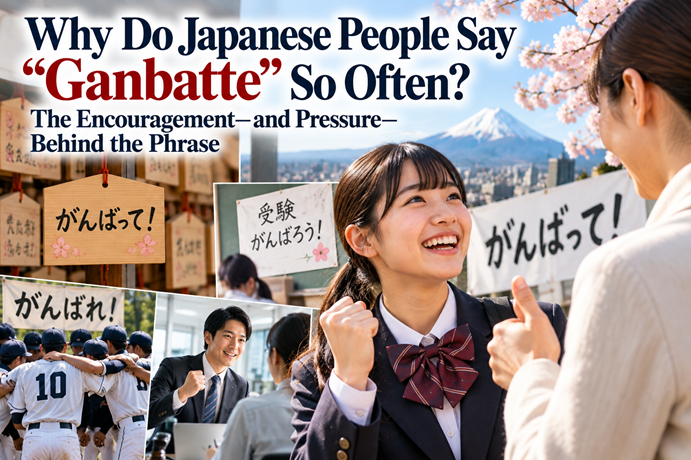
Imagine that a Japanese friend has an important examination tomorrow. A colleague is preparing for a major presentation, a child is about to compete in a sports event, or someone you know is starting a new job. In each situation, there is a familiar phrase you might hear from the people around them: ganbatte. It can be said with a cheerful smile, a reassuring tone, a quick message on a phone, or a more serious expression when somebody is facing something difficult. The situations are different, but the underlying intention is often similar: someone is about to do something that matters, and another person wants to offer encouragement.
If you spend time in Japan, you will hear ganbatte in an enormous variety of settings. Students hear it before examinations, athletes hear it before competitions, friends say it before job interviews, and colleagues exchange it when they are about to undertake challenging work. Parents may use it when their children are learning something new, while someone preparing for a performance might receive the same words from friends or family. The phrase can appear in a text message, at the end of a conversation, or in person just before an important event begins.
For English speakers, ganbatte is often translated as “good luck” or “do your best.” Both translations can be useful, but neither captures every nuance of the Japanese expression. The phrase is connected to the verb ganbaru, which conveys ideas such as making an effort, persevering, holding out, and continuing despite difficulty. Consequently, ganbatte can communicate more than a wish that something turns out well. It can direct attention toward what a person is about to do, the effort involved, and the determination required to see it through.
Yet there is another side to this familiar phrase. If somebody is already exhausted, overwhelmed, grieving, or dealing with a problem they cannot solve through additional effort, hearing ganbatte may feel less like encouragement and more like an expectation to keep going. The same expression that makes one person feel supported can make another feel that their struggle has not been fully understood.
That tension is what makes ganbatte so interesting. It is a common Japanese expression, but it also reveals something about the relationship between language, encouragement, expectations, and the way people respond to one another. To understand why Japanese people say it so often, we need to look beyond its dictionary translation and examine the situations in which it becomes meaningful.
🔎 What Does Ganbatte Really Mean?
The easiest way to understand ganbatte is to begin with ganbaru, the verb from which the expression is formed. Depending on the context, ganbaru can mean to do one’s best, work hard, persevere, stick with something, or refuse to give up when a situation becomes difficult. It can describe a student studying for an examination, an athlete continuing to train, a colleague working toward a deadline, or a person trying to get through a demanding period in life.
Ganbatte is a commonly used form of the verb that works as an encouragement or request, although the way it functions in conversation is more flexible than a simple command to try harder. When someone says ganbatte before an examination, they are usually not issuing a serious instruction to study harder at that exact moment. They are acknowledging that an important task lies ahead and expressing support for the person who must face it. Depending on the relationship and tone, it may sound enthusiastic, affectionate, routine, or gently reassuring.
One reason it is difficult to translate perfectly is that the English phrase depends heavily on the situation. Before an examination, “Good luck” may sound entirely natural. Before a long and difficult task, “Hang in there” may be closer. When someone is preparing for a performance, “You’ve got this” or “I’m rooting for you” might communicate something similar. In other situations, “Do your best” provides the most direct equivalent. Japanese speakers can use one familiar expression across many of these situations, while English speakers may choose among several phrases depending on what they want to emphasize.
There is also a difference between hoping that someone succeeds and expressing confidence in their effort. If you tell a friend “Good luck,” you can leave the outcome somewhat open: you hope events work in their favor. When you say ganbatte, you may be acknowledging the work they are about to undertake. The implication is not necessarily that luck is unimportant or that success is guaranteed, but that the person’s own participation and determination are part of what makes the situation meaningful.
This is why translating ganbatte as “try harder” can sometimes sound too harsh. Although the word is connected to effort, the expression can be warm and encouraging rather than demanding. A friend might say it while smiling as you leave for an interview, or a parent might send it in a message before a school examination. The words are short, but their emotional meaning comes from the relationship, the situation, and the way they are delivered.
The expression does not have a single fixed emotional value. It is better understood as a flexible form of encouragement whose meaning develops through context.
📜 The Interesting History Behind Ganbaru
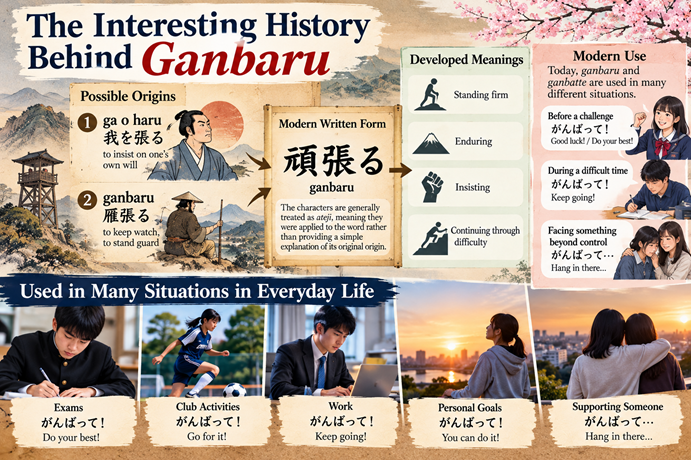
The history of ganbaru adds another layer to the expression. The written form most people recognize today uses the characters for ganbaru, but the characters are generally treated as ateji, meaning they were applied to a word rather than providing a simple explanation of its original origin. Dictionaries describe more than one possible explanation for the word’s development, including a relationship with ga o haru, meaning to insist on one’s own will, and an older expression written as ganbaru, associated with watching or keeping watch. The precise historical derivation should therefore not be presented as a completely settled fact.
For a concise dictionary explanation of the word’s meanings and etymological possibilities, see the Japanese dictionary entry for ganbaru. What matters for the present-day expression is that ganbaru developed meanings related to standing firm, enduring, insisting, and continuing through difficulty. Its modern use includes perseverance and effort, but the word’s history is broader than the positive motivational meaning that many learners encounter first.
This distinction is important because etymology can tempt us to tell a neat cultural story. It would be easy to claim that the original word proves Japanese people have always admired endurance, or that the word itself explains the entire Japanese attitude toward effort. Neither conclusion follows from the possible origins alone. A word’s history and a society’s values influence one another in complicated ways, and a familiar expression can acquire new meanings as it becomes part of everyday conversation.
The present-day use of ganbatte is more useful for understanding Japanese life than trying to draw an entire national philosophy from its etymology. People use it in many different situations, and its meaning changes depending on whether the listener is preparing for a challenge, already working through one, or struggling with something beyond their control. The expression has become conventional enough that it can be used almost automatically, without the speaker consciously thinking about the deeper ideas associated with perseverance.
At the same time, the word’s connection with effort helps explain why it can communicate something that a purely luck-focused expression does not always express. It can recognize the work someone is about to do, encourage them to continue, and signal that the speaker is paying attention to their challenge. The historical meanings do not dictate these modern uses, but they help us understand why the language of persistence remains visible in the phrase.
The history therefore provides an entry point, not a complete explanation. To understand ganbatte, we must also look at its role in contemporary relationships and everyday situations.
🗣️ Why Is Ganbatte Used in So Many Different Situations?
One reason ganbatte is so common is that it can be used when an outcome matters but is not yet known. An examination has not been marked, a competition has not started, a new job has not begun, and a presentation has not been delivered. The person is approaching a moment that requires action, and the speaker wants to acknowledge it. There is no need to know every detail of the task or offer a specific solution. A familiar expression can do the work of recognizing the moment and sending support.
This versatility makes ganbatte useful in daily conversations. A student leaving home in the morning may hear it from a parent before an important test. A friend preparing to travel for a job interview may receive it in a message. Someone about to perform on stage may hear it from the people waiting backstage. In each case, the phrase gives the speaker a way to show interest without requiring a long conversation at a moment when the other person may already be focused on what lies ahead.
The phrase also works for tasks that are ordinary rather than dramatic. It can accompany a difficult workday, a personal goal, a new hobby, or a period of study. Because it does not require the speaker to explain exactly what they admire or what outcome they expect, it is convenient for situations in which a longer statement might feel unnatural. It can simply mean, “I know you have something to do, and I hope you can face it.”
This convenience helps make the expression familiar across different kinds of relationships. The tone may change when the speaker is a close friend, parent, teacher, coach, or manager, but the basic structure remains recognizable. A close friend might use a relaxed and affectionate tone, while a coach might shout it with more energy. A supervisor might use it when a team begins a demanding project, though in that context the phrase can carry expectations as well as encouragement.
Repeated expressions can eventually become part of a social routine. People do not need to invent new words every time someone faces a challenge; they can use a familiar phrase whose meaning is generally understood. That does not make the expression empty. A simple phrase can communicate warmth precisely because the people involved share an understanding of the situation.
However, frequency should not be confused with universal use. Japanese people do not say ganbatte in every situation, and different speakers have different habits. Other expressions may be more suitable when a person needs sympathy, reassurance, practical help, or permission to rest. The high visibility of ganbatte comes from its flexibility, not from a rule that every challenge must be met with the same words.
🎓 From School Exams to Everyday Responsibilities
School life provides one of the clearest settings in which ganbatte becomes familiar. Students may hear the phrase before examinations, sports competitions, school performances, presentations, entrance examinations, and other occasions that require preparation or courage. Parents, teachers, friends, and classmates can all use it, so a student may encounter the expression in several different relationships while working toward the same goal.
The meaning can change slightly with the situation. Before an entrance examination, ganbatte may express encouragement for the effort the student has already put into studying and the challenge that remains. Before a sports event, it may communicate enthusiasm and support for the team. Before a performance, it can be a way of calming nerves while recognizing that the moment is important. The expression does not promise success; it acknowledges that the person is about to take part in something that matters to them.
Japanese school life also contains many responsibilities beyond academic study. Depending on the school, students may participate in classroom duties, group activities, school festivals, cleaning routines, or club activities. These experiences provide practical situations in which people depend on each other, and encouragement may become part of how the group prepares for an activity. A classmate might say ganbatte to someone leading a meeting, a student may hear it before a performance at a school festival, or a team member may use it when a friend takes on a difficult role.
It would be too simple to conclude that these examples prove Japanese schools value effort more than schools elsewhere. Education systems around the world encourage students in different ways, and peers, teachers, and parents in many countries use familiar phrases before important tasks. The interesting point is how easily ganbatte fits into the many stages of school life, from routine academic work to emotionally significant events.
The phrase also connects the individual with the people around them. A student is the one who must take the examination or step onto the field, but the encouragement comes from someone else. The speaker cannot perform the task for the student, yet they can signal that the student is not entirely alone in facing it. This is often the emotional function of ganbatte: it acknowledges the individual’s responsibility while giving them a small reminder that other people are paying attention.
For many people, those everyday moments may be more memorable than any explanation of the word. The phrase becomes familiar because it appears alongside the experiences through which people learn, compete, cooperate, and grow.
🤝 A Way to Show Support Without Saying Very Much
Not every supportive conversation needs to be long. Sometimes the person preparing for a challenge does not want advice, and the speaker may not be in a position to provide practical assistance. A short phrase can still acknowledge the situation and show that the speaker cares about what happens next. Ganbatte can serve this purpose, allowing a person to offer support without turning the moment into a serious discussion.
Imagine a friend who is leaving for a job interview. They have already prepared their answers, chosen their clothes, and checked the route. At that point, a long list of additional advice might be unnecessary or even distracting. A simple ganbatte can acknowledge the importance of the interview while allowing the friend to leave with their attention focused on the task ahead. The speaker does not need to predict the outcome or pretend to know what will happen. They can simply offer encouragement at the moment when it is useful.
The same can happen before a sports competition, musical performance, examination, or presentation. In these situations, the speaker may know that the person has worked hard but cannot remove the uncertainty of the outcome. Encouragement provides a way to recognize the effort without promising success. It also allows the relationship to remain present even when the speaker cannot participate directly in the event.
This is one reason the phrase can function as a form of empathy. The speaker is not necessarily claiming to understand every aspect of the other person’s experience. They are acknowledging that the person has a challenge ahead and that the challenge deserves recognition. That small gesture can feel reassuring, especially when the relationship is close enough that both people understand what is at stake.
Yet empathy depends on more than the words themselves. A cheerful ganbatte before an examination may feel supportive because the speaker knows that the student has prepared and still has the ability to act. The same expression may feel hollow if somebody is describing an overwhelming situation and the listener responds without acknowledging the problem. In that case, a sympathetic question, an offer of practical help, or simply listening may communicate care more effectively.
The phrase is therefore most useful when it matches the needs of the person receiving it. Its brevity can be a strength, but it cannot substitute for every form of support. Understanding that distinction helps explain both why ganbatte is so common and why it sometimes fails to convey what a person truly needs.
🌍 Ganbatte and Encouragement in Other Languages
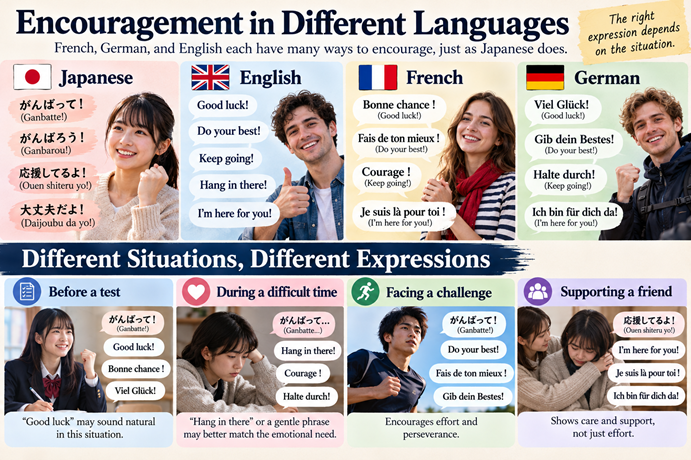
Comparing ganbatte with expressions in other languages helps reveal its nuance, but no single translation perfectly captures the range of situations in which it is used. English speakers may say “Good luck,” “Do your best,” “Keep going,” “Hang in there,” “You’ve got this,” or “I’m rooting for you.” These expressions overlap with ganbatte, yet each emphasizes a slightly different part of the situation. Some express a hope for success, some recognize effort, some encourage perseverance, and others communicate that the speaker is emotionally on the person’s side.
The difference between ganbatte and “Good luck” is particularly useful for learners. “Good luck” often expresses a wish that an event turns out well, while ganbatte can focus more directly on the person’s effort. But English speakers also use phrases that emphasize persistence, and Good luck can be a warm, supportive expression rather than a detached wish about chance. The distinction is one of emphasis, not an absolute division between languages.
French provides another useful comparison with Bon courage. Depending on the context, it can encourage someone facing a demanding or difficult situation, expressing a wish that they have the courage or strength to deal with it. German speakers may use Viel Erfolg to wish someone success, or Viel Glück to wish them luck, while other expressions can encourage a person to keep going. These differences reflect the range of ways languages package encouragement rather than proving that speakers of one language value effort and speakers of another value results.
🌐 How Encouragement Changes Across Languages
| Language or expression | Typical meaning | Important nuance |
|---|---|---|
| Japanese: Ganbatte | Do your best, keep going, make an effort | Often recognizes the effort or challenge ahead |
| English: “Good luck” | I hope things go well | Common before uncertain events; can be warm and supportive |
| English: “I’m rooting for you” | I support you and want you to succeed | Makes the speaker’s emotional support especially clear |
| English: “Hang in there” | Keep going through a difficult situation | Often used when someone is already facing difficulty |
| French: Bon courage | Have courage; face the challenge | Can acknowledge that the task will be difficult |
| German: Viel Erfolg | Much success | Focuses on the desired outcome, but usage depends on context |
The table should be read as a practical guide rather than a ranking of national values. French, German, and English each have many forms of encouragement, just as Japanese does. Speakers select expressions according to the relationship, the activity, and the kind of emotional support they want to convey. Translating every instance of ganbatte as “Good luck” may be convenient, but it can conceal the word’s connection to effort; translating it every time as “Work harder” would be equally misleading because it ignores the warmth and informality that the phrase often carries.
For learners, the most useful approach is to consider the situation rather than memorize one English equivalent. Before a test, “Good luck” may sound natural. If a friend is already struggling, “Hang in there” or “I’m here for you” may better match the emotional need. In Japanese, ganbatte may be perfectly appropriate in the first situation, while a gentler phrase may be preferable in the second. The right translation depends on what the speaker is trying to do, not only on the dictionary definition.
💼 What Ganbatte Means at Work
The workplace is another setting in which ganbatte can be heard, particularly when people begin a demanding task, prepare for a deadline, or face a challenging project. A colleague may say it before a presentation, a manager might use it when wishing a team well, or coworkers might exchange it when they know that a difficult period is coming. In a friendly relationship, the expression can provide a simple sign of support without requiring a formal discussion.
However, workplace context can make the phrase more complicated. When a friend says ganbatte, the listener may interpret it as personal encouragement. When a manager says the same thing, the employee may also hear an expectation. The difference does not lie entirely in the word; it comes from the relationship between the people and the responsibilities attached to their roles. A supervisor controls workloads and deadlines in ways that a friend usually does not, so encouragement from a supervisor can carry additional weight.
For example, a colleague preparing for a presentation may appreciate hearing ganbatte because it recognizes their preparation and communicates confidence. But someone who has been working late every night may hear the same phrase differently, especially if the speaker has the power to change the workload but offers no practical help. What sounds like support in one relationship may feel like an instruction to keep working in another.
This is not a problem unique to Japanese workplaces. In any organization, encouraging employees can be helpful when it recognizes effort and accompanies reasonable support. It becomes less helpful when it is used as a substitute for addressing unreasonable expectations, insufficient resources, or an excessive workload. A phrase of encouragement cannot fix a structural problem.
The distinction is particularly important when interpreting the idea that ganbatte represents Japanese workplace culture. It would be inaccurate to assume that every Japanese manager expects employees to work excessively or that every use of the phrase carries pressure. The expression can be completely ordinary, warm, and appropriate. Yet because it is connected to persistence, its meaning can feel heavier when the person receiving it already believes that they are expected to endure more than they reasonably can.
A deeper understanding of the expression therefore requires us to consider who is speaking, what relationship they have with the listener, and whether the listener has meaningful control over the situation. The same phrase can support a colleague, encourage a team, or unintentionally reinforce a demand. Language does not operate separately from power.
💗 The Warmth Behind the Phrase
It would be a mistake to focus only on the potential pressure of ganbatte. In many situations, the phrase is genuinely kind. A person may not know exactly what to say to someone they care about, especially when a difficult event is approaching. They cannot guarantee the outcome, remove all uncertainty, or take the challenge away. What they can do is acknowledge that the person is facing something important and express a wish for them to get through it.
Sometimes the phrase is accompanied by practical help. A parent who says ganbatte before an examination may also prepare breakfast or help the child get ready. A friend may send the message before an interview and then ask later how it went. A teammate may encourage someone before a competition and help them train. In these situations, the words are part of a wider relationship in which concern is shown through both language and action.
The expression may also help the speaker acknowledge that they cannot do the task themselves. If a friend is taking an examination, giving a performance, or facing a personal goal, the responsibility ultimately belongs to the person doing it. The speaker may wish them well but cannot control the result. Saying ganbatte provides a way to recognize that boundary while still expressing support. It is a small message that says, in effect, “I know this matters to you, and I hope you can face it.”
Another source of warmth comes from familiarity. When a phrase is used regularly between people who know each other, it can carry shared meanings that go beyond its literal translation. The words may be short, but the relationship supplies much of the emotional content. A parent saying ganbatte to a child on the first day of school can mean something different from a coworker saying it before a routine meeting, even though the same expression is used.
This is why counting how often Japanese people use ganbatte cannot by itself tell us what the word means emotionally. Frequency shows that the expression is familiar and convenient, but context explains whether it feels encouraging, affectionate, routine, or demanding. A familiar phrase can be meaningful without being dramatic.
In its most supportive form, ganbatte does not mean that the speaker expects the person to solve every problem by willpower. It simply recognizes that the person is about to make an effort and offers a small gesture of solidarity. The warmth is real, even if the words do not always express it in full.
⚖️ When Encouragement Becomes Pressure
The same expression that can feel warm before an examination may be unwelcome when someone is already struggling. Imagine that a person has been working as hard as they can, but their situation continues to deteriorate. They may be ill, exhausted, grieving, caring for someone, dealing with financial difficulties, or facing a problem that cannot be resolved by additional effort alone. If someone responds with ganbatte, the listener may hear a message that they should try harder, even when what they really need is rest, understanding, or practical help.
This does not mean the speaker intends to be unkind. They may simply be reaching for a familiar phrase because they want to offer encouragement but do not know what else to say. The problem is that the expression directs attention toward the person’s ability to continue making an effort. If the listener has already reached their limit, that focus may unintentionally suggest that their existing effort is insufficient.
This is particularly important in situations where outcomes are only partly within a person’s control. Someone may be doing everything reasonably possible to recover from an illness, find employment, support a family member, or manage a difficult personal situation, yet the outcome may remain uncertain. Telling them to keep trying does not necessarily help, because the problem is not a lack of determination. Sometimes the person needs resources, time, treatment, assistance, or simply space to experience what is happening without being asked to perform resilience.
In these situations, ganbatte can be heard as pressure even when it is intended as kindness. The word itself has not changed, but the context has. Before a sporting event, effort may be an appropriate focus because the person is preparing to act. During severe exhaustion, the same focus may ignore the person’s need to stop. A supportive phrase becomes less supportive when it assumes that continued effort is always the right answer.
There is also a social dimension to this problem. In environments where people feel expected to be dependable, productive, or strong, an instruction to keep trying can reinforce an already heavy sense of responsibility. A student may feel that they must continue studying regardless of exhaustion; an employee may feel that they cannot admit a workload is excessive; a caregiver may feel that asking for help means they have failed. Ganbatte does not create these pressures by itself, and they are not exclusive to Japan, but the phrase can become part of the language through which those expectations are expressed.
The answer is not to ban the expression. It remains a useful and often affectionate form of encouragement. The answer is to notice when effort is actually what the person needs help with. If someone is ready to face a challenge, encouragement may energize them. If they are already at their limit, a different response may be more humane.
🧠 Why Effort Can Be Recognized Before the Result
One reason ganbatte is useful is that it allows someone to express support before the outcome is known. When a student sits an examination, a performer goes on stage, or a person starts a new job, nobody can guarantee that everything will go well. Yet encouragement does not have to wait until success has been achieved. The phrase can acknowledge the effort involved in approaching the moment, rather than reserving all recognition for the final result.
This is an important difference in emphasis, but it should not be turned into a sweeping statement that Japanese people value the process while people in North America or Europe value only results. People in many societies admire preparation, patience, persistence, and hard work. Similarly, Japanese society places considerable importance on results in education, employment, sports, and other areas of life. The contrast is not between two entirely different moral systems.
Instead, ganbatte makes a particular kind of encouragement readily available in ordinary conversation. It can be used when a person is still in the middle of doing something, when the result remains uncertain, or when an event requires personal effort. The speaker does not have to judge whether the person will succeed, and they do not have to promise that the situation will turn out well. They can recognize the challenge that lies ahead and wish the person strength to meet it.
Consider two friends, one preparing for an entrance examination and another preparing for a difficult conversation. The first is studying for a result that can eventually be measured, while the second may be trying to explain a concern or repair a relationship. Both may hear ganbatte, even though their tasks are very different. The common element is not a guarantee of success, but the recognition that something difficult or important lies ahead.
The phrase may also be used after effort has already been made, depending on the form of the verb and the context. Japanese speakers can talk about having done their best, continuing to work, or encouraging a group to persevere. These related expressions show that the language of effort is flexible rather than limited to a single moment before an event.
The deeper point is that recognizing effort can be valuable without making effort the only thing that matters. A person deserves compassion even when their best efforts do not lead to success, and an outcome may depend on circumstances beyond their control. The most thoughtful interpretation of ganbatte leaves room for both ideas: effort can be worth supporting, but it does not determine every result.
🗨️ What Can You Say Instead of Ganbatte?
Understanding ganbatte also means understanding when another expression may be more appropriate. Japanese offers several alternatives, and they do not all communicate the same feeling. The choice depends on whether the person needs encouragement to act, reassurance that they are supported, recognition for what they have already done, or permission to take a break.
When someone is about to begin a challenge and has the ability to act, ganbatte may be a natural choice. If you want to be more explicit about your support, you can say that you are cheering for them or that you hope things go well. If the person is nervous, reassurance may matter more than an instruction to make an effort. If they are exhausted, telling them not to push themselves too hard may be more considerate.
One useful alternative is muri shinaide, which means not to overdo it or not to push oneself beyond one’s limits. It can be appropriate when a person appears tired or is taking on too much, although tone and context still matter. It does not mean that the speaker is dismissing the task; rather, it expresses concern for the person’s well-being. Another option is otsukaresama, an expression used in many Japanese workplaces and social situations to acknowledge someone’s work or effort. Depending on the context, it can recognize what the person has already done instead of focusing on what remains to be done.
There are other ways to offer support without using a direct encouragement phrase. Asking whether the person wants to talk, offering practical help, or saying that you are available can sometimes communicate more than a quick expression. These alternatives are particularly useful when the situation is serious or when the person has made it clear that they are struggling. The important skill is not memorizing a long list of phrases, but recognizing the difference between a person preparing for a challenge and a person who needs care.
🌿 Choosing the Right Expression for the Situation
| Situation | Possible expression | Meaning and nuance |
|---|---|---|
| A friend has an examination tomorrow | Ganbatte | Encouragement before a challenge |
| A teammate is about to compete | Ganbare or ganbatte | A more energetic form of support may fit the occasion |
| Someone is already exhausted | Muri shinaide | Don’t overdo it; take care of yourself |
| Someone has finished a difficult task | Otsukaresama | Acknowledge the effort or work already completed |
| A friend is facing a difficult situation | Itsudemo hanashi o ki ku yo | I can listen whenever you need to talk |
| You want to recognize ongoing effort | Ganbatte iru ne | You’re working hard; I can see your effort |
These are practical approximations rather than universal formulas. Japanese expressions depend on relationships, politeness, tone, and context, and a phrase that sounds natural between close friends may not be the best choice with a supervisor or someone you have just met. The table offers examples of different intentions: encourage someone to act, help them avoid overexertion, recognize work already completed, or offer emotional support.
For foreign residents and learners of Japanese, this distinction can make conversations more natural. It helps move beyond translating ganbatte as a single English phrase and toward understanding what the speaker wants to communicate. Sometimes the best response is a simple arigato, meaning thank you. Sometimes the person may reply that they will do their best. No elaborate response is required every time.
Most importantly, it is acceptable to choose a phrase that suits the other person’s situation rather than automatically repeating the most familiar expression. Language becomes more thoughtful when it responds to the person in front of you.
🌿 How to Understand Ganbatte When You Hear It
If you live in Japan or interact regularly with Japanese speakers, you will probably hear ganbatte in situations where it sounds almost automatic. Someone says it at the end of a conversation, sends it in a message, or uses it when a friend is about to do something ordinary. It is easy to assume that every use carries a deep cultural meaning, but often it is simply a familiar way of showing encouragement.
The most helpful approach is to look at what is happening around the phrase. If someone says it before an examination, competition, performance, or interview, they are probably acknowledging the challenge and wishing the person well. If a colleague says it before a difficult project, it may express support or shared determination, although the speaker’s role and relationship with the listener matter. If it is used after a long conversation about exhaustion or distress, the emotional effect may be different, and the listener may need more than encouragement.
Tone can provide clues. An enthusiastic shout from a teammate has a different effect from a quiet message from a close friend. The relationship also matters: the same words may feel comforting from a supportive parent and demanding from someone who controls your workload. Context helps you understand whether the phrase is likely to be encouragement, routine politeness, or an expression of expectation.
It is also useful to pay attention to what happens after the words. Does the speaker offer help? Do they ask how the event went afterward? Do they listen when the person says they are tired? These actions can clarify what the encouragement means in the relationship. A phrase becomes more supportive when it is accompanied by attention to the person’s actual needs.
You do not need to interpret every instance of ganbatte as evidence of a national philosophy. A common expression can be culturally meaningful while still being ordinary, casual, and sometimes automatic. The point is not to assign a single deep explanation to every conversation, but to understand why the expression works across so many situations and how its meaning changes depending on the circumstances.
For people learning Japanese, this is part of developing pragmatic fluency: understanding not only what a phrase means, but when it fits, what it implies, and how it may be received.
🇯🇵 Is Ganbatte Uniquely Japanese?
The expression ganbatte is strongly associated with Japanese language and everyday life, but the feelings it can communicate are not exclusive to Japan. People in many societies encourage friends before difficult tasks, acknowledge one another’s effort, and offer words of support when someone faces uncertainty. They may use different expressions or place emphasis on different aspects of the situation, but the broader human need to encourage others is widely shared.
The distinctive element is not that Japanese people are uniquely supportive or that they alone recognize effort. It is that ganbatte is a compact and familiar expression that can be used across many everyday contexts. It allows a speaker to acknowledge a challenge, express support for the person facing it, and sometimes encourage them to persist. Because the word is so flexible, it can appear in school, sports, work, family life, friendships, and casual messages.
It is also important not to conclude that the frequency of ganbatte proves that all Japanese people place effort above happiness, success, or personal well-being. Language reflects patterns of communication, but it does not tell us everything about the values of every speaker. Japanese people may use the expression with warmth, habit, humor, or pressure; the same person may use it differently at different times.
The phrase is best understood as a culturally familiar tool for navigating a common human situation: someone is about to attempt something, and another person wants to respond. Its particular wording reflects the meanings that have developed around ganbaru, while its emotional effect depends on the relationship and the moment.
That is more interesting than claiming the phrase proves Japan is fundamentally different from the rest of the world. Culture often becomes visible through the familiar ways people handle experiences that humans share. The challenge may be universal, but the language used to acknowledge it can tell us something about how a particular community communicates.
🌏 The Deeper Meaning of Ganbatte
Why do Japanese people say ganbatte so often? The answer is not simply that Japanese culture values hard work, nor that the phrase has a single meaning that can be translated perfectly into English. It is useful because it can perform several social functions at once. It recognizes that a person is facing a challenge, acknowledges the effort involved, and gives another person a brief way to express support without needing to predict the outcome or solve the problem.
The expression can be warm because it helps people recognize one another’s efforts. A student receives it before an examination, a colleague hears it before a presentation, and a friend is encouraged before trying something new. In these moments, the phrase is often a small gesture of solidarity. It does not have to be dramatic to be meaningful; the fact that another person notices the challenge may be enough.
But the phrase also reminds us that encouragement is not automatically helpful just because it is well intentioned. When a person is already exhausted or facing circumstances beyond their control, asking them to continue can feel like an additional burden. A more thoughtful response may be to listen, offer practical assistance, acknowledge what has already been done, or encourage the person to rest. The meaning of ganbatte therefore depends not only on the speaker’s intention but on the listener’s situation.
Perhaps this is the most important lesson hidden inside such a familiar word. Support requires more than choosing a positive phrase. It requires paying attention to what the other person is actually facing. Sometimes they need encouragement to take the next step; sometimes they need someone to recognize how far they have already come; and sometimes they need permission to stop pushing themselves.
The same phrase can express care or unintentionally create pressure because human relationships are more complicated than dictionaries. Ganbatte provides a small window into that complexity. It connects effort with encouragement, individual responsibility with the presence of others, and a familiar expression with a wide range of emotional situations.
In the end, the most meaningful interpretation of ganbatte is not a command to endure everything or a promise that hard work will always lead to success. It is a reminder that someone is facing something that matters and that another person has taken a moment to acknowledge it. Used with sensitivity, the phrase can offer warmth and solidarity. Used without attention to the situation, it can become an expectation to keep going when continuing is no longer what the person needs.
Understanding ganbatte means learning to recognize both possibilities. And perhaps that is what makes an ordinary expression such a revealing part of everyday Japanese communication: its meaning is not contained entirely in the word itself, but in the human relationship that gives the word its place.
🔗 Explore More of Deep Japan
The phrase ganbatte reveals how everyday Japanese language can carry both encouragement and expectations. Continue exploring Deep Japan to discover more about the ideas, habits, and unspoken meanings that shape life in Japan.
👉 What Does the Language of Japan Reveal About Its Culture? From Respect to Unspoken Meaning
👉 Why Do Life’s Milestones Become Ceremonies in Japan? Understanding Japan’s Ritual Culture
👉 Why Is Humility So Important in Japan? Understanding the Japanese Aesthetic of Modesty (2026 Guide)
👉 Why Is Japanese Gift Wrapping So Detailed? Understanding Japan’s Packaging Culture (2026 Guide)