
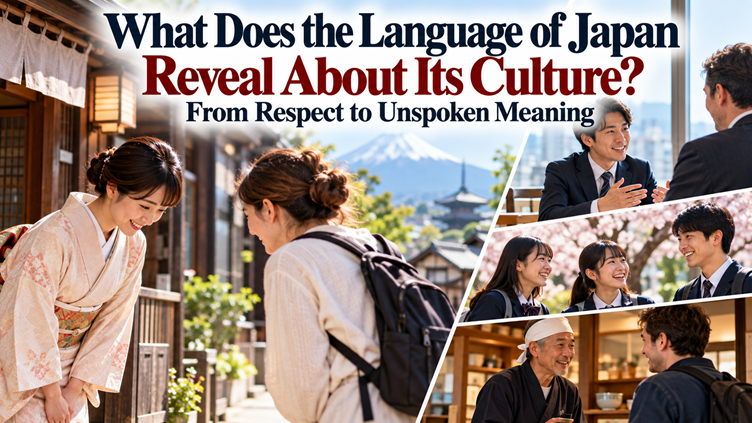
🌏 A Language That Does More Than Deliver Information
When people first encounter the language of Japan, one of the first things they often notice is that it seems to work differently from English. A sentence may leave out the person who performed an action, the object of the action may remain unstated, and a phrase that appears incomplete on paper can be perfectly understandable in conversation. Then there is the writing system, in which several different scripts can appear naturally within a single sentence, each performing a different role. There is also a highly developed system of polite and honorific expression, a remarkable range of words that imitate sounds, movements, textures, emotions, and states, and a constant sensitivity to context that allows speakers to say less while communicating more. None of these characteristics belongs exclusively to Japan, and Japanese is not the only language in the world with any one of them. What is striking is the way so many of these features exist together in one language and operate as part of ordinary daily communication.
That combination makes the language of Japan more than a grammatical system. It provides a fascinating way to think about how people in Japan organize information, express social relationships, describe sensations, and decide what needs to be said aloud and what can remain in the background. It would be too simple to claim that the language created Japanese culture by itself. Languages have their own histories, and culture, social structure, religion, geography, institutions, and historical experience all influence how languages develop and are used. Yet language and culture continually interact. The habits that a language makes easy to express become part of everyday communication, and the ways people repeatedly communicate can reinforce particular cultural expectations. In that sense, the language of Japan can offer a window into ways of noticing relationships, atmosphere, hierarchy, emotion, and context that have become familiar within Japanese society.
This is where the subject becomes much more interesting than a simple lesson in Japanese grammar. The question is not merely, “What is unusual about this language?” It is, “What does the structure and everyday use of this language allow people to notice, express, leave unsaid, and understand together?”
✍️ One Sentence Can Contain Several Writing Systems
Perhaps the most visually obvious feature is the writing system. Modern Japanese does not use one single script for everything. Instead, several writing systems work together. Kanji carries a large amount of lexical information, hiragana is central to grammatical endings and many everyday words, katakana is strongly associated with foreign words and certain forms of emphasis, and Roman letters regularly appear in abbreviations, brand names, technical terms, organizational names, and modern everyday vocabulary. Numbers and Arabic numerals are also mixed freely into ordinary writing. A sentence can therefore move between different visual systems without the reader experiencing that combination as unusual.
This is one of the features that can be difficult for outsiders to appreciate because Japanese readers usually do not experience the scripts as separate competing systems. They have learned to read the visual differences as part of the information itself. A kanji-heavy word can make the core meaning of a phrase immediately visible, hiragana can show the grammatical relationship between words, katakana can signal a particular lexical category or visual emphasis, and Roman letters can indicate a modern abbreviation or technical expression. The scripts are not merely different ways of writing the same thing. They often perform different jobs inside the same sentence.
That makes the Japanese writing system interesting beyond the question of difficulty. A learner may initially see four overlapping ways of writing, while an experienced reader sees a coordinated system in which visual form itself helps organize meaning. The result is not necessarily more efficient in every situation, and it certainly requires considerable learning, but it allows Japanese writing to communicate information through several channels at once. In a very practical sense, the page itself can tell the reader something about what kind of word is being presented before the word has even been fully interpreted.
This does not mean that no other language combines different scripts. Other writing systems also coexist with foreign alphabets, numerals, symbols, and imported vocabulary, and multilingual societies frequently mix scripts. What is distinctive about Japanese is the everyday, highly normalized coordination of kanji, hiragana, katakana, and Roman letters within the same writing environment. The complexity is not simply that Japan has multiple scripts. The deeper feature is that speakers and readers have learned to assign different communicative roles to them and switch among them almost invisibly.
🗣️ Respect Is Not Added to the Language; It Is Built Into Everyday Choice
The next major feature is social language. Japanese is often introduced to foreigners through the idea of politeness, but “polite Japanese” is not simply a softer version of ordinary speech. The language provides multiple ways of positioning the speaker and listener in relation to one another, including polite forms, honorific expressions, humble expressions, and different choices of vocabulary and sentence structure. These choices can change depending on age, workplace role, social distance, familiarity, institutional setting, and the relationship between the people involved.
This is particularly interesting because the social relationship does not stay outside the sentence. It can become part of the sentence itself. When someone speaks to a close friend, a customer, a manager, an elderly relative, a teacher, or a stranger, the language may shift even when the basic information being communicated is almost identical. A speaker is therefore doing two things simultaneously: communicating the content of the message and positioning the relationship between the people involved. The words do not merely say what happened. They also help establish how the speaker and listener should relate to one another at that moment.
This does not mean Japanese society is the only place where language expresses social hierarchy or politeness. Korean, for example, also has a highly developed system of speech levels and honorifics, and many European languages encode social distance through pronouns and formal or informal address. English also has politeness strategies, though they are often expressed less through systematic grammatical distinctions. The important point is that Japanese provides many everyday opportunities to adjust linguistic distance as a conversation unfolds. The relationship is not simply known; it can be continuously reflected in language.
That makes the concept of social distance especially interesting in Japanese. The distance between people is not necessarily fixed. Someone may use formal language at work and more casual language with the same person outside work. Two people who were once strangers may gradually become more informal. Someone can remain friendly while still deliberately maintaining a polite register. In that sense, language can act almost like a live measurement of interpersonal space. The speaker is constantly choosing not only what to say, but how close or distant the expression should feel.
🤝 Language Can Make Relationships Visible
This relationship between language and social distance helps explain why a conversation in Japan can sometimes feel more socially layered than a foreign visitor expects. A learner may understand the dictionary meaning of a sentence perfectly and still miss something important because the choice of wording communicates the relationship between the people involved. Two expressions may have almost the same literal meaning while producing very different impressions because one is more formal, more intimate, more respectful, or more distant.
That does not mean Japanese speakers consciously analyze every relationship before every sentence. Native communication becomes automatic. People learn the appropriate patterns through family life, school, work, media, and repeated social experience. Just as an English speaker does not consciously calculate every article or preposition, a Japanese speaker generally does not stop to explain why a particular polite form is being used. The social meaning has become part of ordinary linguistic instinct.
This is where language and culture begin to overlap in an interesting way. A society does not need to teach people a philosophical theory about interpersonal distance if everyday language already requires them to pay attention to it. The repeated act of choosing expressions according to relationship can make social positioning a normal part of communication. That does not prove that language creates the culture, but it does show how language can provide a place where cultural expectations are repeatedly practiced.
💭 Japanese Can Give Form to Sensations That Are Difficult to Explain
Then there is the world of Japanese mimetic expression, often grouped under the broad category of onomatopoeia. The most familiar examples imitate sounds, but Japanese also has a very rich range of expressions for states, textures, movements, appearances, emotions, physical sensations, and subtle changes in atmosphere. Expressions such as dokidoki, describing a pounding or excited heartbeat, kirakira for sparkling or glittering, shitshito for a gentle, continuous rain, fuwafuwa for something soft or fluffy, and moyamoya for a lingering sense of emotional unease all demonstrate something important. The language is not limited to naming objects and actions. It can also give relatively compact linguistic form to the way something feels.
This is particularly interesting because many of these expressions do not describe a measurable object in the conventional sense. “Rain” is an event, but shitshito can tell you something about how the rain is falling. A heart beating is a physical action, but dokidoki communicates more than the mechanical movement. It can capture excitement, nervousness, anticipation, or emotional tension. Kirakira can describe not only actual light but also the visual quality of something that seems sparkling or dazzling. The word carries an impression.
That gives Japanese a powerful vocabulary for subjective experience. A speaker can describe not only what happened but how the experience appeared, sounded, moved, felt, or affected the body. The distinction between objective event and subjective sensation becomes more linguistically flexible. Again, this should not be turned into the simplistic claim that Japanese people are inherently more sensitive than other people. Other languages also have rich ways of describing sensation, metaphor, sound, and emotion. What is striking in Japanese is the sheer range of everyday mimetic expressions available for turning subtle impressions into relatively compact words.
This can also help explain why Japanese descriptions of weather, food, clothing, texture, movement, and emotional states can sometimes feel unusually vivid to learners. The speaker is not necessarily providing more factual information. Instead, the language allows the speaker to communicate a particular quality of the experience. The difference between something being wet and being drenched, between something being shiny and seeming to sparkle, or between simply feeling uncertain and carrying a vague emotional heaviness can become more expressible through these forms.
🌿 A Language That Can Describe the Atmosphere Around an Event
Once writing systems, honorifics, and mimetic expressions are viewed together, a pattern begins to emerge. Japanese is not limited to communicating the central event. It has many mechanisms for communicating information around the event: the relationship between the people involved, the speaker’s attitude toward the listener, the sensory quality of what is happening, and the emotional atmosphere surrounding it.
This is one reason Japanese can feel difficult to translate directly. A translator may understand the literal meaning of a sentence and still need to make decisions about the social relationship, tone, emotional force, and contextual assumptions that are not contained in one simple English equivalent. The challenge is not necessarily that Japanese has more words. The challenge is that different parts of the language can carry different layers of information simultaneously.
That is also why the idea that Japanese is simply “vague” is not especially useful. Japanese can be extremely precise when precision is needed. Legal documents, scientific writing, technical manuals, academic papers, and business contracts can be highly explicit. What makes everyday Japanese interesting is that it often provides the option of leaving certain information implicit when the context already makes it recoverable. The language can be very specific when necessary and highly economical when repetition would add little.
👀 When the Sentence Does Not Need to Say Everything
This brings us back to the feature that first raises so many questions for English speakers: Japanese can often leave out the subject, object, or other information when the listener can recover it from context. A phrase such as “ashita ikimasu,” meaning roughly “I’ll go tomorrow,” does not need an explicit “I” when the speaker is already obvious. “Mou tabeta?” can mean “Have you eaten?” even though the object is not stated. “Chotto…” can remain unfinished while still communicating hesitation or a polite refusal depending on the context. “Daijobu desu” can mean different things in different situations because the surrounding circumstances help determine whether the speaker means “I’m fine,” “No, thank you,” “It’s okay,” or something similar.
This is not proof that Japanese speakers are simply comfortable with ambiguity. The more precise way to describe it is that some of the meaning is carried outside the sentence. The speaker relies on the listener to recover information from the conversation, the physical situation, the relationship, and what has already been established. The sentence itself does not always need to carry the entire message.
Other languages can also omit information, and some languages such as Spanish and Italian frequently allow subject pronouns to remain unspoken because their verb systems provide useful clues about the subject. Korean and Mandarin Chinese also offer important comparisons with Japanese because context can play a major role in recovering omitted information. English, by contrast, generally requires an explicit subject in ordinary finite clauses, even though everyday spoken English has its own forms of conversational omission. The interesting point is therefore not that Japanese is the only language capable of leaving things unsaid. It is that Japan offers a particularly clear example of a language in which context can carry a very large part of the communicative load.
🧩 The Listener Is Part of the Communication
Once you look at Japanese this way, an important idea appears: communication is not necessarily something the speaker completes alone.
The speaker produces part of the message.
The listener reconstructs another part.
The situation supplies another part.
The relationship between the people supplies another.
The meaning emerges from the combination.
This does not mean that Japanese speakers are constantly expecting other people to read their minds. On the contrary, misunderstanding is common, and Japanese speakers can be as explicit as anyone else when something genuinely needs clarification. The interesting point is that the language provides a very natural way to avoid unnecessary repetition when enough information is already shared.
That has consequences for everyday communication. The listener has a more active role in interpreting what is meant, while the speaker has more opportunities to avoid stating information that seems obvious, repetitive, or socially awkward. This does not make one style inherently better than another. It creates a different balance between explicit wording and contextual interpretation.
It also helps explain why the same short Japanese phrase can feel completely different depending on who says it, to whom, where, and when. The words may remain identical, but the social and situational information surrounding them changes. The language is therefore not operating as a closed object. It is interacting continuously with its environment.
🤫 What Is Not Said Can Still Be Meaningful
One of the most revealing features of Japanese communication is the ability to leave things unfinished without necessarily making the conversation fail. A person can say “chotto…” and allow the listener to infer that something is difficult, undesirable, or unlikely without expressing a complete rejection. A person can pause after “sou desu ne…” and allow the tone and silence to carry part of the response. A person can say “muzukashii desu ne” in a situation where the literal idea of difficulty does not fully explain the communicative purpose.
Again, this does not mean that Japanese speakers never say “no.” They do. It means that Japanese offers a socially familiar space between direct acceptance and direct refusal. The unfinished phrase can leave the other person room to interpret the situation without forcing both sides into an unnecessarily confrontational statement.
This is one place where language and interpersonal culture clearly meet, even if we should not claim that one mechanically caused the other. A communication style that values awareness of the other person’s position can make indirect forms useful. A language that already offers such forms can make them easy to reproduce. Over long periods, language and social convention can reinforce one another.
The important concept is not “Japanese people avoid saying what they mean.” That would be unfair and inaccurate. A better description is that Japanese offers many ways to communicate while deliberately controlling how much of the message is made explicit.
🇯🇵 Why Japanese Does Not Have to Be “Unique” to Be Distinctive
There is a temptation when discussing the language of Japan to turn every characteristic into proof that Japanese is completely unlike every other language on Earth. That would actually weaken the argument.
Japanese is not the world’s only language with omitted subjects. It is not the only language with honorifics. It is not the only language to use multiple writing systems in modern contexts. It is not the only language with rich sound-symbolic vocabulary, indirect expressions, or context-dependent meaning.
What is distinctive is the combination.
A language that combines kanji with hiragana and katakana as everyday functional components; that has an extensive system for adjusting politeness and social distance; that uses a large repertoire of mimetic expressions; that can routinely omit information recoverable from context; and that gives speakers many ways to leave a thought deliberately open creates a particular communicative environment.
That combination deserves attention precisely because it cannot be reduced to one grammatical feature.
🧠 Does Language Create Culture?
This is where the discussion needs to become more careful.
It would be tempting to tell a neat story: Japanese is indirect, therefore Japanese culture is indirect. Japanese has honorifics, therefore Japanese society values hierarchy. Japanese has many words for subtle sensations, therefore Japanese people are more sensitive. Such explanations are attractive because they are simple, but real languages and cultures are not that simple.
Language does not operate independently of history. Japanese developed through long periods of contact, change, borrowing, social transformation, writing-system development, and interaction with institutions and neighboring languages. Japanese culture likewise changed continuously. Religion, family structure, political organization, education, urbanization, technology, media, and international contact all influenced how people communicate.
The relationship therefore works in more than one direction. Culture influences language, while language becomes one of the tools through which cultural habits are practiced and transmitted. A child does not merely learn vocabulary. The child learns how to address different people, how to soften a refusal, how to read an unfinished sentence, how to recognize emotional nuances, how to switch between formal and informal speech, and how to interpret what the situation contributes to the conversation. These are linguistic skills, but they are also social skills.
Over time, the language becomes one of the places where a culture’s habits of attention are stored and practiced.
That is a more interesting claim than saying that language mechanically creates culture.
👁️ A Culture of Paying Attention to Relationships, Context, and Atmosphere
When all of these linguistic features are considered together, a broader picture emerges. The writing system pays attention to visual categories. Honorific language pays attention to interpersonal relationships. Mimetic expressions pay attention to sensations and states. Context-dependent expressions pay attention to what is already shared. Indirect forms can pay attention to the social consequences of saying something too directly. Even sentence endings can change the emotional and interpersonal feel of an utterance.
None of these features proves that Japanese people have a single collective worldview.
But taken together, they create a language in which relationship, context, sensation, and atmosphere can occupy a surprisingly visible place in ordinary communication.
This may help explain why so many aspects of Japanese culture can feel particularly attentive to small differences in setting. The distinction between formal and informal spaces, public and private behavior, insider and outsider language, seasonal mood, subtle texture, and interpersonal distance appears in many areas of Japanese life. Language does not explain all of these things, but it gives people an everyday system for talking about some of them, signaling some of them, and recognizing some of them.
In other words, the language may not tell people what to see. It can make certain things easier to notice once they have become culturally meaningful.
🌿 From Language to the Japanese Sense of Context
This is where the phrase “you do not always have to say everything” becomes particularly important.
A Japanese conversation can sometimes feel as though it has more space around the words. A pause can matter. A change in politeness can matter. A missing subject can matter. A deliberately unfinished sentence can matter. A tiny change in word choice can matter. The weather, the location, the identity of the other person, and what was said ten seconds earlier can all influence what an apparently simple sentence means.
This does not mean Japanese conversation is mysterious.
It means that context is not merely background information.
Context can become part of the message.
That may be one reason foreign learners can understand every individual word in a Japanese sentence and still feel that they have not completely understood what was being communicated. The vocabulary is only one layer. Another layer may be social position. Another may be tone. Another may be the history of the conversation. Another may be the physical situation. Another may be what the speaker intentionally chose not to say.
The result is not necessarily vagueness.
It can be a different distribution of information.
🌌 What the Language of Japan Can Reveal About Its Culture
The deeper lesson is not that Japanese is “the most complicated language in the world,” nor that Japanese culture is somehow mysterious because Japanese is difficult for foreigners to learn. Complexity is not a measure of cultural value, and every major language has its own intricate systems that become invisible to native speakers precisely because they are normal.
The more interesting observation is that the language of Japan has developed a distinctive combination of ways to organize meaning. It can distribute information across several writing systems. It can make social distance visible through speech choices. It can turn subtle sounds, movements, textures, and emotional states into compact expressions. It can leave subjects and other information unstated when the context already makes them clear. It can allow the listener to participate in completing the meaning. It can soften, delay, or leave unfinished what might otherwise be expressed as a direct statement.
These linguistic habits do not automatically create Japanese culture. They exist in a much larger historical and social environment. Yet they also do more than merely reflect that environment. Every time a Japanese speaker chooses an honorific, interprets an omitted subject, uses a mimetic expression, switches scripts, or leaves part of a thought unsaid, the relationship between language and culture is being practiced again.
Perhaps that is the most useful way to think about the language of Japan. It is not a secret code explaining the Japanese people, and it is not proof that Japan sees the world in one single special way. It is a living record of countless choices about what to make explicit, what to leave to context, how to position oneself toward another person, how to describe a sensation, and how to turn something difficult to explain into words.
And this brings us back to the most interesting question of all. What if the uniqueness of a language is not simply the number of words it contains or the rules it follows, but the kinds of attention it allows its speakers to practice every day?
The language of Japan may not tell its speakers exactly how to see the world. But it gives them an unusually rich set of tools for expressing relationship, atmosphere, sensation, context, and the space between what is said and what is understood.
Perhaps that is why the language feels so distinctive.
Not because it says everything.
But because it has developed so many ways to communicate what exists around the words.
🔗 Explore More About Deep Japan
To explore more of the ideas behind Japanese culture, communication, and the way everyday life takes on meaning, continue with the Deep Japan series and related culture articles.
👉 Why Do Japanese People Say “Ganbatte” So Often? The Encouragement—and Pressure—Behind the Phrase
👉 Why Do Life’s Milestones Become Ceremonies in Japan? Understanding Japan’s Ritual Culture
👉 Why Is Humility So Important in Japan? Understanding the Japanese Aesthetic of Modesty (2026 Guide)
👉 Why Is Japanese Gift Wrapping So Detailed? Understanding Japan’s Packaging Culture (2026 Guide)
👉 Why Do Japanese People Say “Sumimasen” So Much? The Word That Means Sorry, Thank You, and More (2026 Guide)