
🌅 Before Most of the City Wakes Up
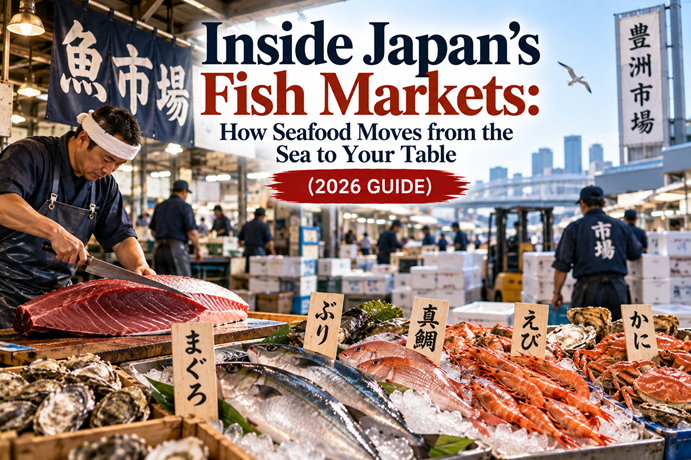
Walk into a Japanese fish market early in the morning, and you may feel that the day has already been underway for hours.
The city outside may still be quiet, but inside the market there is movement everywhere. Boxes are being carried. Fish are being inspected. Workers are moving quickly through narrow spaces. Buyers are looking closely at what has arrived. Conversations happen across the market floor, sometimes loudly and rapidly because this is a workplace rather than a quiet exhibition. Somewhere nearby, another shipment is arriving, another buyer is making a decision, and another restaurant is preparing for the day.
Then you start looking at the fish.
Whole fish lie next to fillets. Shellfish sit beside species you may not recognize. Some fish are familiar; others may be completely new to you. The size, color, condition, origin, and season all seem to matter. What looks like an overwhelming collection of seafood to a visitor is actually a highly organized system of buying, selling, sorting, evaluating, and moving food.
This is the first thing worth understanding about Japanese fish markets: they are not primarily designed to impress visitors. They are working infrastructure.
Japan’s Ministry of Agriculture, Forestry and Fisheries describes wholesale markets as a core part of the fresh-food distribution system, connecting producers with urban consumers and performing functions that include collecting products, sorting and distributing them according to demand, forming prices, settling transactions, and exchanging information between producers and buyers. For seafood specifically, the Fisheries Agency describes fish markets as performing those same essential functions while dealing with products whose quality and value can vary according to species, season, production area, fishing method, and how the catch was handled after landing.
That makes a fish market much more interesting than a place where fish happen to be sold.
It is where the seafood supply chain becomes visible.
🐟 A Fish Does Not Arrive at the Market With a Price Tag
One of the most important things a visitor can learn from a fish market is that seafood does not simply appear with a predetermined value.
A fish may have been caught in different waters, in different seasons, by different methods, and handled differently after being landed. Even two fish belonging to the same species can have different qualities and different market values. The Fisheries Agency specifically identifies price formation as one of the central functions of seafood wholesale markets because factors such as the production area, season, fishing method, and post-catch handling can affect the quality and value of the product.
This makes the market floor a place of judgment.
Someone has to decide what this fish is worth.
Someone has to compare it with similar products.
Someone has to know what buyers are looking for.
Someone has to understand whether the market is currently short of a particular species or receiving unusually large quantities.
That knowledge is part of the market’s invisible infrastructure.
A person unfamiliar with seafood may see twenty boxes of fish.
A professional may see twenty different business decisions.
🔨 The Famous “Auction” Is Only One Part of the Story
When people outside Japan think about Japanese fish markets, one word often comes to mind: auction.
The image is memorable. Buyers gather early in the morning, a fish or tuna is displayed, prices are called out rapidly, and the highest bidder takes the product. This certainly exists and is an important part of the culture associated with major seafood markets, but the reality of seafood distribution is broader than the cinematic image of an auction.
Markets perform several functions before and after a transaction. Seafood must be collected, sorted, distributed, evaluated, priced, paid for, and moved onward. The auction, where used, is one mechanism within that larger process.
Toyosu Market in Tokyo is one of the clearest modern examples. It began operating in 2018 as Tokyo’s central wholesale market for fish, fruits, and vegetables, and its tuna wholesale area remains a functioning part of the market. In 2026, members of the public can also apply for official opportunities to observe tuna auctions from a designated observation deck, while a public walkway provides another viewing option.
But the real significance of the auction is not that it looks exciting.
It is that the market needs a mechanism for determining value.
The speed and energy come from the economic function.
The spectacle is a side effect.
🌊 The Fish Market Is Where the Sea Enters the City
A fish market creates a connection between two places that may be physically far apart: the sea and the city.
A restaurant in Tokyo may be hundreds of kilometers from the fishing port where its seafood originated. A consumer buying fish at a supermarket may never know where it came from. Once the product reaches the final plate, the journey has almost disappeared.
The fish market sits in the middle of that journey.
The Fisheries Agency describes Japanese seafood distribution as a system connecting fishermen and consumers, with wholesale markets playing an important role in collecting catches and distributing them according to demand.
This is why a fish market can feel surprisingly regional even when the products have traveled from far away. A market gathers seafood from multiple places and brings those different origins into one physical environment. The market becomes a map made of fish.
You may see products associated with a particular coastline alongside seafood from another region. Some will be strongly seasonal. Some will be available more consistently. Some will be familiar local species, while others may have traveled through much longer distribution networks.
The market brings them together without erasing where they came from.
🍂 You Can See the Season on the Market Floor
Japanese food culture often talks about seasonality in an almost poetic way, but at a fish market, seasonality becomes concrete.
A particular fish becomes more prominent.
Another becomes less common.
The size or quality of the catch changes.
Prices move.
Restaurants change their menus.
Buyers adjust what they purchase.
The relationship between the calendar and food is no longer an abstract cultural concept. You can literally see it in the boxes being moved across the market.
This is one of the reasons fish markets are such a powerful entry point into Japanese food culture. A restaurant menu tells you what is being served today. A market can show you some of the forces that made that menu possible.
The season has already affected the supply.
The supply has affected the market.
The market has affected the buyer.
The buyer has affected the restaurant.
And eventually, the season appears on your plate.
That chain is one of the most important stories in Japanese seafood.
🧑💼 The People Who Work There See a Different Market Than Visitors Do
A visitor may arrive looking for something memorable to photograph.
A buyer arrives looking for a product.
That difference changes everything.
The professionals working inside a fish market are not simply admiring seafood. They are evaluating it. They need to know what their customers want, what their restaurants or stores require, what quantity is appropriate, what quality is available, and what price makes sense.
That requires knowledge that cannot be gained from a single visit.
A fish market is therefore also a place where expertise becomes visible.
A skilled buyer may recognize differences that an ordinary consumer barely notices. They may understand which products are valuable at a particular time of year, which fish are suitable for specific uses, and which characteristics will matter to the next person in the supply chain.
This is why the voices you hear in a market are important.
They are not background noise.
They are part of the information system.
People are constantly exchanging practical knowledge about food.
🗣️ The Energy Comes From Work, Not Entertainment
A Japanese fish market can feel incredibly energetic, but it is worth asking why.
The answer is not simply that Japanese people make markets lively.
The energy comes from the fact that seafood is moving quickly through a system that has to coordinate many different people.
A box arrives.
Someone checks it.
Someone buys it.
Someone moves it.
A wholesaler sorts it.
A retailer or restaurant receives it.
Another person prepares it for the customer.
The market has momentum because food has a limited shelf life and businesses are waiting.
That gives the place a different atmosphere from a modern shopping center.
A shopping center can be busy because people are browsing.
A fish market is busy because people are working.
This distinction is one of the reasons the experience can feel so intense for visitors. You are watching an economic system operating at close range.
🧊 Freshness Is About More Than “Fresh”
The word “fresh” is used constantly when people talk about Japanese seafood, but the market reveals why freshness is actually a complicated concept.
Freshness is affected by time, temperature, handling, transportation, storage, species, and intended use. Seafood does not remain equally desirable indefinitely, and different products behave differently.
That means market infrastructure has to be designed around speed and quality control.
The Fisheries Agency identifies seafood wholesale markets as places where products are collected and redistributed according to demand and emphasizes the importance of quality and hygiene management in market facilities. It also notes that modernization of market facilities has increasingly focused on stronger hygiene and quality-control systems.
That is another reason modern fish markets can look very different from romantic images of old-fashioned wooden stalls.
The market still has voices, fish, boxes, and movement.
But behind that atmosphere is sophisticated infrastructure designed to move perishable food safely and efficiently.
🏗️ Modern Fish Markets Are Not Frozen in the Past
This is particularly clear when you compare today’s Toyosu with the popular image many people have of Tsukiji.
Toyosu is a modern central wholesale market designed around logistics, food safety, efficient movement, and the handling of large volumes of fresh products. Tokyo’s official information describes it specifically in terms of food safety, security, efficient logistics, and diverse market needs.
That is important because international discussions about Japanese fish markets sometimes become nostalgic very quickly.
People imagine narrow traditional stalls, handwritten signs, shouting vendors, and an almost timeless atmosphere.
Those elements can exist, especially in retail districts and regional markets, but the underlying market system has changed.
Japan’s fisheries and food distribution systems are changing as well. The Fisheries Agency notes that domestic seafood distribution volumes have declined and that direct transactions between producers and retail or food-service businesses have been increasing, reducing the share of seafood flowing through consumption-area wholesale markets.
So the fish market is not a frozen piece of traditional Japan.
It is a working system adapting to a changing food economy.
That makes it more interesting, not less.
🐠 There Is More Than One Kind of Fish Market
Another important distinction is that “fish market” can describe different kinds of places.
Some markets are closely connected to fishing ports, where seafood arrives from local fisheries. Others are consumption-area wholesale markets that serve large urban populations. Some are primarily professional environments, while others have developed retail areas where ordinary customers can shop. Some have famous public viewing opportunities, while others are not designed for visitors at all.
The Fisheries Agency distinguishes different market functions within Japan’s seafood distribution system, including markets located at production areas and those serving consumption areas.
This explains why two fish markets can feel completely different even though both are called markets.
One may smell strongly of the sea because boats and fishing communities are nearby.
Another may feel more like a huge urban logistics center.
Another may be known for its surrounding restaurants and retail shops.
Another may be a small regional market serving local businesses.
There is no single Japanese fish-market experience.
That diversity is part of the story.
🍣 And Then You Walk Outside the Market
This is where the famous idea of the “outer market” becomes interesting.
Around some major markets, retail businesses and restaurants have developed around the professional market environment. These areas can be much more accessible to ordinary visitors than the wholesale trading floor itself.
Tsukiji is a particularly well-known example. Although Tokyo’s wholesale fish market moved to Toyosu, the Tsukiji outer market continues as a district of food-related businesses, including seafood, produce, kitchenware, and restaurants. The area’s official information presents it as a place serving both professionals and ordinary visitors.
But this distinction is important: not every Japanese fish market has an outer market in the same sense.
The outer market is not a universal feature of Japanese fish markets.
Where it does exist, however, it creates an unusual bridge between professional food distribution and public food culture.
Inside the working system, the focus is on moving seafood.
Outside, the same food becomes something to browse, buy, prepare, and eat.
The boundary between the supply chain and the dining experience becomes very thin.
🍚 Why Are There Restaurants Near Fish Markets?
The obvious answer is that seafood is nearby.
But the deeper reason is that a fish market creates a concentration of ingredients, expertise, suppliers, customers, and reputation.
A restaurant located in a market district can build its identity around seafood because the surrounding environment reinforces that identity. Visitors arrive specifically because they want to experience seafood. Local workers need somewhere to eat. Buyers and sellers create a permanent customer base. Retail shops attract additional visitors.
The result is a food ecosystem.
You see a fish being sold.
A few streets away, you see fish being cut.
Then you sit down and eat it.
The distance between ingredient and meal becomes unusually short in your imagination, even when the actual supply chain is much more complicated.
This is one reason eating near a fish market can feel different from eating seafood somewhere else.
The market gives the meal a context.
🍣 The Famous Seafood Bowl Is Only the Final Scene
Visitors often remember the meal more than the market.
That makes sense. A beautiful bowl of sushi or sashimi is easier to photograph and easier to explain than a complicated wholesale distribution system.
But the meal is the final scene.
Before the fish became a piece of sashimi, it existed as part of a longer chain.
Someone caught it.
Someone landed it.
Someone transported it.
Someone evaluated it.
Someone bought it.
Someone handled it.
Someone prepared it.
Someone served it.
A market allows you to see at least part of that story.
And once you have seen the story, the meal can feel different.
You are no longer thinking only about taste.
You are thinking about the chain that made that taste possible.
🌊 Fish Markets Also Explain Regional Japanese Cuisine
One of the biggest advantages of focusing on fish markets is that they allow us to move beyond the idea that “Japanese food” is one single cuisine.
Japan is an island country with a long coastline, enormous geographic variation, and many different fishing communities. The seafood available in one region may be quite different from what is familiar in another.
That regional difference affects what restaurants serve, what households cook, what products are preserved, and which fish become associated with local identity.
A fish market is therefore a kind of regional fingerprint.
You can learn something about a place by asking what seafood appears there, when it arrives, how it is sold, and how local restaurants use it.
The market connects geography with taste.
The sea outside the town becomes food inside the town.
🐟 What Makes a Japanese Fish Market Feel So “Japanese”?
It is not simply the fish.
Fish markets exist in countries around the world, and many of them are lively, crowded, noisy, and culturally important. Japan does not have a monopoly on fish markets, fresh seafood, auctions, or energetic sellers.
What is distinctive is the way Japanese fish markets sit inside a broader food culture that places considerable attention on seasonality, regional origin, preparation, freshness, and the transformation of ingredients into carefully defined dishes.
The market becomes one of the places where those ideas intersect.
Seasonality influences what arrives.
Origin influences how it is valued.
Handling influences quality.
Market knowledge influences price.
Restaurants transform ingredients into meals.
Consumers eventually experience the result as food culture.
The market is therefore not separate from Japanese cuisine.
It is one of the places where Japanese cuisine is built.
🌅 The Market Tells You When the Day Has Begun
There is something else that makes a fish market memorable.
It starts early.
The reason is practical, not romantic. Seafood has to move through the system while it is still useful to the businesses waiting for it.
But for a visitor, that early beginning produces a completely different experience of the day.
The city is only starting to wake up.
The market is already alive.
You arrive while restaurants are preparing for service, while buyers are making decisions, while seafood is being moved toward its next destination.
The market feels like a hidden morning city operating inside the larger city.
By the time most people are having breakfast, a significant part of the market’s work may already have happened.
This is one reason visiting a fish market early can feel almost like discovering a second version of Japan.
It is the Japan that works before the Japan most visitors wake up to see.
🧭 You Should Not Treat Every Fish Market Like a Tourist Attraction
This is perhaps the most important practical point.
A famous market may welcome visitors, have observation areas, retail shops, and restaurants, while another may primarily be a professional working facility. Access, opening hours, visitor routes, and the areas where photography is permitted can differ greatly.
Toyosu, for example, has designated visitor routes and official viewing opportunities, while the market itself continues to function as a working wholesale facility. Its current official information also notes that opening days and individual shop and restaurant hours vary.
The lesson is simple: a fish market is a workplace first and a visitor experience second.
That actually makes visiting more meaningful.
You are not entering a theme park built to imitate a market.
You are observing a real system that happens to be interesting to watch.
🌏 The Fish Market Is a Window Into Everyday Food
Perhaps the best way to understand Japanese fish markets is to stop thinking about them as attractions.
Think of them as windows.
Through a fish market, you can see the relationship between the sea and the city. You can see how seasonality enters the food system. You can see how expertise influences value. You can see how prices are formed. You can see how seafood moves from producers toward restaurants, retailers, and eventually consumers. You can see how a working environment can become a cultural symbol without ever being designed primarily for tourists.
And then, if the market district has public restaurants or retail areas, you can close the loop by eating.
That is what makes the experience so satisfying.
You see the fish.
You hear the market.
You notice the season.
You learn where the seafood came from.
And then you taste the result.
🌊 From the Sea to Your Table
The next time you see a beautifully arranged plate of sashimi in Japan, it is easy to focus only on the final presentation.
But somewhere earlier in that story, there may have been an early morning market floor full of people who were already working.
Someone had to decide what the fish was worth.
Someone had to know where it came from.
Someone had to understand the season.
Someone had to move it quickly.
Someone had to maintain its quality.
Someone had to connect it to the restaurant or retailer that eventually sold it to you.
The fish market is where all those invisible steps become visible for a moment.
That is why Japanese fish markets are worth understanding as part of food culture, not simply as places to visit.
They are noisy because food is moving.
They are busy because decisions matter.
They change with the seasons because the sea changes.
They differ from region to region because geography matters.
And the restaurants around some markets exist because the story does not end when the fish is sold.
It ends much later, at the table.
The fish market is not where Japanese seafood begins, and it is not where it ends. It is the place where the journey becomes visible.
🌏 Continue Exploring Japanese Food Culture
Japanese food becomes much more interesting when you look beyond the finished dish and explore the seasons, ingredients, and everyday systems that make the cuisine possible.
👉 Kanpai in Japan: Why Everyone Raises Their Glass Together Before the Meal Begins (2026 Guide)
👉 Tsukimi Soba in Japan: How the Autumn Moon Became a Bowl of Soba (2026 Guide)
👉 Japanese Yatai: The Food Stalls That Bring Japanese Streets to Life (2026 Guide)
👉 Sanma: Why Pacific Saury Became the Taste of Autumn in Japan (2026 Guide)
👉 Japanese Shotengai and Food Culture: Eating Your Way Through Local Neighborhoods (2026 Guide)
👉 What Do Japanese People Eat at Summer Festivals? The Food, Memories, and Magic of Yatai (2026 Guide)