
🍁 Introduction: A School Year Filled With Meaning
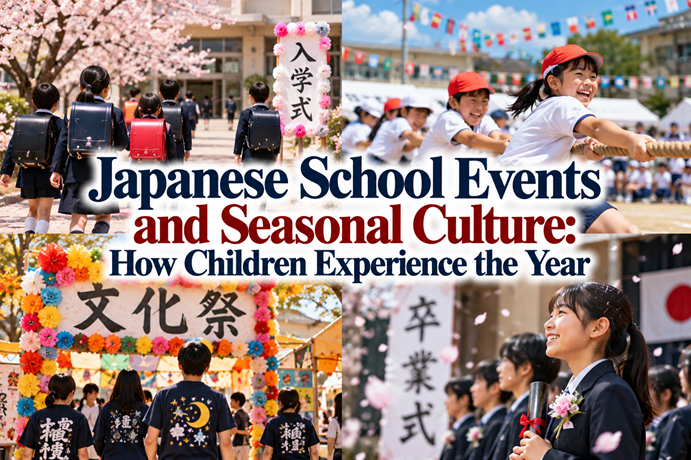
In Japan, school life follows a rhythm that extends beyond lessons, homework, and examinations. The school year begins in spring, when cherry blossoms often appear around entrance ceremonies. Later in the year, students may make Tanabata decorations, prepare for sports days and cultural festivals, explore traditional customs, and take part in activities connected with winter. The exact calendar differs from school to school, but seasonal experiences can become familiar landmarks in childhood.
Japanese school events and seasonal culture are not simply about giving children enjoyable breaks from ordinary lessons. They can introduce students to local traditions, create shared memories, connect learning with the natural world, and mark important changes in school life. Some events are formal parts of the school curriculum, while others are activities chosen by individual schools or communities. Together, they offer a window into how Japanese education connects learning with everyday experience.
One particularly important role is cultural transmission. Not every family celebrates every traditional occasion at home, and children may have different opportunities to encounter local customs. A school activity can provide a shared starting point: students might learn about Tanabata, make decorations, discover the meaning of Setsubun, or discuss how people have celebrated the moon in autumn. Rather than encountering a custom only as a fact in a textbook, they can participate in an activity connected with it.
This role is not unique to Japan. Schools around the world introduce children to local history, seasonal celebrations, and cultural traditions. What makes the Japanese example worth exploring is the way traditional customs, the school calendar, seasonal changes, and shared school events can come together in children’s everyday lives.
🗓️ Table of Contents
- 🌱 A Year of School Events
- 🌸 Spring: New Beginnings and Cherry Blossoms
- 🎋 Summer: Tanabata and Seasonal Experiences
- 🍂 Autumn: Sports Days, Festivals, and the Harvest
- ❄️ Winter: Seasonal Customs and the End of the Year
- 🏮 Schools as Keepers of Cultural Traditions
- 📚 Learning Beyond the Textbook
- 🤝 Shared Experiences and Childhood Memories
- 🌍 A Role Shared by Schools Around the World
- ❤️ Conclusion: Experiencing Culture Together
🌱 1. A Year of School Events
📅 The Japanese School Year
In Japan, the school year generally begins in April and ends in March of the following year. This differs from countries where the academic year begins in late summer or early autumn. The timing gives spring a special place in the school calendar: new students enter school, older students move into the next grade, and graduating students prepare to leave.
Many schools divide the year into terms or semesters, with ceremonies and other events marking transitions. There may be opening ceremonies at the beginning of a term, closing ceremonies at its end, and larger events during the year. The specific schedule depends on the school, local education authority, and school system. Not every school holds the same events on the same dates.
The calendar also interacts with Japan’s seasonal environment. Spring blossoms, summer heat, autumn foliage, and winter weather can influence what schools do and when they do it. Yet the connection is not simply a matter of nature determining the school schedule. The academic calendar, local customs, curriculum, facilities, and practical considerations all influence the timing of activities.
🎎 Different Events, Different Purposes
It is useful to distinguish between traditional seasonal customs and school events that mark educational milestones. Tanabata and Setsubun have cultural histories outside the modern school system. Entrance ceremonies, graduation ceremonies, sports days, and school festivals have different origins and purposes, even when they take place during a particular season.
Japan’s curriculum formally includes Special Activities, known as Tokubetsu Katsudō or Tokkatsu. These include class activities, student council activities, club activities, and school events. The Ministry of Education, Culture, Sports, Science and Technology explains that school events can include ceremonies, cultural activities, health and physical education events, trips and group stays, and work or service-related activities. The categories are intended to support students’ development and participation in school life, rather than simply provide entertainment. See the official EDU-Port Japan overview of Japanese-style education.
Not every seasonal activity is a formal requirement, however. A school may organize a Tanabata craft session, while another may mention the festival during a lesson or not mark it at all. Local traditions, age groups, teaching priorities, and available time all matter. Understanding this variety is essential: Japanese school culture has recognizable patterns, but it is not one identical experience shared by every child.
🌸 2. Spring: New Beginnings and Cherry Blossoms
🎒 Entrance Ceremonies
April is a season of new beginnings in Japanese schools. Entrance ceremonies welcome students who are starting elementary school, junior high school, high school, or another stage of education. Students and families may dress formally, gather in a school hall, listen to speeches, and hear messages from school leaders and teachers. New students are introduced to their school and the community they are joining.
For children, the ceremony can be exciting, confusing, or a mixture of both. They may be meeting classmates for the first time, entering an unfamiliar building, and beginning a new routine. For parents and caregivers, it can mark a significant family milestone. Photographs taken on the day may become treasured records of a child’s growth.
🌸 Cherry Blossoms and the Feeling of a Fresh Start
Cherry blossoms are strongly associated with spring in Japan, and they often appear in photographs of entrance ceremonies. The timing of the blossoms varies by region and year, so schools do not always hold ceremonies at the peak of flowering. Nevertheless, the image of new students standing beneath cherry trees has become a familiar representation of the Japanese school year.
The connection is cultural as well as seasonal. Cherry blossoms bloom for a relatively short period, making their beauty feel temporary. In Japanese poetry, art, and everyday conversation, blossoms can evoke renewal, passing time, and the fleeting nature of life. These meanings should not be treated as a single interpretation shared by everyone, but they help explain why cherry blossoms often feel appropriate for a ceremony marking a new stage.
For children, the experience may be much simpler: a new uniform, a new classroom, a family photograph, and flowers around the school grounds. Yet these ordinary details can link a personal milestone with a wider seasonal image. The first day of school becomes associated not only with a date but also with the look and feeling of spring.
🎓 Graduation and the End of a Chapter
Graduation ceremonies usually take place in March, near the end of the Japanese school year. Students receive certificates, listen to speeches, and say goodbye to teachers and classmates. At the end of elementary or junior high school, graduation may also mean moving to a new school and entering a different stage of life.
The ceremony creates a formal moment to recognize change. Students who have spent years together may reflect on shared experiences, while teachers and families acknowledge their progress. Songs, speeches, and photographs can give the occasion an emotional character, although the details vary by school.
The connection between spring’s beginning and ending is especially noticeable in Japan’s calendar. April welcomes new students, while March sends others onward. Seasonal change and educational change appear alongside each other, helping give the school year a clear narrative: joining a community, growing within it, and eventually moving on.
🎋 3. Summer: Tanabata and Seasonal Experiences
⭐ Tanabata and the Wish-Making Tradition
Tanabata, often called the Star Festival in English, is celebrated in many parts of Japan on July 7, although some regions observe it later according to local customs or the lunar calendar. The festival is associated with the story of two celestial lovers, commonly known as Orihime and Hikoboshi, who are allowed to meet once a year. The details of the story vary across retellings, and its origins reflect a mixture of influences rather than one simple, unchanged tradition.
A familiar Tanabata activity is writing wishes on small strips of paper called tanzaku and hanging them on bamboo branches. In schools that mark the occasion, children may write wishes, make paper decorations, and display them in classrooms or corridors. Some wishes concern family members, future dreams, or personal goals; others are playful or practical.
This activity gives children a way to take part in a cultural custom without needing to understand every historical detail. They can learn the story, see the decorations, write something meaningful to them, and read the wishes of classmates. The classroom becomes a place where a traditional occasion is experienced together.
The activity also invites reflection. What do children hope for? How do their wishes change as they grow older? Why do people express wishes through festivals and shared rituals? These questions can turn a simple craft into an opportunity to explore how people use traditions to express hopes and feelings.
🌿 Nature, Weather, and Summer Life
Summer brings its own practical realities. Heat, humidity, rain, and the risk of extreme weather can affect school activities. Outdoor events may need to be adjusted or cancelled, and schools must consider students’ safety during physical activity. This is a reminder that seasonal culture is not only about attractive decorations or festivals; it also involves living with the conditions of a particular time of year.
Some schools organize activities connected with plants, insects, gardens, or other aspects of the natural world. Students may observe how plants grow, collect natural materials for artwork, or learn about local environments. These activities vary considerably, but they can help children connect classroom knowledge with the world around them.
Summer can also include swimming lessons or other physical education activities, depending on the school’s facilities, curriculum, and local conditions. These are not traditional festivals, yet they contribute to the rhythm of the school year. They show how school life combines seasonal experience with educational goals and practical needs.
🧺 Summer Holidays and Local Traditions
The summer holiday is a major break in the Japanese school calendar, although its length varies by region and school. During this period, families may travel, visit relatives, attend local festivals, or take part in community activities. Some students may be given homework that includes observation, reading, research, or creative projects.
Schools do not control everything children experience during the holidays, but learning can continue outside the classroom. A student might learn about a local festival from family members, notice how a neighborhood prepares for an event, or observe seasonal changes in the environment. These experiences can become material for later discussion or school assignments.
This connection between school and life outside school is important. Culture is not transmitted only by teachers or written materials. It is also learned through family stories, community participation, local landscapes, food, and shared experiences. School activities can help children recognize and reflect on those experiences, even when the school itself is not organizing a festival.
🍂 4. Autumn: Sports Days, Festivals, and the Harvest
🏃 Sports Day as a Shared School Experience
Sports days, commonly called undōkai in elementary schools, are among the most recognizable Japanese school events. Depending on the school, they may take place in spring or autumn. Activities can include races, relays, team games, group performances, and other physical challenges. Families may come to watch, and students often prepare in advance through practice and class activities.
A sports day is not a traditional seasonal festival in the same sense as Tanabata or Setsubun. Its importance comes from its place in school life and its role in bringing students together around a shared event. Students may support teammates, learn rules, practice movement, and experience both competition and cooperation.
For younger children, the event can be a chance to try something new or take part in a large gathering. Older students may have responsibilities such as helping organize activities or supporting younger pupils. The exact structure depends on the school. The common feature is that the event extends beyond a regular lesson and creates a shared point in the school year.
Sports days can also reveal the balance schools must maintain between tradition and inclusion. Some children enjoy competition and public performance; others may find these activities difficult. A well-planned event considers safety, different abilities, and meaningful ways for students to participate. The goal need not be that everyone performs in exactly the same way, but that students can take part in an experience that is appropriate to them.
🎨 Cultural Festivals and the Work Behind Them
Many Japanese junior high and high schools hold cultural festivals, often called bunkasai. Depending on the school, classes may prepare plays, displays, presentations, themed rooms, or food-related activities, while music, art, science, drama, and other clubs may present the results of their work. Some festivals welcome families and other visitors; others are organized primarily for the school community.
The public event is only the visible part. Preparation can begin well in advance, with students discussing ideas, dividing responsibilities, making decorations, rehearsing performances, and solving unexpected problems. A class that creates an exhibition, for example, needs to decide what to show, how to explain it, how to arrange the room, and how to make the result understandable to visitors.
This process gives the festival educational value beyond the final performance. Students may use skills from different subjects, negotiate different preferences, and discover that a shared project depends on many forms of work. A student who does not want to perform on stage might contribute through design, writing, sound, or organization. The quality of the event depends on both visible and less visible contributions.
The format differs from school to school, and cultural festivals are not identical across all age groups. Still, they are a useful example of how a school event can combine learning, creativity, cooperation, and a seasonal milestone. The event is memorable partly because students have helped create it.
🌾 Harvest, Food, and Autumn Traditions
Autumn is associated with harvests, seasonal foods, and changing landscapes in many parts of Japan. Schools may use this season to explore local agriculture, observe plants, visit farms, or learn about food production. Some schools organize activities such as harvesting crops they have grown; others use classroom lessons, field trips, or school meals to introduce the topic.
These activities should not be confused with a universal Japanese school tradition. They depend on local conditions, available facilities, and educational priorities. A school in a farming area may have different opportunities from one in a dense urban neighborhood. Yet both can explore where food comes from and how seasonal changes influence what people eat.
Food can make cultural learning especially tangible. Students may learn about ingredients associated with a season, discuss regional dishes, or discover how a local community celebrates a harvest. These experiences can connect geography, science, history, and daily life. They can also prompt questions about the people who grow, transport, prepare, and share food.
The wider lesson is that seasonal culture is not limited to festivals with special names. It can also appear in the changing foods available, the work people do, and the way communities respond to the natural world.
❄️ 5. Winter: Seasonal Customs and the End of the Year
🫘 Setsubun and the Arrival of Spring
Setsubun is observed around February 3 in many years, although the exact date can vary. It is associated with the transition from winter to spring in the traditional Japanese seasonal calendar. One well-known custom is mamemaki, or bean throwing, in which roasted soybeans are thrown while people say a phrase intended to drive away misfortune and invite good fortune. Customs vary by region and household.
In schools that mark Setsubun, students may learn about the custom, make masks, participate in age-appropriate activities, or discuss the ideas of good fortune and protection from misfortune. Some schools may organize a playful activity involving a person dressed as an oni, a figure often represented as an ogre or demon in Japanese folklore. Other schools may not hold a Setsubun activity at all.
The educational value lies partly in discovering how a custom connects stories, seasonal change, symbols, and everyday behavior. Children can learn that traditions often have several layers: an explanation of the season, a story passed down through generations, and a practice that people repeat because it is familiar or meaningful.
It is also useful to avoid presenting the custom as though every Japanese person believes exactly the same thing about it. People participate for different reasons, and some treat it as a cultural activity rather than a religious or spiritual practice. A school can introduce the tradition without requiring every student to share the same beliefs.
🌕 Winter Events and Local Differences
Winter customs differ across Japan. Some communities have distinctive festivals, snow-related events, or local traditions that reflect their climate and history. Schools may introduce local customs through art, music, storytelling, food, or visits to community sites. In regions with heavy snowfall, winter experiences may look very different from those in warmer areas.
The idea of a single national seasonal calendar can therefore be misleading. Certain customs are widely recognized, but local practices remain important. A school in one region may teach children about a local festival that is unfamiliar to students elsewhere in Japan. These differences do not make the activity less Japanese; they show how culture is shaped by place.
Winter can also include year-end activities and preparations for the new year. Depending on the school, students may reflect on the term, complete projects, or take part in closing ceremonies. The school calendar gives the end of the year a structure, while family and community traditions provide other ways of marking the season.
🎍 The School Calendar and the New Year
New Year is a major seasonal occasion in Japan, associated with family visits, shrine or temple visits for many people, special foods, and customs intended to welcome the year ahead. Schools are generally on winter break around this period, so the traditions children experience at home or in their communities may be distinct from school-organized events.
This separation is meaningful. Not every cultural experience needs to be organized by the school. Schools can provide background knowledge, while families and communities may provide other forms of participation. Some children encounter the same customs in both settings; others learn about them primarily through one.
The role of school is not to replace the family or community. It can provide a common educational foundation and help students understand why a practice matters to people, while recognizing that families celebrate in different ways. This approach makes room for cultural learning without assuming that all children have the same experiences or beliefs.
🏮 6. Schools as Keepers of Cultural Traditions
👨👩👧 Why School Matters When Family Experiences Differ
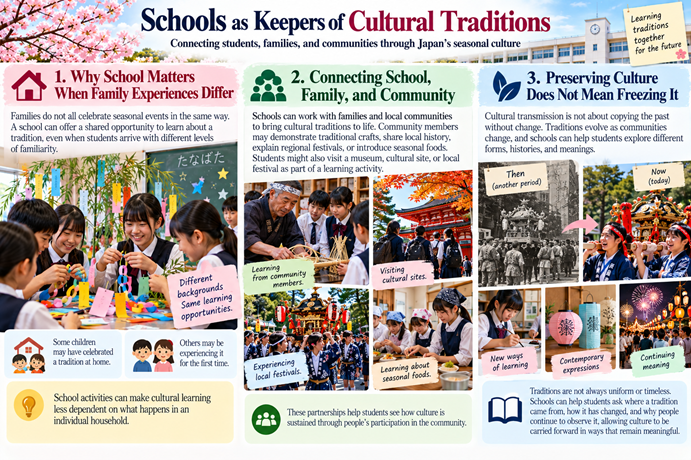
Families do not all celebrate seasonal events in the same way. Some maintain elaborate traditions, while others mark only a few occasions or do not observe certain customs at all. Work schedules, household circumstances, regional background, personal beliefs, and family preferences can all affect what children experience at home.
A school can offer a shared opportunity to learn about a tradition, even when students arrive with different levels of familiarity. A child who has made Tanabata decorations at home may bring prior knowledge to the classroom; another may be encountering the custom for the first time. Both can participate in the same activity and learn from one another.
This does not mean that modern families have abandoned Japanese traditions or that schools must take over the role of families. Many households continue to celebrate seasonal events, and family customs can be a powerful source of cultural knowledge. The important point is that opportunities differ. School activities can make cultural learning less dependent on what happens in an individual household.
🏘️ Connecting School, Family, and Community
Schools can also connect students with the wider community. Depending on local circumstances, they may invite community members to demonstrate traditional crafts, introduce local history, explain regional festivals, or share knowledge about seasonal foods and agriculture. Students might visit a museum, cultural site, or local festival as part of a learning activity.
Such partnerships allow traditions to be understood as living practices rather than objects that exist only in books. A local festival may depend on people who organize it, prepare decorations, maintain equipment, perform music, or pass skills to younger generations. Learning about these roles can help students see how culture is sustained through people’s participation.
These opportunities are not available in exactly the same form everywhere. Some schools have strong community partnerships, while others have limited time or resources. Nevertheless, when they are possible, they can give students a richer picture of the place where they live and the people who help maintain its cultural life.
🧵 Preserving Culture Does Not Mean Freezing It
Cultural transmission should not be understood as copying the past without change. Traditions evolve as communities change, people reinterpret old customs, and schools adapt activities to their students. A classroom craft inspired by a traditional festival is not identical to the way the festival was practiced in another period. It is a contemporary way of introducing students to a cultural reference.
This distinction matters because traditions are not always uniform or timeless. A custom may have different forms in different regions, and its meaning may change between generations. Some people emphasize its historical or spiritual associations, while others value it as a family activity or a seasonal celebration.
Schools can help students explore these differences rather than presenting one version as the only authentic form. Asking where a tradition came from, how it has changed, and why people continue to observe it can make cultural education more thoughtful. Preserving culture can involve learning its history and allowing people to carry it forward in ways that remain meaningful.
📚 7. Learning Beyond the Textbook
🌿 Bringing Nature Into Learning
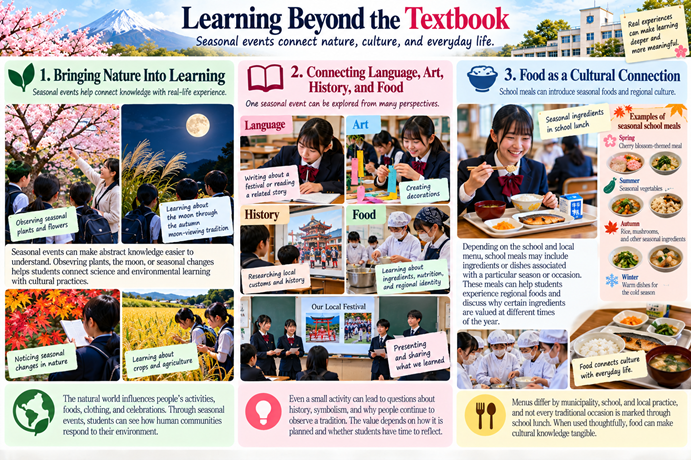
Seasonal events can make abstract knowledge easier to connect with lived experience. A lesson about the moon may become more memorable when linked with the autumn moon-viewing tradition. A discussion of plants may feel more immediate when students observe seasonal leaves, flowers, or crops. These examples can help connect science and environmental learning with cultural practices.
The natural world is not simply a decorative backdrop. Seasonal changes influence people’s activities, foods, clothing, and celebrations. When students notice these connections, they can begin to understand how human communities respond to their environments. The relationship is not always simple, however: traditions may reflect history, religion, trade, and social change as well as local climate.
🎨 Connecting Language, Art, History, and Food
A seasonal event can also provide material for different subjects. Students may write about a festival, read a story connected with it, create decorations, research a local custom, or prepare a presentation. Food-related activities can lead to discussions of ingredients, agriculture, nutrition, and regional identity. A class display can combine writing, drawing, research, and teamwork.
Not every school connects all these subjects in a formal interdisciplinary project. Sometimes the learning is much simpler: a teacher introduces a custom, students make something, and the class discusses what they have learned. Even a small activity can prompt questions about history, symbolism, and the reasons people repeat familiar practices.
The point is not that seasonal events automatically produce deeper learning. Their value depends on how they are planned, what students are invited to notice, and whether they have opportunities to reflect. A craft activity can be enjoyable on its own, but it becomes a richer cultural experience when students also explore what the craft represents and how it relates to people’s lives.
🍚 Food as a Cultural Connection
School meals can sometimes provide another link between seasonal culture and daily life. Depending on the school and local menu, a meal may include ingredients or dishes associated with a particular season or occasion. Such menus can give students a chance to encounter regional foods and discuss why certain ingredients are valued at particular times of year.
However, it would be inaccurate to suggest that every school serves the same seasonal dishes or that every traditional occasion is marked through school lunch. Menus differ by municipality, school, budget, food availability, and local practice. Some schools may provide an event-related meal, while others may address the occasion through a lesson or not mark it at all.
When food is used thoughtfully, it can connect culture with ordinary experience. Students do not simply hear that a dish is associated with a season; they can taste it, ask questions about its ingredients, and discover how food connects households and communities. These experiences can help make cultural knowledge tangible.
🤝 8. Shared Experiences and Childhood Memories
🧑🤝🧑 Experiencing the Same Season Together
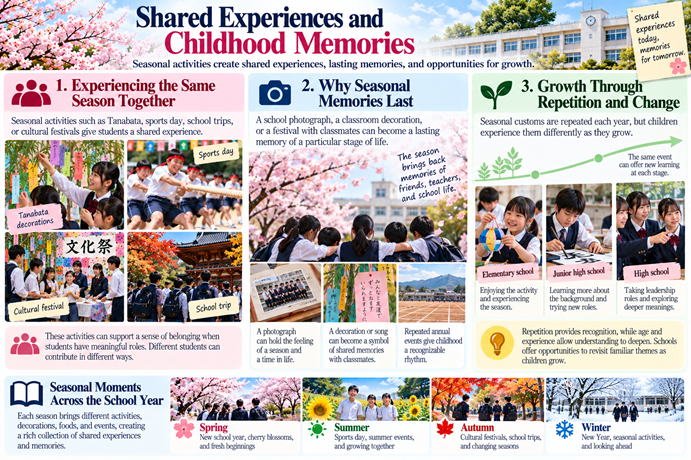
A seasonal activity can create a shared reference point for a class. Students may decorate the classroom for Tanabata, prepare for a sports day, visit a local site, or display work at a cultural festival. The activities differ, but they offer a common experience that students can remember together.
Shared experiences can support a sense of belonging, especially when students have meaningful roles in the activity. One student may enjoy making decorations, another may contribute ideas, and another may help organize materials. The group does not need every child to have the same interests or abilities. It needs ways for different students to participate.
At the same time, shared events can be challenging for some children. Large gatherings, competition, public performance, or busy schedules may be stressful. Schools can make participation more inclusive by offering varied roles, considering accessibility, and recognizing that children respond differently to the same activity. A memorable event should not require every student to experience it in precisely the same way.
📷 Why Seasonal Memories Last
People often remember childhood through a combination of places, people, objects, and recurring events. A school photograph beneath cherry blossoms, a classroom filled with Tanabata wishes, or a cultural festival prepared with classmates may become a marker of a particular stage of life. The event itself may be modest, but the memory can carry meaning because it is connected to a time when many things were changing.
Not every student remembers school events positively, and memories differ according to personal experience. Still, repeated annual events can give childhood a recognizable rhythm. Students may notice how much they have grown when they compare one year’s sports day with the next, or when they move from being newcomers to helping younger pupils.
The seasonal setting can make those changes easier to remember. A certain flower, song, decoration, or activity becomes linked with a particular time of year. Over time, the season itself may bring back memories of classmates, teachers, and school life.
🌱 Growth Through Repetition and Change
Many seasonal customs are repeated each year, but children encounter them at different ages. A young student may enjoy a craft or costume without understanding much of its background. Older students may learn more about the history of a custom, compare regional versions, or help organize an activity for younger children.
This progression can make a familiar event a different learning experience over time. Repetition provides recognition, while age and experience allow understanding to deepen. The goal need not be that every child masters a tradition in one lesson. It can be enough to create an opening for future curiosity.
This is another reason schools can be valuable cultural spaces. They provide repeated opportunities to revisit familiar themes as children grow, rather than treating cultural education as a single lesson that must explain everything at once.
🌍 9. A Role Shared by Schools Around the World
🏫 Schools Reflect the Communities They Serve
Schools in many countries introduce children to local history, seasonal changes, and cultural traditions. Depending on the country and community, activities may involve harvest celebrations, winter holidays, national commemorations, local festivals, Indigenous knowledge, or community service. The content differs, but schools often provide opportunities for children to learn about the society in which they live.
This does not mean every school celebrates every holiday, or that cultural education takes the same form everywhere. Public schools may serve students from different religious backgrounds, and some traditions may be taught historically rather than celebrated. Policies, local communities, and the preferences of families influence what schools choose to do.
Japan is therefore not unique simply because schools introduce cultural customs. The more useful question is how a particular school system connects culture with its calendar, curriculum, and shared experiences. In Japan, the April-to-March school year, the formal place of school events in Special Activities, and the familiar seasonal customs together create a distinctive pattern.
🌐 Understanding Similarities Without Erasing Differences
A reader from another country may recognize the role of school ceremonies or local celebrations, even if the Japanese examples are unfamiliar. They may remember an event that brought their class together, a lesson about a national tradition, or a school activity linked to the changing seasons. These comparisons can make Japanese school life easier to understand without assuming that all countries follow the same model.
At the same time, it is important not to force a direct equivalent for every Japanese custom. Tanabata, Setsubun, and moon-viewing traditions have particular histories and forms. Their meanings cannot be fully explained by comparing them with a festival from another country simply because both involve decorations or seasonal timing.
A good comparison begins with shared questions: What do children learn? Who organizes the event? Is it connected to family, religion, local history, nature, or the school calendar? What parts of the tradition have changed? These questions allow readers to recognize common educational purposes while respecting cultural differences.
💬 What Makes a School Tradition Meaningful?
A tradition becomes meaningful in different ways for different people. Some students may value the history behind an event; others may remember the people they spent time with or the excitement of preparing something together. Teachers may see an opportunity to connect subjects, while families may value the chance to share a school experience with their children.
No single explanation captures every participant’s experience. The same event can have educational, social, cultural, and personal meanings at once. It may introduce a historical custom, create a shared memory, and give students a reason to notice the changing season.
This complexity is precisely why seasonal school events deserve more than a list of dates and activities. They show how culture is learned through repeated experiences and how schools can create opportunities for children to encounter traditions that might otherwise remain unfamiliar.
❤️ Conclusion: Experiencing Culture Together
Japanese school life includes more than lessons and examinations. Across the year, students may encounter entrance ceremonies, cherry blossoms, Tanabata decorations, sports days, cultural festivals, seasonal customs, and the transition toward graduation. Not every school follows the same calendar, and not every event is a traditional festival, but these experiences can help children connect school life with the wider world around them.
One of the most valuable roles of these activities is cultural learning through participation. Children can read about a custom, hear its story, make something connected with it, taste a seasonal dish, or share an experience with classmates. The activity may be simple, but it can make a cultural reference personal and memorable. Schools can also provide a common opportunity for students whose families have different traditions or different chances to participate in seasonal customs.
This role is not exclusive to Japan. Schools around the world help children encounter the history, customs, and seasonal experiences of their communities. Japan offers one particular example of how these experiences can fit into the school year and become part of childhood memories.
Ultimately, seasonal school events are not meaningful only because they preserve the past. They can also help children ask questions, notice changes, understand their communities, and discover what traditions mean to different people. Culture is not simply something inherited and repeated unchanged. It is something people learn, experience, interpret, and carry forward.
🌍 Continue Exploring the School Series
Japanese school life becomes much easier to understand when you look at the everyday structures, seasonal traditions, and shared experiences behind the scenes.
👉 Japanese School Group Activities: Learning to Work and Live Together
👉 Why Do Japanese Schools Have Their Own School Songs? The Music, Landscape, and Memories of School Life
👉 What Is Nichoku in Japanese Schools? The Daily Classroom Duty Behind School Life
👉 Japanese School Evacuation Drills: Earthquakes, Tsunamis, Fires, and the U.S. Difference