
📑 Table of Contents
- 🎄 Introduction: Two Very Different Christmas Scenes
- 🏡 Why North American Homes Can Become Christmas Displays
- 🇯🇵 Christmas Decorations in Japan: A Different Kind of Display
- 🚪 Front Doors, Wreaths, and Small Seasonal Touches
- ✨ Small Trees, Window Displays, and Balcony Decorations
- 🌃 Why City Lights Often Make a Bigger Impression
- 📏 Does the Size of Japanese Homes Explain Everything?
- 🛍️ How Christmas Decorations Fit into Everyday Life
- 🌲 Natural Greenery, Artificial Trees, and Personal Style
- 🏘️ Why Some Japanese Homes Stay Undecorated
- 🎁 A Different Balance Between Private Homes and Public Spaces
- 🌎 What Christmas Decorations Reveal About Everyday Life
- 🎄 Conclusion: Different Homes, Different Ways to Celebrate
- 🌍 Continue Exploring the Home Series
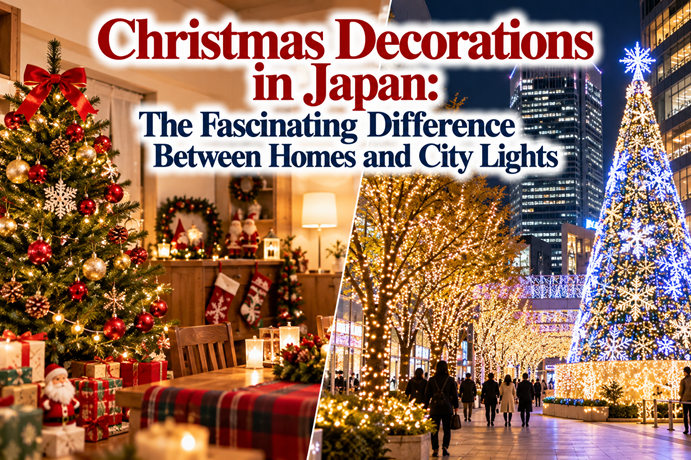
🎄 Introduction: Two Very Different Christmas Scenes
When I lived in the United States and Canada, one of the most memorable sights of the Christmas season was the way some residential neighborhoods transformed after dark. Houses were covered in elaborate strings of lights, rooflines glowed in different colors, and front yards became miniature Christmas scenes filled with enormous inflatable Santas, reindeer, snowmen, and other festive figures. Some homes seemed to compete playfully with their neighbors, adding more lights and decorations each year.
The impression stayed with me. The decorations were not limited to a Christmas tree inside the house or a wreath on the front door. The entire property could become part of the display, visible to anyone walking or driving through the neighborhood. In some places, simply taking an evening walk to look at the houses was an enjoyable part of the Christmas season.
Japan can offer a very different residential scene. Although Christmas decorations are easy to find in shopping districts, stations, hotels, and commercial areas, it is much less common to see an entire ordinary residential street filled with large, elaborate displays on the scale found in some North American neighborhoods. Japanese homes certainly can be decorated for Christmas, but the decorations are often smaller, more contained, or less visible from the street.
You might see a wreath hanging on a front door, a few warm-white lights wrapped around a small garden tree, or a Christmas tree glowing behind a living-room window. In another house, the only visible sign of the season might be a small ornament near the entrance. Some homes have no outdoor decorations at all.
These differences are interesting because they show that Christmas does not look the same everywhere, even when people enjoy many of the same symbols. The way a home is decorated depends not only on personal taste but also on the available space, the design of the property, local habits, and where people choose to express the festive atmosphere.
This article explores Christmas decorations in Japan through the contrast between North American residential displays and Japanese homes. It looks at the decorations people may encounter, the practical considerations behind them, and the striking difference between festive lights in public spaces and those around private houses.
🏡 Why North American Homes Can Become Christmas Displays
In parts of the United States and Canada, decorating the outside of a house is a familiar way to celebrate Christmas. Some families hang lights along rooflines, outline windows and garage doors, illuminate trees, and place large seasonal figures across their front lawns. Others create carefully coordinated displays with music, animated figures, or thousands of individual lights.
Not every household participates, of course. Some families prefer a simple wreath or an indoor tree, and the amount of decoration varies widely between neighborhoods. Nevertheless, elaborate residential displays are visible enough in some communities to become a recognizable part of the season.
✨ The House Becomes Part of the Celebration
One striking feature of a large outdoor display is that it changes the appearance of the whole property. The house is no longer simply a private space decorated for the people who live inside. Its exterior becomes a visible expression of the holiday, shared with neighbors and passersby.
A roofline covered in lights can emphasize the shape of the building. Illuminated trees can make a front yard glow, while an inflatable Santa or a group of reindeer creates a playful scene that is easy for children to recognize. When several nearby houses are decorated, the street itself becomes part of the experience.
For families who enjoy the tradition, setting up decorations can be an event in its own right. Lights may be unpacked from storage, tested, arranged, and adjusted over several days. Children might help choose ornaments or decide where a particular figure should stand. Some families keep decorations for many years, while others add something new each season.
The result can be much more than a collection of objects. It can become a family ritual, a way to mark the beginning of the holiday season, and a familiar sight that people look forward to each December.
🎅 The Front Yard as a Seasonal Stage
A front yard offers room for decorations that would be difficult to accommodate inside a house. Large inflatable figures, illuminated reindeer, decorative sleighs, and oversized ornaments can be arranged across the lawn. Because the display faces the street, it can be enjoyed without visitors entering the property.
The scale of these decorations is especially memorable to someone encountering them for the first time. A large inflatable Santa is not just a small seasonal accent; it can become the central feature of the entire house. When neighboring homes have their own displays, the visual effect becomes even more impressive.
However, this style of decoration depends on practical conditions. A household needs enough outdoor space, a suitable place to secure decorations, access to electricity where needed, and somewhere to store everything after the season. Weather, maintenance, and the time required for installation also matter.
The point is not that every North American household decorates this way. Rather, in some neighborhoods, outdoor Christmas displays are an established and highly visible expression of the holiday.
🇯🇵 Christmas Decorations in Japan: A Different Kind of Display
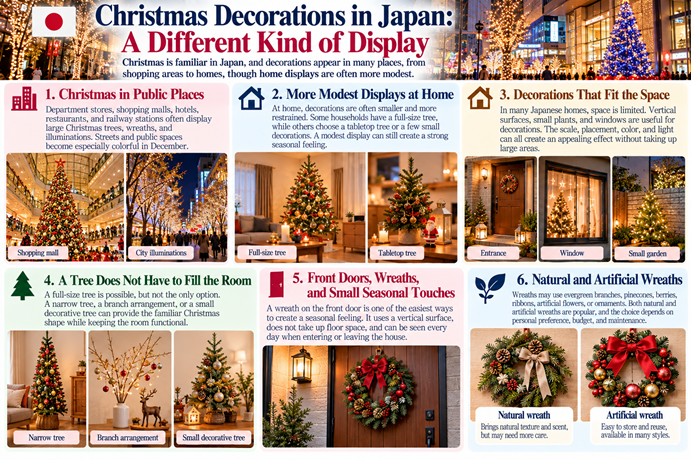
Christmas is familiar in Japan, and seasonal decorations appear in many places as December approaches. Department stores, shopping malls, hotels, restaurants, and railway stations may display Christmas trees, wreaths, ornaments, and elaborate lighting. Streets and public spaces can become especially colorful during the winter illumination season.
At home, however, the picture is often more restrained. Some households put up a full-size Christmas tree, while others choose a tabletop tree or a few small decorations. Outdoor displays may be limited to the entrance, a window, a balcony, or a small garden plant.
This does not mean Japanese people lack interest in Christmas decorations. A modest display can still create a strong seasonal feeling, particularly when it is placed where the family sees it every day. Nor is there one universal Japanese style: a detached house with a large garden can accommodate much more than a compact home with only a narrow entrance.
🏠 Decorations That Fit the Space
In many Japanese residential areas, houses stand relatively close together, and the space between the building and the road may be limited. A front entrance might have room for a potted plant and a small decorative object, but not for a large inflatable figure surrounded by lights.
In these settings, vertical surfaces become useful. A wreath can be hung on the front door without taking up floor space. A small decoration can sit beside the entrance, and a string of lights can be wrapped around a compact tree or shrub. The window can also provide a view of decorations placed indoors.
These are practical choices, but they can also produce an appealing visual effect. A wreath framed by a simple door, a small evergreen with warm lights, or a softly illuminated tree inside the house can feel festive without covering the entire property.
The scale of the decoration is only one part of its impact. Placement, color, light, and the relationship between the object and the surrounding space can be just as important.
🎄 A Tree Does Not Have to Fill the Room
A full-size Christmas tree is possible in a Japanese home, but it is not the only option. A tabletop tree, a narrow artificial tree, a branch arrangement, or a small decorative tree can provide the familiar Christmas shape without occupying much floor space.
This is particularly practical in a living room that serves several purposes. The same room may be used for relaxing, eating, studying, or hosting visitors, so a large tree can interfere with everyday movement. A smaller tree allows the family to enjoy the seasonal decoration while keeping the room functional.
The choice also depends on storage. An artificial tree must be packed away after Christmas, and a large tree needs somewhere to go during the rest of the year. A compact tree or a small set of ornaments can be easier to store in a home where cupboard space is limited.
These considerations do not apply to every Japanese household, but they help explain why small decorations can be a sensible choice rather than a sign of limited enthusiasm.
🚪 Front Doors, Wreaths, and Small Seasonal Touches
One of the easiest ways to decorate a Japanese home for Christmas is to focus on the entrance. A wreath hanging on a front door creates a clear seasonal signal without requiring a large garden or extensive installation.
Christmas wreaths may use evergreen branches, pinecones, berries, ribbons, artificial flowers, or ornaments. Some are designed to look natural and understated, while others use bright red, gold, silver, or other festive colors. Store-bought wreaths are widely accessible, and people who enjoy crafts can also make their own.
The wreath is particularly practical because it uses a vertical surface. It does not occupy valuable floor space, and it can be seen by family members whenever they enter or leave the house. On a home with a small entrance, that can be enough to create a welcoming seasonal detail.
🌿 Natural and Artificial Wreaths
A natural wreath can bring texture and the scent of greenery into the entrance. Evergreen branches and pinecones create a connection with winter plants, while dried materials can add a handmade appearance. The look changes as the materials age, so natural wreaths may need a little more care than artificial ones.
Artificial wreaths offer a different kind of convenience. They can be stored and reused, and they do not rely on fresh branches staying attractive throughout the season. Some are deliberately simple, using only a few leaves and a ribbon, while others are full of ornaments and decorative details.
Neither option is inherently better. The choice depends on personal preference, budget, maintenance, and how long the decoration will be displayed.
🚪 Decorating the Entrance Without Crowding It
A wreath can be combined with a small potted plant, a lantern-style light, or a modest seasonal ornament. The key is to keep the entrance usable. Doors need to open freely, pathways should remain clear, and decorations should not create a tripping hazard or block access.
In a narrow entrance, one well-chosen object may work better than several items crowded together. A simple wreath and a small evergreen can create a coherent look without making the area feel cluttered.
For people who rent their homes, it is also worth considering how decorations are attached. Some doors and exterior surfaces may be damaged by adhesive hooks or heavy objects, so removable hanging methods should be chosen carefully.
These details are small, but they reflect a practical approach to decorating: a festive home should still work comfortably as an everyday living space.
✨ Small Trees, Window Displays, and Balcony Decorations
Not every decoration needs to face the street directly. Some Japanese households place a Christmas tree or seasonal ornaments near a window, where the family can enjoy them from inside and passersby may see their light or silhouette from outside.
A window display can be particularly effective after dark. A small illuminated tree, a few ornaments on a sill, or a warm light beside a curtain creates a seasonal atmosphere without requiring the exterior of the house to be extensively decorated.
🪟 A Christmas Tree by the Window
A tree near a window has two roles: it decorates the room and can become part of the home’s appearance from the street. The effect depends on the layout of the house, the position of the window, and how visible the room is from outside.
Some families prefer the tree to be a private part of the living room, while others enjoy placing it where its lights can be seen beyond the glass. Neither approach is more authentically Japanese. It is simply a matter of how the household wants to use its space.
Warm-white lights can create a calm, intimate atmosphere, while colored lights and bright ornaments make the display more playful. A small tree does not need many decorations to be effective; the contrast between its shape and the darker winter evening can provide much of the visual interest.
🌳 Lighting a Small Garden Tree
Where a home has a garden or a small planted area, a few strands of LED lights may be wrapped around a tree or shrub. An olive tree, evergreen, or other compact garden plant can become a seasonal feature without requiring a separate decorative structure.
The scale is different from a lawn filled with large illuminated figures. Instead of transforming the entire property, the lights highlight something already present in the garden. A small tree becomes a point of interest, especially when the rest of the entrance remains relatively simple.
Outdoor lighting should always be suitable for exterior use and installed according to the manufacturer’s instructions. Cables should not obstruct paths, and lights should be protected from weather as specified by the product maker. A small display can be attractive without creating unnecessary maintenance or safety problems.
🏢 What About Balconies?
Some apartment residents decorate a balcony with a small light display or a seasonal object visible from outside. However, balconies are not the same as private gardens. Apartment rules, fire-safety requirements, drainage, wind exposure, and the need to keep evacuation routes clear can limit what residents may place there.
For this reason, indoor window displays may be easier than elaborate balcony decorations. A small tree placed just inside the window can provide much of the same visual effect without extending into shared or exposed space.
The important distinction is that Japanese homes do not all have the same opportunities for outdoor decoration. The style that works for a detached house with a garden may not suit an apartment building.
🌃 Why City Lights Often Make a Bigger Impression
If you visit Japan during the Christmas season, you may see spectacular illuminations around railway stations, shopping districts, parks, commercial complexes, and tourist destinations. Trees may be wrapped in lights, open spaces transformed by large installations, and streets given a coordinated seasonal appearance.
The contrast with many residential neighborhoods can be striking. A station area may be full of glowing trees and elaborate displays, while a short walk away, the surrounding homes show only a few small decorations or none at all.
Japan’s winter illuminations are not limited to Christmas itself. Some displays begin in November and continue into the winter, with dates varying by location and year. They can be organized around seasonal themes rather than being restricted to a private home’s Christmas decorations.
The Japan National Tourism Organization’s English-language information about December in Japan describes winter illuminations as a prominent seasonal attraction. The Japan Tourism Agency also documents public displays such as the Sendai Pageant of Starlight, where trees along Jozenji-dori Avenue are illuminated during the winter season.
These examples show how public lighting can become a shared seasonal experience. Visitors and residents can walk through a display, take photographs, meet friends, or simply enjoy the atmosphere without having to decorate their own homes.
🌟 Public Spaces Can Create a Shared Experience
A large public illumination has a different purpose from a residential display. It is designed to be seen by many people, often across a broad area. Lighting can define a street, guide visitors through a park, or turn an ordinary commercial space into a seasonal destination.
Because the display is concentrated in a public or commercial setting, it can be more elaborate than the decorations most households choose for their own property. Large installations also benefit from coordinated planning, professional equipment, and dedicated space.
For visitors, this can make Christmas feel highly visible in Japan even when residential streets are relatively quiet. A person may encounter enormous trees and spectacular lights in a city center, then return to a home with a small wreath on the door.
That contrast is not a contradiction. Public and private decorations serve different purposes, and the scale of one does not need to be repeated in the other.
🏙️ The Difference Between Looking at Lights and Living with Them
A public display is temporary and designed for visitors. A household decoration must fit into daily life. It should not obstruct the entrance, make the living room difficult to use, or require more storage than the family can spare.
This difference helps explain why large illuminations can flourish even where elaborate residential displays are less visible. A city can create a shared attraction in a designated area, while individual homes make their own choices based on space, time, cost, and preference.
The result is a Christmas season in which the most dramatic lights may be found away from ordinary front doors. For someone accustomed to driving through neighborhoods to admire decorated houses, this can make the Japanese experience feel different, but not necessarily less festive.
📏 Does the Size of Japanese Homes Explain Everything?
Limited outdoor space is a useful part of the explanation, but it is not enough on its own. Japanese homes vary widely, and many detached houses have gardens, driveways, and enough room for outdoor decorations. Some households do create elaborate displays, while others choose not to decorate regardless of how much space they have.
The relationship between a house and the street also matters. In some neighborhoods, the front entrance is close to the road, the garden is small, or neighboring homes are nearby. In others, the property has a larger setback and a more open front yard. These differences influence what can be displayed and how visible it will be.
Storage is another consideration. Large inflatable figures, long strings of lights, and outdoor ornaments take up space when not in use. They also need to be unpacked, installed, removed, and stored carefully. A household may decide that a wreath and a small tree provide enough seasonal atmosphere without creating an additional annual task.
Time and cost matter as well. Outdoor decorations can require extension cords, suitable fixtures, mounting equipment, replacement bulbs, and attention to weather. Even when the initial cost is manageable, the time needed to set up and take down a display may discourage people who prefer a simpler approach.
Finally, personal taste should not be overlooked. Some people enjoy bright, playful displays; others prefer natural materials, warm lights, or no decoration at all. The size of the property may shape the available options, but it does not determine the family’s preferences.
🛍️ How Christmas Decorations Fit into Everyday Life
Christmas decorations are easy to find in Japan during the season. Home-goods stores, department stores, garden centers, supermarkets, and discount shops may offer wreaths, ornaments, artificial trees, LED lights, and small decorative figures. The selection varies by store, but people can usually choose between a simple seasonal touch and a more elaborate indoor display.
For someone living in Japan, a small decoration can be a convenient way to mark the season without changing the home dramatically. A wreath can be hung near the entrance, a miniature tree can sit on a shelf, or a string of lights can brighten a window. These choices allow people to participate in the visual atmosphere of Christmas while keeping their usual living arrangements intact.
🎄 Decorations That Can Be Reused
Reusable decorations are practical for households that want to avoid buying new items every year. An artificial wreath, a compact tree, or a collection of ornaments can be stored and brought out again the following December. Choosing a small number of pieces that work together can also make storage easier.
Natural materials offer a different experience, particularly when they are used in wreaths or seasonal arrangements. They may need more attention and may not last as long, but they can provide texture and a connection with greenery. Some households combine natural and artificial materials to balance appearance, cost, and convenience.
There is no need to create a large display to make the home feel festive. A few objects chosen with care can be enough, especially when they are placed where the family naturally spends time.
🧹 Taking Decorations Down
In Japan, Christmas decorations in shops and public spaces can disappear quickly after December 25 as retailers and households turn their attention to the New Year period. The transition can feel surprisingly abrupt to people accustomed to keeping Christmas decorations up for longer.
This is partly a matter of the seasonal calendar. New Year, or oshōgatsu, is one of Japan’s most important annual celebrations, and preparations may include cleaning the home, arranging seasonal foods, and displaying traditional New Year decorations. Christmas and New Year therefore sit close together, but they have different visual identities.
Not every household follows the same schedule, and some people keep winter decorations up longer. Still, the rapid change from Christmas displays to New Year decorations is a recognizable feature of the season in many commercial settings.
🌲 Natural Greenery, Artificial Trees, and Personal Style
Christmas decorations can be natural, artificial, handmade, or a mixture of all three. A wreath made with evergreen branches and pinecones has a different character from a shiny artificial wreath with bright ribbons. A natural-looking tree may suit a quiet entrance, while a colorful tree with many ornaments can create a more playful atmosphere indoors.
Japanese homes are not limited to one decorative style. A family may prefer a traditional-looking tree, a minimalist arrangement, a character-themed display, or a collection of ornaments gathered over many years. The scale of the decoration does not necessarily reveal how much the family enjoys Christmas.
The same is true of lighting. Warm-white LEDs can make a small tree look gentle and understated, while multicolored lights create a livelier effect. Some people prefer a single illuminated feature, while others enjoy combining lights, ornaments, greenery, and decorative figures.
The most useful approach is to consider the space and the desired atmosphere together. A small entrance can look attractive with one carefully chosen wreath, while a larger garden can accommodate several objects without feeling crowded. A window display may work particularly well when outdoor space is limited.
🏘️ Why Some Japanese Homes Stay Undecorated
It is easy to notice decorated homes and assume that everyone else has chosen not to celebrate. In reality, an undecorated exterior does not tell you much about what happens inside a house.
A family may have a Christmas tree in the living room, exchange gifts, prepare a special meal, or enjoy a seasonal cake without displaying anything outside. Another household may celebrate in a different way, or may not place much importance on Christmas at all. The exterior alone cannot tell you which is true.
Some residents also have practical reasons for avoiding outdoor decorations. They may rent their homes, live in an apartment with restrictions, lack a suitable power source, or simply prefer not to spend time installing and storing equipment. Others may be away during the holiday season or may not want decorations exposed to weather.
It is important not to interpret the absence of outdoor lights as a lack of festive feeling. In the same way, a large display does not necessarily indicate a deeper attachment to Christmas. Decorations are one visible expression of a holiday, not a complete measure of how a household experiences it.
🎁 A Different Balance Between Private Homes and Public Spaces
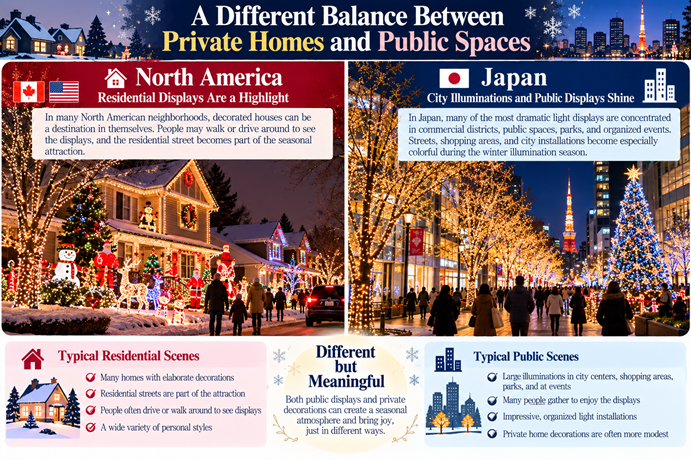
The contrast between North American residential displays and Japanese city illuminations offers a useful way to think about the different places where a holiday becomes visible.
In some North American neighborhoods, a decorated house can be a destination in itself. People may walk or drive around to see the displays, and the residential street becomes part of the seasonal attraction. In Japan, many of the most dramatic light displays are concentrated in commercial districts, public spaces, parks, and organized events.
This is a broad observation, not a strict national rule. There are Japanese households with elaborate outdoor decorations, just as there are North American homes with only a wreath or an indoor tree. The difference lies in the kinds of scenes that are especially visible and familiar in each setting.
The public display and the private decoration also create different relationships with the viewer. A large city installation invites people to gather, walk through the lights, and share the experience with strangers. A wreath on a front door is more intimate: it welcomes the people who live there and anyone who comes to the entrance.
Both forms can be meaningful. One creates a seasonal atmosphere across a public area; the other adds a small sign of celebration to an ordinary home.
🌎 What Christmas Decorations Reveal About Everyday Life
Looking at Christmas decorations is a surprisingly effective way to understand the relationship between housing, daily routines, and public space. The objects themselves may be familiar across countries, but where they are placed and how extensively they are used can differ.
In Japan, a wreath, a small illuminated tree, or a window display can fit naturally into a compact entrance or living room. Public illuminations provide a larger visual spectacle in places where many people can enjoy it. In some North American neighborhoods, by contrast, the outside of a private house may become a major part of the seasonal display.
These patterns are shaped by more than architecture. They also involve personal taste, local habits, available storage, time, cost, and the way a community uses its streets during the holiday season. No single factor explains every household, and no one style is inherently better.
For someone living in Japan, the most useful lesson is to look beyond the size of the decoration. A small wreath may be chosen with care; a modest tree may be the center of a family’s seasonal routine; a quiet house may still be full of Christmas activity indoors. What appears from the street is only one part of the story.
The contrast also reminds us that festive atmosphere does not need to take the same form everywhere. Sometimes it is a street filled with elaborate lights. Sometimes it is a city square glowing with a public display. And sometimes it is simply a small tree beside a window, visible from the sidewalk on a cold December evening.
🎄 Conclusion: Different Homes, Different Ways to Celebrate
The elaborate Christmas displays I saw in the United States and Canada remain memorable because they transformed entire houses and front yards into seasonal scenes. The lights, oversized figures, and decorated rooflines made ordinary residential streets feel completely different after dark.
In Japan, the Christmas landscape often has another balance. Public illuminations in stations, shopping districts, parks, and commercial areas can be spectacular, while home decorations may be smaller and more personal. A wreath on a front door, lights around a garden tree, or a Christmas tree glowing behind a window can create a festive atmosphere without covering the whole property.
Limited outdoor space helps explain some of this difference, but it is not the whole story. Housing design, storage, convenience, local habits, and individual preferences all play a role. Japanese households vary just as much as households elsewhere, and there is no single way to decorate—or not decorate—for Christmas.
The most interesting point is not that one country celebrates more enthusiastically than another. It is that the same holiday can take different forms depending on where people live and how they use their homes and public spaces.
Once you notice these details, a Japanese residential street in December becomes more than a quiet contrast to a brightly lit North American neighborhood. It becomes another way to understand everyday life in Japan, where seasonal atmosphere may appear in small domestic touches as well as in the spectacular lights of the city.
🌍 Continue Exploring the Home Series
Japanese homes reveal a great deal about everyday life, from the way people use limited space to the seasonal objects and routines that make a house feel like home. Explore more articles in the Home Series to discover the practical details, traditions, and design choices behind daily life in Japan.
👉 How to Use a Japanese Fish Grill: A Simple Guide to Japan’s Surprisingly Versatile Kitchen Appliance
👉 What’s Inside a Japanese Refrigerator? What Everyday Food Reveals About Life in Japan
👉 What Is a Kamidana? Understanding the Shinto Altar in Japanese Homes
👉 Japanese Kitchens vs. American Kitchens: Space, Storage, Appliances, and Daily Life