
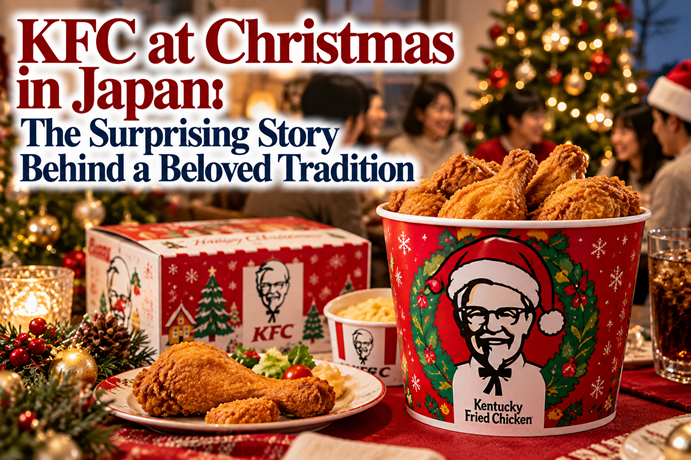
🎄 Introduction: Why Does Japan Eat KFC at Christmas?
Imagine walking through a Japanese neighborhood in late December. Illuminated trees brighten shopping streets, department-store windows display elaborate cakes, and restaurants advertise special holiday menus. Outside a Kentucky Fried Chicken restaurant, people may be waiting to collect boxes of fried chicken they ordered weeks earlier. For many international visitors, this scene raises an obvious question: why is KFC at Christmas in Japan such a familiar combination?
In countries where Christmas dinner traditionally means roast turkey, ham, or a long meal prepared at home, a bucket of fast-food chicken can seem like an unusual substitute. The association is especially striking because Japan does not have the same centuries-old Christian Christmas traditions found in many Western countries. December 25 is not a national public holiday, and the way many people celebrate the season is more social and commercial than religious.
Yet KFC has become one of the most recognizable food symbols of a Japanese Christmas. Its presence is visible in seasonal advertisements, special menus, pre-order campaigns, and family celebrations. The familiar image of a red-and-white bucket on a decorated table has become part of the way many people imagine the holiday.
The story, however, is not simply that Japanese people could not find turkey and therefore started eating fried chicken. That explanation leaves out the timing of the campaign, the appeal of Western-style celebrations during a period of economic and social change, the convenience of ready-made party food, and the importance of advertising in giving a relatively new custom a recognizable form.
It also risks creating a misleading picture of Japan, as though every household follows the same menu. Some families order KFC, some buy roast chicken or other prepared foods, some cook at home, and others do not celebrate Christmas at all. The famous chicken tradition is real, but it is only one part of a much broader seasonal culture.
To understand KFC at Christmas in Japan, it helps to look beyond the bucket itself. The deeper story is about how a holiday can acquire a local meaning, how food can turn an unfamiliar occasion into something easy to enjoy, and how a commercial campaign can become part of ordinary family memories.
📜 1. How KFC Became Associated with Christmas in Japan
🍗 KFC Arrived in a Changing Japan
KFC entered the Japanese market in 1970, when American-style fast food was becoming more visible in everyday life. For many consumers, eating at an American fast-food restaurant offered an experience that felt different from an ordinary meal at home. It could be a treat, a modern convenience, or a small opportunity to enjoy something associated with life overseas.
Christmas was also developing into a more widely enjoyed seasonal occasion. Although the holiday was not a traditional religious event for most Japanese households, Christmas decorations, gifts, cakes, and festive gatherings were becoming familiar parts of December. People did not need to adopt the religious meaning of Christmas to enjoy its atmosphere or borrow elements of its celebration.
This created an interesting opportunity. A growing number of people were interested in celebrating Christmas, but there was no single, deeply established Japanese Christmas dinner that everyone was expected to serve. Unlike the traditional New Year meal, Christmas food did not have to follow a fixed set of customs passed down through generations.
That absence of a single standard menu was important. It meant that a company could offer a practical idea for what a Christmas meal might look like, rather than asking people to abandon a firmly established national tradition. KFC did not need to replace an existing Japanese Christmas dinner. It could help define one.
🇺🇸 The Famous Story Behind the Campaign
According to KFC’s account of its history, a foreign customer remarked that turkey was difficult to obtain in Japan for a Christmas celebration and that chicken could serve as an alternative. The idea reportedly inspired a Christmas promotion built around fried chicken.
This anecdote is widely repeated, but it is worth understanding what kind of story it is. The conversation is part of the company’s account of how the campaign began; it should not be treated as though every detail has been independently established by historical records. The broader development of the campaign is more significant than whether a single conversation alone caused it.
The idea made commercial sense. Turkey was not a routine centerpiece of most Japanese home meals, and preparing a large bird required ingredients, equipment, and cooking knowledge that were not necessarily part of everyday domestic life. A bucket of fried chicken, by contrast, was already a finished product. Customers could buy it, take it home, put it on the table, and begin celebrating without organizing an unfamiliar cooking project.
The appeal was not that fried chicken was a traditional Japanese Christmas dish. It was that it could become one.
📣 The 1974 Campaign That Gave the Idea a Name
In December 1974, KFC Japan launched its nationwide Christmas campaign, commonly associated with the phrase Kurisumasu ni wa Kentakkii—“Kentucky for Christmas.” The campaign helped connect a particular food, a recognizable brand, and a specific time of year in the public imagination.
A seasonal meal is easier to remember when it has a simple message. The campaign did not require customers to understand a complicated history or learn a new recipe. It offered a clear suggestion: when Christmas comes, buy Kentucky Fried Chicken.
That message could be repeated in advertisements and passed from one household to another. Children could recognize the campaign, parents could turn it into a convenient dinner, and families could repeat the experience in later years. Over time, a purchase associated with a promotion could become a familiar annual ritual.
This is the crucial distinction between inventing a product and establishing a tradition. KFC did not invent Christmas in Japan, and it did not invent the idea of eating chicken at a celebration. What it did was help make one specific version of Christmas food memorable, accessible, and repeatable.
The nationwide campaign is a much firmer historical anchor than the details of the famous customer anecdote. The campaign’s long life also shows that its success was not simply a short-lived novelty. It continued to be reinforced through seasonal menus and advertising, allowing each generation to encounter the same association.
🏠 2. Why Fried Chicken Fit Japanese Christmas Celebrations
🍽️ A Festive Meal Without a Complicated Recipe
One of the most practical reasons for the success of KFC at Christmas in Japan is that it makes a meal feel special without requiring the host to cook everything from scratch. Fried chicken is familiar enough to enjoy immediately, but a large order feels more celebratory than an ordinary weekday meal.
This matters because a holiday meal is not only about the food itself. It is also about the work needed to prepare it, the time available to eat together, and the feeling that the occasion is different from an ordinary evening. A ready-made meal can reduce the work involved while preserving the sense of an event.
A traditional roast turkey dinner may require a large oven, considerable preparation time, and several side dishes. Those requirements are manageable for households that already prepare such meals, but they are less convenient for people who rarely cook a whole bird. Fried chicken offers a simpler alternative, especially when the aim is to create a festive dinner rather than reproduce a particular Western menu exactly.
This does not mean Japanese homes have no ovens or that nobody cooks Christmas dinner. Domestic kitchens vary, and many people prepare elaborate meals. The point is more modest: a ready-to-serve chicken meal is an easy option for households that do not want to organize a traditional roast.
🪣 The Bucket Makes the Occasion Visible
KFC’s bucket is more than packaging. It helps transform individual pieces of chicken into a meal designed to be shared. A family can place the container in the middle of the table, open it, and let everyone choose a piece. The format encourages a casual, communal style of eating rather than a formal plated dinner.
The visual impact matters too. A familiar red-and-white bucket is easy to recognize in advertisements and family photographs. When the same image appears every December, it becomes a seasonal signal. Seeing the bucket can remind people of previous Christmases, much as a particular cake, decoration, or song might do elsewhere.
This is one reason food traditions can be so durable. They are not sustained by taste alone. They are supported by packaging, routines, memories, and the anticipation of repeating something familiar. The meal becomes part of the atmosphere surrounding the holiday.
The bucket also makes the idea easy to pass on. A person does not need to explain the history of the campaign to a child or a visiting friend. The meal itself communicates that this is a special occasion, and the repeated appearance of the product helps establish a shared reference point.
🎅 A Brand That Looked Ready for Christmas
KFC’s founder, Colonel Sanders, is recognizable by his white hair and beard. When the familiar restaurant figure is dressed in a Santa-style outfit, the visual connection with Christmas becomes immediate. The red clothing, white beard, and festive presentation bring together the brand and the season in a way that is easy to remember.
This is not the same as saying the Colonel was deliberately designed to resemble Santa Claus. His appearance existed independently of the holiday. The seasonal use of that appearance, however, created a convenient visual bridge between a fast-food restaurant and Christmas imagery.
Advertising often works by linking things that are not naturally connected. In this case, fried chicken was not historically central to Christmas in Japan, but a familiar brand character could be placed within the holiday’s visual language. Repetition then made the combination feel less surprising.
The result is a useful example of how commercial imagery can become cultural imagery. A character used to promote a product can eventually remind people of the season itself, even when they are not actively thinking about the advertisement.
🎁 A Ready-Made Party Rather Than Just a Meal
The appeal of a Christmas chicken set is also social. Buying a prepared meal can make it easier for a household to gather without assigning one person the full burden of cooking. Instead of spending the evening in the kitchen, the people hosting the celebration can spend more time with their guests.
KFC’s seasonal offerings have also changed over time. The company has promoted Christmas sets and party-style assortments that bring chicken together with side dishes and other festive items. Some seasonal packages have included additional dishes or commemorative items, reinforcing the impression that the purchase is intended for a special event.
The precise contents and prices vary by year, so it is better not to treat any single menu as permanent. What matters culturally is the format: the customer is not merely buying lunch or dinner but purchasing a packaged version of a celebration.
This convenience fits a holiday that many people enjoy without following a fixed religious or culinary tradition. The food supplies a ready-made structure for the evening. It tells the household what to serve and helps make the occasion feel complete.
📈 3. How a Marketing Campaign Can Become a Tradition
🔁 Repetition Turns an Idea Into a Habit
A successful campaign can introduce an idea, but a tradition requires repetition. Someone who buys KFC for Christmas one year may do so again because the meal was easy, because the family enjoyed it, or because the experience became part of the holiday routine. Children who grow up with that routine may later recreate it in their own homes.
This is how a commercial suggestion can move beyond the original advertisement. The first purchase may be motivated by curiosity or convenience; later purchases may be motivated by memory. Eventually, the reason can become as simple as “This is what we do at Christmas.”
Such habits do not require everyone to participate. A tradition can be culturally recognizable even when many households do something different. Christmas cake is widely associated with the season, for example, but that does not mean every person in Japan buys the same cake. Similarly, KFC can be an iconic Christmas symbol without being the meal of choice for every family.
The distinction is important when reading English-language accounts of Japan. Headlines sometimes imply that the whole country follows one rule, because a simple generalization is more striking than a nuanced explanation. In reality, food habits vary according to household preference, budget, location, age, and personal experience.
📺 Advertising Keeps the Association Alive
Seasonal advertising gives a tradition a regular public reminder. Each year, as December approaches, the appearance of Christmas promotions signals that the season has begun. Even people who do not intend to buy KFC encounter the same association in shops, on posters, and in media coverage.
This repetition helps connect a product with a date on the calendar. The campaign becomes part of the rhythm of the year, just as decorations appear in stores or special cakes become available for a limited time. The food is no longer presented as an everyday product alone; it is framed as something that belongs to a particular moment.
At the same time, the relationship works in both directions. KFC’s campaign reinforces the image of Christmas, while the wider popularity of Christmas creates demand for seasonal products. The company benefits from the holiday, but the holiday also provides a familiar setting in which the product can be understood.
This is not unique to Japan. Companies in many countries connect products with holidays, sporting events, family gatherings, and seasonal rituals. The Japanese example is particularly noticeable because the connection between Christmas and fried chicken is less obvious to people whose own holiday meals are built around other foods.
🧠 Familiarity Can Matter More Than Historical Authenticity
People often assume that traditions must be ancient to be meaningful. Yet a custom can become important because it is repeated, shared, and remembered, even if its present form is relatively recent.
For a child, the Christmas meal may be less about the origins of the campaign than about the excitement of opening the box, seeing the cake, or sitting with family members. Years later, that memory can carry emotional weight. The commercial origin does not erase the personal meaning that has accumulated around it.
This is why describing the custom as “just marketing” is incomplete. Marketing helped popularize the association, but it cannot fully explain why people continue to participate. Convenience, taste, affordability relative to other festive options, family routines, and nostalgia all help maintain it.
Nor does the tradition have to be followed every year to matter. A family might choose KFC one December and roast chicken the next. Another household may stop buying it when children grow up, then return to the habit when grandchildren arrive. Cultural practices are often flexible rather than fixed.
The lasting achievement of the campaign was not that it made every Japanese person eat the same dinner. It made KFC one of the foods people could immediately associate with Christmas.
🍰 4. Why Christmas Cake Matters Alongside KFC
🍓 The Strawberry Shortcake as a Christmas Symbol
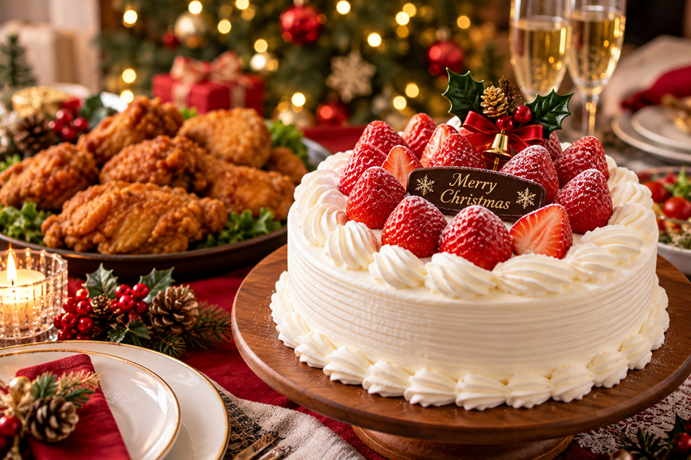
A Japanese Christmas table may feature another familiar sight: a round sponge cake covered with whipped cream and decorated with red strawberries. Often called strawberry shortcake, this cake is one of the season’s most recognizable sweets.
Its appearance helps explain why Christmas food in Japan cannot be reduced to KFC alone. The chicken provides a savory centerpiece, while the cake contributes a distinctly festive visual finish. White cream and bright red strawberries create a color combination that fits Christmas decorations, and the cake is easy to share after a meal.
The cake also suits the way many people celebrate the occasion. It can be bought from a bakery, confectionery shop, supermarket, or department-store food hall. Families can reserve one in advance or choose a smaller cake for a couple or a few friends. Its size and presentation make it suitable for both modest gatherings and larger celebrations.
The custom of buying a Christmas cake developed through a different commercial and culinary history from the KFC campaign. It belongs to the wider growth of Western-style confectionery and seasonal gift culture in Japan. Although the two traditions reinforce each other on the Christmas table, they should not be treated as though one was simply created to accompany the other.
🍰 A Cake That Feels Special Without Being Unfamiliar
Sponge cake, cream, and fruit are easy to recognize, even for people who do not usually eat Western-style desserts. The cake is festive but not necessarily challenging or unfamiliar. It can be shared in slices, photographed, and presented as the centerpiece of a small celebration.
This is one reason seasonal foods often succeed when they combine novelty with familiarity. A Christmas cake looks different from an everyday dessert, yet its ingredients and format are accessible. The design says “special occasion,” while the taste remains comfortable.
There is no need to claim that every household prefers strawberry shortcake or that it is the only Christmas dessert in Japan. Chocolate cakes, roll cakes, baked sweets, and other seasonal desserts are also available. Individual preferences differ, and the range of products has expanded over time.
Nevertheless, the classic strawberry-and-cream cake has a strong place in the popular image of Japanese Christmas. For some people, Christmas would feel incomplete without it, whether or not they eat KFC.
🧁 Chicken and Cake Create a Simple Celebration
The combination of prepared chicken and a ready-made cake illustrates a practical approach to the holiday. Both can be purchased in advance, both can be shared, and neither requires the household to follow a complex recipe. Together, they create the feeling of a planned occasion with relatively little preparation.
This does not mean the meal is necessarily cheap. Special Christmas sets and decorated cakes can cost more than ordinary everyday food, particularly when several people are involved. The advantage is not always the lowest price; it is the convenience of buying items designed for the occasion.
The combination also offers a clear sequence to the meal: savory food first, dessert afterward. That structure is familiar in many places, but the specific pairing of fried chicken and strawberry cake has become a recognizable Japanese Christmas image.
In this sense, KFC and Christmas cake are complementary symbols. One is strongly connected to a particular brand and campaign, while the other represents a broader seasonal dessert culture. Both help turn December 24 or 25 into a day that feels different from an ordinary weekday.
👨👩👧 5. What Christmas Food Means in Everyday Japanese Life
🏡 A Reason to Gather
For many people in Japan, Christmas is an opportunity to spend time with family, a romantic partner, or friends. The exact form of the celebration varies, but food often provides a simple reason to gather. A meal does not need to carry a deep religious meaning to be emotionally important.
A family might collect a reserved chicken set after work, buy a cake on the way home, and eat together in the evening. Another household might prepare pasta, salad, roast chicken, or a meal inspired by a restaurant they enjoy. Some people celebrate with friends, while others treat the day as an ordinary evening.
These different choices do not contradict the existence of a recognizable Christmas food culture. A cultural pattern is not a rule that every person must follow. It is a set of familiar possibilities that people can accept, adapt, or ignore.
This is also why the KFC tradition can remain meaningful even as individual habits change. A person may associate the bucket with childhood Christmases without ordering it every year as an adult. The image can remain part of their memory even when the actual meal changes.
🧒 Childhood Memories and the Meaning of a Treat
For people who grew up in Japan during the period when Christmas chicken became familiar, KFC may be associated with a sense of occasion. A meal that was not purchased regularly could feel exciting precisely because it appeared at a particular time of year.
My own childhood memories include eating KFC and chicken at Christmas. Chicken also appeared in school lunches, so it was not an entirely unfamiliar food. What made the Christmas meal feel different was the context: it belonged to a day when decorations, presents, cake, and time with family made ordinary things seem special.
That personal experience should not be taken as a description of every Japanese childhood. School lunch menus differ, family habits vary, and some people did not grow up eating KFC at Christmas. Still, it illustrates how a seasonal food can become connected with memory. The same dish can mean one thing on a regular school day and something quite different when it appears as part of a celebration at home.
For many people, the emotional value of a familiar holiday meal comes from its repetition. A child remembers what the family ate; the adult later remembers the people who sat around the table. The food becomes a marker of time, not simply a source of flavor.
💑 Christmas Eve, Couples, and Friends
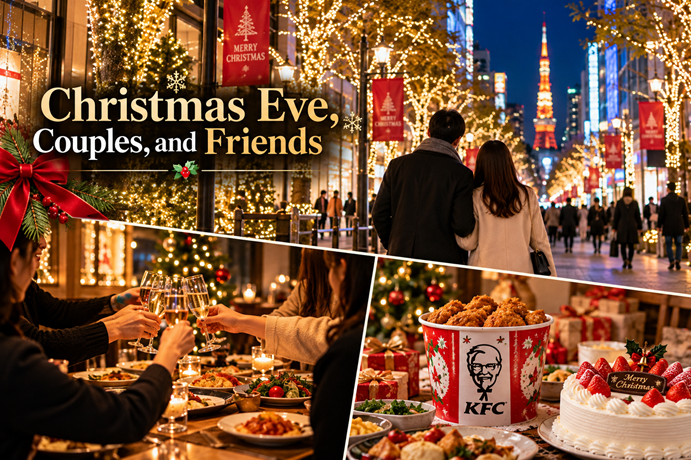
Christmas in Japan is also associated with romantic outings, especially on Christmas Eve. Illuminations, decorated shopping areas, restaurants, and seasonal events create an atmosphere suited to a date or a special evening with a partner. Friends may also meet for dinner or exchange gifts.
This social side of Christmas helps explain why there is no single required dinner. A couple may choose a restaurant, a group of friends may share takeout, and a family may eat at home. The occasion can be intimate or casual, and food can be adapted to the size and mood of the gathering.
KFC fits particularly well into informal celebrations because it is easy to share. A family can buy a bucket; friends can bring several dishes; a couple can choose a smaller set or another meal entirely. The important point is not that every celebration includes fried chicken, but that the food can be incorporated into different kinds of gatherings.
It would also be inaccurate to describe Japanese Christmas as entirely secular or to suggest that no one celebrates it religiously. Christian communities and churches observe Christmas in religious ways. The broader popular culture, however, includes many people who enjoy the decorations, food, gifts, and social atmosphere without treating the holiday as a religious observance.
🛍️ The Experience Begins Before the Meal
Christmas food culture begins well before people sit down to eat. Seasonal displays appear in shops, bakeries advertise cakes, and restaurants promote special menus. In the case of popular KFC Christmas sets, pre-ordering can be important because demand is concentrated around a small number of dates.
That planning changes the experience. Instead of deciding spontaneously what to eat on Christmas Eve, some households choose a menu ahead of time and organize the evening around collection or delivery. The purchase becomes part of the preparation for the event, much like choosing a cake or arranging a family gathering.
The seasonal food market also gives people alternatives. Supermarkets, convenience stores, restaurants, and specialist food shops offer different kinds of chicken and festive dishes. KFC is highly visible, but it is not the only place to buy Christmas food.
For visitors, this variety is worth remembering. If you see long queues outside a KFC restaurant, you are seeing a recognizable part of the season, not proof that every household in Japan has the same dinner planned.
🇯🇵 6. Is KFC Really the Christmas Meal for Everyone in Japan?
🍗 A Famous Custom, Not a National Rule
The short answer is no. KFC is strongly associated with Christmas in Japan, but it would be misleading to say that all Japanese people eat it on December 24 or 25. Some do, some buy other kinds of chicken, and some have entirely different meals.
The popularity of a cultural image can make a habit look more universal than it is. A photograph of a queue outside a restaurant is memorable, and a headline about an entire country eating the same food is easy to share. Everyday life is less uniform.
Households have different budgets, tastes, schedules, and family structures. Some people work during the holiday period, some do not celebrate Christmas, and some prefer to cook. Others may enjoy KFC at Christmas but choose a different menu in a particular year.
The more accurate statement is that KFC has become one of Japan’s most recognizable Christmas food traditions. It is a widely understood reference point, not an obligation.
🍖 What Do People Eat Instead?
There is no single alternative menu. Some households buy roast chicken from supermarkets or restaurants, while others prepare homemade dishes. Pizza, pasta, salads, roast meat, and assorted prepared foods may appear on the table depending on the household. Some people focus more on dessert, gifts, or going out than on preparing a special dinner.
The availability of alternatives is part of the same seasonal culture that helped KFC succeed. Once Christmas became an occasion for special food, different businesses could offer products that fit the mood. The result is a wider market for festive meals rather than a single fixed national menu.
The range also changes over time. People encounter new foods through restaurants, social media, travel, and changing shopping habits. A younger household may prefer a menu different from the one their parents served. A person living alone may buy a small cake or a single serving of chicken rather than a family-size set.
Cultural traditions do not necessarily disappear when choices expand. Instead, they can become one option among several. KFC remains recognizable because the association has been reinforced over decades, even though consumers are free to celebrate differently.
🧭 Why the Stereotype Misses the More Interesting Story
The idea that Japan “eats KFC for Christmas” is catchy, but the most interesting question is not why an entire country follows an unusual rule. It is how a commercial product became a shared cultural reference in a society where Christmas did not begin with one established national dinner.
That story reveals how traditions can develop through a combination of timing, convenience, visual identity, and repeated experience. It also shows how people adapt imported holidays to their own social lives. They do not have to reproduce the exact practices of another country to find meaning in the occasion.
The same principle applies to many cultural customs. A practice may begin through advertising, fashion, entertainment, or a practical need, then acquire meanings that go beyond its original purpose. What matters to participants may be the shared memory, the pleasure of the meal, or the opportunity to spend time together.
Seen this way, the KFC Christmas custom is not simply an amusing exception. It is an example of culture being made and remade through everyday choices.
🗓️ 7. Christmas in Japan and the Sudden Arrival of New Year
🎄 A Short but Intense Christmas Season
One distinctive feature of the Japanese Christmas season is how quickly the public atmosphere can change after December 25. Christmas decorations, seasonal displays, and holiday products may give way to New Year decorations and preparations within a very short time.
This shift can surprise visitors who are used to a Christmas season that continues through the period between Christmas and New Year’s Day. In Japan, the New Year period has a much stronger place in traditional seasonal customs, and preparations for it can become prominent as December ends.
The contrast helps explain the character of Christmas in Japan. For many people, it is a lively but relatively brief seasonal event. The atmosphere is built around lights, gifts, cakes, special meals, shopping, and social gatherings. Then attention moves to the next major occasion on the calendar.
The transition is not identical in every shop or household, and Christmas is not simply forgotten overnight. But the rapid change in public decorations reflects the way different holidays occupy different places in the seasonal calendar.
🍚 New Year Has a Different Cultural Role
New Year celebrations are associated with customs that have deeper roots in Japanese family and community life. Foods such as osechi ryori and ozoni, visits to shrines or temples, and time spent with relatives can be important parts of the season, though practices vary by region and household.
The Japanese government’s English-language publication Highlighting Japan discusses traditional winter events and the cultural roles of foods associated with the New Year season. You can read its overview of Traditional Winter Events in Japan.
This contrast does not mean Christmas is unimportant. It means that different occasions carry different kinds of significance. Christmas is often enjoyed as a modern seasonal celebration, while New Year is connected to a broader range of customary practices and family rituals.
The food reflects that difference. KFC or a decorated cake may create a sense of Christmas, while New Year dishes can evoke family continuity, regional customs, and the symbolic start of another year. Both are part of Japanese life, but they do not play identical roles.
🔄 Traditions Can Coexist Without Being the Same
It is tempting to classify foods as either “traditional” or “foreign,” as though a country must choose between preserving its culture and adopting outside influences. Everyday life is rarely so simple. People can enjoy a highly recognizable Japanese New Year meal and a Western-inspired Christmas celebration within the same week.
Japanese food culture itself contains many examples of adaptation and change. The Ministry of Agriculture, Forestry and Fisheries explains that Japanese confectionery developed through a long history of domestic practices, outside influences, and changes in production technology. Its overview of Japanese sweets offers a useful reminder that food traditions are not static objects untouched by exchange.
KFC at Christmas belongs to a different category from older ceremonial foods, but it illustrates the same broad point: the way people eat reflects history, technology, commerce, and changing social habits. A custom does not need to be ancient to become familiar, and a foreign influence does not remain unchanged simply because it came from overseas.
The Christmas meal has developed in a society that also has its own seasonal customs, family routines, and ideas about hospitality. Its meaning comes from the way people use it, not from whether it can be traced to a single original culture.
💡 8. What KFC at Christmas in Japan Really Tells Us
The popularity of KFC at Christmas in Japan is often presented as a curious fact, but it becomes more understandable when we look at the circumstances surrounding it. Christmas was becoming a popular seasonal occasion without one established nationwide dinner. KFC offered a ready-made meal, a simple message, and a visual identity that could be repeated each year.
The 1974 nationwide campaign gave the association a recognizable form. Subsequent advertising, seasonal products, family routines, and childhood memories helped keep it alive. The famous origin story is part of the way the company explains the custom, but the tradition’s wider success cannot be reduced to one conversation or one clever advertisement.
The role of Christmas cake adds another dimension. The cake and the chicken are different products with different histories, yet both help make the holiday tangible. They can be purchased ahead of time, shared with others, and associated with a particular moment in the year. Together, they illustrate how a seasonal celebration can be built around familiar foods without requiring a single prescribed menu.
Most importantly, the custom is not universal. Some people buy KFC, others choose different food, and others do not celebrate Christmas. The cultural significance lies in the strength of the association, not in the claim that everyone participates.
For someone visiting Japan in December, the sight of a KFC queue can therefore be more than a novelty. It is a glimpse of how an imported holiday has been adapted to everyday life. The meal is practical, recognizable, and easy to share; over time, those qualities have helped it become a symbol of the season.
❤️ Conclusion: More Than a Bucket of Chicken
So, why did KFC become part of Christmas in Japan? The story begins with a marketing campaign in the 1970s, but its longevity depends on much more than advertising. Fried chicken offered an easy way to create a festive meal, the bucket made the celebration visually recognizable, and repeated seasonal campaigns helped connect the product with Christmas year after year.
The tradition also fits a particular way of enjoying the holiday. For many people, Christmas is an opportunity to share a meal with family, a partner, or friends. The food does not have to carry a religious meaning to become part of a cherished memory. A familiar dinner, a strawberry cake, and time spent together can be enough.
That is why the simple image of KFC at Christmas in Japan tells a larger story. It shows how a new custom can become meaningful through repetition, convenience, and shared experience. It also reminds us that culture is not made only of ancient rituals. It is shaped by the things people choose to do together, year after year.
And although the familiar red-and-white bucket may be the most famous symbol, it is not the whole story. The cake on the table, the family gathering, the date with a partner, and the quick transition to New Year all belong to the wider picture of Japanese Christmas.
☕ Continue Exploring Japanese Food Culture
If you enjoyed discovering why KFC has become part of Christmas in Japan, you may also enjoy these articles exploring the country’s unique food culture, seasonal traditions, and everyday dining experiences. Discover how Japanese people eat, celebrate, and connect through food.
👉 Japanese Yakiimo: The Sweet Taste of Autumn in Japan
👉 Japanese Kissaten Food: Napolitan, Cream Soda, Pudding, and the Taste of Everyday Japan
👉 What Is Gotouchi Gourmet in Japan? How Food Changes from Region to Region
👉 Japanese Chestnuts in Autumn: 7 Fascinating Chapters from Ancient Japan to Modern Sweets