
🌏 Introduction
For many international visitors, Japan’s gift-giving culture seems to appear everywhere. Beautifully wrapped boxes fill department stores before New Year’s, neatly folded envelopes are exchanged at weddings and funerals, and small souvenirs are often brought back from business trips or vacations. It quickly becomes clear that giving gifts is an important part of everyday life in Japan.
What surprises many people, however, is that Japan has another major gift season in the middle of summer.
Every year, as July approaches, department stores transform entire floors into colorful displays of carefully packaged gifts. Catalogs become thicker, delivery services grow busier, and beautifully wrapped boxes begin arriving at homes and offices across the country. Beer sets, premium fruit, somen noodles, fruit jelly, juices, hams, cooking oils, and countless regional specialties are shipped from one end of Japan to the other.
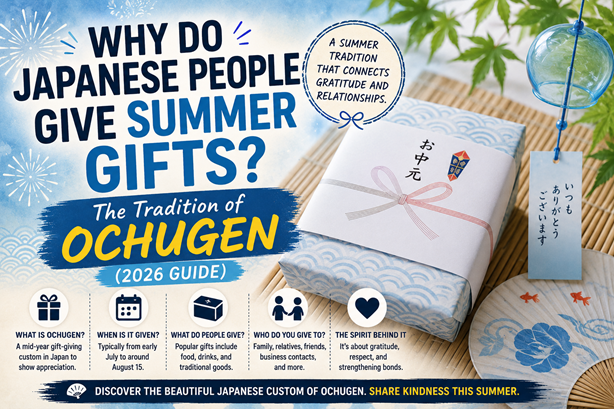
This tradition is known as Ochugen.
Unlike birthdays or Christmas, Ochugen is not about celebrating a particular person or receiving something in return. Instead, it is a quiet expression of gratitude toward people who have supported us throughout the year. Teachers, business partners, relatives, parents, mentors, clients, and close friends may all receive a thoughtful gift simply because someone wants to say, “Thank you.”
Growing up in Japan, I never thought this was unusual.
Every summer, gift boxes would arrive at our home. As a child, I was mostly excited to discover what was inside. Sometimes it was colorful fruit jelly that we could only find during summer. Other years there were boxes of premium juice, somen noodles, or beautifully packaged sweets. I remember opening the boxes with curiosity, never realizing that the gifts themselves were only part of the story.
Only much later did I understand that what was really being exchanged was gratitude.
Living overseas helped me appreciate this even more. In North America and Europe, I experienced wonderful gift-giving traditions during Christmas and the holiday season. Families gathered together, presents were exchanged under decorated trees, and communities celebrated generosity in their own unique ways. Those experiences taught me that expressing appreciation through gifts is something shared by many cultures.
What felt distinctly Japanese was not the act of giving.
It was the timing.
The idea that people pause in the middle of an ordinary summer—not because of a national holiday or a family celebration, but simply to thank those around them—felt quietly remarkable.
🎁 Gratitude Comes Before the Gift
The word “Ochugen” has historical roots stretching back centuries, but for most Japanese people today, its meaning is much simpler. It is an opportunity to express appreciation before another busy season begins. Rather than waiting until the end of the year, people take a moment during summer to recognize relationships that have supported them through everyday life.
That difference is important.
Many gift-giving traditions around the world are connected to celebrations. Birthdays celebrate individuals. Wedding gifts celebrate new beginnings. Christmas gifts celebrate a holiday shared with family and friends. Ochugen is different because there is often no special event at all.
The relationship itself is the occasion.
That idea has always fascinated me.
When I lived overseas, I often noticed that gifts were closely connected with calendars. Christmas arrived, gifts appeared. A birthday arrived, gifts appeared. Valentine’s Day arrived, flowers appeared.
In Japan, someone may unexpectedly receive a carefully wrapped box of fruit or noodles in July without any obvious celebration taking place.
The message is wonderfully simple.
“I haven’t forgotten what you’ve done for me.”
Perhaps that is why Ochugen feels less like an obligation and more like a quiet conversation that continues from year to year.
🍉 Why Summer Foods Fill Ochugen Gift Boxes
One of the most charming aspects of Ochugen is how closely the gifts reflect the season itself.
Walk through a Japanese department store in early July and you immediately notice that almost everything on display is designed to help people enjoy the summer. Boxes of chilled fruit jelly sparkle under bright lights. Premium fruit such as melons or peaches are presented almost like works of art. Carefully packaged somen noodles promise simple meals on hot afternoons. Beer gift sets are stacked neatly beside fruit juices, while elegant boxes of mizuyokan offer a refreshing traditional dessert that perfectly matches the humid weather.
As a child, I simply thought these foods tasted special.
As an adult, I see something more thoughtful.
The gifts are chosen not because they are luxurious alone, but because they suit the season and make daily life a little more comfortable. During the hottest weeks of the year, sending something refreshing carries its own quiet kindness.
This seasonal awareness appears throughout Japanese culture.
Spring brings cherry blossom sweets.
Autumn introduces chestnuts and sweet potatoes.
Winter welcomes hot pots and warming dishes.
Ochugen naturally follows that same rhythm, reminding us that gratitude can also reflect the changing seasons.
Perhaps that is why these gifts rarely feel random.
They feel appropriate.
They acknowledge not only the relationship between people but also the time of year in which that relationship continues to grow.
🎐 The Beauty of Giving Something That Disappears
One of the ideas that surprises many international visitors is the Japanese preference for kiemono, literally “things that disappear.” At first, the phrase may sound strange. Why would people intentionally choose gifts that will eventually be eaten, drunk, or used up? Wouldn’t a lasting object be a more meaningful expression of gratitude?
Growing up in Japan, I never questioned this custom because it was simply considered good manners. Ochugen gifts were almost always consumable. Juice disappeared after a few days. Somen noodles were enjoyed during family meals. Jelly became a welcome dessert on hot evenings. Beer was shared with friends or relatives. Even beautifully presented fruit eventually became part of the dining table. Nothing remained on a shelf collecting dust, and nothing created an obligation for the recipient to find space for another permanent possession.
Only after living overseas did I begin to appreciate how thoughtful this idea really is.
In many countries, lasting gifts are often seen as symbols of affection because they preserve memories. A framed photograph, a decorative object, or a handcrafted souvenir may continue reminding someone of the giver for many years. I have received gifts like these while living abroad, and I still treasure them.
Japan simply approaches certain occasions differently.
Ochugen is not meant to leave behind another object.
It is meant to leave behind a feeling.
The gift disappears naturally.
The gratitude does not.
There is also a quiet consideration hidden inside this custom. By choosing something that can be enjoyed and then finished, the giver avoids creating an additional burden for the recipient. Nobody has to decide where to display it, whether to keep it forever, or how to dispose of it later. The gift enters daily life, brings a little happiness, and then gently disappears.
The more I think about it, the more this reflects a wider Japanese way of considering other people’s comfort before our own intentions.
🎀 Even the Wrapping Has Meaning
Another part of Ochugen that often catches visitors’ attention is the presentation.
In many Western countries, gift wrapping is primarily decorative. Beautiful paper, colorful ribbons, and elegant boxes help create excitement before the present is opened. Japan certainly appreciates beautiful packaging as well, but Ochugen introduces another layer through the use of noshi, the traditional gift wrapping paper that includes a decorative design and the sender’s name.
As a child, I hardly noticed these details.
The interesting part was always discovering what was inside the box.
Today, however, I find the outside almost as meaningful as the contents.
The noshi quietly explains that this gift is being offered respectfully, not casually. It reflects care, etiquette, and consideration. Rather than making the gift appear more expensive, it communicates that the relationship itself deserves thoughtfulness.
Department stores in Japan make this remarkably easy. Customers simply choose a gift, and the staff carefully prepare the wrapping, attach the appropriate noshi, and arrange delivery. Watching experienced staff wrap a gift is almost a performance in itself, reminding us that presentation can also be an expression of respect.
🌍 Looking at Ochugen Through Overseas Eyes
Living overseas changed how I viewed Ochugen more than almost any history book could.
In Canada and the United States, the busiest gift season always arrived toward the end of the year. Christmas transformed entire shopping districts into celebrations of generosity. Families exchanged presents, colleagues organized gift exchanges, and beautifully wrapped packages appeared beneath Christmas trees. The atmosphere was warm, festive, and full of anticipation.
Japan also has an important winter gift season with Oseibo, but what fascinated me after returning home was realizing that Japanese people had created another opportunity to express gratitude halfway through the year.
That idea felt uniquely refreshing.
Life becomes busy everywhere.
Months pass quickly.
Sometimes we simply assume that the people supporting us already know we are grateful.
Ochugen gently interrupts that routine.
It reminds us that appreciation does not always need a birthday, a holiday, or a major celebration.
Sometimes an ordinary summer afternoon is reason enough to say thank you.
Of course, modern Japan has changed.
Not every family exchanges Ochugen gifts today, and many younger generations participate less frequently than their parents or grandparents did. Some companies have even stopped encouraging seasonal gifts in order to simplify business relationships. Online shopping has also transformed how people choose and send gifts, making the process much easier than in the past.
Yet despite these changes, the underlying idea continues to resonate.
Expressing gratitude before it is forgotten is something that never becomes outdated.
🇯🇵 Conclusion
Why do Japanese people give summer gifts?
The answer is much deeper than tradition alone.
Ochugen is not really about beer, fruit, noodles, or beautifully wrapped boxes.
It is about remembering the people who quietly support our lives and taking the time to acknowledge them before another season slips away.
Growing up, I looked forward to opening the gift boxes that arrived at our home each summer.
Today, I realize that the most valuable thing inside those boxes was never the jelly, the juice, or the sweets.
It was the message that accompanied them.
“Thank you.”
Perhaps that is also why so many Ochugen gifts are things that disappear.
The beer is eventually shared.
The fruit is eaten.
The noodles are cooked.
The wrapping paper is removed.
Nothing lasts forever.
Except, perhaps, the feeling of knowing that someone paused in the middle of an ordinary summer simply to let you know that you mattered.
In the end, Ochugen reminds us that gratitude does not always need grand words or expensive presents.
Sometimes, a thoughtful gift that quietly disappears says more than something that lasts forever.
🌏 Continue Exploring Japan’s Culture of Gratitude
If you enjoyed learning about Ochugen, you may also enjoy these articles exploring the customs, values, and everyday traditions that shape Japanese life beyond what most visitors see.
👉 Why Do Japanese People Take Off Their Shoes So Often? (2026 Guide)
👉 Why Does Japanese Food Come With Rice, Soup, and Side Dishes? (2026 Guide)
👉 Why Do Japanese People Express Gratitude Before Every Meal? (2026 Guide)
👉 Why Do Japanese People Carry Handkerchiefs Everywhere? (2026 Guide)
👉 Why Do Adults in Japan Read Manga? More Than Just Entertainment (2026 Guide)