
🌏 Introduction
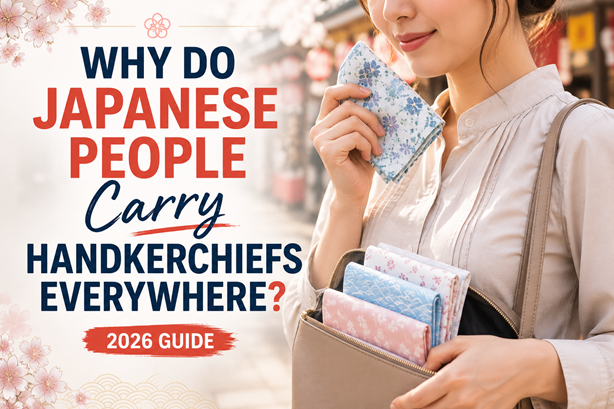
One thing that often surprises visitors to Japan is how many people carry handkerchiefs. Children carry them to school, office workers keep them in their bags or pockets, and many adults leave home without even thinking about whether they have one. It is simply part of everyday life.
I am one of those people.
In fact, I carry a handkerchief almost every day, and if you asked me why, my first answer would probably be, “Because I always have.” It is not something I consciously decided to do as an adult. Like many Japanese people, I developed the habit as a child and never stopped.
When I was growing up, my parents would often ask a simple question before I left for school.
“Did you bring your handkerchief and tissues?”
For many children in Japan, that question is almost a daily ritual. A handkerchief and a packet of tissues were considered basic necessities, just like notebooks, pencils, or a school lunch. Teachers sometimes checked. Parents often reminded us. If we forgot them, we might feel embarrassed or inconvenienced during the day.
At the time, I never thought much about it.
It was simply normal.
It was only after living overseas that I realized how unusual this habit actually is.
When I lived in Canada and the United States, I noticed that many people did not carry handkerchiefs at all. Public restrooms often provided paper towels or air dryers. Restaurants supplied napkins. Offices and schools usually had disposable alternatives available. Because of that, carrying a personal cloth for drying your hands was often unnecessary.
That contrast made me wonder.
Why do so many Japanese people continue carrying handkerchiefs everywhere?
The answer has less to do with fashion or hygiene and more to do with childhood habits, everyday practicality, and the way small routines become part of a culture.
🏫 A Habit Learned in Childhood
One reason the habit remains so common is that it often begins at a very young age.
Japanese children are frequently taught to bring both a handkerchief and tissues to school. This expectation starts early and continues throughout much of their education. While children may not fully understand the reason at first, they quickly learn that these items are part of being prepared for the day.
Looking back, I think the lesson was about more than simply drying your hands.
It was also about responsibility.
A handkerchief is a small thing, but remembering to bring it every day teaches children to prepare for themselves. Instead of assuming someone else will solve a problem, they learn to carry what they might need. If they wash their hands, they have something to dry them with. If they spill water, they can wipe it up. If they need to clean something, they have a tool available.
These are small moments, but childhood often consists of small lessons repeated over and over again.
By the time many Japanese children become adults, carrying a handkerchief no longer feels like a task. It feels automatic.
🚻 Public Restrooms and Everyday Practicality
Another reason handkerchiefs remain useful is that Japan developed differently from countries where paper towels became the standard solution.
Although many public facilities now provide paper towels or modern air dryers, this has not always been the case. Even today, visitors occasionally encounter restrooms where neither option is available.
For Japanese people, this is rarely a problem.
Most simply use the handkerchief they already carry.
Visitors sometimes find this surprising because they expect public facilities to provide everything they need. Yet for many Japanese people, carrying a handkerchief feels easier than depending on whatever happens to be available.
The habit becomes self-reinforcing.
Because people carry handkerchiefs, facilities do not always need to provide paper towels.
Because facilities do not always provide paper towels, people continue carrying handkerchiefs.
Over time, this becomes part of everyday life.
🌏 My Experience Living Overseas
Living abroad made me appreciate how cultural habits often become invisible until they disappear.
When I first lived in North America, I rarely thought about handkerchiefs. Most public restrooms had paper towels or air dryers. If I forgot a handkerchief, it did not matter. The system was designed differently.
At first, I assumed Japan would eventually move completely in that direction as well.
Yet when I returned home, I noticed something interesting.
People were still carrying handkerchiefs.
Students still carried them.
Parents still reminded their children.
Stores still sold beautiful handkerchiefs in every department store.
The habit had survived despite technological changes.
That made me realize that the handkerchief was no longer just a practical tool.
It had become part of a routine.
And routines are often much stronger than convenience.
👔 More Than Just Drying Your Hands
Another reason handkerchiefs remain popular is that they are surprisingly versatile.
Many people use them to wipe sweat during Japan’s hot and humid summers. Others use them when caught in light rain. Some use them during meals, while others keep one available for unexpected situations throughout the day.
Japan’s climate may play a role here.
Summer can be extremely humid. Walking outside for even a short time often leaves people sweating. Having a handkerchief available is practical in a way that people living in drier climates may not fully appreciate.
This does not mean every Japanese person constantly uses a handkerchief.
Rather, it means many people like knowing it is available when needed.
🎁 The Handkerchief as a Personal Item
Interestingly, handkerchiefs in Japan are often treated as personal accessories rather than purely functional objects.
Department stores sell countless designs. Some are elegant and formal. Others are colorful and playful. Some feature famous characters, seasonal themes, or traditional patterns.
Because handkerchiefs are carried daily, people often choose ones that reflect their personality.
They are also popular gifts.
Receiving a handkerchief as a present is common and generally considered practical rather than unusual.
This gives the object a cultural presence beyond its original purpose.
A handkerchief is not merely something people use.
It is something they carry.
🌱 An Unexpected Environmental Benefit
In recent years, some people have also pointed out environmental advantages.
Unlike disposable paper towels, a reusable handkerchief can be washed and used repeatedly.
However, I do not think this is the main reason most Japanese people carry them.
Long before environmental concerns became a major public discussion, children were already bringing handkerchiefs to school.
The environmental benefit exists, but it is more accurate to view it as a side effect of an older habit rather than the original motivation.
The practice survived because it was useful and familiar.
The environmental aspect simply became an additional advantage later.
🌏 Different Solutions to the Same Problem
One thing travel has taught me is that cultures often solve the same problem in different ways.
In Canada and the United States, paper towels and air dryers became the standard solution.
In Japan, many people simply carry their own handkerchief.
Neither approach is necessarily better.
Both work.
Both keep people’s hands dry.
Both fit the systems and habits that developed in those societies.
What makes the Japanese approach interesting is how deeply it became connected to childhood education and daily routines. A habit learned in elementary school often continues for decades without people even realizing it.
That is not because they are consciously following a rule.
It is because the habit became part of who they are.
🇯🇵 Conclusion
Why do Japanese people carry handkerchiefs everywhere?
The answer is not simply cleanliness, convenience, or environmental awareness. Those factors play a role, but the deeper explanation lies in habit. Japanese children are often taught from an early age to carry handkerchiefs and tissues, and that small routine frequently continues throughout adulthood.
My own experience reflects this perfectly. I still carry a handkerchief almost every day, not because I carefully decided to do so, but because it has been part of my daily routine for as long as I can remember. Only after living overseas did I realize that something so ordinary in Japan was actually a distinctive cultural habit.
Like many aspects of everyday life, the handkerchief is easy to overlook precisely because it is so common.
Yet sometimes the smallest habits reveal the most about how a society works.
🌏 Explore More Everyday Japanese Habits
If you enjoyed learning about this small but fascinating aspect of daily life in Japan, you may also enjoy these articles exploring other everyday habits and cultural traditions that many Japanese people rarely think about but continue to practice every day.
👉 Why Do Japanese People Carry an Umbrella Even When It Might Not Rain? (2026 Guide)
👉 Why Do Japanese People Sleep on Trains So Easily? The Hidden Trust Behind Everyday Commuting
👉 Why Do Japanese People Bathe at Night Instead of the Morning? (2026 Guide)
👉 Why Do Japanese Students Clean Their Own Classrooms? The Lesson Behind School Cleaning Time
👉 Why Is Being On Time So Important in Japan? Understanding Japanese Punctuality
👉 Why Does Japan Feel So Calm Even in Big Cities? The Hidden Rhythm Behind Urban Life