
🌏 Introduction
One of the first cultural differences many visitors notice in Japan is how often they are asked to remove their shoes. It starts at the entrance of a home, but it rarely ends there. Depending on where you go, you may also remove your shoes at schools, traditional restaurants, temples, shrines, historic castles, clinics, fitting rooms, ryokan inns, and many other places. For first-time visitors, it can feel surprising at first. For Japanese people, however, it feels completely natural.
I grew up in Japan, so taking off my shoes was simply part of everyday life. At home, we removed our shoes at the entrance. At school, we changed into indoor shoes. When visiting relatives, we removed our shoes. When entering traditional rooms with tatami flooring, we removed our shoes. I never questioned it because everyone around me did the same thing.
It was only after living overseas that I realized how unusual this habit can seem.
One of my first experiences visiting friends’ homes in Canada and the United States left a strong impression on me. When people entered the house wearing the same shoes they had worn outside, I felt strangely uncomfortable. I remember wondering whether the floor would become dirty or whether I should take my own shoes off even if nobody else did. Of course, I eventually understood that different cultures simply developed different habits. Still, it was one of the first moments when I realized that something I had always considered normal was actually deeply cultural.
Today, many households in North America also remove shoes indoors, especially in Canada where snow, mud, and winter weather make shoe removal practical. Yet even there, the habit usually stops at the home. In Japan, shoe removal extends far beyond private houses and appears throughout daily life. To understand why, we need to look beyond cleanliness alone and explore how Japanese people think about space, boundaries, and the relationship between the outside world and the spaces where life happens.
👟 It Starts With the Entrance
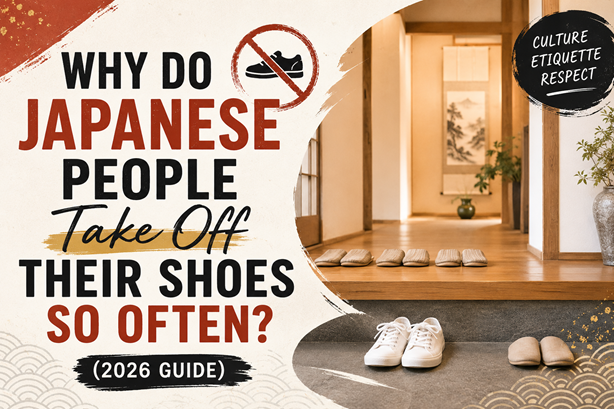
For many visitors, the Japanese entrance known as the genkan is their first introduction to this custom.
The genkan is more than a place to leave shoes. It serves as a boundary between two different worlds. Outside is the public world filled with streets, weather, dust, and countless interactions with other people. Inside is a private space where people relax, eat, sleep, study, and spend time with family.
By removing shoes, people symbolically leave part of the outside world behind.
This may sound philosophical, but it helps explain why the custom remains so deeply rooted. The act itself takes only a few seconds, yet it marks a transition. Many Japanese people perform it automatically without consciously thinking about it.
Visitors often focus on the practical aspect of keeping floors clean, and that certainly plays a role. However, cleanliness alone does not fully explain why the practice became so widespread or why it appears in so many different places.
The deeper idea involves creating a distinction between different kinds of spaces.
🏠 More Than a Household Rule
Many cultures have rules about what happens inside a home. Japan certainly does as well, but the concept extends beyond the house itself.
This is where many visitors become surprised.
In Japan, removing shoes is not limited to private residences. Schools are perhaps the most famous example. Children typically change into indoor shoes when they arrive. This practice begins early, often in kindergarten, and continues through elementary school, middle school, and high school.
Hospitals may have shoe-removal areas.
Traditional restaurants with tatami seating often require it.
Ryokan inns expect it.
Historic castles frequently require it.
Temples and certain shrine buildings may require it.
Even clothing stores sometimes ask customers to remove their shoes before entering a fitting room.
At first glance, these locations seem unrelated. Yet they all share one characteristic. They contain spaces that are treated differently from the outside environment.
🏫 Why Japanese Schools Use Indoor Shoes
School culture provides one of the clearest examples of this idea.
Japanese students spend a significant portion of their lives at school. Classrooms are not merely places where lessons happen. Students eat lunch there, clean the building themselves, participate in activities, and spend much of their daily lives within the school environment.
Because of this, schools are treated almost like a second home.
Changing into indoor shoes helps protect floors from dirt and weather, but it also creates a psychological transition. Students leave behind the outside world and enter an environment dedicated to learning.
Looking back on my own school days, I never viewed indoor shoes as unusual. Everyone did it. It was simply part of arriving at school. Only later did I realize that many schools in other countries do not require students to change footwear at all.
The practice reflects a broader Japanese tendency to separate spaces according to their purpose.
🌏 Reading the Signs Without Thinking
One of the fascinating things about Japanese culture is that people often know when to remove their shoes without being told.
Visitors sometimes ask how Japanese people can immediately recognize these situations.
The answer is that certain visual cues are deeply familiar.
A step up at the entrance often signals a transition.
A change in flooring material can indicate a different type of space.
A row of shoe lockers provides an obvious clue.
Tatami flooring almost always means shoes should come off.
These signals are so common that many Japanese people notice them subconsciously.
When I travel with foreign friends in Japan, I sometimes realize how invisible these signs have become to me. I instinctively know when shoes should come off, while they are still trying to figure out what everyone else is doing.
That difference highlights how cultural habits become embedded in everyday perception.
🏯 The Influence of Traditional Architecture
History also plays an important role.
Traditional Japanese homes were designed differently from many Western houses. People often sat directly on tatami mats. Futons were placed on the floor for sleeping. Daily life happened much closer to the ground.
In such an environment, keeping floors clean became especially important.
Shoes designed for outdoor travel naturally brought dirt, moisture, and debris indoors. Removing them helped preserve both cleanliness and comfort.
Over time, the habit became deeply connected to architecture itself.
Even though modern Japanese homes often use different materials, the custom remains.
Many traditions survive long after the original practical reasons have evolved.
🧠 A Small Ritual of Transition
One reason I find this topic fascinating is that removing shoes does more than protect floors.
It creates a moment of transition.
Think about what happens when you arrive home after a long day.
You remove your shoes.
Perhaps you change clothes.
You begin to relax.
Without realizing it, you are shifting from one mindset to another.
The same thing happens in schools, inns, temples, and other locations.
The act of removing shoes marks a change in environment and expectations.
It is a small ritual that signals, “You are entering a different kind of space.”
This may help explain why the practice persists even when modern cleaning technology could theoretically make it unnecessary.
The custom serves a social and psychological purpose as well as a practical one.
🌏 My Perspective After Living Abroad
Living overseas changed the way I view this habit.
When I first encountered homes where people kept their shoes on indoors, I felt surprised. Yet over time, I realized those customs also made sense within their own cultural context. Different countries have different climates, different architectural traditions, and different expectations regarding personal space.
Today, I no longer think of one approach as better than another.
Instead, I see them as different answers to the same question.
How do we define the boundary between outside and inside?
Japan simply happens to answer that question more visibly than many places.
The moment you remove your shoes, the boundary becomes clear.
🇯🇵 Conclusion
Why do Japanese people take off their shoes so often?
The simple answer is cleanliness. The deeper answer is culture.
For centuries, Japanese people have used shoe removal to separate different kinds of spaces, protect traditional living environments, and create a clear distinction between the outside world and the places where people live, learn, relax, and reflect.
What begins as a practical habit ultimately reveals something larger about Japanese society. The custom reflects the importance of boundaries, context, and respect for space. Whether entering a home, a classroom, a temple, or a traditional inn, removing shoes signals that you are stepping into an environment with its own purpose and atmosphere.
For many Japanese people, this action is so familiar that it hardly feels noticeable.
Yet when viewed from the outside, it offers a fascinating glimpse into how everyday habits can express deeper cultural values.
🌏 Explore More Deep Japan Articles
If you enjoyed learning about why Japanese people remove their shoes so often, you may also enjoy these articles exploring the habits, values, and everyday customs that shape life in Japan.
👉 Why Do Japanese People Carry Handkerchiefs Everywhere? (2026 Guide)
👉 Why Do Japanese People Express Gratitude Before Every Meal? (2026 Guide)
👉 Why Do Japanese People Worry So Much About Causing Trouble? Understanding a Unique Social Mindset
👉 Why Do Japanese People Carry an Umbrella Even When It Might Not Rain? (2026 Guide)
👉 Why Do Japanese Students Clean Their Own Classrooms? The Lesson Behind School Cleaning Time