
🌏 Introduction
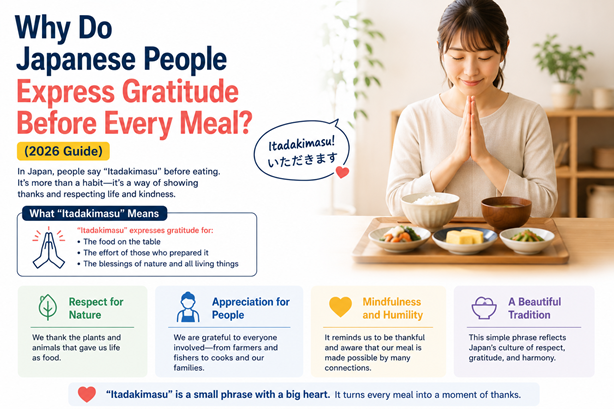
One of the first things many visitors notice when eating with Japanese people is that there is often a brief pause before the meal begins. Just before picking up their chopsticks, many people quietly say a short phrase together. It happens at home, in schools, at restaurants, and even during business lunches. For most Japanese people, it is such a normal part of daily life that they rarely stop to think about it.
Yet for many visitors, the habit raises an interesting question.
Why do Japanese people express gratitude before every meal?
At first glance, it may look like a religious ritual. Some people assume it is connected to a specific faith or formal tradition. Others think it is simply a rule of etiquette. The reality is often much simpler and much more personal.
I grew up in Japan, and saying a word of gratitude before eating was something I learned from an early age. It happened at home. It happened at school. It happened almost everywhere food was served. However, I was never taught that it was primarily about religion. The explanation I remember hearing most often was much more practical. It was about appreciation.
We were taught to appreciate the people who prepared the meal. We were taught to appreciate the farmers who grew the vegetables, the fishermen who caught the fish, and the countless people involved in bringing food to the table. We were also taught to appreciate the fact that food itself exists because living things were sacrificed in some way for us to eat. Even the parents or family members who worked to provide the money that paid for the meal were often included in that chain of gratitude.
As a child, I probably did not fully understand all of that.
As an adult, I think about it more often.
What interests me now is not the phrase itself, but the mindset behind it.
🍚 A Habit Learned So Early We Rarely Question It
One reason this tradition can be difficult to explain is that most Japanese people learn it before they are old enough to analyze it.
Children are taught to express gratitude before meals long before they begin thinking about culture or philosophy. It becomes part of the rhythm of everyday life. Breakfast begins. A short expression of thanks is offered. Lunch arrives. The same thing happens. Dinner comes. Again, the routine repeats itself.
Because it is repeated thousands of times throughout childhood, it eventually feels as natural as saying hello or goodbye.
When I was young, I never sat down and wondered why we did it. I simply assumed everyone did. It was only after spending time overseas that I realized how different meal traditions can be from one country to another.
Many cultures have their own ways of expressing gratitude before eating. Some families say prayers. Some pause for a moment of reflection. Some simply begin eating immediately. None of these approaches are inherently better or worse than the others. They simply reflect different ways of thinking about food and daily life.
The Japanese habit stands out because it is often practiced regardless of religious belief. People who consider themselves religious may do it. People who do not consider themselves religious may do it too. The act is less about declaring faith and more about acknowledging the many connections that made the meal possible.
🌾 More People Contribute to a Meal Than We Realize
Modern life makes it easy to forget how complicated food really is.
When we sit down to eat, all we see is the finished meal. We see a bowl of rice, a plate of vegetables, a sandwich, or a bowl of ramen. What we do not see are the countless people whose work contributed to that moment.
Someone planted the ingredients.
Someone harvested them.
Someone transported them.
Someone sold them.
Someone prepared them.
Someone cooked them.
Most meals represent the efforts of dozens or even hundreds of people.
Expressing gratitude before eating can be understood as a brief recognition of that reality.
The interesting thing is that this idea becomes even clearer when living abroad. When I lived outside Japan, I still found myself expressing gratitude before meals. The language remained the same, but the people behind the meal changed.
Perhaps the vegetables came from a farm in Canada.
Perhaps the bread was baked by someone in the United States.
Perhaps the meal was prepared by a restaurant in Europe.
The location changed, but the basic idea did not.
The meal still existed because many people contributed to it.
🌏 Gratitude Beyond Borders
One thing I realized while living overseas is that appreciation does not belong to any particular country.
Every society contains people who work hard to grow food, transport products, cook meals, and support their families. Every culture has traditions that encourage gratitude in one form or another.
Because of that, I never felt that expressing gratitude before eating was something that only made sense in Japan.
I continued doing it abroad.
Not because I was trying to preserve a Japanese identity.
Not because I wanted to stand out.
I simply appreciated the reminder.
It helped me remember that food does not appear magically. It arrives through the efforts of many people, most of whom I will never meet.
In a world where convenience often hides those connections, taking a few seconds to acknowledge them feels meaningful.
🐟 Gratitude for Life Itself
Another aspect often mentioned in Japan is appreciation for life.
This idea can sound abstract at first, but it is actually quite straightforward.
Whether someone eats vegetables, fish, meat, fruit, or grains, living things are involved in the process. Food requires resources, labor, and biological life. Even when we do not think about it directly, eating depends on a chain of events that extends far beyond ourselves.
Expressing gratitude before eating can therefore be understood as recognizing that reality.
Again, this does not need to be interpreted as a religious statement.
Many people simply see it as a reminder not to take food for granted.
In wealthy societies, food is often readily available. Supermarkets are full. Restaurants are everywhere. Meals can be delivered with a few taps on a smartphone.
Because food is so accessible, it becomes easy to forget how extraordinary that situation actually is.
A brief expression of thanks encourages people to pause before consuming something they might otherwise take for granted.
👨👩👧👦 A Lesson Many Children Learn at Home
For many Japanese people, the meaning behind this habit is first explained by parents or teachers.
Children may be told to appreciate the person who cooked the meal.
They may be encouraged to think about farmers.
They may be reminded not to waste food.
These lessons are rarely presented as grand philosophical concepts.
Instead, they are woven into everyday life.
A parent preparing dinner after a long day of work.
A school lunch prepared by staff members before students arrive.
A family gathering where everyone sits down together.
In these ordinary moments, gratitude becomes a habit rather than an abstract idea.
Over time, that habit can shape how people think about food and the people around them.
🍽️ The Pause Matters
What I find most interesting is that the actual words are not necessarily the most important part.
The pause is.
Modern life moves quickly. People eat while working, scrolling through phones, watching television, or rushing between appointments. Meals often become just another task to complete.
A brief pause before eating interrupts that rhythm.
For a few seconds, people stop.
They acknowledge the meal.
They recognize its value.
Then they begin eating.
The act may be small, but small rituals often have surprising power. They remind us to pay attention to things we might otherwise overlook.
🌏 What This Habit Reveals About Everyday Japan
When people try to understand another culture, they often focus on major festivals, famous landmarks, or historic traditions.
Those things are important.
But sometimes the most revealing details are much smaller.
A habit repeated every day often tells us more about a society than an event that happens once a year.
Expressing gratitude before meals is one of those habits.
It reflects an awareness of relationships. Not just relationships between people, but relationships between people and food, people and work, and people and the larger systems that support daily life.
It is not about claiming that one culture appreciates food more than another. Many cultures have powerful traditions of gratitude. The interesting part is simply how that gratitude is expressed.
In Japan, one common way is through a short phrase said before eating.
🇯🇵 Conclusion
Why do Japanese people express gratitude before every meal?
For many people, the answer has less to do with religion and more to do with appreciation. It is a way of acknowledging the people who produced, transported, prepared, and paid for the food. It is also a reminder that meals depend on resources and forms of life that should not be taken for granted.
I learned this habit as a child and have continued it throughout my life, whether I was in Japan, Canada, the United States, or elsewhere. The location never seemed particularly important. The meaning remained the same.
Food connects us to countless people we may never meet. Taking a moment to recognize that connection is a small act, but perhaps that is precisely why it has endured for so long.
Sometimes the most ordinary habits reveal the deepest values.
And sometimes gratitude begins with nothing more than a brief pause before the first bite.
🌏 Explore More Everyday Habits That Reveal the Real Japan
If you enjoyed learning about the meaning behind everyday Japanese customs, you may also enjoy these articles exploring the values, habits, and cultural ideas that quietly shape daily life in Japan.
👉 Why Do Japanese People Bow? Meaning, Types, and When to Do It (2026 Guide)
👉 Why Do Japanese People Worry So Much About Causing Trouble? Understanding a Unique Social Mindset (2026 Guide)
👉 Why Is Being On Time So Important in Japan? Understanding Japanese Punctuality (2026 Guide)
👉 Why Do Japanese Students Clean Their Own Classrooms? The Lesson Behind School Cleaning Time (2026 Guide)
👉 Why Do Japanese People Bathe at Night Instead of the Morning? (2026 Guide)