
🌏 Introduction
Many travelers arrive in Japan expecting convenience stores to become their best friend. After all, Japanese convenience stores are famous around the world. They are clean, efficient, open almost twenty-four hours a day, and filled with surprisingly good food. Visitors quickly discover onigiri, sandwiches, bentos, desserts, and countless drinks. For many people, the convenience store becomes one of their first stops after landing in Japan.
However, after spending a little more time here, many visitors discover another place that can be even more useful.
The Japanese drugstore.
When I lived in North America, I usually bought medicine from supermarkets, Walgreens, or CVS. If I had a cold, a headache, allergies, or needed basic health products, those were the places I visited. Because of that experience, I assumed drugstores around the world were generally similar. Then I returned to Japan and was reminded that Japanese drugstores are something completely different.
What surprised me was not that they sold medicine. What surprised me was everything else.
Today, Japanese drugstores are part pharmacy, part cosmetics store, part discount shop, part convenience store, and sometimes even part supermarket. In many situations, they are actually more useful than convenience stores, especially for travelers and foreign residents. If you only visit convenience stores during your trip, you may miss one of the most practical shopping experiences Japan has to offer.
🏪 More Than Just a Pharmacy
The word “drugstore” can be misleading because many visitors imagine a place focused mainly on medicine. In Japan, medicine is only one part of the experience.
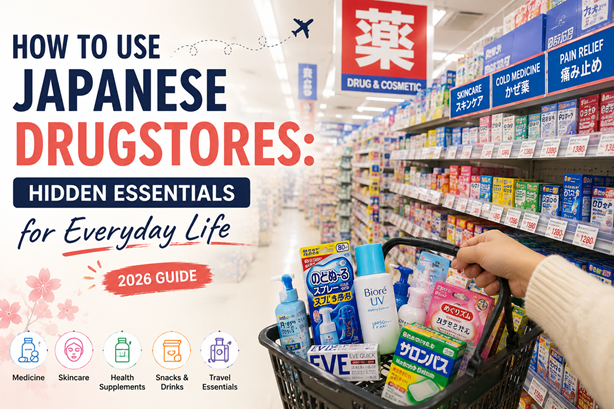
Walk into a typical drugstore and you will find shelves filled with skincare products, cosmetics, shampoo, sunscreen, toothpaste, vitamins, supplements, snacks, drinks, instant foods, cleaning supplies, baby products, face masks, contact lens solutions, and countless other everyday necessities. Some stores even carry fresh food, frozen meals, and household goods.
For travelers, this means one stop can solve multiple problems. Need sunscreen after forgetting yours at home? A drugstore has it. Need snacks for the Shinkansen? A drugstore has those too. Need cold medicine, eye drops, toothpaste, a phone charger, and a face mask? You can probably find all of them in the same store.
Many visitors are surprised by just how large some Japanese drugstores can be. What initially looks like a pharmacy often turns out to be a mini department store dedicated to everyday life.
🏪 Drugstores vs Convenience Stores
Visitors often ask whether they should shop at convenience stores or drugstores. The answer depends on what you need.
Convenience stores are unbeatable when you need something immediately. They are everywhere, they stay open late, and they offer excellent ready-to-eat meals. If you want a quick breakfast, lunch, dinner, coffee, or cash withdrawal from an ATM, convenience stores are hard to beat.
Drugstores, however, often offer lower prices and a much wider selection of products. In many cases, the exact same bottle of water, snack, supplement, or daily necessity costs less at a drugstore than at a convenience store. Cosmetics selections are usually much larger, health products are far more extensive, and tax-free shopping is commonly available.
The comparison table below highlights some of the major differences between convenience stores and drugstores in Japan.
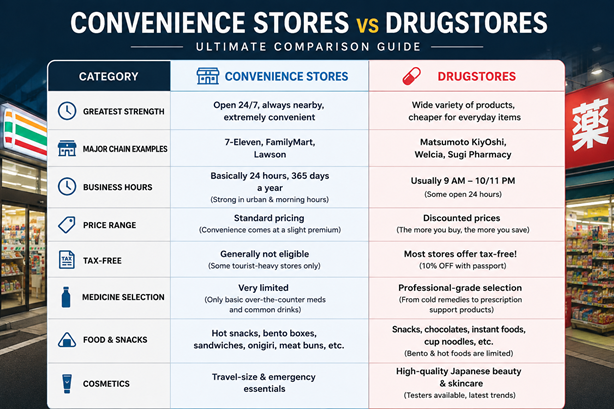
Many travelers eventually develop a simple routine. They use convenience stores when they need speed and convenience, and they use drugstores when they want better prices, larger selections, or tax-free shopping.
💄 Why Cosmetic Lovers Love Japanese Drugstores
One area where Japanese drugstores truly stand out is cosmetics and skincare.
Even visitors who have no interest in beauty products often find themselves browsing these sections out of curiosity. The variety is impressive. Japanese skincare products have developed a strong international reputation, and drugstores are one of the easiest places to explore them.
What often surprises foreign visitors is the number of testers available.
Many stores allow customers to try products before purchasing them. Foundations, lotions, creams, sunscreens, and other skincare products frequently have tester samples available. While testers certainly exist in other countries, Japanese drugstores often offer an unusually wide variety.
This allows shoppers to compare products more comfortably and make informed decisions before buying.
For travelers looking for souvenirs, this section alone can easily consume an hour of browsing.
🎁 One of the Best Places to Buy Souvenirs
Many tourists automatically assume airport shops are the best place to buy souvenirs.
In reality, drugstores are often better.
Popular Japanese products such as sheet masks, eye drops, bath additives, beauty products, seasonal snacks, vitamins, supplements, and health products are often cheaper and available in a much wider variety than at airport stores.
Some items that foreigners specifically travel to Japan to purchase can be found in nearly every drugstore.
This is one reason why many experienced travelers visit a drugstore early in their trip rather than waiting until the last day. By doing so, they can compare prices, discover local products, and avoid rushing through airport stores before departure.
Perhaps more importantly, drugstores show what Japanese people actually buy in everyday life. Instead of focusing only on products designed for tourists, visitors can see what local customers place in their shopping baskets.
📱 Payke Makes Shopping Much Easier
One challenge many visitors face is language.
Product packaging is often written primarily in Japanese, and understanding ingredients or usage instructions can sometimes be difficult.
This is where Payke becomes useful.
Payke allows users to scan product barcodes and view information in multiple languages. Instead of guessing what a product does, travelers can quickly access explanations and descriptions on their phones.
For first-time visitors, this can remove much of the uncertainty associated with shopping for unfamiliar products.
I often recommend Payke because it allows people to shop with greater confidence. Rather than relying entirely on translation apps or staff assistance, visitors can independently learn more about the products they are considering.
💊 Medicine Is Only Part of the Story
Of course, medicine remains an important reason many people visit Japanese drugstores.
Travelers occasionally catch a cold, develop headaches, suffer from seasonal allergies, or need basic first-aid supplies during their trip. Having easy access to over-the-counter products can provide significant peace of mind.
However, what makes Japanese drugstores unique is that medicine exists alongside so many other aspects of daily life.
The same store that sells cold medicine also sells snacks for your train ride, skincare products for dry weather, and souvenirs for friends back home.
This combination makes drugstores feel less like pharmacies and more like practical everyday hubs.
💴 Understanding Tax-Free Shopping
One of the biggest advantages for international visitors is tax-free shopping.
Many Japanese drugstores participate in Japan’s tax-free program, allowing eligible visitors to save the consumption tax on qualifying purchases.
The process is usually straightforward. Travelers simply present their passport during checkout, and the store handles the necessary paperwork electronically.
However, there is one important rule many visitors do not know.
Certain consumable tax-free items may be sealed inside a special transparent tax-free bag. These products are intended to leave Japan with you.
If you open and use products that have been sealed as part of a tax-free purchase before departing Japan, customs officials may require you to pay the consumption tax when leaving the country.
In practice, not every traveler is inspected, but it is still important to follow the rules. If products are sealed as tax-free purchases, it is generally best to leave them unopened until after you leave Japan.
Many visitors simply assume tax-free means discount shopping. In reality, tax-free shopping comes with specific conditions, and understanding them helps avoid unnecessary complications.
🌏 A Window Into Everyday Japanese Life
One reason I enjoy visiting Japanese drugstores is that they reveal aspects of daily life that tourists sometimes miss.
Visitors often spend time at famous temples, shrines, museums, and observation decks. Those places are important and memorable. Yet a local drugstore offers a different kind of insight.
The shelves reveal which products are popular. Seasonal displays show what people are buying at that particular time of year. New skincare products appear alongside allergy medications, cooling wipes, summer essentials, and limited-edition snacks.
In a surprisingly small space, you can learn a great deal about how people live.
That is why I often encourage visitors to spend a little extra time browsing instead of treating drugstores as simple pharmacies.
They are practical, useful, affordable, and surprisingly revealing.
🇯🇵 Conclusion
Japanese drugstores are one of the most underrated resources available to travelers. While convenience stores often receive the attention, drugstores frequently offer lower prices, larger selections, tax-free shopping, extensive cosmetic sections, useful health products, and excellent souvenir opportunities all under one roof.
My perspective changed after living overseas. Having spent years shopping at supermarkets, Walgreens, and CVS, I realized that Japanese drugstores occupy a unique position somewhere between a pharmacy, a discount store, and a convenience store. They are designed around everyday life, and that is exactly what makes them so useful.
For visitors, they are more than places to buy medicine.
They are places to discover products, save money, find souvenirs, and better understand modern Japanese daily life.
Sometimes the most interesting things about Japan are not found in famous tourist attractions.
Sometimes they are found in the aisle of a neighborhood drugstore.
🌏 More Practical Guides for Everyday Life in Japan
If you found this guide helpful, you may also enjoy these practical articles designed to make everyday life and travel in Japan easier.
👉 How to Buy Medicine in Japan: What Travelers Need to Know (2026 Guide)
👉 What Should You Do If You Get Sick or Injured in Japan? A Practical Guide for Travelers (2026 Guide)
👉 How to Use Coin Lockers in Japan: Sizes, Prices, and Travel Tips (2026 Guide)
👉 Best Apps for Traveling in Japan (2026): 6 Essential Apps Every Tourist Needs
👉 What to Wear in Japan During Summer (2026 Guide)
👉 Japanese Convenience Stores (Konbini): Why They’re Open 24/7 and How They’re Changing in 2026
👉 How to Use ATMs in Japan: A Complete Guide for Foreign Travelers (2026)