
🌏 Introduction
Getting sick or injured while traveling is something nobody wants to think about, but it happens more often than many travelers expect. A sudden fever, food poisoning, a sports injury, dehydration during the summer, or even a simple accident can quickly turn an exciting trip into a stressful experience.
I have lived in several countries and traveled extensively around the world, and one thing I have learned is that medical emergencies feel much more complicated when they happen in a foreign country. Years ago, while living in the United States, I had to visit an emergency room unexpectedly. The illness itself was not the most difficult part. The unfamiliar medical system, different procedures, language barriers, and uncertainty about what would happen next created far more stress than the actual medical problem.
Many visitors feel the same anxiety when they imagine getting sick in Japan. The good news is that Japan has a safe, modern, and reliable healthcare system. Most of the fear comes from not knowing what to do or where to go. Once you understand the available resources, handling a medical situation in Japan becomes much easier.
🚑 When to Call an Ambulance in Japan
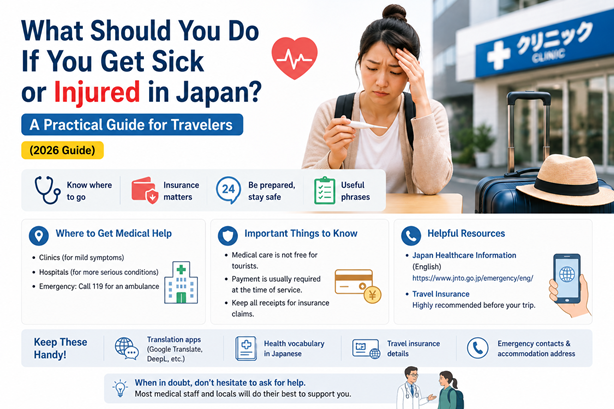
If you are experiencing a serious medical emergency, such as difficulty breathing, severe chest pain, loss of consciousness, a major injury, or symptoms that appear life-threatening, call 119 immediately. This is Japan’s emergency number for ambulances and fire services.
Many visitors are surprised to learn that ambulance transportation itself is generally free in Japan. However, medical examinations, treatments, medications, and hospital stays are not free. Depending on your situation, costs may be covered by travel insurance, so it is always a good idea to have insurance information available during your trip.
If you are unsure whether a situation is serious enough to call an ambulance, it is usually better to seek help than to wait too long.
🏨 Ask Your Hotel for Help
If your condition is not immediately life-threatening, your hotel can often be one of the most useful sources of assistance.
Hotel staff are accustomed to helping international visitors and can often recommend nearby hospitals, clinics, or pharmacies. They may also help arrange transportation, explain local procedures, or communicate with medical facilities when language barriers exist.
Many travelers overlook this option, but asking the front desk for assistance is often the fastest and simplest first step.
📞 Japan Visitor Hotline: 24-Hour Support for Travelers
One of the most valuable resources available to foreign visitors is the Japan Visitor Hotline operated by the Japan National Tourism Organization (JNTO).
The hotline is available 24 hours a day, 365 days a year and provides multilingual support for travelers facing illnesses, injuries, accidents, natural disasters, transportation problems, and other emergencies.
Even if you are unsure where to go or what to do, the hotline can help point you in the right direction.
Japan Visitor Hotline: +81-50-3816-2787
You can find more information here:
Japan Visitor Hotline : https://www.japan.travel/en/plan/hotline/
For many travelers, simply knowing that help is available in their own language can significantly reduce stress during an emergency.
🏥 Finding an English-Speaking Hospital or Clinic
One of the biggest concerns for foreign visitors is finding medical care in a language they understand.
Fortunately, JNTO provides an official medical information guide that allows travelers to search for hospitals and clinics by location, language availability, and medical specialty.
This resource can help you find facilities that offer support in English and other languages throughout Japan.
Official Medical Guide for Travelers : https://www.jnto.go.jp/emergency/eng/mi_guide.html
If you are staying in Japan for an extended period or traveling outside major cities, saving this link before your trip can be extremely helpful.
💊 For Minor Illnesses and Everyday Problems
Not every medical issue requires a hospital visit.
Japan has excellent drugstores located throughout the country, and many common travel problems can be addressed with over-the-counter medications. Headaches, mild colds, allergies, motion sickness, insect bites, and minor stomach issues can often be managed with products available at local pharmacies and drugstores.
Major chains such as Matsumoto Kiyoshi, Welcia, and Sugi Pharmacy can be found in most cities and tourist areas. Staff may not always speak English fluently, but translation apps can often help bridge communication gaps.
☀️ Summer Travel Requires Extra Attention
Because this article is being written during Japan’s summer season, it is worth mentioning one of the most common health risks for visitors: heat exhaustion and heatstroke.
Japan’s summer is not only hot but also extremely humid. Travelers often underestimate how quickly dehydration can develop, especially when walking long distances, visiting outdoor attractions, or carrying luggage.
If you begin feeling dizzy, weak, nauseous, or unusually tired, move to a cool location immediately, drink water, and rest. Convenience stores, train stations, shopping centers, and cafes can provide valuable places to cool down.
Preventing heat-related illness is always easier than treating it.
🌏 Travel Insurance Matters More Than You Think
Many travelers focus on flights, hotels, and sightseeing plans but give little thought to travel insurance.
Medical care in Japan is generally excellent, but costs can become significant if hospitalization, surgery, or emergency treatment becomes necessary. Travel insurance provides financial protection and can also help coordinate medical support when unexpected situations arise.
It is one of those things you hope never to use but are grateful to have when needed.
🇯🇵 Final Thoughts
Getting sick or injured while traveling can feel frightening anywhere in the world. In my own travels and years living overseas, I have learned that the greatest source of stress is often uncertainty rather than the medical problem itself. Not knowing where to go, who to call, or how the system works can make a manageable situation feel overwhelming.
Fortunately, Japan offers excellent healthcare, reliable emergency services, helpful hotel staff, and official support resources specifically designed for international visitors. By knowing where to find help before you need it, you can travel with greater confidence and peace of mind.
Hopefully, you will never need any of these services during your trip. But if you do, remember that help is available, and you are not facing the situation alone.
🌏 New to Japan? Start Here
Traveling in Japan is easier when you understand how things work before you arrive. Explore these essential guides to help you enjoy a smoother and more comfortable trip.
・Best Apps for Traveling in Japan (2026): 6 Essential Apps Every Tourist Needs
・How to Use ATMs in Japan: A Complete Guide for Foreign Travelers
・How to Use Visit Japan Web: Skip Paper Forms and Save Time at the Airport (2026 Guide)
・Essential Travel Tools for Japan: Everything You Need for a Smooth Trip (2026 Guide)