
📑 Table of Contents
- ✏️ Introduction: The Everyday Objects People Ask You to Bring from Japan
- 🔍 Japanese Stationery: More Than Pens and Pencils
- 🧽 Why a Simple Eraser Can Make Such a Strong Impression
- ✍️ The Small Improvements Behind Everyday Writing Tools
- 📓 Paper, Notebooks, and the Experience of Writing
- 🎨 When Stationery Becomes a Form of Personal Expression
- 🏫 How School Life Shapes Familiarity with Stationery
- 🏭 Product Development: Making Small Problems Easier to Solve
- 🎁 Why Japanese Stationery Makes a Memorable Souvenir
- 🌏 Is Japanese Stationery Really Different?
- 🛍️ The Pleasure of Choosing in a Japanese Stationery Store
- 🧠 What Stationery Reveals About Everyday Life in Japan
- 🎯 Conclusion: The Value of Getting the Small Things Right
- 🌍 Continue Exploring Deep Japan
✏️ Introduction: The Everyday Objects People Ask You to Bring from Japan
When I lived in the United States, Canada, and Mexico, I occasionally received an unusual kind of request from friends: could I bring them some Japanese stationery when I returned from Japan? They were not asking for an expensive fountain pen or a luxury notebook. They wanted ordinary items such as erasers, mechanical pencils, and ballpoint pens.
The erasers were especially memorable. Something that seemed completely ordinary to me could make a surprisingly good gift for someone living abroad. A good eraser removes pencil marks cleanly, does not require excessive pressure, and makes correcting a mistake feel straightforward. It is a small convenience, but one that becomes noticeable when you use it every day.
These requests made me think about the things people take for granted in their own countries. In Japan, stationery is part of everyday life. Students use pencils and erasers at school, office workers keep pens and notebooks nearby, and shops offer an enormous variety of writing tools, paper products, organizers, stickers, and other small accessories. Because these products are so familiar, it is easy to overlook the amount of thought that can go into their design.
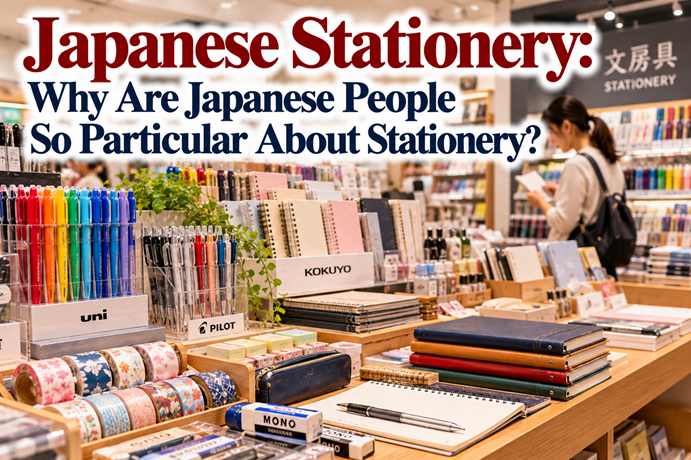
Yet Japanese stationery has also attracted international attention. Visitors may spend time browsing entire sections devoted to pens, notebooks, and erasers, sometimes leaving with far more than they originally planned to buy. The appeal is not limited to expensive or collectible products. It can be found in an inexpensive pen that writes smoothly, an eraser that works well, or a notebook that feels pleasant to write in.
So why do some Japanese stationery products inspire this kind of enthusiasm? The answer is not that Japanese people are naturally more meticulous than everyone else, nor that Japanese products are automatically superior. It is more useful to look at the combination of product development, everyday expectations, consumer choice, design, and the pleasure people can find in ordinary objects.
Japanese stationery offers a fascinating way to explore how small improvements can become meaningful when people interact with the same tools day after day.
🔍 Japanese Stationery: More Than Pens and Pencils
In many languages, the word stationery covers a broad range of products used for writing, organizing, drawing, labeling, and working with paper. Japanese stationery includes the familiar basics, but the range available in many Japanese stores can be striking: different pen mechanisms, lead sizes, ink colors, notebook formats, decorative tapes, specialized erasers, folders, clips, and accessories for organizing a desk.
The important point is not simply that there are many products. It is that products within the same category can be designed for noticeably different purposes. One person may want a pen that glides easily across paper, while another prefers a fine line for detailed notes. A student may prioritize a mechanical pencil that reduces lead breakage, whereas someone who draws may care more about precision and grip.
The same is true of notebooks. Some are designed for taking class notes, others for planning, journaling, sketching, or carrying in a small bag. Paper can vary in thickness, texture, color, ruling, and how it handles different kinds of ink. A notebook is not merely a collection of blank pages; its design affects how people use it.
This variety gives consumers the opportunity to find products that suit their habits. It also gives manufacturers room to develop alternatives within familiar categories. Instead of asking only whether a pen writes, a company can consider how it feels in the hand, how consistently the ink flows, how easily the refill can be replaced, or whether the body is comfortable during long writing sessions.
Such choices are not unique to Japan. Manufacturers around the world develop specialized products, and stationery enthusiasts in many countries pay close attention to writing instruments and paper. What makes Japanese stationery interesting is the way functional refinements, visual variety, and everyday accessibility often appear together in the same market.
🧽 Why a Simple Eraser Can Make Such a Strong Impression
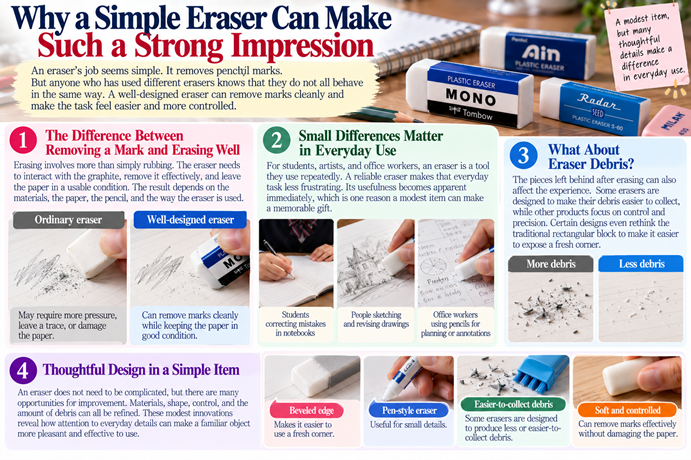
An eraser is one of the most revealing examples because its job seems so simple. It removes pencil marks. Most people do not expect it to be particularly interesting, and few would describe an ordinary eraser as an impressive piece of technology.
But anyone who has used different erasers knows that they do not all behave in the same way. Some require more pressure, some leave marks behind, and some break into small pieces or create a large amount of debris. A well-designed eraser can remove pencil marks cleanly while making the task feel easier and more controlled.
📝 The Difference Between Removing a Mark and Erasing Well
When you erase a pencil mark, several things happen at once. The eraser needs to interact with the graphite on the paper, remove it without damaging the writing surface, and leave the page in a usable condition. The result depends on the materials, the paper, the pencil, and the way the eraser is used.
A good eraser is therefore not simply one that is soft or one that removes marks aggressively. It needs to balance effective removal with control. Too much friction can damage the paper, while an eraser that performs poorly may leave a gray trace or require repeated rubbing.
For someone who writes or draws regularly, these small differences matter. Students correct mistakes in notebooks, people sketch and revise drawings, and office workers may use pencils for planning or annotations. An eraser that performs reliably makes a repeated task less frustrating.
This is why a modest item can make a memorable gift. Its usefulness becomes apparent almost immediately, without a long explanation or a special occasion.
🧹 What About Eraser Debris?
The pieces left behind after erasing can also affect the experience. Some erasers are designed to make their debris easier to collect, while other products focus on the way the eraser handles small details. Certain designs even rethink the traditional rectangular block to make it easier to expose a fresh corner.
These are modest innovations, but they reveal an interesting approach to product design: the main function is only part of the user experience. The way a product is held, the control it offers, and the mess it leaves behind can also be improved.
That does not mean every Japanese eraser is exceptional or that comparable products do not exist elsewhere. It means that an ordinary object offers many opportunities for refinement, and manufacturers can compete by making those refinements noticeable in everyday use.
✍️ The Small Improvements Behind Everyday Writing Tools
Pens and mechanical pencils provide another way to understand why stationery attracts so much attention. Their basic functions have existed for a long time, but the details of how they work can still be improved.
🖊️ A Pen Is More Than Its Ink
A ballpoint pen needs to deliver ink to paper consistently. However, users experience more than the ink itself. The pressure required to write, the shape of the grip, the weight of the pen, the size of the line, and the way the ink dries can all affect comfort and legibility.
Different writing systems and personal habits also influence what users prefer, but there is no single pen that suits everyone. Someone who takes fast notes may prefer a different pen from someone who writes slowly, annotates documents, or draws precise diagrams.
Japanese manufacturers offer many types of ballpoint and gel pens, including products designed to emphasize smooth writing, fine lines, quick drying, or convenient refilling. The Uni Jetstream, for example, is known for its low-viscosity ink formulation, while Pilot’s FriXion range uses heat-sensitive ink that can be made visually less apparent through friction. These products solve different problems, and their suitability depends on how a person intends to use them.
The broader lesson is that the familiar category “ballpoint pen” contains many distinct user needs. Product development can focus on those differences rather than treating all pens as interchangeable.
✏️ Mechanical Pencils and the Problem of Broken Leads
Mechanical pencils are another example of a familiar tool that has continued to evolve. A conventional mechanical pencil advances a thin graphite lead as it wears down. The lead must be narrow enough to create a precise line, but thin leads can break if they are exposed too far or pressed too hard against the paper.
Some products attempt to address this problem through different lead-feeding systems, protective mechanisms, or designs that help keep the lead point more consistent. Mitsubishi Pencil’s Kuru Toga, for instance, uses a mechanism that rotates the lead as the user writes. The aim is to reduce uneven wear and maintain a more consistent point shape.
Other mechanical pencils focus on reducing lead breakage or making the writing experience more comfortable. Their mechanisms and benefits differ, so it is important not to assume that every pencil offers the same feature.
What is interesting is the willingness to reconsider a tool that already works. A pencil does not need to be reinvented from scratch to become more convenient. Sometimes, the opportunity lies in reducing a recurring annoyance that users have learned to tolerate.
🔧 Why Small Improvements Can Matter
A small improvement may appear insignificant when considered once. But a student who writes for several hours a day, an illustrator who draws fine lines, or an office worker who takes notes repeatedly encounters the same limitations.
If a design reduces interruptions, makes writing more comfortable, or gives the user greater control, the benefit accumulates over time. That is one reason stationery can inspire strong preferences: people form habits around tools they use frequently, and a change in how the tool feels can be immediately noticeable.
The best design is not necessarily the most complicated. A well-shaped grip, a reliable click mechanism, or an eraser that performs consistently may be more valuable to a user than an elaborate feature they rarely need.
📓 Paper, Notebooks, and the Experience of Writing
Pens often receive the most attention, but paper is an equally important part of the writing experience. A pen and a notebook work together, and the same pen can feel different depending on the paper beneath it.
Paper varies in texture, thickness, absorbency, smoothness, and resistance to ink spreading through the fibers. Some people prefer a surface that feels smooth under a pen, while others like a little resistance. Fountain-pen users may pay close attention to feathering, show-through, and bleed-through, while students may be more concerned with how easily they can write on both sides of a page.
📄 Not All Paper Is the Same
A notebook designed for quick classroom notes has different priorities from one intended for fountain-pen writing or detailed journaling. Paper weight affects the overall feel of the notebook, while the ruling and page layout influence how information can be organized.
For example, a student may prefer a notebook with clear lines and enough space for diagrams. Someone who keeps a daily journal may care about how the paper feels, whether it works with different pens, and whether the notebook is comfortable to carry. A planner may require a layout that accommodates appointments, lists, and short reflections.
Japanese stationery stores often make it possible to compare these choices directly. The range can encourage shoppers to consider not only the cover or page count but also the way a notebook fits into a particular routine.
This is one reason stationery can appeal to people who do not consider themselves collectors. Choosing a notebook becomes a decision about how to work, study, or record daily life.
📔 The Appeal of Planners and Journals
Paper planners and journals have also developed dedicated communities of users. Some people use a planner mainly to track appointments, while others combine schedules with habit tracking, sketches, photographs, stickers, or personal notes.
The Hobonichi Techo and Traveler’s Notebook are examples of products associated with different approaches to planning and journaling. They appeal to people who enjoy making a notebook part of an ongoing routine, though neither represents how everyone in Japan organizes their life.
A notebook can become personal through use. The blank pages gradually fill with handwriting, lists, reminders, and memories. Decorative tape or colored pens can add visual structure, but decoration is optional; some users prefer a clean and functional layout.
The important point is that paper products can support activities beyond simply recording information. They can help people organize their thoughts, develop a routine, or create a physical record of a period in their lives.
🎨 When Stationery Becomes a Form of Personal Expression
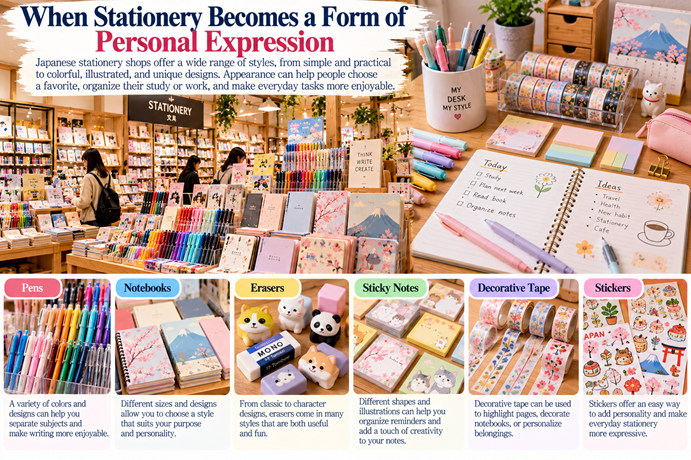
One reason Japanese stationery shops can be so engaging is the range of visual styles available. Alongside plain office supplies, shoppers may find pastel-colored pens, patterned notebooks, character erasers, illustrated sticky notes, decorative tape, stickers, and small accessories designed to make a desk more personal.
This is not merely a question of making products look cute. Appearance can help people distinguish items, choose a favorite, organize information, or make routine tasks feel more enjoyable. A set of colored pens may be useful for separating subjects in a notebook, while different sticky-note designs can help organize reminders.
🌈 Color and Design Have Practical Uses
Color can make information easier to scan. A student might use one color for definitions and another for examples, while someone planning a project may use different colors to identify tasks or deadlines. In these cases, appearance supports function.
Design also affects how a product fits into a person’s daily environment. Someone who enjoys illustration may choose stationery with expressive graphics, while another person may prefer neutral colors and simple shapes. A product that looks appealing to one user may not appeal to another.
The abundance of choices gives people room to select tools that match their own tastes. It does not mean everyone in Japan decorates notebooks or collects colorful pens. Some people prefer basic products and use them without thinking much about appearance.
🎀 Why Small Objects Can Feel Personal
A pen, notebook, or pencil case is often used repeatedly and carried between different places. Over time, it can become associated with a school year, a particular job, a favorite hobby, or a daily routine.
Choosing a design can therefore be a small way of expressing preference. A person might choose a notebook with a favorite color, a pen that feels comfortable, or a pencil case that reflects an interest. These decisions are usually modest, but they make a practical object feel more personal.
Stationery also makes it easy to change one’s mind. A person can try a new color, switch to a different notebook format, or add a few stickers without making a major purchase. The relatively low cost of many items lowers the barrier to experimentation.
This combination of practical use, visual choice, and personal preference helps explain why stationery can be more than a category of office supplies. For some people, it is also a small hobby.
🏫 How School Life Shapes Familiarity with Stationery
School is one setting in which many people become familiar with writing tools at an early age. Children use pencils, erasers, notebooks, rulers, colored pencils, and other supplies for classroom activities and homework. Over time, they learn which tools suit their needs and how to look after them.
In Japan, school supplies can also become part of a child’s personal choices. Pencil cases may feature characters or preferred colors, and students may develop opinions about which pens or erasers they like. As children grow older, their needs can change: a tool that works well for elementary-school writing may not suit the detailed notes or drawing tasks they encounter later.
This experience creates familiarity with stationery, but it should not be treated as a uniquely Japanese phenomenon. Children around the world use school supplies and develop preferences. The interesting point is how the range of products available in Japan can provide many options for those preferences to develop.
📝 The Everyday Habit of Writing
Although digital devices are now common in education and work, handwriting remains useful for many tasks. Students may write notes, solve problems, draw diagrams, or practice characters. Adults may jot down reminders, annotate printed documents, or use a notebook during meetings.
Different tasks create different demands. Writing a quick reminder is not the same as taking detailed notes for several hours. A pencil that is comfortable for sketching may not be the best choice for a dense page of text, and a pen that dries slowly may be inconvenient for someone who writes quickly.
The existence of many types of stationery reflects these varied needs. It does not mean that all Japanese students use specialized products or that handwritten work always takes priority over digital tools. Rather, stationery remains useful because writing itself continues to serve many purposes.
🏭 Product Development: Making Small Problems Easier to Solve
It is tempting to explain Japanese stationery through a single cultural idea, such as craftsmanship or attention to detail. Those ideas may help describe some products, but they do not fully explain how a modern stationery market develops.
Manufacturers need to understand users, design products, test materials, manage costs, and compete with other companies. They may improve a product after identifying a problem, or create a new version that serves a particular group of users. Successful products can then influence what consumers expect from similar items.
🔬 Improvement Does Not Always Mean Reinvention
Many stationery innovations are incremental. A product may retain the same basic function while changing how it is held, refilled, opened, stored, or used. An eraser might be redesigned to make a corner easier to use. A mechanical pencil might change how the lead is advanced. A pen might use a different ink formulation to improve the writing experience.
These changes can be easy to overlook because the product still looks familiar. But when a tool is used repeatedly, even a small improvement can make it more convenient.
This is one way to understand the Japanese concept of kaizen, often translated as continuous improvement. The term is widely associated with business and manufacturing, but it should not be used as a universal explanation for every Japanese product. Stationery design also reflects commercial competition, materials science, manufacturing capabilities, consumer feedback, and the practical limits of price and production.
💡 The Challenge of an Affordable Product
A further challenge is making useful features available at an accessible price. A highly specialized pen or notebook can justify a higher price for some users, but everyday stationery also needs to serve people who want reliable basics.
Manufacturers therefore make choices about materials, mechanisms, production methods, packaging, and product ranges. Not every product needs the most advanced mechanism, and not every consumer wants to pay for one. A market with many options allows users to decide which features are worth the cost to them.
This helps explain why Japanese stationery can include both inexpensive everyday products and premium items. They serve different needs, and their value depends on how the buyer intends to use them.
🎁 Why Japanese Stationery Makes a Memorable Souvenir
My own experience of being asked to bring stationery home from abroad helped me see the appeal of these products from another perspective. A pen or eraser may seem like a small gift, but it is practical, easy to carry, and often simple to share with friends or colleagues.
Stationery also offers many price points. A person does not need to buy an expensive item to find something useful. A few pens, a well-designed eraser, a notebook, or a set of stickers can make a thoughtful gift without taking up much luggage space.
🧳 Practical, Portable, and Easy to Share
Compared with many souvenirs, stationery is relatively easy to pack. Most pens, erasers, and notebooks are lightweight, and they do not require the special handling needed for fragile objects or perishable food. Small items can also be divided among several people.
Another advantage is that stationery can be used immediately. A recipient can try the pen at work, use the eraser at school, or start writing in the notebook. The gift does not need to be displayed or saved for a special occasion to have value.
The most thoughtful choice is often something suited to the recipient. Someone who draws may appreciate colored pens or markers, while a person who takes handwritten notes may prefer a comfortable ballpoint pen. A notebook enthusiast may care about paper and binding, whereas a student may simply want an effective eraser.
🎁 A Small Gift That Demonstrates Its Value
Stationery can be a good gift because the recipient discovers its qualities through use. There is no need to make a sweeping claim that Japanese products are always better. If a particular eraser removes pencil marks cleanly or a pen feels comfortable to write with, the recipient can experience that benefit directly.
That was what made the requests from my friends memorable. They were not necessarily looking for an object that symbolized Japan. They wanted a useful item that they had come to appreciate.
For travelers considering stationery as a gift, it can help to choose a few different products rather than buying many of the same item. A pen, an eraser, and a small notebook can offer a variety of uses. If the recipient has a specific preference, however, following that request is often the best option.
🌏 Is Japanese Stationery Really Different?
Japanese stationery has a strong international following, but it is important to avoid turning that popularity into a claim that every Japanese product is better than its foreign equivalent. Many countries have excellent manufacturers, specialist stationery shops, and communities of people who care deeply about writing tools and paper.
What shoppers notice in Japan may be a combination of product design, availability, variety, price, and presentation. In some stores, stationery is arranged so that shoppers can compare many kinds of pens, notebooks, and accessories in one place. The breadth of choice can make the category feel like a world to explore rather than a short list of supplies to buy.
Products also differ in ways that are meaningful to particular users. Someone who prefers a smooth gel pen may love a specific model, while someone who uses a fountain pen may care more about paper performance. A person who rarely writes by hand may not notice the same differences at all.
🛒 Availability Changes the Shopping Experience
A large specialist store allows shoppers to compare products side by side. They can examine pen bodies, look at different notebook formats, and discover items they did not know existed. This experience can be difficult to reproduce when stationery is sold only in a small section of a general store.
Japan has large stationery departments and specialist retailers, as well as smaller shops and general stores with stationery sections. The selection varies by location, but the presence of dedicated retail spaces makes browsing part of the experience for many shoppers.
This is one reason an ordinary shopping trip can turn into an extended visit. People may arrive looking for a pen and leave with notebooks, clips, decorative tape, or an eraser they had not planned to buy.
⚖️ Preference Is Not the Same as Superiority
A pen that feels excellent to one person may be uncomfortable for another. A notebook with thin paper may be perfect for someone who values a lightweight planner but unsuitable for someone who uses heavy ink. A brightly decorated pencil case may delight one buyer and feel excessive to another.
These differences are not flaws in the products or the users. They show that stationery is personal, and that choice matters.
The most useful way to appreciate Japanese stationery is therefore not to ask whether it is objectively the best in the world. It is to ask what problems a particular product solves, how it feels to use, and why someone might prefer it to the alternatives available to them.
🛍️ The Pleasure of Choosing in a Japanese Stationery Store
A stationery store can be enjoyable even when you do not need anything urgently. The shelves may contain products organized by function, size, color, or brand, and a simple category such as pens can branch into many options.
You might start by looking for a black ballpoint pen, then discover a model with a different grip, a refillable body, or a fine tip. Nearby, there may be colored pens, mechanical pencils, highlighters, correction tools, and notebooks designed for different kinds of writing.
The experience is not necessarily about buying the most products. It is about discovering what is available and comparing details that are easy to ignore when choosing the first item on a shelf.
🧭 Finding What Suits You
If you are interested in Japanese stationery, it helps to begin with the task you want the product to perform. Do you need a pen for long writing sessions, a pencil for detailed drawing, a notebook for daily planning, or an eraser that works well on a particular kind of paper?
Thinking about the task can make the selection process easier. A product with many features is not automatically the best choice, and the most expensive option may offer little benefit for your needs. A simple, comfortable tool may be all you require.
It can also be useful to test a pen where testers are provided, check the notebook paper directly, or compare the size of a product with the way you intend to carry it. Small practical questions often matter more than marketing language.
The goal is not to collect everything. It is to find a few tools that make writing, studying, drawing, or organizing your day a little more pleasant.
🧠 What Stationery Reveals About Everyday Life in Japan
Japanese stationery provides a small but useful window into everyday life because it shows how familiar objects can develop in response to repeated use. A pen or eraser is not usually the center of attention, yet the details of its design can affect how comfortably someone studies, works, or records information.
The same principle applies beyond stationery. Everyday products are shaped by the tasks people perform, the space available to them, the prices they are willing to pay, and the expectations they develop through experience. A market with many choices can support users who want different things, from the simplest functional tool to a product designed around a very specific need.
It would be misleading to attribute all of this to a single national personality trait. Japanese people have different preferences, and stationery manufacturers respond to practical and commercial conditions as well as cultural influences. The more revealing question is how particular products come to exist and why people choose to use them.
The experience of discovering a good eraser captures this idea especially well. Its job is modest, but a well-designed one can make a common task easier. That improvement does not transform anyone’s life, yet it can make a difference every time the tool is used.
Perhaps this is the most interesting aspect of Japanese stationery: it invites us to pay attention to things that are usually overlooked. The value of an everyday object is not always found in a dramatic invention or an expensive material. Sometimes it lies in the small details that make an ordinary action feel easier, more comfortable, or more enjoyable.
🎯 Conclusion: The Value of Getting the Small Things Right
The Japanese stationery that friends asked me to bring home from the United States, Canada, and Mexico was not necessarily expensive or unusual. Often, it was something as ordinary as an eraser, a mechanical pencil, or a ballpoint pen. Yet those products were appreciated because their usefulness could be experienced directly.
Japanese stationery offers many examples of manufacturers refining familiar tools. Some pens focus on smooth writing, some mechanical pencils address lead wear or breakage, and some erasers make it easier to remove marks or control small details. Notebooks and planners offer choices in paper, layout, and format, while colors and designs allow people to select products that suit their tastes.
These developments do not prove that Japanese people are uniquely meticulous or that every product from Japan is superior. They show how everyday needs, product development, commercial competition, and consumer preferences can combine to create a rich range of useful objects.
Stationery also reminds us that functionality and enjoyment are not opposites. A pen can write well and look appealing. A notebook can help someone stay organized and become a record of personal memories. An eraser can perform a simple task so reliably that the user barely needs to think about it.
That is why stationery can be more than a souvenir or a school supply. It is a reminder that small improvements matter when they become part of daily life. Sometimes, the most interesting way to understand a culture is not through its grandest achievements, but through the ordinary objects people choose, use, and appreciate every day.
🌍 Continue Exploring Deep Japan
Everyday objects often reveal more about a culture than we expect. Explore more stories in Deep Japan to discover the ideas, habits, and subtle social patterns that shape life in Japan.
👉 Why Do Japanese People Enjoy Karaoke Alone? The Freedom of Singing Without an Audience
👉 Why Do Japanese People Say “Ganbatte” So Often? The Encouragement—and Pressure—Behind the Phrase
👉 What Does the Language of Japan Reveal About Its Culture? From Respect to Unspoken Meaning
👉 Why Do Life’s Milestones Become Ceremonies in Japan? Understanding Japan’s Ritual Culture