
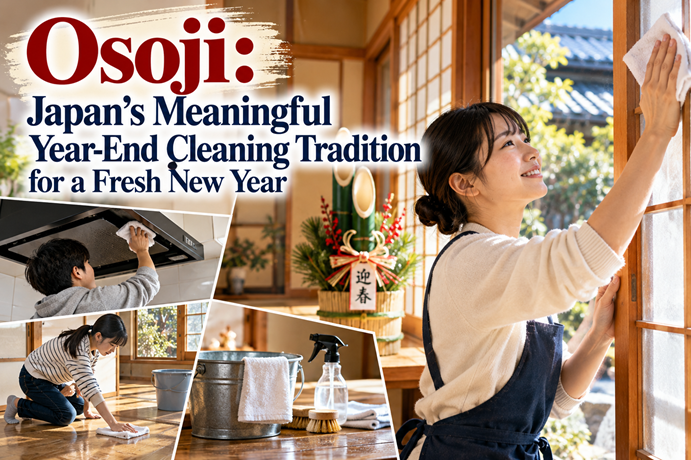
🌏 Introduction: When Cleaning Becomes Part of the New Year
As December approaches its final days in Japan, an ordinary household task begins to take on a different meaning. Kitchen cupboards are emptied, windows are wiped, forgotten items are taken out of closets, and the spaces behind furniture receive attention that they may not have received for months. Families look at their homes with the awareness that the year is almost over, while schools, offices, shops, and other shared spaces may also set aside time for a thorough clean.
This custom is known as Osoji (大掃除), literally meaning “big cleaning.” Although the name sounds straightforward, the practice is connected to something larger than removing dust. It belongs to a wider collection of Japanese year-end and New Year traditions through which people prepare their surroundings, organize their lives, and welcome the beginning of another year.
For many people today, Osoji is a practical opportunity to clean areas that are usually neglected. It can also be a demanding seasonal chore, especially when work, school, shopping, and other New Year preparations compete for the same limited time. Not every household completes an elaborate deep clean, and not everyone attaches a religious meaning to the activity. Nevertheless, the timing of the custom gives it a distinctive cultural character.
The roots of this tradition can be explored through an older practice called susuharai (煤払い), which literally means “sweeping away soot.” In earlier centuries, soot was a more visible part of domestic life because many homes and buildings depended on open fires, hearths, and other sources of smoke. Cleaning away accumulated soot was therefore a practical necessity. Yet the timing of this work, particularly in preparation for the New Year, also connected it to ideas of purification and the welcoming of Toshigami, a deity associated with the New Year.
Historical accounts and illustrations of year-end cleaning reveal another side of the custom, too. In Edo-period Japan, the cleaning could be a lively communal event rather than a silent, solitary household chore. Some depictions show people celebrating after the work was completed, reminding us that the occasion could involve cooperation, reward, and amusement as well as effort.
Understanding Osoji therefore requires looking beyond the modern image of someone scrubbing a kitchen before the holidays. Its story brings together changing domestic technology, seasonal religious customs, communal life, and the human desire to begin again with a sense of order. It also offers an interesting comparison with spring cleaning in other parts of the world, where a similar practical task is associated with a different point in the annual cycle.
📖 Table of Contents
- What Is Osoji?
- From Susuharai to Modern Year-End Cleaning
- Why December 13 Became an Important Date
- The New Year Deity and the Meaning of Preparation
- The Lively Side of Edo-Period Cleaning
- How Osoji Changed as Japanese Homes Changed
- Why Schools and Workplaces Clean Together
- Osoji and Spring Cleaning: Two Different Seasonal Rhythms
- How Japanese Households Approach Osoji Today
- When the Tradition Meets Modern Life
- A Clean Home and the Feeling of a Fresh Start
- Conclusion: Making Room for the Year Ahead
🧽 1. What Is Osoji?
Osoji is the thorough cleaning traditionally carried out in Japan toward the end of the year. The word combines ō (大), meaning “big” or “great,” and sōji (掃除), meaning “cleaning.” Together, they describe a larger-than-usual cleaning effort intended to prepare a home or another space for the coming New Year.
Ordinary cleaning is generally concerned with maintaining a space as it is used. Floors are swept, dishes are washed, rubbish is removed, and frequently touched surfaces are wiped. Osoji goes a step further by encouraging people to look at areas that may be overlooked during the rest of the year. These might include the tops of cupboards, window frames, kitchen ventilation fans, the inside of storage spaces, bathroom corners, or the space behind a refrigerator.
The distinction is not that Japanese people clean only once a year. Daily and weekly cleaning remain important parts of ordinary life, and many households maintain their homes throughout the year. Osoji is instead a concentrated opportunity to deal with accumulated dirt, reorganize belongings, and prepare the home for a significant seasonal transition.
Its timing is central to its meaning. In Japan, New Year has traditionally been one of the most important points in the annual calendar. Preparations may involve arranging decorations, preparing or buying special foods, visiting family, and planning the first activities of the new year. Cleaning fits into this broader process because the home itself is part of the setting in which the new year will be welcomed.
The custom also extends beyond private houses. Schools may organize cleaning activities before the winter break, and companies may set aside time for employees to clean offices or shared work areas. Religious institutions may conduct their own large-scale cleaning ceremonies. These activities are not necessarily identical in purpose or procedure, but they share the idea that the end of the year is an appropriate time to put a space in order.
For someone encountering Japanese culture from outside, Osoji can look like a familiar form of deep cleaning placed at an unusual time of year. The deeper significance lies in the relationship between cleaning and the calendar: the task is not simply performed because the house has become dirty. It is also associated with the wish to close one chapter and welcome the next.
🏯 2. From Susuharai to Modern Year-End Cleaning
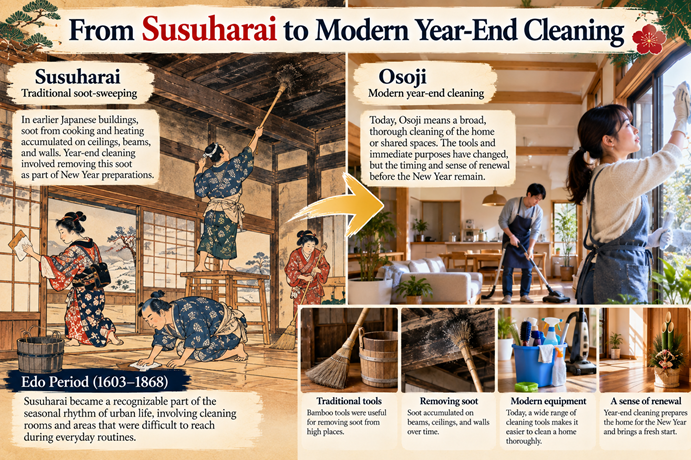
To understand how Osoji developed, it helps to look at susuharai, the older custom of sweeping away soot. The two terms are closely related in the history of Japanese year-end cleaning, but they should not be treated as perfectly interchangeable in every historical context. Susuharai refers more specifically to the traditional removal of soot and accumulated dirt, while modern Osoji usually means a broad, thorough cleaning of a home or shared space.
In earlier Japanese buildings, soot was a familiar problem. Cooking and heating methods produced smoke, and that smoke could leave dark deposits on ceilings, beams, walls, and other surfaces. Even when a home was maintained carefully, soot accumulated as part of ordinary life. A major cleaning was therefore useful for practical reasons as well as for the seasonal preparations surrounding the New Year.
The practice of cleaning before the new year has a long history in Japan. Historical descriptions and cultural records connect susuharai with preparations for the New Year, while later illustrations show how the custom was carried out in different settings. It is important, however, not to imagine that every household across every period followed exactly the same schedule or performed the same ritual. Practices varied according to social position, location, the kind of building involved, and the resources available to the people living or working there.
During the Edo period (1603–1868), year-end cleaning became a recognizable part of the seasonal rhythm of urban life. Edo, the city that later became Tokyo, was a large and active center of commerce, government, and everyday social activity. Preparing for the New Year involved far more than cleaning: people also purchased seasonal goods, arranged decorations, prepared food, and made other arrangements for the holiday period.
Susuharai belonged to this wider process of getting ready. It could involve cleaning rooms and structural areas that were difficult to reach during everyday routines. Bamboo tools were useful for removing soot from high places, while other materials and methods were used according to the task. The work might require several people to cooperate, particularly in larger houses, shops, or residences.
A useful visual record is the Edo-period woodblock print associated with Kitagawa Utamaro and known as Buke Susuharai no Zu, depicting soot-sweeping at a samurai residence. Such images provide a glimpse of how cleaning could be represented as a recognizable seasonal activity, rather than merely an invisible domestic chore. They also remind modern readers that historical cleaning practices took place in buildings and under living conditions very different from those of contemporary homes.
The practical conditions of cleaning have changed dramatically since then. Modern homes have electric lighting, different heating and cooking systems, and a wide range of cleaning equipment. Many of the soot-related tasks that once gave susuharai its name are no longer routine for most households. Yet the annual habit of giving a home extra attention before New Year has continued in a transformed form.
This is one reason Osoji is culturally interesting. Traditions do not always survive by preserving every detail of their original form. Sometimes their tools and immediate purposes change while the timing, social associations, and underlying sense of occasion remain recognizable. In the case of year-end cleaning, a task once closely associated with soot and traditional New Year preparations has become a broader practice of household maintenance and seasonal renewal.
🗓️ 3. Why December 13 Became an Important Date
December 13 is traditionally associated with the beginning of New Year preparations in Japan. In this context, the date is linked to shōgatsu kotohajime, the start of preparations for the New Year, and to susuharai. It is therefore often identified as the traditional day for beginning the year-end cleaning process.
The historical calendar requires some care here. Japan’s older customs developed under calendars and seasonal systems that did not always correspond exactly to the modern Gregorian calendar. When a traditional date is discussed today as December 13, it is helpful to understand it as the conventional date associated with the custom in the modern calendar, rather than assuming that every historical community followed an identical schedule under all calendar systems.
In the Edo period, December 13 became associated with large-scale soot-sweeping, including cleaning at Edo Castle. From there, the date became part of the familiar account of year-end preparations. The day was not simply a deadline for finishing every task before January 1; it marked the point at which preparations could begin in earnest.
This distinction matters because modern Osoji is often imagined as a frantic cleaning session during the last few days of December. The older seasonal rhythm was more spacious. Once preparations began, households and workplaces had several tasks to manage before the New Year arrived. Cleaning was one part of a larger sequence that might also include buying decorations, preparing foods, arranging the home, and attending to social obligations.
The traditional date does not mean that contemporary Japanese households all start cleaning on December 13. Work schedules, school calendars, family circumstances, and the practical demands of daily life make that unrealistic for many people. Some begin early in December, others clean in stages on weekends, and some concentrate on a few essential areas during the final days of the year.
The date nevertheless gives the custom a historical anchor. It connects a modern household activity with an older calendar of seasonal preparation. Even when people no longer follow the traditional timing closely, the broader expectation that December is a time to put things in order remains familiar.
It is also useful to separate established historical associations from popular explanations that may be repeated without sufficient context. The date’s connection with the start of New Year preparations and susuharai is well documented. More specific claims about why that exact day was selected should be treated carefully unless they are supported by reliable historical evidence. A cultural explanation is stronger when it distinguishes what is known from what is merely plausible.
For readers interested in Japanese seasonal customs, December 13 offers a reminder that the approach to New Year has traditionally been treated as a process rather than a single midnight celebration. The new year begins on January 1, but the cultural work of preparing to welcome it begins earlier.
🎍 4. The New Year Deity and the Meaning of Preparation

The connection between cleaning and New Year becomes clearer when we consider Toshigami (年神), a deity associated with the arrival of the new year and the good fortune it may bring. In traditional Japanese belief, welcoming the new year was not only a matter of turning a calendar page. It could also involve preparing the home to receive Toshigami and the blessings associated with the coming year.
The details of New Year beliefs vary by region and historical period, and people today understand and observe these traditions in different ways. Nevertheless, Toshigami remains an important concept for understanding why cleaning, decorations, and other preparations became connected with the seasonal transition.
A home prepared for New Year was not merely a tidier version of the home as it had been in November. It was a place being made ready for a particular occasion. Cleaning, arranging decorations, and preparing food could all form part of the process of welcoming the new year properly.
In this context, susuharai had a practical and a symbolic dimension. On the practical side, it removed soot and dirt that had accumulated through daily living. On the symbolic side, the act belonged to a period of preparation associated with welcoming the new year. Cleaning helped make the home ready for the occasion, rather than functioning only as a response to visible dirt.
It would be misleading, however, to claim that dust was universally understood as a container for bad energy, or that every person who cleaned did so with the same religious intention. Japanese traditions often bring together practical habits, family customs, local beliefs, and religious ideas without requiring every participant to interpret them in exactly the same way. A household might regard Osoji as a spiritual preparation, a useful annual chore, or both.
New Year decorations help illustrate the wider idea. Items such as kadomatsu, arrangements made with pine and bamboo, and shimekazari, decorative ropes or ornaments associated with the season, are connected with welcoming the new year and marking the home as prepared for the occasion. Their meanings are not identical to cleaning, but they belong to the same broader process of getting the household ready.
The relationship between cleanliness and welcome is easy to understand even without a religious framework. People often tidy their homes before guests arrive, prepare a room before an important event, or clear a desk before beginning a new project. In these cases, cleaning communicates readiness and attention. The Japanese New Year tradition gives that familiar impulse a seasonal and cultural setting.
Osoji therefore sits at an intersection between everyday practicality and ritual preparation. It is possible to understand the custom without adopting a particular belief, but the historical connection with Toshigami helps explain why year-end cleaning came to be associated with the beginning of a new annual cycle.
🎉 5. The Lively Side of Edo-Period Cleaning
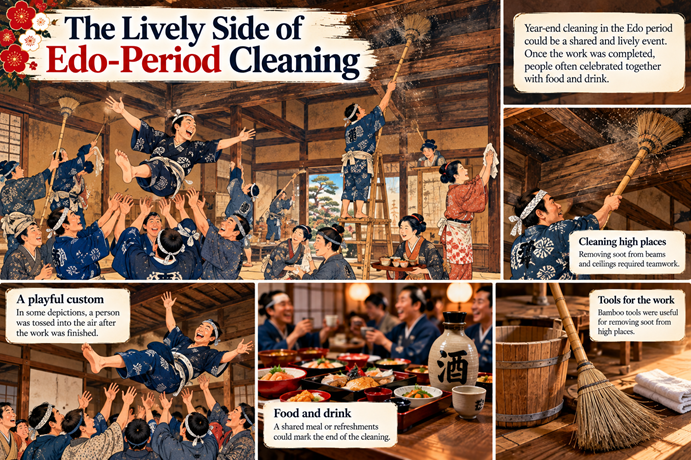
One of the most surprising details in accounts of historical susuharai is that the event was not always solemn or quiet. Some descriptions and illustrations suggest that year-end cleaning could be a lively occasion, with food, drink, and celebration after the work had been completed.
In the popular modern image of Osoji, a family member may be found cleaning a ventilation fan while everyone else tries to avoid being assigned the next task. It is easy to imagine the activity as a necessary burden, especially when it involves difficult jobs that have been postponed throughout the year. Historical scenes of cleaning offer a different perspective: the work could be organized as a shared event with a recognizable beginning and end.
In Edo-period households and businesses, cleaning could involve people who worked or lived together. A large residence, a merchant’s premises, or a shop might require coordinated effort to reach high surfaces and remove accumulated soot. Once the work was completed, a shared meal or refreshments could mark the end of the activity. The reward was social as well as practical: people had worked together, finished a demanding task, and reached an important point in the seasonal calendar.
Some historical depictions of year-end cleaning show a person being tossed into the air by others after the work. This is a striking detail because it contrasts so sharply with the image of careful, orderly housework. The scene is associated with a playful custom sometimes discussed under terms such as dōburui or dōage, although the precise terminology and interpretation should not be treated as uniform across every account.
It would be too much to conclude that every household performed this action or that it had one universally accepted meaning. A surviving illustration can show that a practice was represented in a particular setting, but it cannot establish that all Japanese people participated in it. The safest interpretation is that some forms of year-end cleaning could include exuberant celebrations, and that the event could be understood as more than a routine obligation.
The image is valuable partly because it reveals the social character of the occasion. Cleaning is often associated with private responsibility: one person notices the dirt, another is expected to remove it, and the work is completed without much recognition. In a shared seasonal event, the end of the work could instead become an occasion for acknowledgment, laughter, or a collective reward.
Historical references also describe the distribution of food and drink after the cleaning. These details suggest that completing the work could be recognized as an achievement. A shared meal or drink helped turn a physically demanding task into a social occasion, reinforcing the relationship among the people who had taken part.
The work itself would have been different from modern cleaning. Removing soot from beams or ceilings is not the same as wiping a microwave or vacuuming a carpet. Yet the social pattern remains recognizable: people cooperate to finish an unpleasant job, then enjoy the satisfaction of having completed it together.
The lively side of susuharai also challenges the idea that tradition always means quiet formality. Seasonal customs can include work, play, food, and social relationships all at once. The historical record does not justify presenting every detail as universal, but it does show that year-end cleaning could have a communal and celebratory dimension that is easy to overlook today.
🏠 6. How Osoji Changed as Japanese Homes Changed
The transition from susuharai to modern Osoji reflects changes in Japanese domestic life. In earlier centuries, soot was a major cleaning concern in many buildings. Today, most homes have different sources of dirt and different tools for dealing with them. The annual cleaning has adapted accordingly.
A modern household might concentrate on the kitchen, bathroom, windows, entryway, storage spaces, and appliances. Grease, dust, mould, limescale, and clutter can all become targets, depending on the design of the home and the household’s routines. Some people clean the entire home thoroughly, while others choose the areas that most need attention.
The entryway is an especially visible part of a Japanese home. Shoes are commonly removed before entering the main living space, and the genkan serves as a transition between outside and inside. Keeping this area orderly can be part of the general preparation for the New Year. This does not mean every household follows a formal ritual around the entrance, but it illustrates how practical cleaning can connect with the way a home is organized.
Storage also plays an important role. Japanese homes vary widely in size and layout, and not every home has the same cupboards, closets, or traditional storage spaces. Where items have accumulated over the year, Osoji may involve sorting belongings as well as removing dirt. The result can be a more usable home, with fewer unnecessary objects and a clearer sense of what needs to be kept.
This is where Osoji overlaps with katazuke, the act of putting things in order. Cleaning and organizing are related but not identical. A room can be free of dust while still being cluttered, and a neatly arranged room can still need a thorough clean. Many households combine the two activities during the year-end period because both contribute to the feeling of starting the new year in an orderly environment.
The timing can also influence how the task is approached. Because New Year is a major holiday period for many Japanese families, the home may become a place for visits, meals, or time spent together. A clean and organized living space can make those activities more comfortable. For households that do not host visitors, the value may be more personal: a sense of having finished the year with some loose ends taken care of.
Yet the modern practice is not a perfect survival of the past. Electric appliances, contemporary housing, commercial cleaning products, and changing work patterns have altered the practical side of the task. Some people hire professional cleaners for difficult areas, while others use a checklist or divide the work among family members. Others do relatively little, especially if December is already crowded with obligations.
These variations do not make the tradition meaningless. They show how a custom can remain recognizable while its details change. The modern Osoji is not simply susuharai performed with a vacuum cleaner; it is a contemporary practice shaped by the older association between year-end preparation and putting one’s surroundings in order.
🏫 7. Why Schools and Workplaces Clean Together
Osoji is not limited to the home. In Japan, cleaning can also be a familiar part of shared institutional life, particularly in schools. Students may take turns cleaning classrooms, corridors, stairways, and other areas as part of their regular school routine. At the end of a term, these activities can become more extensive as students prepare the school for a break.
The exact arrangements vary by school, and it would be inaccurate to suggest that every institution follows the same schedule or assigns every task in the same way. Nevertheless, many students encounter the idea that shared spaces should be cared for by the people who use them. This is one reason school cleaning can be a useful context for understanding the broader place of cleaning in Japanese daily life.
The educational meaning of such activities is not limited to achieving a spotless classroom. Shared cleaning can encourage students to notice their surroundings, take responsibility for common areas, and cooperate with classmates. It can also make maintenance visible: rather than assuming that someone else will always take care of the room, students participate directly in keeping it usable.
At the same time, school cleaning should not be romanticized. Its value depends on how it is organized, whether tasks are appropriate, how students are supervised, and whether the work is shared fairly. Schools differ, and cleaning routines can be debated like any other part of school life. The cultural point is that cleaning may be treated as a shared responsibility, not merely as a service performed by someone outside the group.
Workplaces offer another example. Some offices and businesses set aside time near the end of the year to clean desks, shared equipment, storage areas, and other parts of the workplace. In some organizations, this is a formal annual activity; in others, it may be a relatively informal effort. The practice varies, but the timing creates an opportunity to clear accumulated materials before the New Year break.
For employees, the activity can have a practical purpose. A tidy desk makes it easier to return to work after the holiday, while sorting papers or shared supplies can reveal items that are no longer needed. Cleaning communal areas can also signal that the workplace is closing one annual cycle and preparing for the next.
There is an important distinction between the historical religious associations of susuharai and the reasons a school or company might organize cleaning today. A modern workplace may be concerned mainly with order, maintenance, and preparing for a break, rather than with welcoming Toshigami. The two practices can share a seasonal pattern without having identical meanings.
Taken together, homes, schools, and workplaces show how year-end cleaning can operate at several levels. It is a household task, a way of maintaining shared environments, and a visible sign that the calendar is approaching an important transition. The same broad habit can mean different things in different settings, and that flexibility is part of how it remains relevant.
🌷 8. Osoji and Spring Cleaning: Two Different Seasonal Rhythms
For readers familiar with North American or European customs, Osoji may bring to mind spring cleaning. Both involve doing more than routine maintenance, reaching neglected corners, and organizing the home at a particular point in the year. Both can provide an opportunity to remove unwanted items and make living spaces feel fresher.
The difference lies primarily in the seasonal context. In Japan, Osoji is closely associated with the end of the year and preparation for New Year. Spring cleaning, where it is practiced, is often connected with the arrival of warmer weather, longer days, and the opportunity to open windows after winter. Neither pattern is universal: households in different regions and cultures organize their cleaning according to their own calendars, climate, traditions, and personal habits.
The practical logic of spring cleaning is easy to understand. After a cold season, people may want to ventilate their homes, wash textiles, clean windows, or deal with dust that has accumulated while windows remained closed. The changing weather can make certain tasks easier and can provide a natural prompt to refresh the home.
The Japanese year-end rhythm is different. Rather than waiting for warmer weather, the custom places a major cleaning effort at the threshold between one year and the next. The task becomes part of a wider period of preparation that may include New Year decorations, special foods, visits, and time with family. It is the calendar transition, rather than the arrival of spring, that gives the cleaning its distinctive place.
This difference should not be exaggerated into a claim that Japan cleans while the West does not, or that all households in other countries follow spring cleaning traditions. Many people around the world clean deeply at different times of year, and some do not observe a special annual cleaning routine at all. The useful comparison is between two recognizable seasonal patterns, not between entire populations.
The comparison also reveals that cleaning can be attached to different ideas of renewal. In a spring-cleaning context, the home may be refreshed as nature changes around it. In the Japanese New Year context, cleaning is part of preparing for a new annual cycle and, in traditional belief, welcoming Toshigami. In both cases, a practical activity can take on symbolic significance because of when it is performed.
There is also a difference in the way time is imagined. Spring cleaning looks forward to the coming season, with warmer weather and renewed activity. Osoji looks back as well as forward: the household deals with the residue of the year that is ending while preparing for the year that is about to begin. It is a way of bringing one period to a close before entering another.
This does not mean that everyone experiences the custom in such reflective terms. For some people, Osoji is simply a long list of jobs that must be finished before the holidays. Yet the seasonal framework gives the work a meaning that ordinary cleaning may not have. It offers a culturally recognizable reason to pause, assess the home, and prepare for what comes next.
🧺 9. How Japanese Households Approach Osoji Today
There is no single correct way to carry out Osoji in contemporary Japan. Some households begin in early December and divide the work across several weekends. Others concentrate on a few rooms, leaving less urgent tasks for another time. Families with children may involve them in age-appropriate jobs, while people living alone may decide which tasks are most worthwhile for their own homes.
The familiar image of the entire household cleaning from morning to evening can be misleading if treated as a universal standard. Work schedules, health, family responsibilities, housing conditions, and personal preferences all influence what people actually do. Some homes receive an extensive deep clean every year; others are maintained through regular cleaning without a major year-end session.
A staged approach can make the work more manageable. Instead of treating every room as equally urgent, people may begin with tasks that are easy to overlook during the year, such as clearing storage areas, cleaning windows, or wiping the surfaces above cupboards. Kitchen and bathroom cleaning may take more time because grease, water stains, and other residues can be difficult to remove. The order depends on the home, available time, and the needs of the people living there.
Sorting possessions is another common part of the process. A year of everyday living can leave behind unused stationery, clothing, packaging, old documents, and household items that no longer serve a purpose. Deciding what to keep, repair, donate, recycle, or discard can make the home easier to maintain. However, it is worth distinguishing decluttering from cleaning: both can be useful, but one does not automatically accomplish the other.
For some households, the entryway and shared living spaces receive special attention because they are used frequently and may be visible to visitors. Others prioritize the kitchen, where cooking leaves grease and residue, or the bathroom, where moisture can create cleaning challenges. There is no universal list of rooms that must be completed for Osoji to count.
The custom also exists alongside the practical demands of December. People may be shopping for New Year food, sending greetings, arranging travel, finishing work, or preparing for family gatherings. A rigid expectation to clean every corner can turn a meaningful seasonal practice into an unnecessary source of stress. Choosing realistic priorities may be more useful than trying to reproduce an idealized image of a perfectly clean house.
It is equally reasonable to recognize the limits of what a household can do. Heavy furniture should not be moved without appropriate help, and cleaning products need to be used safely. If a task requires more time or equipment than is available, it can be postponed or handled professionally. A tradition connected with preparation should not require people to put their safety or well-being at risk.
For readers outside Japan who want to try Osoji, the most meaningful approach is not to copy every detail of another household’s routine. Instead, the idea can be adapted: choose a few neglected areas, sort items that have accumulated, and make the home feel ready for the next stage of life. The cultural context explains why the end of the year is a natural time to do this in Japan, but the practical benefits are not limited to one country.
⏳ 10. When the Tradition Meets Modern Life
Modern life creates a tension that is familiar to many seasonal traditions. The end of the year can be a time when people most want to feel organized, yet it is also a period crowded with deadlines, shopping, travel, family commitments, and other preparations. Osoji may therefore feel both satisfying and inconvenient.
Some of the conditions that shaped historical susuharai have disappeared or changed. Most households no longer face the same level of soot accumulation from traditional hearths, and modern cleaning equipment can make many tasks easier. At the same time, contemporary homes contain different sources of clutter and dirt, and busy schedules can make it difficult to set aside a full day for deep cleaning.
The result is a wide range of approaches. Some people preserve the custom as an important annual routine. Others complete only a small number of tasks, perhaps focusing on the kitchen, bathroom, or entrance. Some may clean more thoroughly because family members are gathering for the holidays, while others have no special reason to prepare the home for visitors.
These differences are not evidence that the tradition has simply disappeared. Cultural practices often survive through adaptation. A custom can retain its place in the annual calendar even as people reinterpret its purpose or change the amount of effort they invest in it. The modern form of Osoji reflects the realities of contemporary housing, employment, family life, and individual choice.
The language used to describe cleaning can also influence how the task is perceived. Calling it a “big clean” emphasizes the scale of the work, while describing it as preparation for New Year emphasizes the occasion. Both are accurate in different ways. The first explains what people do; the second helps explain why the timing matters.
There is no need to assume that every person who cleans at year-end is consciously following an ancient ritual. Many people may think mainly about the practical benefits. Others may associate the custom with family memories, school routines, religious ideas, or the satisfaction of finishing the year in good order. A tradition can remain culturally recognizable even when its participants do not share one explanation for it.
This flexibility is one of the reasons Osoji is a useful subject for understanding Japanese culture. It shows how a familiar activity can carry historical associations without remaining frozen in its original form. The modern practice is shaped by both inherited ideas and contemporary needs.
🌅 11. A Clean Home and the Feeling of a Fresh Start
A clean home does not guarantee a better year, and the Japanese tradition should not be reduced to a promise that cleaning brings good fortune. Nevertheless, there is an understandable relationship between the physical act of putting a space in order and the feeling of beginning again.
During ordinary life, small tasks are easily postponed. A drawer becomes crowded, a shelf collects objects, or a corner is left untouched because there is always something more urgent to do. Over time, these unfinished jobs can become part of the background of daily life. A concentrated cleaning session brings them into view and creates an opportunity to decide what should happen next.
This is one reason year-end cleaning can feel different from an ordinary weekend chore. The calendar supplies a natural boundary. The year is ending, so the household has a reason to look back at what has accumulated and decide what to carry forward. Cleaning becomes a practical expression of closing one chapter and preparing for another.
The effect need not be dramatic. A cleared table, a reorganized cupboard, or a clean entryway may simply make daily life easier. Yet these small changes can provide a sense of completion. The home feels more manageable, and the people living in it can enter the next period with fewer visible reminders of unfinished tasks.
The connection with New Year gives that feeling a shared cultural frame. Rather than treating renewal as an entirely private decision, Osoji places it within a season when many people are also preparing their homes, arranging decorations, and thinking about the year ahead. The activity becomes part of a collective rhythm, even though each household carries it out differently.
For some people, the most important result may be the physical cleanliness of the home. For others, it may be the chance to sort belongings, work alongside family members, or feel that a long-standing task has finally been completed. Still others may value the connection with inherited customs and the idea of welcoming the new year with care.
These meanings can coexist without requiring a single explanation. The historical association with Toshigami helps illuminate the tradition’s roots, while modern experience shows how the custom can continue to matter in a more secular or practical form. The same act can serve several purposes at once.
Osoji also offers a useful reminder that renewal does not always begin with a grand resolution. Sometimes it begins with something small and concrete: opening a cupboard, wiping a shelf, putting a room in order, or deciding that an object is no longer needed. These actions cannot solve every problem carried over from the previous year, but they can create a little more space—both physically and mentally—for what comes next.
🎊 12. Conclusion: Making Room for the Year Ahead
Osoji, Japan’s year-end cleaning tradition, is much more than an annual attempt to make a house spotless. Its history connects modern deep cleaning with susuharai, the older practice of sweeping away soot, and with the wider preparations traditionally made before welcoming the New Year.
December 13 remains an important date in the historical account of this custom because it is associated with the start of New Year preparations. In the Edo period, susuharai could be a substantial communal activity, and historical depictions suggest that the work could end with food, drink, and celebration. The practice belonged to a broader seasonal world in which homes and other spaces were prepared for the arrival of the new year and, in traditional belief, Toshigami.
Over time, domestic conditions changed. Soot-sweeping gave way to a more general form of deep cleaning, and the custom became part of the modern December routine in homes, schools, workplaces, and other shared spaces. Not everyone follows the same schedule or attaches the same meaning to the activity, but the association between year-end preparation and putting one’s surroundings in order remains recognizable.
Comparing Osoji with spring cleaning elsewhere reveals that similar tasks can be shaped by different seasonal rhythms. One may be associated with the arrival of spring; the other is linked with closing the old year and preparing for the new. Neither pattern is universal, but both show how the calendar can give ordinary work a wider significance.
The most revealing part of Osoji may be the way it joins practical action with the idea of renewal. Cleaning removes dirt and makes a home easier to use, but the timing also invites people to pause, assess what has accumulated, and prepare for a new beginning. That meaning can be religious, cultural, personal, or simply practical.
The next time you see a Japanese household giving extra attention to its home in December, remember that the activity has a history reaching beyond modern cleaning products and household checklists. It is part of a seasonal tradition that has adapted to changing ways of life while retaining a familiar message: before welcoming what comes next, take a moment to put the present in order.

🔗 Explore More of Japanese Culture
Osoji is one part of the wider world of Japanese seasonal customs and everyday practices. To explore how Japanese traditions connect ordinary life with the changing calendar, visit Culture/Mind on Real Japan Navigator for more articles about Japanese culture, customs, and seasonal events.
👉 Christmas Lights in Japan and North America: Two Ways of Creating a Winter Landscape
👉 Christmas in Japan: KFC, Strawberry Cake, Christmas Eve, and the Sudden Switch to New Year
👉 Momijigari in Japan: The Fascinating Culture of Going Out to See Autumn Leaves
👉 Japanese Chrysanthemums in Autumn: 7 Fascinating Stories Behind Japan’s Seasonal Culture