
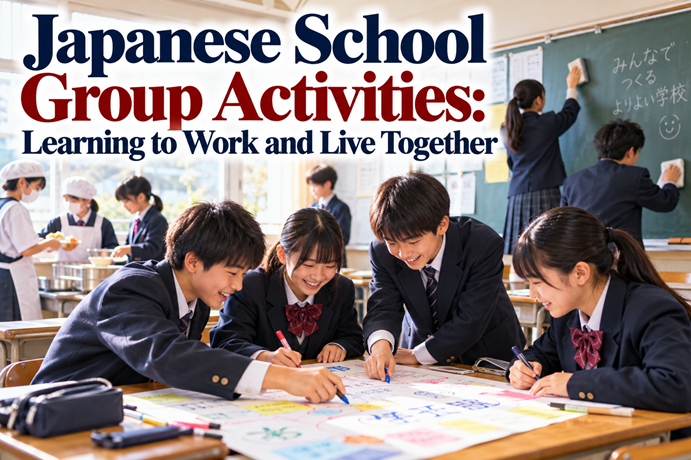
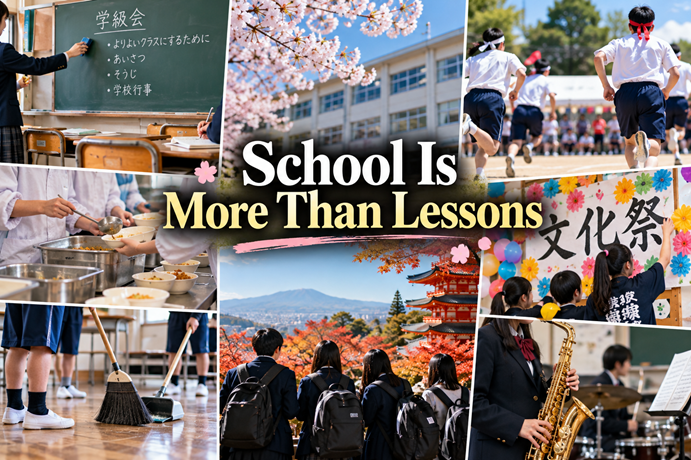
🌱 Introduction: School Is More Than Lessons
Japanese school life is often remembered for uniforms, school lunches, cleaning time, sports days, and after-school clubs. Yet these familiar scenes share something key: students are not only learning academic subjects. They are taking part in the everyday work of living with other people. A class may decide how to improve its atmosphere, students may take turns serving lunch, and a whole grade may spend weeks preparing for a school event. These activities can look ordinary, but together they reveal a key feature of Japanese education.
Japanese school group activities are not limited to group projects in a science or language lesson. They can include classroom duties, cleaning, lunch service, class meetings, student committees, sports festivals, cultural festivals, school trips, and club activities. Some are brief daily routines; others require weeks of planning and cooperation. Their aims also differ. A relay race may involve competition, a class meeting may involve solving a problem, and cleaning may simply involve looking after a shared space. What connects them is the expectation that students learn through participating in the life of a group.
Practices vary by school, age, and region, and not every student enjoys group work. Cooperation is not uniquely Japanese; schools around the world use projects, teams, and student councils. What stands out is how many forms of involvement can be woven into ordinary school life.
To understand these activities, it helps to look at both what students do and what they are expected to learn. Japanese schools often treat the classroom as a small community: students study there, but they also help organize and maintain it. This can build a sense of duty, teamwork, and belonging, while also creating tension when the group’s needs seem to outweigh an individual’s. Japanese school group activities are not a single lesson in obedience, but a range of routines and events through which children practice involvement. Some are directed by adults; others give students room to plan, decide, and contribute in varied ways.
🧭 Table of Contents
- Everyday Group Activities
- School Events
- Club Activities
- Student Committees
- Educational Ideas and Tokkatsu
- The Individual Within the Group
- Japan and the United States
- Conclusion
🧹 1. Everyday Group Activities: Learning Through Routine
🧽 Cleaning Time
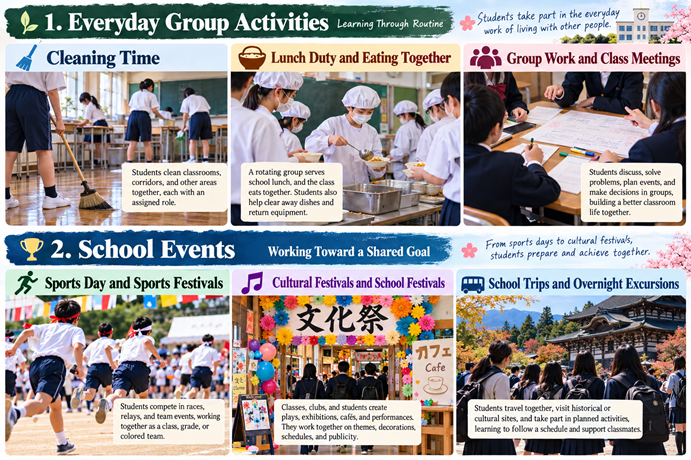
In many Japanese schools, students take part in cleaning classrooms, corridors, and other areas used by the school. Depending on the school, students may work in small assigned groups, with each group responsible for a particular place or task. One student may sweep, another wipe desks, and others collect rubbish or tidy shared materials. The routine is usually organized so that students know what they are expected to do and can complete the work together.
For a visitor accustomed to schools where custodial staff handle most cleaning, this may be a surprising part of school life. It is vital, however, not to present it as proof that Japanese people are naturally cleaner or more disciplined than people elsewhere. Cleaning is a practice within a particular school setting, and its meaning depends on how the school organizes and explains it.
The Japanese government’s English-language publication Highlighting Japan describes cleaning, daily classroom duties, and committee work as part of a broader culture in which students help run school life. Its account also discusses how such routines can support social skills and public-mindedness. Read the official overview, Social Skills Nurtured Through a Culture of Autonomy and Collaboration in Japanese Schools.
🍱 Lunch Duty and Eating Together
In many elementary schools, students help serve school lunch. A rotating group, often called the lunch-duty group, puts on aprons and hats, brings food to the classroom, portions dishes, and helps distribute meals to classmates. When lunch is over, students may help clear away dishes and return equipment according to the school’s routine. The details vary by school, but the process gives children a practical role in a shared daily activity. Classroom jobs and rotating daily leaders provide another example: students may distribute handouts, organize supplies, water plants, or help lead a short routine. These small tasks make each role visible and give students a chance to contribute.
🗣️ Group Work and Class Meetings
Group work in academic lessons is familiar in many education systems, including Japan. Students may discuss a reading, solve a mathematics problem, plan an experiment, prepare a presentation, or compare possible answers. The amount and style of group work vary by teacher, subject, and school. It would be inaccurate to imagine that every Japanese lesson is organized around teamwork or that individual study has little importance.
Class meetings are a different kind of activity. Students may discuss how to make classroom life better, plan an event, agree on a class goal, or consider how to respond to a shared problem. Depending on the age group and the teacher’s approach, students may suggest ideas, listen to other views, make a decision, and divide tasks for carrying it out.
Japan’s curriculum includes a formal area called Special Activities, often discussed internationally under the Japanese term Tokkatsu. It includes class activities, student council activities, club activities, and school events. It is part of the school framework, not merely an optional collection of fun events. The Ministry of Education’s EDU-Port Japan site explains that these activities use the school and classroom as communities in which students work together to improve group life while developing their own capacities. See What Is Japanese-Style Education?.
🏃 2. School Events: Working Toward a Shared Goal
🏅 Sports Day and Sports Festivals
Sports days, often called undōkai in elementary school and taiikusai or sports festivals in some secondary schools, are among the most familiar Japanese school events. The program can include short races, relays, ball games, group performances, tug-of-war, or activities in which students compete as teams. Some schools divide students by class, grade, or colored teams, and family members may come to watch. Teachers may also adapt events to local facilities, traditions, and students’ needs, so one school’s sports day should not be treated as a template for every school in Japan.
🎭 Cultural Festivals and School Festivals
School festivals, often called bunkasai, are especially visible in many Japanese junior high and high schools, though the format varies. A class might create a themed room, stage a play, organize a small attraction, present research, or run a café-style activity where permitted. Cultural clubs may perform music, dance, or theater, while art, photography, science, or manga clubs may display their work. Students may also work together on decorations, schedules, publicity, and visitor guidance.
🚌 School Trips and Overnight Excursions
School trips, including longer overnight trips in some grades, are another form of shared experience. Students may travel together by bus or train, visit historical or cultural sites, learn about nature, or take part in planned activities away from their usual classroom. They often need to follow a schedule, stay with a group, share information, and consider the needs of classmates while moving between locations.
🏀 3. Club Activities: Belonging to a Team Over Time
🎺 Sports Clubs and Cultural Clubs
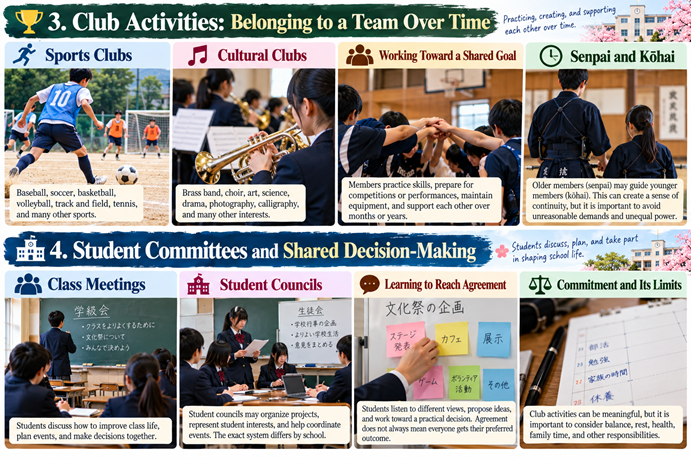
In many Japanese junior high and high schools, students can take part in after-school clubs, known as bukatsudō. Clubs may focus on baseball, soccer, basketball, volleyball, track and field, tennis, or other sports. Cultural clubs can include brass band, choir, art, science, drama, photography, calligraphy, and many other interests. The range, time commitment, and availability depend on the school; participation is not identical everywhere, and students’ choices vary.
Club activities differ from one-off events because members often meet repeatedly over months or years. They practice skills, prepare for competitions or performances, maintain equipment, and work toward shared goals. New members may learn from more experienced students, while older members may help explain routines or organize practice. This can create a sense of continuity within the group.
These relationships are sometimes discussed through the terms senpai and kōhai, referring broadly to senior and junior members in a school, club, or other group. The relationship is not the same in every school or club. It can provide mentorship and continuity, but it can also become overly hierarchical if age or seniority is used to justify unreasonable demands. A balanced explanation should acknowledge both the supportive potential and the risks of unequal power.
⏰ Commitment and Its Limits
Club activities can also raise questions about workload and balance. Some clubs meet casually, while others practice frequently and may require substantial time outside regular classes. The expectations can affect students’ rest, family time, academic work, and chances to pursue other interests. Conditions vary, and reforms and school policies have sought to address the balance between meaningful activities and students’ well-being.
This is a key part of the wider discussion about group culture. Commitment can help students persevere and support teammates, but it should not mean that a student must ignore exhaustion, health, or other duties. A group’s success is not a sufficient reason to disregard the needs of the people who make it up.
🗳️ 4. Student Committees and Shared Decision-Making
🏫 Class Meetings and Student Councils
Japanese schools may give students chances to discuss class life and participate in student councils. In elementary school, the structure may include class activities and a children’s council; in secondary school, a student council can coordinate projects, represent student interests, or help organize events. The exact system differs, but these activities can give students a role in shaping parts of school life rather than leaving every decision to teachers.
🧩 Learning to Reach Agreement
Consensus should not mean that everyone must secretly or publicly agree with the majority. Sometimes a group has to make a practical decision even when preferences differ. Students can learn to distinguish between having their own view respected and getting their preferred outcome. They can learn that a decision should be revisited if it creates an unfair or unworkable result.
A useful meeting gives students a real voice, clear limits, and a chance to see what follows from their choice. That makes shared decision-making more than a classroom exercise: it connects speaking up with action, review, and care for the people affected. A teacher’s role is key here: guiding a discussion does not mean deciding every answer in advance. Students need clear boundaries and support, but also a genuine chance to influence the result. When the decision is made, looking back at what worked can help them see that involvement includes responsibility for the outcome, not just the chance to speak.
🧠 5. The Educational Ideas Behind Japanese School Group Activities
📚 Academic Learning and Whole-Child Development
Japanese education is often described through the idea of developing academic ability alongside humanity, social growth, and physical well-being. Official descriptions of Japanese-style education emphasize learning across school life, not only during lessons. This does not mean Japan invented holistic education, or that every school balances these aims perfectly. Many education systems recognize that children develop in more than one dimension.
What matters for this article is how the idea appears in everyday practice. A child may learn mathematics during a lesson, but learn to share equipment during a group task. A student may study rules in a textbook, then encounter fairness while planning a class event. A team may practice physical skills while learning to communicate under pressure. The same school day can contain academic, practical, social, and physical experiences.
🤝 Special Activities and Tokkatsu
The formal curriculum area known as Tokubetsu Katsudō, usually translated as Special Activities, is central to understanding this approach. It includes class activities, student council activities, club activities, and school events. The activities help students improve group life and develop their own abilities.
This framework matters because it recognizes that school is a community that students help shape. Students can learn how to organize an activity, make decisions, solve shared problems, and review the result. These are not simply breaks from academic learning. They are intended learning experiences in their own right, although individual schools differ in how they implement them.
🧑🤝🧑 The School as a Small Community
A common way to understand these routines is to think of the classroom as a small community. Students do not only receive instruction from adults; they share a space, use common resources, take turns with duties, and encounter problems that affect everyone. The school provides a structured setting in which children can practice how to participate in a group before facing more complex social situations outside it.
This metaphor has limits. A classroom is not a miniature version of every part of society, and students do not have the same power as adults. Teachers remain responsible for safety, teaching, and decisions that children cannot reasonably make alone. Still, the idea of a small community helps explain why daily duties and group decisions can be considered educational rather than merely administrative.
⚖️ 6. The Individual Within the Group: Benefits and Challenges
🌟 What Group Activities Can Offer
Well-designed group activities can give students chances to practice cooperation, patience, communication, and shared duty. They can make less visible contributions valuable, because a group event depends on planning, preparation, and support as well as public performance. Students may discover strengths they would not show in individual tests, such as organizing materials, resolving a disagreement, encouraging a teammate, or noticing what needs to be done. This is one reason Japanese school group activities can reveal abilities that a test or solo assignment may not capture.
A student who is hesitant to speak in front of the class might be excellent at planning a schedule, noticing when someone is left out, or helping a group stay organized. These contributions should not be treated as lesser simply because they are less visible. When schools recognize a range of strengths, group work can widen students’ understanding of what it means to participate and succeed.
Group routines can also help students feel that they belong. A class that prepares an event together may develop shared memories; a club may provide friendship and a sense of progress; a student council may show that young people can influence their environment. These experiences can be especially meaningful when adults create a structure in which students have genuine roles and can see the results of their work.
🤐 When Cooperation Becomes Pressure to Conform
The same emphasis on group harmony that can encourage mutual support may make it difficult for some students to express discomfort or disagreement. A child might feel that refusing a role will disappoint the class, that asking for an adjustment will inconvenience teammates, or that a different view will be seen as selfish. The pressure may be explicit, but it can also be subtle: students may anticipate other people’s reactions and silence themselves before anyone asks them to.
This does not mean Japanese schools inevitably suppress individuality. Some teachers actively encourage varied viewpoints and make space for students who need support. Nor is conformity pressure unique to Japan; students in many countries worry about peer approval. The relevant question is whether a particular group can recognize individual needs while still working toward a shared purpose.
🧩 Making Room for Different Students
Not every student thrives in the same kind of group activity. Some enjoy competition and public performance; others prefer quiet, practical roles. Some students need additional time, physical accommodations, communication support, or flexibility because of disability, health, anxiety, family needs, or other factors. A group activity is more inclusive when these differences are treated as normal considerations rather than as inconveniences that one student must solve alone.
Teachers can help by offering varied ways to contribute, making roles clear, rotating duties fairly, and checking whether the workload is balanced. In a school festival, for example, a student who does not want to perform on stage might contribute to design, writing, sound, or planning. During sports day, schools can think carefully about how to make involvement possible for students with varied physical abilities. The exact arrangements will depend on the activity and the student, but the underlying principle is that belonging should not require everyone to contribute in an identical way.
🇯🇵🇺🇸 7. Japan and the United States: Different Starting Points, Not Opposite Values
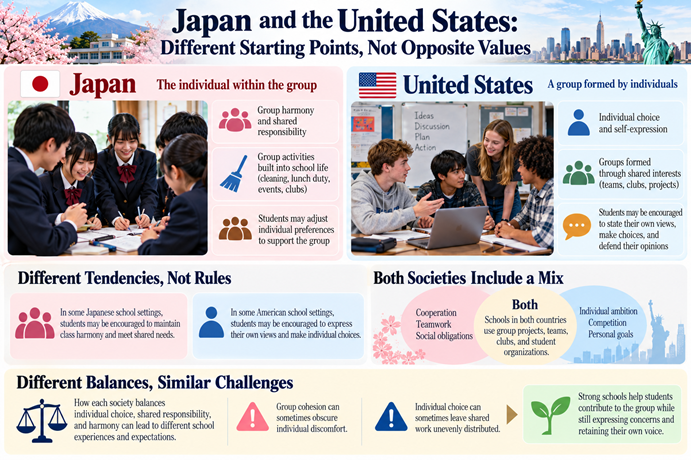
It can be tempting to summarize Japan as collectivist and the United States as individualist. The labels may point toward differences in cultural rules, but they become misleading if treated as complete descriptions of either country. Both societies contain cooperation, competition, individual ambition, social obligations, and pressure to fit in. Schools in both countries use group projects, teams, clubs, and student organizations, though their forms and meanings vary.
One useful comparison is what happens when an individual preference conflicts with a group’s needs. In some Japanese school settings, students may be encouraged to adjust their behavior to maintain class harmony and meet shared responsibilities. In some American settings, students may be encouraged to state their own view, make choices, or defend an individual position. These are broad tendencies, not rules that apply to every teacher or student.
The image of Japan as “the individual within the group” and the United States as “a group formed by individuals” can be a helpful lens, provided it is not treated as a national formula. In the first image, the group is a setting in which a person learns how to act in relation to others. In the second, the group is made up of people with distinct preferences and rights who cooperate. Neither model excludes the other: Japanese students have individual identities, and American groups need shared commitments to function.
The difference is not that one society cares about groups and the other does not, but how each balances individual choice, shared responsibility, and harmony. Group cohesion can obscure individual discomfort; individual choice can leave shared work unevenly distributed. These are risks, not inevitable outcomes. Strong schools help students contribute while still expressing concerns and retaining their own voice.
💡 8. What These Activities Reveal About Japanese School Life
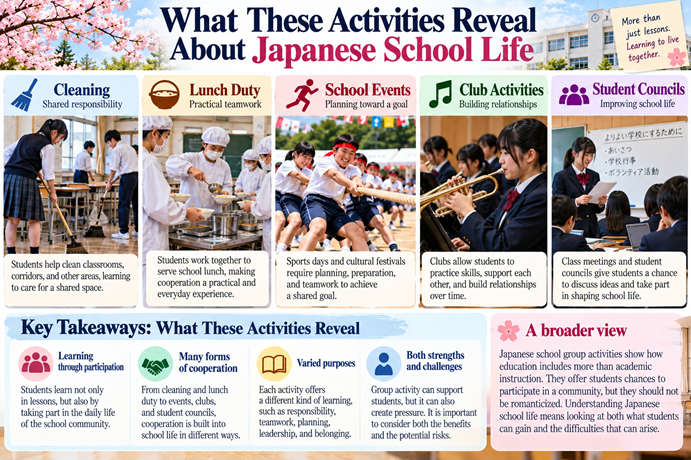
Japanese school group activities make visible an idea that can be missed when school is understood only as a place for academic instruction. Students learn through lessons, but they learn by caring for shared spaces, organizing daily routines, preparing events, participating in clubs, and discussing how their class should function. Cooperation is not confined to a worksheet asking students to work in pairs; it can be built into the structure of the school day.
The activities have varied purposes. Cleaning introduces shared responsibility for a common space. Lunch duty makes teamwork practical and immediate. School events require planning toward a shared goal, while clubs build relationships over time and student councils create chances to improve school life. Together, they show several ways in which students can learn to participate in a group.
The approach should not be romanticized. Group activity does not guarantee kindness, fairness, or belonging. A group can support a student, but it can also pressure that student to hide a difficulty. Understanding Japanese school culture means asking not only how many activities students do together, but also what they are expected to learn and whether the group makes room for individual differences.
❤️ Conclusion: Learning to Work and Live Together
From cleaning the classroom and serving lunch to performing at a cultural festival, practicing with a club, and discussing class decisions, Japanese school life offers many chances to experience shared duty. These activities show that education can include not only learning information, but learning how to participate in the everyday life of a group.
Their significance lies in the connection between the individual and the group. Students may notice what others need, carry out a duty, share an idea, or adjust a plan. They may encounter unequal workloads, pressure to conform, or difficulty being heard. Both sides matter.
The question is not whether the group matters more than the individual. A healthy group needs people who can contribute, and people need a group that respects their needs. The best possible form of cooperation is not one in which everyone becomes identical, but one in which different people can work toward something shared without losing their voice. That balance matters far beyond school: belonging should not require people to hide their needs, and asking for support should not mean letting a group down. The aim is shared work, with room for each child to speak and grow, too.
To explore how Japanese schools reflect the country’s culture and everyday life, visit
👉 Why Do Japanese Schools Have Their Own School Songs? The Music, Landscape, and Memories of School Life
👉 What Is Nichoku in Japanese Schools? The Daily Classroom Duty Behind School Life
👉 Japanese School Evacuation Drills: Earthquakes, Tsunamis, Fires, and the U.S. Difference
👉 Why Do Japanese Parents Attend Their Children’s Classes? Class Observation Days Explained