
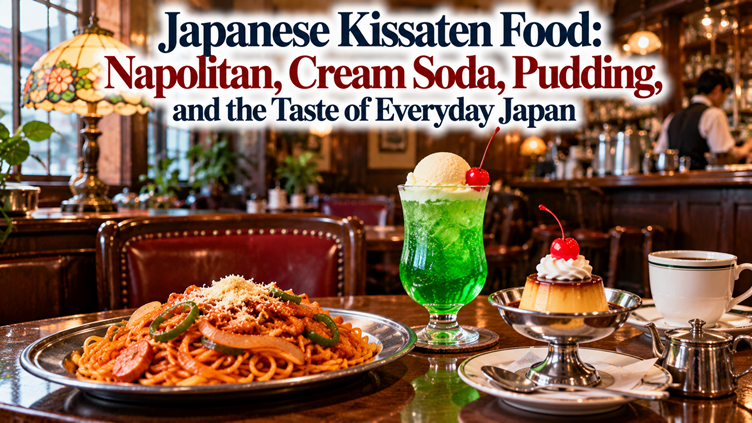
☕ Why I Look for a Kissaten When I Visit a Japanese Town
Whenever I visit a Japanese town, one of the things I like to do is look for a local kissaten. I am not necessarily looking for the most famous café, the most beautiful café, or a café that has appeared on social media. In fact, I usually prefer the opposite. I want to find a place that has been sitting quietly in the neighborhood for years, perhaps decades, serving coffee and simple meals to people who live and work nearby.
Sometimes the entrance is easy to miss. Sometimes the sign looks as though it has not changed for years. The furniture may be old, the lighting slightly dim, and the menu may contain foods that would not look particularly fashionable anywhere else. That is exactly what makes me want to go inside.
A chain café can be comfortable, reliable, and convenient, and there is nothing wrong with that. You know what kind of coffee you are going to get, you can often find Wi-Fi and power outlets, and the environment is designed to be familiar. But a traditional kissaten can offer something completely different. You are not simply buying a drink and finding a place to sit. You are stepping into a small piece of the neighborhood’s history.
The person behind the counter may have been serving customers there for decades. The tables may have been used by generations of regulars. The menu may barely have changed. The music, cups, curtains, chairs, counter, lighting, and smell of coffee can create an atmosphere that cannot be reproduced simply by buying vintage furniture and putting it into a new café.
That is why I think Japanese kissaten food is worth understanding as more than a collection of nostalgic menu items. Napolitan, cream soda, pudding, curry, hamburger steak, toast, sandwiches, and other familiar dishes are part of the experience, but the food makes the most sense when you understand the place where it is served. A plate of Napolitan is not simply a plate of spaghetti. A cream soda is not simply soda with ice cream. A pudding is not simply dessert. In a traditional kissaten, these foods become part of a particular atmosphere, a particular rhythm, and sometimes a particular memory of everyday Japan.
The real question, then, is not only what you eat in a kissaten.
It is why eating it there feels different.
🌏 Kissaten Is Not Simply the Japanese Version of a Café
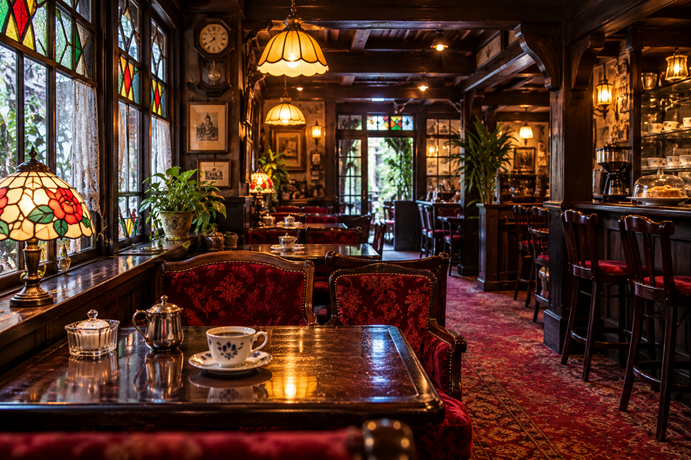
The Japanese word kissaten is often translated as “coffee shop” or “café,” but those translations can hide some important differences. Japan certainly has modern cafés that resemble contemporary coffee shops found throughout North America and Europe, but a traditional kissaten developed its own character over the twentieth century. Coffee was central, but the space gradually became a place for meals, conversation, reading, resting, listening to music, and spending time away from the street.
This means that comparing a traditional kissaten directly with every café in Europe or North America would be misleading. Parisian cafés, Italian bars, independent coffee shops in Canada, American diners, neighborhood bakeries, and contemporary specialty cafés all have their own cultures. The interesting comparison is not “Japan is like this while the West is like that.” Instead, it is the difference between the atmosphere and purpose of a traditional neighborhood kissaten and the experience many people associate with a modern café or coffee-shop environment.
☕ A Traditional Kissaten and a Modern Café
| Cafe | Typical Modern Café / Coffee Shop | Traditional Japanese Kissaten |
|---|---|---|
| Main purpose | Coffee, conversation, work, meetings, or a quick break | Coffee, meals, conversation, reading, resting, and enjoying the atmosphere |
| Time | Often designed around convenience and flexible use | The time spent in the shop can itself be part of the experience |
| Interior | Contemporary furniture, bright design, open layouts | Wood, leather, classic furniture, counters, curtains, old lamps, intimate spaces |
| Sound | Contemporary music, ambient conversation, café noise | Jazz, classical music, radio, or a quieter atmosphere |
| Food | Pastries, sandwiches, cakes, light meals | Napolitan, curry, hamburger steak, pizza toast, katsu sandwiches, pudding, parfaits |
| Drinks | Espresso-based drinks, brewed coffee, tea, cold drinks | Hand-brewed coffee, dark-roast coffee, tea, cream soda, floats |
| Identity | Often influenced by a broader café or brand style | Often shaped by the owner, regular customers, and neighborhood |
| Consistency | Similar experience can be expected from branch to branch | Every independent kissaten can feel completely different |
| Local connection | May be local, but can also belong to a larger chain | Often deeply tied to one street, neighborhood, or community |
The difference is therefore not that one is better than the other. A modern café can be exactly what you need when you want to work for two hours, meet a friend, charge your phone, or grab a sophisticated espresso drink. A kissaten offers a different kind of value. It asks you to slow down and accept the fact that the room itself is part of what you came for.
That is the first key to understanding the culture.
🕰️ The Kissaten Is a Place Where Time Becomes Part of the Meal
One of the most unusual things about a traditional kissaten is that the passage of time can become visible.
A modern restaurant often tries to make everything feel new. A kissaten can do the opposite. The counter may have scratches from years of use. The wooden table may have become slightly darker where people’s hands have rested. The chairs may no longer look fashionable, but they may still be comfortable. A coffee cup may look as though it has belonged to the shop longer than some of its customers have been alive.
These details are not necessarily decorations.
They may simply be the result of people continuing to use the same things because they still work.
That creates a very different kind of atmosphere from a deliberately designed “retro” café. There is a difference between something that is made to look old and something that has actually been used for a long time. Modern restaurants can reproduce the visual language of a kissaten with vintage furniture, old-looking signs, retro menus, and nostalgic colors, but an independent neighborhood kissaten that has genuinely been serving customers for decades contains something that cannot be manufactured easily.
It contains accumulated time.
This is one reason older kissaten can feel almost like small museums of ordinary life, although they are still functioning businesses rather than museums. You may see furniture styles that were common when Japan was rapidly changing in the postwar decades. You may hear music that belongs to an older generation. You may see a menu that has remained surprisingly stable. You may notice a particular style of cup, plate, sugar container, or table setting that would feel completely ordinary to someone who grew up in an earlier period.
For a foreign visitor, this can be fascinating because these objects are not historical exhibits. They are still part of everyday life.
You are not merely looking at the twentieth century.
For an hour, you are sitting inside one small corner of it.
🇯🇵 From Coffee to a Whole Style of Japanese Everyday Food
The word kissaten originally related to a place for drinking tea, but coffee became increasingly important, and the culture of these shops developed strongly during the twentieth century. Kissaten became particularly widespread during Japan’s postwar decades, when cafés could serve the needs of office workers, students, travelers, local residents, and people simply looking for somewhere to sit.
As these businesses adapted to their customers, food became an increasingly important part of the experience.
That helps explain why the food served in a traditional kissaten often feels different from what someone might expect at a modern coffee shop. The menu does not necessarily focus on elaborate culinary techniques. Instead, it tends to concentrate on satisfying, familiar food that works well in a relatively small kitchen and can be prepared consistently for regular customers.
That is where foods such as curry, hamburger steak, sandwiches, pizza toast, toast sets, and Napolitan entered the kissaten world.
These foods also tell an important story about Japan’s relationship with Western-style cooking.
They are often described as yoshoku, meaning Western-influenced food that was adapted to Japanese tastes and circumstances. They are not simply European dishes reproduced exactly as they would be in Europe. Over time, Japan took ingredients and ideas from outside the country and turned them into something that fit Japanese eating habits.
The kissaten became one of the places where this transformation became part of everyday life.
🍝 Napolitan: A Pasta Dish That Is Japanese
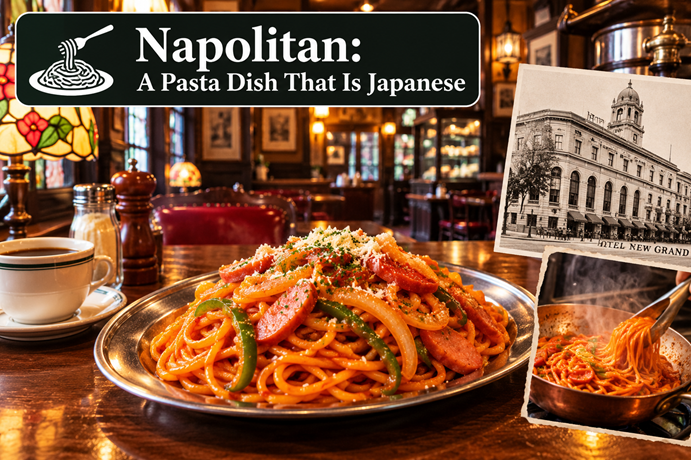
Few foods demonstrate this better than Napolitan.
The name immediately creates an expectation for anyone familiar with Italian food. You might imagine Naples, tomatoes, Italian pasta traditions, and perhaps a classic dish from southern Italy.
Then the plate arrives.
The spaghetti is often soft and substantial. The sauce is tomato-based but strongly associated with ketchup. Onion, green pepper, ham or sausage may appear. The overall flavor is sweet, savory, familiar, and unmistakably Japanese.
Napolitan is not a traditional Italian dish that simply became popular in Japan.
It is a Japanese creation.
One of the most important stories in its history is connected to Yokohama’s Hotel New Grand, where a version of the dish was developed in the years after World War II. The hotel’s chef was inspired by the simple ketchup-based spaghetti eaten by American military personnel and developed a more elaborate tomato-based version for the hotel. The dish was later adapted and spread through restaurants and kissaten across Japan.
The story is fascinating because it demonstrates how food moves between cultures. An ingredient and a basic preparation can arrive from somewhere else, and then local cooks reinterpret them until the result no longer belongs neatly to the culture from which the ingredients came.
Napolitan is therefore not “fake Italian food.”
It is something more interesting.
It is Japanese food that carries an international history.
The dish contains pasta, a food strongly associated with Italy, ketchup associated with American mass food culture, ingredients commonly used in Japanese home and restaurant cooking, and the postwar history of Yokohama. These elements came together in Japan and eventually became something that generations of Japanese people regarded as completely normal.
That is what food culture does.
It takes outside influences and gives them a local life.
🍝 Why Does Kissaten Napolitan Taste Different?
There is another reason Napolitan has become so strongly associated with kissaten culture.
The dish was designed as practical food.
A kissaten is not a large restaurant kitchen with a huge staff. The menu has to work in a relatively compact space, serve regular customers, and maintain a familiar taste. Over the years, many kissaten developed their own approach to the dish, including the texture of the noodles, amount of sauce, level of sweetness, vegetables, meat, and finishing touches.
That is why two plates of Napolitan can taste surprisingly different.
One may be sweet and heavily coated in ketchup.
Another may have a more developed tomato sauce.
One may use thick noodles.
Another may emphasize onions and green peppers.
One might arrive on a hot metal plate.
Another might come on a simple ceramic dish.
You can therefore discover a very personal local version of a dish that is already a Japanese adaptation of a foreign food.
And that is exactly the kind of thing that makes eating in independent kissaten so rewarding.
There is no universal standard.
The restaurant itself has a personality.
🥤 Cream Soda Is Almost a Piece of Japanese Pop Memory
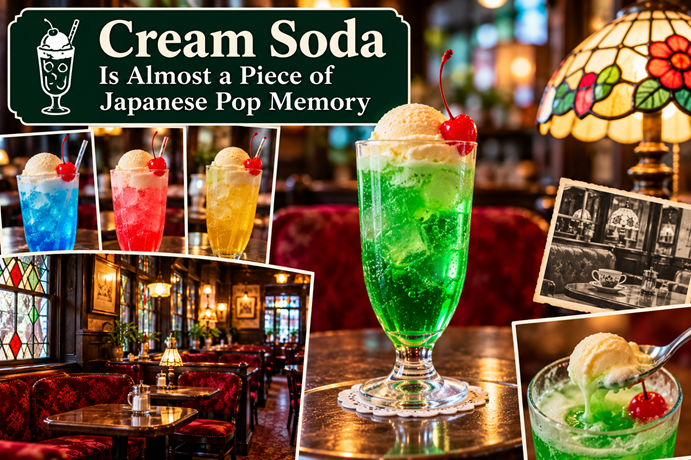
If Napolitan represents the savory side of kissaten food, cream soda represents its playful side.
A classic Japanese cream soda often arrives in a tall, transparent glass filled with brightly colored soda, topped with a scoop of vanilla ice cream and sometimes finished with a cherry. The visual effect is almost as important as the taste. The vivid green version is especially recognizable, although other colors are common too.
Technically, it is a simple drink.
Culturally, it is much more than that.
The glass matters.
The color matters.
The melting ice cream matters.
The cherry matters.
The long spoon or straw matters.
Even the shape of the table on which it arrives can matter.
A cream soda in a plastic takeaway cup feels like one thing. A cream soda served in an old-fashioned glass inside a traditional kissaten feels completely different.
That is because the drink has become part of a visual language associated with the kissaten experience.
It looks like an old postcard of everyday Japan.
And that is one reason younger generations can also find it appealing. The drink can feel nostalgic even to someone who did not grow up with it. It represents a style of café culture that seems slower, more colorful, and less standardized than much of the modern food environment.
🍮 Japanese Pudding: Simple, Firm, and Full of Character
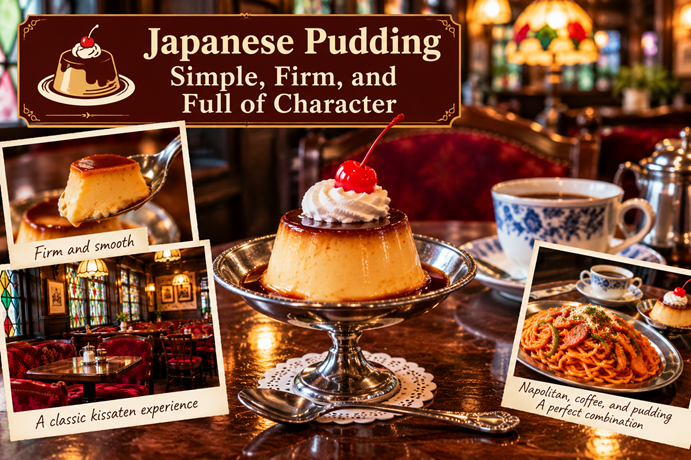
Then there is pudding.
Japanese purin is based on the custard-pudding tradition introduced through Western influence, but the Japanese version developed its own familiar character. A traditional kissaten pudding is often firm enough to hold its shape when turned out onto a plate, with caramel at the bottom and sometimes whipped cream, fruit, or a cherry alongside it.
Again, the ingredient list is not complicated.
Eggs.
Milk.
Sugar.
Caramel.
What makes the experience memorable is the texture and the setting.
Modern desserts often emphasize softness, elaborate presentation, multiple textures, or visual complexity. Traditional kissaten pudding can feel almost deliberately simple. You cut into it with a spoon and find a clean, firm custard with a slight bitterness from the caramel.
The simplicity is part of the charm.
And when that pudding arrives after a plate of Napolitan, with a cup of coffee beside it, the three things become part of one experience.
The meal has a rhythm.
Savory first.
Coffee or soda.
Then something sweet.
It is not a tasting menu.
It is ordinary food made memorable by context.
🍛 Curry, Hamburger Steak, and Pizza Toast: The Other Kissaten Classics

It would be a mistake to think that Napolitan, cream soda, and pudding are the entire story.
Traditional kissaten menus can contain an entire world of Japanese interpretations of Western-style comfort food.
Curry is particularly important because Japanese curry itself has been transformed so thoroughly that it has become part of ordinary Japanese cuisine. A kissaten version may be simple, rich, slightly sweet, and served with rice rather than attempting to recreate an Indian or European curry tradition.
Hamburger steak is another example of yoshoku becoming everyday food. It is not the same as a hamburger in a bun. The ground-meat patty is served as a plated meal, often with sauce, vegetables, rice, or other accompaniments. It belongs to a different Japanese food tradition.
Pizza toast takes the same process even further. A slice of toast becomes the foundation for pizza-style ingredients and cheese, creating something that is both obviously inspired by Western food and unmistakably part of Japanese everyday cooking.
Katsu sandwiches, egg sandwiches, hot toast, gratin, omelet rice, and other dishes can also appear depending on the individual shop.
This is one of the secrets of kissaten food.
The menu is full of foods that feel familiar but become culturally interesting once you ask where they came from and how Japan adapted them.
🥪 Kissaten Food Is Often Hearty Because the Café Was Also a Meal Place
The word “café” can sometimes create an expectation of a small snack, pastry, or drink.
Traditional kissaten food often breaks that expectation.
You can eat a full lunch.
You can eat curry.
You can order Napolitan.
You can have hamburger steak.
You can get a katsu sandwich.
You can order toast and eggs in the morning.
The food does not treat coffee as the only reason to visit.
The customer might come because they want lunch, stay because the room is comfortable, and order coffee afterward.
This is another important difference between many traditional kissaten and the modern café model. The boundary between coffee shop and casual restaurant becomes blurry.
A kissaten can be both.
That is why the menu can look so distinctive to foreign visitors.
It does not fit neatly into the categories of café, diner, restaurant, or dessert shop.
It occupies a space somewhere in between.
🍞 Morning Service: When Coffee Became Breakfast
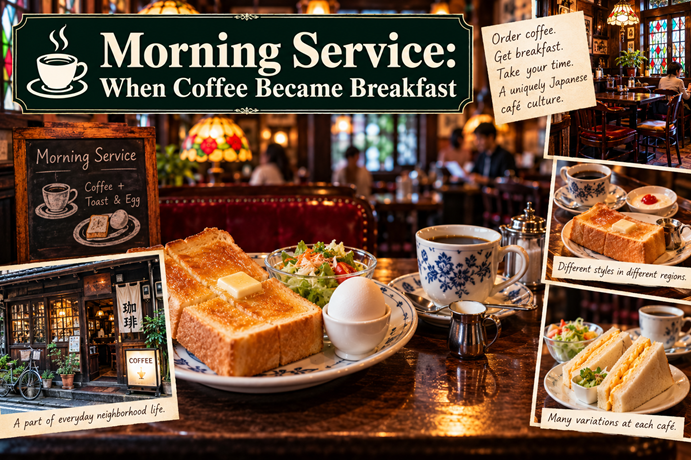
There is perhaps no better example of this than Japan’s morning service culture.
In some regions, particularly Nagoya and surrounding Aichi, cafés and kissaten became famous for offering substantial breakfast sets with a drink. A coffee order might come with toast and a boiled egg, while individual shops developed their own versions with different foods and levels of generosity.
The appeal is easy to understand.
You order coffee.
You get breakfast.
You sit down.
You do not have to rush.
The meal becomes part of the morning rhythm.
This is another area where regional culture enters the kissaten story. The exact menu and customs vary from place to place, so “morning service” should not be treated as something every kissaten in Japan offers in exactly the same form. But where it exists, it demonstrates how deeply cafés became integrated into everyday neighborhood routines.
A kissaten was not necessarily somewhere you visited only when you wanted a special coffee.
It could be somewhere you went because it was Tuesday morning.
That is a very different relationship with a café.
🪑 The Regular Customer Is Part of the Atmosphere
One of the most important differences between a chain café and an old neighborhood kissaten may not appear on the menu at all.
It is the regular customer.
A long-established kissaten can have people who visit repeatedly over many years. The owner may know what they normally order. Customers may recognize one another. Someone may read the newspaper in the same seat. Another person may always sit at the counter. A local business owner may stop in during the morning. A retired resident may spend part of the afternoon there.
None of this necessarily makes the place loudly social.
In fact, some kissaten are quiet precisely because regular customers do not need to perform their presence.
They know the space.
They know how it works.
They can sit, drink coffee, read, talk, or simply be there.
That creates an atmosphere that cannot easily be standardized.
The café becomes part of the neighborhood.
And the neighborhood becomes part of the café.
🏘️ A Kissaten Can Show You the Everyday Face of a Town
This is why I like looking for local kissaten when I travel within Japan.
If I visit a famous tourist restaurant, I am likely to see a version of the town designed for visitors. That can be enjoyable, and there is nothing wrong with it. But when I enter a kissaten that has served local people for years, I sometimes feel that I am seeing another side of the same place.
The menu may not mention the town’s famous sightseeing spots.
There may be no carefully designed explanation for foreign travelers.
The people around me may simply be having lunch.
Someone might be reading.
Someone might be talking quietly.
Someone might order the same coffee they have ordered for years.
And that is precisely the attraction.
For a traveler interested in understanding Japan, a local kissaten can offer a glimpse of the town’s everyday rhythm rather than its tourist image.
You may learn more about a neighborhood from one hour inside an ordinary kissaten than from a photograph of its shopping district.
You see how people actually spend time.
🏙️ Kissaten and the Japanese City
Kissaten culture also makes more sense when you consider Japan’s cities during the decades when these shops flourished.
Postwar Japan experienced enormous economic and social change. Cities became increasingly important places to work, study, shop, meet, and commute. Homes and workplaces did not always provide the ideal environment for relaxing, reading, meeting someone, or simply taking a break.
The kissaten filled part of that gap.
It became a small private-feeling space inside the city.
You could be alone without being lonely.
You could meet someone without needing a formal restaurant.
You could read without staying at home.
You could drink coffee without rushing.
You could eat a substantial meal without going to a large restaurant.
This is one reason the interior matters so much.
The room itself solved a social problem.
It created a place where people could temporarily step out of the pressures of the city.
🎵 Jazz, Classical Music, and the Sound of a Different Japan
Some kissaten developed an especially strong relationship with music.
Jazz kissaten became spaces where people could listen to records seriously, sometimes with high-quality audio equipment and an atmosphere designed for focused listening. Classical music kissaten developed along similar lines. In these places, the music was not simply background entertainment.
It was part of the reason you were there.
This reveals another characteristic of traditional kissaten culture: the café could be a place for a particular kind of attention.
You might pay attention to your coffee.
You might pay attention to the music.
You might pay attention to the person you are talking to.
Or you might simply pay attention to the room.
That is a different experience from scrolling through your phone while drinking a takeaway coffee.
Modern cafés can certainly encourage the same kind of quiet concentration, but the older kissaten tradition developed it in a particularly Japanese form.
📻 The Sound of a Kissaten Is Part of Its Identity
Even when there is no jazz record playing, sound matters.
The grinder.
The spoon against the cup.
The coffee machine.
The door opening.
A conversation at the counter.
The quiet sound of a television.
The background music.
Sometimes almost nothing.
A modern café often tries to create a carefully controlled atmosphere, but an old kissaten may have accumulated its atmosphere naturally over years.
The result can feel intimate.
That is why people sometimes say that a kissaten has a certain “air.”
It is not only visual.
It is acoustic.
It smells like coffee and food.
It sounds like cups and conversation.
It feels like old furniture.
It tastes like a familiar meal.
It is a complete sensory experience.
🍝 Why the Food Feels So Nostalgic Even to Foreign Visitors
Something interesting happens when foreign visitors encounter these foods.
They may have no personal memory of Japan in the 1960s or 1970s.
They may never have seen their grandparents eating Napolitan.
They may never have visited a kissaten as a child.
And yet the environment can still feel nostalgic.
Why?
Because the visual language of the kissaten communicates a period.
The dark wood.
The glass.
The old cups.
The thick toast.
The retro menu.
The cream soda.
The pudding.
The Napolitan.
These things form a coherent picture of another era.
The visitor does not need to remember that era personally to recognize the feeling of it.
This is one reason kissaten culture has attracted younger Japanese customers and foreign visitors as well. The experience offers something that contemporary food culture often lacks: a feeling that the objects around you have a past.
🧑🍳 Independent Kissaten Have Something Chains Cannot Reproduce
A chain can reproduce a menu.
It can reproduce a design.
It can reproduce a recipe.
It can even recreate the look of a retro café.
But it cannot automatically reproduce the particular history of one neighborhood.
That is what makes independent kissaten special.
One owner may have learned coffee preparation from a previous generation.
Another may have kept the same curry recipe for decades.
Another may use a particular cup because it was there when the shop opened.
Another may prepare the pudding in exactly the same way year after year.
Another may have a counter that has become part of the physical identity of the street.
There is a kind of irregularity in these places.
One kissaten is not interchangeable with another.
That is the point.
A chain asks you to recognize the brand.
An independent kissaten asks you to recognize the place.
🌿 This Is Why I Search for Kissaten When I Travel
When I am visiting a town in Japan, I do not need every meal to be famous.
Sometimes I want to know what breakfast looks like in that neighborhood.
Sometimes I want to sit somewhere that has not been redesigned for tourists.
Sometimes I want to eat a dish that a local person might consider completely ordinary.
Sometimes I want to understand the atmosphere of the street rather than photograph it.
A kissaten can provide all of that at once.
I might order coffee and toast in the morning, or Napolitan at lunch, followed by pudding. On another visit I might try curry or hamburger steak. The specific food matters, but so does the feeling of sitting there for an hour, watching the rhythm of the neighborhood through the window.
That is the difference between visiting a place and temporarily becoming part of its everyday rhythm.
You remain a traveler, of course.
But for a short time, you are occupying a space that was designed for ordinary life rather than sightseeing.
That is a special feeling.
🍮 The Three Foods That Best Explain Kissaten Culture
Napolitan, cream soda, and pudding are often grouped together because they look like a convenient list of retro Japanese foods. But they actually represent three different parts of the kissaten experience.
Napolitan represents everyday comfort food and Japan’s ability to transform outside culinary influences into something local. The dish has an international history, but the version served in a kissaten is unmistakably Japanese.
Cream soda represents visual memory. The bright color, tall glass, scoop of ice cream, and cherry turn a simple drink into an image of the classic Japanese café.
Pudding represents simple dessert and old-fashioned pleasure. Its firm texture, caramel, and restrained presentation feel almost deliberately different from many modern desserts.
Together, they create something larger than three menu items.
They create an image of a certain kind of everyday Japan.
🇯🇵 A Kissaten Is Not a Better Café. It Is a Different Idea of a Café.
It is tempting to romanticize kissaten culture.
The old furniture looks beautiful.
The retro food looks charming.
The quiet room feels mysterious.
The coffee feels authentic.
But there is no reason to claim that a kissaten is inherently superior to a modern café.
Modern cafés offer things that traditional kissaten often do not. Better accessibility, standardized quality, specialty drinks, digital services, larger spaces, modern equipment, and predictable environments can all be valuable.
The appeal of a kissaten is simply different.
A modern café may be designed to make your present moment comfortable.
A traditional kissaten can make you aware of the moments that came before you.
That is its special quality.
The shop has a history.
The table has a history.
The menu has a history.
Sometimes even the recipe has a history.
And you get to enter that history for a little while.
🌏 The Most Interesting Part Is Not the “Retro” Look
Perhaps the biggest misunderstanding about kissaten culture is to think that it is mainly about looking retro.
Retro is the surface.
The deeper story is continuity.
A café that has survived for decades has survived because people kept coming back. Somebody wanted the coffee. Somebody wanted the curry. Somebody wanted the Napolitan. Somebody wanted the newspaper and a quiet seat. Somebody wanted to meet a friend there. Somebody wanted to spend half an hour alone.
The food survived because it remained meaningful to people.
The furniture survived because it remained useful.
The atmosphere survived because customers continued to accept it as part of the place.
That makes the kissaten more than nostalgia.
It is a living piece of continuity.
🍽️ Food Can Preserve a Version of Everyday Japan
This is why the subject belongs on a site about understanding Japan rather than simply traveling around Japan.
A famous temple can tell you about religion.
A castle can tell you about political history.
A railway station can tell you about transportation.
A kissaten can tell you about something more difficult to document: how ordinary people spent their time.
What did they eat?
Where did they meet?
What kind of coffee did they drink?
How long did they stay?
What music did they listen to?
What did a lunch break feel like?
Where did students study?
Where did office workers sit after work?
Where did someone go when they simply wanted to be alone?
Those questions do not always appear in tourist brochures.
But they are part of the culture of a city.
The kissaten preserves some of the answers.
☕ From Coffee to Memory
The most interesting thing about Japanese kissaten food is therefore not the food itself.
It is the relationship between food, place, and time.
Napolitan tells a story about Japan adapting Western food and making it local.
Cream soda tells a story about postwar popular culture and the visual language of the classic café.
Pudding tells a story about Western-influenced sweets becoming familiar Japanese comfort food.
Curry, hamburger steak, pizza toast, sandwiches, and toast tell similar stories.
But the kissaten adds another layer.
It gives those foods a room.
It gives them furniture.
It gives them music.
It gives them regular customers.
It gives them a neighborhood.
And eventually, it gives them memories.
That is why I keep looking for local kissaten when I visit Japanese towns.
I am not only looking for a good cup of coffee.
I am looking for a place where I can feel how ordinary life once sounded, tasted, and looked.
Sometimes I find a small shop that has been there for decades. The menu is simple, the lighting is low, the furniture has clearly been used for a long time, and a plate of Napolitan arrives with a coffee or a bright cream soda. Nothing about the meal is necessarily extravagant.
And yet, after sitting there for an hour, I feel that I have experienced something that I could not have learned from simply walking past the building.
I have tasted a little of the town’s everyday history.
That may be the real appeal of Japanese kissaten food.
It is not food designed simply to impress you.
It is food designed to belong somewhere.
And when you find the right kissaten, you are not only eating Japanese food.
For a little while, you are sharing the time of a place.
🔗 Explore More of Japan Through Food
Kissaten show another side of Japanese food culture: not just what people eat, but how food becomes connected to neighborhoods, memories, travel, and everyday life. Continue exploring that relationship through these related articles.
👉 What Is Gotouchi Gourmet in Japan? How Food Changes from Region to Region
👉 Japanese Chestnuts in Autumn: 7 Fascinating Chapters from Ancient Japan to Modern Sweets
👉 Japanese University Cafeterias: More Than Lunch for Students
👉 Inside Japan’s Fish Markets: How Seafood Moves from the Sea to Your Table (2026 Guide)