
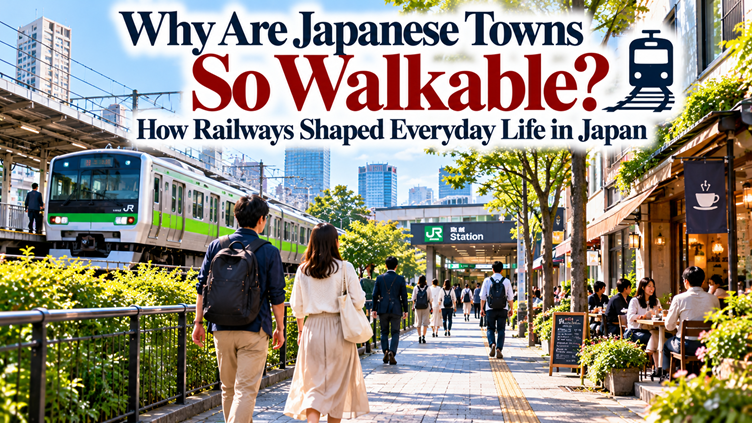
🚶 What Does It Really Mean to Live in a Walkable Town?
There is a particular moment when you realize that you have been living differently from the way you lived before. It may happen when you walk out of your home, head toward the station, buy something at a small shop, take a train to another part of town, walk again, and return home without ever thinking about where you parked the car. You may not even realize that this is unusual until you remember that, in another country, the same ordinary day would have required you to start a car before almost every part of your life could begin.
This is one of the most interesting things about everyday life in Japan. In many Japanese towns and cities, particularly those connected to established railway and bus networks, it is possible to live a large part of daily life by walking and using public transportation. You can walk from your home to a station, take a train to work or school, walk from another station to a destination, catch a bus to a neighborhood farther away, or simply walk to a supermarket, convenience store, clinic, restaurant, school, or local shopping street. You do not necessarily need to own a car merely to participate in ordinary life.
That does not mean Japan is a country where every person can walk everywhere. It certainly is not. Rural communities, mountain areas, outer suburbs, and places poorly served by public transportation can be highly car-dependent. Even within large cities, some neighborhoods are much easier to navigate on foot than others. The important point is something slightly different: Japan has a remarkably broad network of towns and neighborhoods in which walking and public transportation can form the basic framework of daily life.
That distinction matters because “walkable” is often misunderstood as meaning that everything is within a five-minute walk. That is not what everyday walkability in Japan necessarily looks like. A Japanese town can be walkable because walking connects you to a railway station, the railway connects you to another part of the city, and a bus fills the gaps where walking is inconvenient. In other words, the real system is often not simply walking but walking plus public transportation.
And once you understand that, the shape of Japanese towns begins to look very different.
🇺🇸 My Experience: In America, the Car Was Part of the Map of Daily Life
I noticed this difference particularly clearly because I have lived in the United States and in Mexico, and in the places where I lived, it was difficult to imagine ordinary life without a car. There was no convenient railway station waiting at the end of the street, and there was no bus network that made it realistic to rely on public transportation for the full range of everyday needs. The car was not simply a way to travel somewhere occasionally. The car was part of the structure of daily life itself.
You woke up at home, walked to the garage, got into the car, and drove to school, work, the supermarket, a shopping center, a restaurant, or almost anywhere else you needed to go. Once you arrived, you parked in another large parking area and walked from your car to the destination. Then you did the same thing in reverse. Home had a garage, the school had parking, the workplace had parking, the supermarket had parking, and many restaurants and stores had parking. The whole day could be understood as a series of points connected by roads.
And honestly, there was nothing wrong with that lifestyle.
I enjoyed it. There is a genuine freedom in being able to get into your car and drive almost anywhere whenever you want. You can carry large quantities of groceries without thinking about weight. You can buy something bulky without wondering how you will get it home. You can live farther from work or school. You can leave the house with several bags, sports equipment, children, luggage, or whatever else you need and simply put everything into the vehicle.
The American car-centered lifestyle can be extremely comfortable, especially when the surrounding environment is designed for it. A house with a garage, a wide road, a large supermarket, a spacious parking lot, and a car that takes you directly from one place to another creates a kind of convenience that is difficult to appreciate until you compare it with something else.
So this article is not an argument that one lifestyle is superior to another.
The interesting question is what kind of town each lifestyle creates.
🏙️ A Japanese Town Often Begins With the Station
One of the biggest differences is that many Japanese towns are structured around railway stations in a way that has become deeply embedded in everyday life. Japan’s railway system is not simply a transportation network that happens to exist inside cities. Railways have helped shape the cities themselves.
Japan’s Ministry of Land, Infrastructure, Transport and Tourism describes the country’s urban development as having been closely associated with railway development for roughly 150 years, with housing, commercial areas, stations, and other urban functions developing along railway lines. It also specifically identifies station-centered and railway-line-centered development as a characteristic of Japanese urban planning.
This is one of the keys to understanding why a Japanese neighborhood can feel so different from a car-oriented suburb.
Imagine a town as a series of circles.
At the center is the station. Around the station are shops, restaurants, supermarkets, banks, clinics, offices, schools, apartment buildings, and other services. Move farther away and the streets become more residential. Beyond that, buses may connect the outer neighborhoods to the station. The exact shape differs from town to town, but the basic relationship between transportation and everyday life can remain surprisingly strong.
The station is therefore not simply somewhere you go when you have to take a train.
It can function as one of the organizing points of the town itself.
This is particularly important because the station does not have to be a huge station like Tokyo Station or Shinjuku Station. A modest local station can have a surprisingly important relationship with the neighborhood around it. A smaller station may sit beside a supermarket, a row of restaurants, a pharmacy, a bakery, a convenience store, a clinic, or a shopping street. From there, residential streets spread outward.
You can therefore live near the station without living in the middle of a giant commercial district.
That is a very important part of Japanese neighborhood life.
🚉 Japan’s Railway Story Is Also a Story About Housing
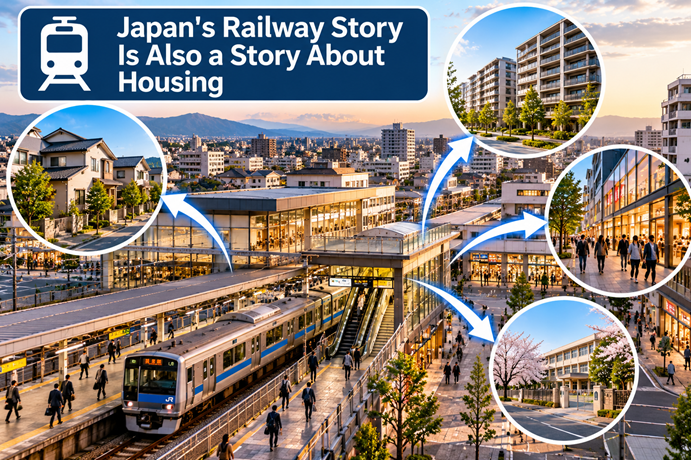
The relationship between Japanese railways and towns becomes even more interesting when you look at how some railway companies historically developed areas along their lines.
In Japan, railway development and residential development were sometimes pursued together. The basic idea was remarkably practical: build a railway, develop housing along the line, attract residents, increase railway passengers, and create commercial and leisure facilities that make the area more attractive. This model became particularly important in major metropolitan areas. Japanese government material describing transit-oriented development in Japan specifically discusses railway construction combined with residential land development, including the development of housing within walking distance of stations and bus networks connected to those stations.
That history matters because it helps explain something that visitors often notice without knowing why.
You can arrive at a Japanese station and find that the town seems to begin immediately around you.
There may be no enormous gap between the railway station and the ordinary life of the neighborhood. Instead, the station can be directly connected to shops, streets, apartments, schools, houses, restaurants, and local services.
The railway is therefore not merely moving people between already-existing cities.
In many places, it helped shape the city around itself.
This is one reason the Japanese railway system is so closely associated with everyday life. The train is not just for tourists, commuters, or long-distance travel. It is part of the basic architecture of the town.
👟 You Do Not Have to Walk Everywhere to Live Without a Car
This is perhaps the most important point to understand about walkable towns in Japan.
When people imagine walkable cities, they sometimes imagine a European-style old town where every destination is close enough to walk. Japan often works differently.
You may walk ten minutes from your home to the station, ride a train for twenty minutes, walk another ten minutes to work, take a bus to another neighborhood on a different day, and then walk home from your local station in the evening.
Technically, you did not walk to work.
But you also did not need a car.
That is the difference.
Japan’s walkability is often created through a chain of small connections. The first connection is your feet. The second is the station. The third is the railway. The fourth might be another walking segment. The fifth could be a bus. The system does not require every part of the journey to be walkable by itself because the network connects those individual pieces together.
This is why a Japanese town can feel much more walkable than its actual distances might suggest.
A destination can be several kilometers away and still be accessible without a car because the transportation network breaks the journey into manageable pieces.
In other words, the question is not always, “Can I walk all the way there?”
The better question is, “Can I reach it without needing to drive?”
That is a much more useful definition of everyday walkability.
🛒 The Neighborhood Around You Can Handle More of Your Daily Life
Another reason Japanese neighborhoods can feel walkable is that many everyday services are distributed relatively close to where people live.
A supermarket does not necessarily need to be fifteen minutes away by car. There may be a smaller supermarket within walking distance. A convenience store may be several minutes away. A local clinic might be nearby. A bakery, pharmacy, restaurant, dry cleaner, school, bank, or small shopping street may exist within the same general neighborhood.
None of these places has to be enormous.
That is another important difference.
A car-oriented environment often makes scale important. Because customers drive to the destination, a large store with a large parking area can serve people from a wide geographic area. In a more walking-oriented environment, smaller stores can survive because customers may come from the surrounding neighborhood every day.
This is one reason Japanese neighborhood streets can sometimes look surprisingly ordinary while still being useful.
A street does not have to contain an enormous shopping center to support daily life. It might contain a small bakery, a family restaurant, a clinic, a pharmacy, a barber, a convenience store, a local vegetable shop, or a small restaurant. Each individual business may seem modest, but together they create a network of daily services.
The result is that your neighborhood can become more than the place where your house happens to be.
It becomes part of your daily infrastructure.
🏫 School Is Another Reason the Neighborhood Matters
Schools also play an important role in this structure, particularly for children.
In many Japanese communities, children travel to local schools on foot or by bicycle, depending on age, distance, and local circumstances. Elementary school routes can become part of the neighborhood itself, with children walking through residential streets rather than being driven to school every morning.
This means that a residential neighborhood is not necessarily designed only around cars traveling from one private property to another. It can also function as a path connecting children, families, schools, stores, parks, stations, and local facilities.
That changes the feeling of a street.
You may see children walking together in the morning, older people walking to shops, someone carrying groceries home, a bicycle delivering something, or people heading toward the station. The street becomes a space through which everyday life moves.
This is very different from a neighborhood that is almost entirely understood as a place where cars travel between driveways.
And again, this is not simply a cultural preference.
The physical organization of the town makes certain behaviors easier.
🇺🇸 The American Car-Centered Life Is Not the Opposite of Good Life
This is where I think comparisons often become too simplistic.
It would be easy to write an article saying that Japan is wonderfully walkable while America is trapped in car dependency. That would not reflect my own experience.
When I lived in the United States, I was perfectly satisfied with the car-centered lifestyle.
In some ways, it was incredibly convenient.
I could put everything in the car and go. I could drive to a large supermarket and buy a week’s worth of groceries. I could buy something heavy without thinking about how to carry it onto a train. I could drive directly from home to work, from work to the supermarket, from the supermarket to another destination, and then return home. Parking was part of the landscape, so I rarely had to think about it.
The entire environment was designed around that freedom.
There is an important point here that is often lost in comparisons of urban form: car dependency and car convenience are related, but they are not exactly the same thing.
When the environment is designed around cars, owning a car may feel restrictive from one perspective because you need it to do almost everything. But from another perspective, it can feel liberating because once you have the car, distance becomes easy.
You are not constantly thinking about whether the train runs every ten minutes.
You are not checking the last train.
You are not carrying your groceries down a narrow street.
You are simply driving.
That can be a very satisfying way to live.
🇲🇽 Mexico Showed Me Another Side of the Same Problem
My experience in Mexico also made the contrast clear. In the places where I lived, the absence of convenient public transportation for everyday trips meant that the car became part of the basic equation of daily life.
Again, this does not describe every part of Mexico. Mexican cities vary enormously, and some have extensive public transportation and highly walkable districts. The same is true of the United States and Canada. A central neighborhood in a major city can be completely different from a suburban community several hours away.
This is why comparisons between “countries” can become misleading.
The more useful comparison is often between urban forms.
A dense neighborhood built around transit works differently from a low-density suburb built around roads, no matter which country it happens to be in.
And yet Japan has something particularly interesting.
🇨🇦 🇫🇷 🇩🇪 Big Cities Around the World Can Be Walkable Too
Japan is certainly not the only place where people can live without a car.
Toronto has neighborhoods where people can walk to shops, take public transit to work, and conduct a large part of daily life without driving. Paris is famous for neighborhoods in which daily services can be reached on foot or by public transportation. German cities also contain many highly walkable neighborhoods with strong public transportation networks.
The same basic principle exists in many major cities around the world.
So what makes Japan interesting?
I would argue that it is not the existence of walkable neighborhoods.
It is the breadth and repetition of the pattern.
Japan has an unusually extensive railway network integrated into everyday urban life, and station-centered neighborhoods appear in many different parts of the country. The pattern is especially striking in the large metropolitan regions, where railways form a dense network and railway lines are closely connected to residential and commercial development. Japan’s transport ministry notes that urban railways carry a very large share of passenger transport in the country’s major metropolitan areas and that railway lines have played a central role in urban structure.
That means the experience of “walking from home to the station” is not restricted to a tiny collection of famous city centers.
It is repeated again and again across many ordinary neighborhoods.
That repetition is what makes Japan unusual.
🗺️ Japan’s Walkable Area Is Often Much Bigger Than the Tourist Center
This may be the most important distinction for someone visiting Japan.
A foreign visitor may arrive in Tokyo, Osaka, Kyoto, or another famous destination and assume that the walkability they are experiencing is simply a feature of a major world city. But the deeper story is what happens when you leave the tourist center.
You take a local train.
You get off at a smaller station.
You walk ten minutes.
Suddenly you are surrounded by ordinary houses.
There are no famous landmarks.
There may be no tourists.
But you can still find a convenience store, a small supermarket, a clinic, a school, a pharmacy, a restaurant, a bus stop, a railway station, a park, and other everyday services within a reasonable distance.
That is the part of Japan that is easy to overlook.
The walkable city is not necessarily just the glamorous center.
It can extend into ordinary residential life.
This is particularly powerful because it changes the meaning of “city” itself. A city is not only its downtown skyline, department stores, stations, museums, and major attractions. It is also the thousands of streets where people buy breakfast, take children to school, walk to the station, visit a doctor, meet neighbors, and return home.
When those ordinary streets remain connected to public transportation and local services, the city becomes much more than a place you visit.
It becomes a place you can live.
🏘️ The Station Is Often the Beginning, Not the Destination
There is another subtle difference that becomes visible once you stop thinking of a station purely as a transportation facility.
In Japan, the station can function almost like a town’s front door.
You leave the station and immediately encounter the neighborhood. You might walk through a shopping street, pass a supermarket, cross a small road, and then enter a residential area. The distance between “transportation,” “commerce,” and “home” can be remarkably short.
This creates a rhythm in everyday life.
Home leads to the neighborhood.
The neighborhood leads to the station.
The station leads to another neighborhood.
And that neighborhood leads to another station.
The network repeats.
Japan’s government has explicitly promoted “railway-line community development,” recognizing that railway corridors can serve as the backbone around which urban services, shopping, childcare, healthcare, and other functions are concentrated, with buses and other feeder transportation connecting surrounding areas to stations.
In practical terms, that means a train station can influence much more than your commute.
It can influence where you shop.
Where you live.
Where children go to school.
Where apartments are built.
Where businesses open.
Where people meet.
And even which streets feel like the center of a neighborhood.
🚗 Japan Did Not Eliminate the Car
It is also important not to imagine that Japan is somehow a society without cars.
Japan has plenty of cars. Families own cars. People drive to work, go shopping, take children to activities, visit relatives, travel to rural areas, and use cars where public transportation is inconvenient.
The difference is that in many urban and suburban areas, a car is not necessarily the only way to participate in daily life.
That is a huge distinction.
A Japanese household may own a car and still live in a neighborhood where walking to a station or supermarket is completely normal. Someone may drive on weekends but walk to the convenience store every morning. A family may use the train for commuting and the car for larger shopping trips.
The two systems can coexist.
This is particularly important because it moves the conversation away from “cars versus trains.”
Real life is usually more complicated.
The question is not whether cars exist.
The question is whether the town gives you another practical choice.
🚶 What Walking Does to a Neighborhood
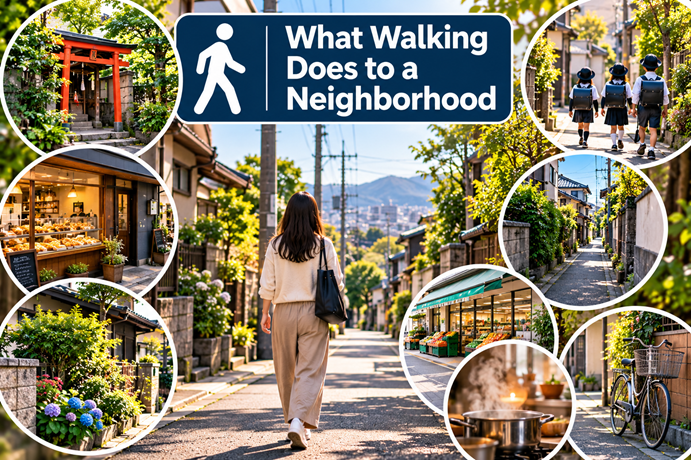
There is also something psychological about a town that can be experienced on foot.
When you drive everywhere, the neighborhood becomes a sequence of destinations. You leave one place, enter a vehicle, travel through the space in between, and arrive somewhere else.
When you walk, the space between destinations becomes part of your experience.
You notice the small shrine that you never knew existed.
You see a neighborhood bakery.
You notice that one house has changed its garden.
You see children walking home from school.
You discover a narrow street.
You realize that the supermarket is closer than you thought.
You notice the smell of someone’s cooking.
You hear the sound of a bicycle.
You begin recognizing the same people.
Walking does not simply reduce transportation costs or emissions. It changes what the neighborhood means.
The journey itself becomes part of everyday life.
This connects directly to the previous article in the Neighborhood Series about the quietness of Japanese residential areas. A quiet street is one thing, but a quiet street that people regularly walk through is something else. It remains a living public space.
🌏 The Deeper Story: Japan Built Everyday Life Around Connections
Perhaps the simplest way to understand walkable towns in Japan is to stop thinking about individual transportation methods and start thinking about connections.
A house connects to a neighborhood street.
The neighborhood street connects to a local shop.
The local shop connects to a larger shopping area.
The residential area connects to a station.
The station connects to a railway line.
The railway line connects to another town.
A bus connects the outer neighborhood to the station.
A school connects children to the neighborhood.
A shopping street connects commerce to daily life.
None of these elements has to be extraordinary on its own.
What matters is that they connect.
This is why the station-centered structure of Japan is more important than the simple fact that Japanese people use trains. The train works because the surrounding town works with it.
You can have a railway station without having a walkable neighborhood.
You can have buses without having walkable streets.
You can have shops without having a usable transportation network.
Japan’s interesting achievement is the way these pieces have often been layered together over long periods of urban development.
The result is not perfect, and it does not exist everywhere, but in many places the system works well enough that you can live an ordinary life without constantly thinking about transportation.
And perhaps that is the greatest sign that a transportation system is successful.
You stop noticing it.
🧭 A Different Way to Compare Japan With the United States
When I think back to my life in the United States, the difference is not that one place allowed me to live and the other did not.
Both worked.
They simply gave me different maps of daily life.
In the United States, the map was often something like this: home, garage, road, parking lot, destination, parking lot, road, garage.
The car was the connection between almost every point.
In Japan, the map can look more like this: home, neighborhood street, station, train, another station, another neighborhood, and then perhaps another short walk or bus ride.
Your feet and the railway become the connection.
Neither map is automatically better.
The American version can give you enormous freedom of movement, private space, easy access to large stores, and the ability to carry almost anything.
The Japanese version can give you the ability to live close to services, move between neighborhoods without driving, and participate in a city without having to operate a vehicle for every ordinary journey.
What becomes fascinating is that you can live both ways and then realize that each one shapes your sense of distance.
In a car-centered environment, two miles may feel close because you can drive there in a few minutes.
In a railway-centered environment, two miles may feel quite different because the station, the train, and the surrounding neighborhood determine how easily you can cross that distance.
The physical distance has not changed.
Your relationship with it has.
🌿 A Walkable Town Is Really a Town That Gives You Choices
This may be the most useful way to think about the Japanese experience.
A truly livable neighborhood is not necessarily one where everyone walks.
It is one where walking is practical enough that you have a choice.
You can walk to the station.
You can take the train.
You can use a bus.
You can ride a bicycle.
You can drive when you need to.
You can walk to the supermarket instead of driving.
You can take the train to work instead of sitting in traffic.
You can use a car for a large shopping trip but not need it for a small one.
That flexibility matters.
Japan’s railway-centered towns did not create a world without cars. They created many places where the car does not have to be the default answer to every question.
And that changes everyday life in ways that are easy to overlook.
You may not think about transportation when you walk to the station.
You may not think about urban planning when you buy groceries at the supermarket near your home.
You may not think about public infrastructure when you take a local train.
You simply live.
That is exactly why the structure is so powerful.
🇯🇵 Why Japan Can Feel So Walkable
So, why are Japanese towns so walkable?
There is no single answer.
It is not simply because Japanese people like walking. It is not simply because Japan has good trains. It is not simply because cities are dense. It is not simply because cars are less important.
The larger story is that railways, stations, housing, shops, schools, buses, and neighborhoods have often developed as parts of an interconnected system. Japan’s long history of railway-centered urban development helped create towns in which stations are not isolated transportation facilities but organizing points for residential and commercial life.
That is also why the comparison with America is more interesting when it is based on personal experience rather than judgment.
I remember the convenience of my American life. I remember driving from the garage to school, work, supermarkets, and other destinations. I remember how easy it was to carry things, how easy it was to travel long distances, and how natural it felt to simply get into the car and go.
I also know what it feels like to live in Japan, step outside, walk through a residential neighborhood, reach a station, take a train, walk through another neighborhood, and return home without needing a car at all.
Neither experience was necessarily better.
But they taught me that a town can organize everyday life around completely different assumptions.
One can ask, “Where is your car?”
The other can quietly ask, “Where is your nearest station?”
And once you start noticing that difference, you begin to see Japanese neighborhoods in a completely new way.
The walkable Japanese town is not just a collection of streets where people happen to walk.
It is the visible result of a much deeper relationship between transportation and everyday life.
The railway did not simply carry people through the town.
In many places, it helped shape the town itself.
🔗 Continue Exploring How Japanese Neighborhoods Shape Everyday Life
The quietness of a Japanese residential street and the ability to move through it without a car are actually two sides of the same story: how people share, use, and move through everyday space.
👉 Why Do Japanese Residential Neighborhoods Feel So Quiet? The Sound of Everyday Life in Japan
👉 Why Are There Jizo Statues on Japanese Street Corners?
👉 Why Do Japanese Neighborhood Shopping Streets Still Matter? More Than Places to Shop
👉 Why Are Japanese Neighborhoods So Different Near Train Stations? The Hidden Structure of Everyday Japan (2026 Guide)