
🍜 What Is Gotouchi Gourmet?
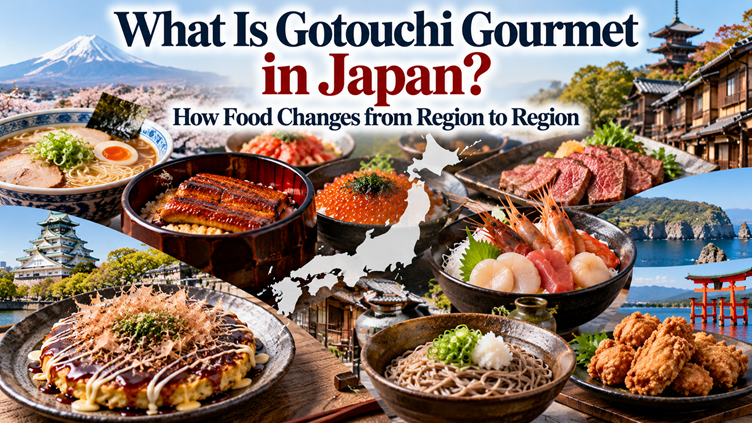
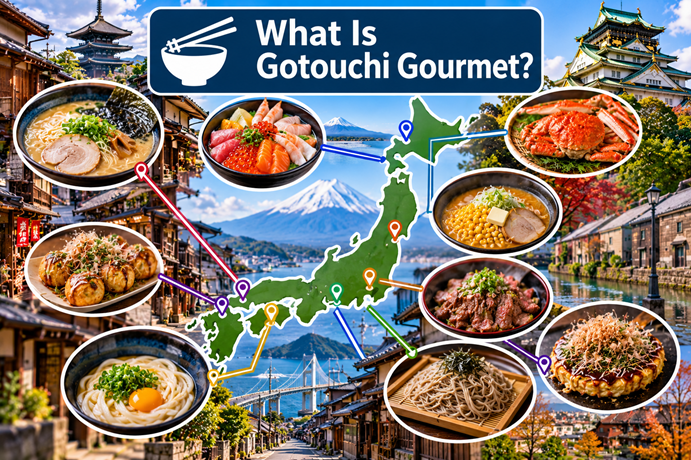
There is a particular kind of food experience that can turn an ordinary trip into something you remember for years. You hear that a certain town is famous for one dish, or that a particular region has a specialty that you should try while you are there, and suddenly the food becomes part of your reason for going. You are no longer simply visiting the place and deciding what to eat after you arrive. You are beginning to think about the place through its food. In Japan, this relationship is often expressed through the idea of gotouchi gourmet, a broad term for food that is strongly associated with a particular region, city, town, or place. The English translation “local food” is useful, but it does not quite capture the feeling of the Japanese word gotouchi, which carries the sense of something belonging specifically to a certain place.
Gotouchi gourmet can include traditional dishes that have been eaten for generations, local ingredients, regional styles of cooking, inexpensive everyday foods that became famous, restaurant dishes that developed a strong local identity, and newer specialties that have become closely connected to a particular town. Some are deeply rooted in history. Others are surprisingly modern. Some are dishes that local families have made for generations, while others may be foods that became famous through restaurants, festivals, tourism, or local promotion. What connects them is the idea that the food and the place are difficult to separate.
That makes gotouchi gourmet something more than a list of famous Japanese dishes. It is a way of understanding the country through geography, history, movement, memory, and local identity.
And there is an important question behind all of this: why does Japan seem to have so many foods that are associated with such specific places?
The answer begins with geography, but it certainly does not end there.
🌎 Japan Is Not the Only Country With Regional Food
Before talking about what makes Japan interesting, it is important to say something that sometimes gets lost in articles about Japanese food: Japan is not unique in having regional cuisine.
I have personally experienced this outside Japan, and some of my strongest food memories actually come from the United States.
I still remember eating clam chowder in Boston. It was not simply a bowl of soup that happened to be available while I was traveling. The place was part of the experience. I was in Boston, surrounded by the atmosphere of the city, eating a food that felt deeply connected to New England and its relationship with the sea. I have eaten many foods in many countries, but that particular bowl of clam chowder became one of those meals that stays in your memory long after the trip is over. I suspect I will remember it for the rest of my life.
That is exactly what local food can do.
The same thing happened to me with American hot dogs. A hot dog sounds like one simple category until you travel around the country and realize how differently it can be interpreted. The sausage can be prepared differently, the toppings can change, the sauce can change, the bread can change, and sometimes the entire personality of the food changes with the region. You may encounter a sausage that is grilled, another preparation that is fried, one place that emphasizes a particular sauce, another that has its own combination of toppings, and another where the surrounding food culture has turned the hot dog into something almost completely different from what you expected.
Hamburgers work the same way. So do steaks. The cut, seasoning, cooking method, degree of doneness, sauce, side dishes, and the culture surrounding the meal can vary dramatically from region to region. Once you have spent enough time in the United States, it becomes difficult to think of “American food” as one single thing.
There is regional America.
There is regional Canada.
There is regional France, regional Germany, regional Italy, regional Spain, regional Mexico, regional China, regional India, and countless other examples around the world.
So when we talk about Japanese regional food, the point is not that Japan invented the concept.
It did not.
The more interesting question is why Japan developed such a dense and highly recognizable relationship between food and specific places, and why the idea of traveling specifically to eat a local specialty became so deeply embedded in domestic travel culture.
That is where Japan becomes particularly fascinating.
🗺️ Japan Is a Country Where Geography Changes Quickly
Part of the answer is simply that Japan has an extraordinary variety of geographical environments compressed into a relatively narrow country.
Japan stretches a long distance from north to south. It includes snowy northern regions, subtropical Okinawa, Pacific coastlines, Sea of Japan coastlines, inland seas, extensive mountain ranges, river valleys, plains, basins, and volcanic landscapes. Mountains occupy much of the country, while towns and cities often developed in plains, valleys, basins, coastal areas, and other places where people could build communities and cultivate food.
This matters because food is never just about what people “like.”
Food begins with what can be grown, caught, raised, gathered, preserved, transported, and cooked.
A fishing community has a different relationship with food from an inland farming village. A snowy region has different preservation challenges from a warm coastal region. A mountain community may historically rely on foods that can be dried, pickled, fermented, or stored. A fertile plain can support crops that are difficult to grow elsewhere. A port can receive ingredients from distant places that an inland village may rarely encounter.
The closer you look, the more geography becomes visible in the food.
And Japan is especially suited to producing these differences because the landscape changes so dramatically over relatively short distances.
You can travel from the sea into the mountains in a surprisingly short time. You can move from a major urban center into agricultural countryside. You can leave a coastal region and enter a snow country. You can cross a mountain range and find that the ingredients, preservation techniques, and flavor preferences of the local community have changed.
The food map begins to follow the physical map.
⛰️ Mountains Did Not Simply Isolate Japan
It would be easy to say that Japan has many local foods because mountains isolated different communities from one another.
That explanation contains some truth, but it is far too simple.
People in Japan were never completely cut off from one another. Roads connected communities. Merchants traveled. Products moved. Coastal shipping connected ports. Travelers crossed mountain passes. Religious pilgrims moved between regions. Major highways connected important towns. Later, railways and modern roads dramatically increased mobility.
The mountains did something more interesting than simply isolating people.
They created different environments next to one another.
A mountain community could face a different agricultural reality from a coastal community only a relatively short distance away. A town on one side of a mountain range could develop a different food tradition from a town on the other side. A snowy region might develop a sophisticated preservation culture because winter created very different storage challenges. A coastal town could develop food traditions based on local seafood, while an inland community developed dishes around grains, vegetables, fermented products, or preserved foods.
These differences accumulated.
A practical solution became a habit.
A habit became a recipe.
A recipe became a local specialty.
A local specialty became part of regional identity.
And eventually, that identity could become something outsiders recognized as “the food from that place.”
🏯 The Old Regional Divisions of Japan Also Mattered
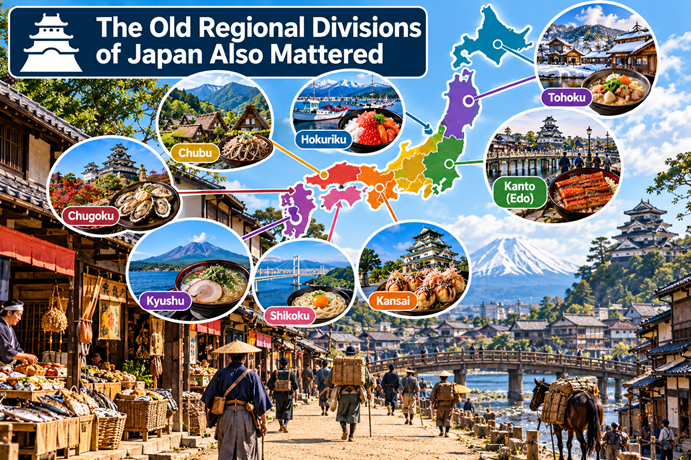
Geography alone is not enough to explain the density of Japanese regional food culture. History matters just as much.
During the Edo period, Japan was governed through a system of domains, and the country contained many regions with their own castle towns, economic bases, agricultural products, industries, and political identities. It would be misleading to imagine those domains as completely independent countries, but their local economic and administrative structures helped reinforce regional identities.
A domain could have particular agricultural products.
Another could become important for brewing.
Another could have access to a major fishing area.
Another could specialize in a particular craft or commercial product.
Another could develop a famous castle town with a distinctive urban food culture.
These regional economies were not sealed off from each other. In fact, people and goods moved constantly. The system of official travel and the development of major highways created connections between regions, while Edo itself became an enormous market where people from different parts of the country interacted.
This is actually one of the most interesting parts of the story.
Japan did not develop regional food diversity simply because people never met one another.
Regional differences survived even in a country where people, products, techniques, and ideas were moving.
Exchange did not necessarily erase local identity.
Sometimes it strengthened it.
A region became known for something partly because it participated in a larger network. A product could travel beyond its place of origin, gain a reputation, and eventually make people curious about where it came from.
In that sense, regional food and mobility are not opposites.
They are connected.
🚶 Roads, Travelers, and Food Helped Create Local Identities
Long before modern tourism, people traveled for practical reasons. Merchants moved goods. Officials traveled between territories. Religious pilgrims moved along established routes. Travelers needed inns, meals, snacks, and supplies.
A road therefore did more than carry people.
It carried food culture.
A town located on an important route could become known for a particular product or dish. Travelers tried the food, talked about it, brought products home, and told others about it. Local producers had an economic reason to preserve what made their product distinctive.
The relationship between food and travel began long before the modern tourist industry.
This is one of the reasons that the idea of “going there to eat it” feels so natural in Japan today.
The modern version is different from the old one, of course. Today people travel by train, highway, airplane, and car, and social media can make a local specialty famous in a matter of days. But the underlying relationship is older: food gives a place an identity, and that identity gives travelers a reason to stop there.
🧂 Why Seasoning Can Change Across Japan
One of the easiest ways to notice regional differences in Japanese food is seasoning.
Visitors often encounter the broad distinction between eastern and western Japan, particularly in the use of soy sauce and dashi. Kanto cooking became strongly associated with darker-colored koikuchi soy sauce, while Kansai cuisine became known for greater use of lighter-colored seasonings that could preserve the appearance of ingredients.
But this should not be reduced to “East is salty and West is light.”
The real story is more subtle.
Color, saltiness, sweetness, dashi, aroma, and the way a seasoning interacts with the ingredient all matter. Regional tastes developed through the availability of ingredients, local production, historical preferences, and urban food culture.
Even something as simple as a bowl of noodle soup can therefore reveal where you are.
The noodles may look familiar.
The ingredients may look familiar.
But the broth can tell a different regional story.
This is one reason Japanese food is so useful for understanding the country geographically. The differences are not always dramatic enough for a casual visitor to notice immediately, but once you start paying attention, the details accumulate.
Japan does not have one national taste.
It has layers of regional taste.
🍶 Miso, Soy Sauce, and Fermentation Created Regional Flavor Worlds
Perhaps nothing demonstrates this better than fermented foods.
Miso and soy sauce are familiar throughout Japan, but their production methods, ingredients, maturation, color, texture, sweetness, saltiness, and regional preferences vary. Fermentation allowed communities to transform simple agricultural ingredients into foods that could be stored and used over long periods, while local production conditions and traditions shaped the final flavors.
Once a regional seasoning became part of everyday cooking, it influenced everything around it.
The seasoning affected soups.
It affected noodles.
It affected sauces.
It affected meat and fish.
It affected vegetables.
Eventually, local people could develop a sense that a particular taste simply felt like home.
That is how ingredients become culture.
A seasoning is no longer just something added to food.
It becomes part of the flavor memory of a place.
🍤 The Sea Created Different Food Cultures From the Mountains
Japan’s coastline adds another enormous layer to this story.
A coastal community lives with the rhythm of the sea. What can be caught changes seasonally. Different ports have access to different catches. Freshness matters. Preservation matters. Markets matter. Transportation matters.
A fishing port may become famous for one species.
Another may develop a particular method of preserving seafood.
Another may create a local sushi tradition.
Another may turn its catch into a festival food.
A mountain community, meanwhile, may have an entirely different culinary history.
The result is not simply that “coastal Japan eats more fish.”
It is that the sea becomes part of local identity.
This is why eating seafood in a port city can feel so different from simply ordering the same species of fish somewhere else. The food is connected to the economic and cultural history of the place.
The same principle applies to agriculture.
Rice, wheat, buckwheat, vegetables, fruit, livestock, tea, dairy, and other products become local identities when production, landscape, tradition, and reputation reinforce one another.
🥢 Traditional Regional Cuisine and Modern Gotouchi Gourmet Are Not the Same Thing
This distinction is important because “local food” in Japan covers several different layers.
There are traditional regional dishes that were deeply connected to local life, seasonal events, agricultural cycles, festivals, religious traditions, or household cooking.
Then there are foods that became famous as inexpensive local favorites. These are sometimes described through the expression B-kyu gourmet. The “B” does not mean poor-quality food. It refers more to approachable, inexpensive, everyday food rather than luxury cuisine.
A bowl of noodles eaten at a small local restaurant can become a symbol of an entire city.
A simple fried dish can become something visitors deliberately seek out.
A local curry can become part of regional identity.
A particular style of noodles can become inseparable from the name of a prefecture or town.
These foods may not have ancient histories.
And they do not need to.
Food culture is always changing.
A dish does not have to be hundreds of years old to become meaningful to a community. Sometimes local identity is created in one generation.
This is one of the reasons the concept of gotouchi gourmet remains alive rather than becoming a museum of old recipes.
🇺🇸 The Same Thing Happens in America — and That Is What Makes the Comparison Interesting
My experience in the United States makes me especially cautious about saying that Japan is somehow uniquely regional in its food.
American food culture is incredibly regional.
Clam chowder immediately creates a sense of place. Even before someone tells you exactly where they are from, the dish itself can evoke a particular part of the country. My own experience of eating clam chowder in Boston is inseparable from Boston in my memory. The food and the location have become one experience.
Hot dogs provide another example.
Once you travel across the United States, you realize that “a hot dog” is not really one thing. Different cities and regions have their own expectations about the sausage, the cooking method, the toppings, the sauce, the bread, and the way the food is served. In some places the sausage is grilled, in others it may be prepared differently, and the combination of mustard, onions, chili, relish, cheese, or other toppings can completely change the character of the dish.
Hamburgers also tell a regional story.
The meat may be seasoned differently.
The bun may be different.
The toppings may be different.
The cooking method may change.
The size may change.
The surrounding side dishes may change.
Even the idea of what makes a “good burger” can be influenced by the region.
Steak offers the same lesson from another direction. The cut, seasoning, cooking temperature, sauce, side dishes, and the way the meal is presented can vary considerably.
None of this means America lacks a national food culture.
It means that a national food culture can contain many regional food cultures.
Japan is exactly the same in principle.
The interesting question is how fine the map becomes.
🧭 The Difference Is Not “Japan Has Regional Food”
This is where I think many explanations of Japanese local food stop too early.
They say Japan has regional cuisine.
Yes.
So does almost everywhere else.
They list ramen here, okonomiyaki there, udon somewhere else, and a seafood dish somewhere else.
That tells the reader what exists, but it does not really explain why.
The more interesting observation is that in Japan, the connection between place and food can remain surprisingly precise.
A dish can be linked to a prefecture.
Then a city.
Then a particular local style.
Sometimes even a particular neighborhood, restaurant district, festival, or railway station.
And people understand that connection.
They use the name of the place as part of the identity of the food.
That is a different level of geographical labeling.
This is also why the Japanese idea of gotouchi is not simply about ingredients.
It is about belonging.
The food belongs to this place.
And because it belongs to this place, going there to eat it becomes meaningful.
🚉 Japan Turned Local Food Into Part of the Journey
This is where Japan’s transportation history becomes especially important.
Japan developed an extensive railway network that connected cities and regions while maintaining strong station-centered local communities. As rail travel became part of ordinary life, food naturally entered the experience of movement.
The most famous example is the ekiben, the regional boxed meal sold at stations.
An ekiben can contain local ingredients, local specialties, or foods associated with the surrounding area. The traveler may open the box on the train, look out at the landscape, and eat something that represents the place they are passing through.
That is a remarkable relationship between food and transportation.
The journey itself becomes part of the meal.
The same idea exists at highway service areas and roadside facilities, where regional foods can become part of the reason people stop.
So Japan developed something more than a culture of regional food.
It developed a culture in which regional food accompanies movement through the country.
You travel.
You eat.
You discover the region through food.
And then the food gives you another reason to remember the place.
🧳 The Souvenir Is Also a Piece of the Regional Food Map
There is another part of this system that is easy to overlook: the food you take home.
A trip to a Japanese town often ends with some kind of food souvenir. It might be a local sweet, a packaged snack, noodles, seasoning, preserved food, tea, rice crackers, seafood product, or another specialty.
The item is not necessarily valuable in a financial sense.
Its importance comes from the place.
You bought it there.
That makes it part of the memory of the trip.
You can give it to somebody else and say, “I bought this in this town.”
The food becomes a small piece of geography.
In that sense, Japanese food tourism has another fascinating characteristic: the local flavor can travel home with you.
You do not simply visit the place.
You bring part of the place back.
🍚 Why Ordinary Food Can Become a Regional Symbol
One of the things I find most interesting about Japanese gotouchi gourmet is that the food does not have to be sophisticated.
A luxury restaurant can represent a city.
But so can a bowl of inexpensive noodles.
A simple noodle dish can become more famous than a complicated dish because people have eaten it for generations, because local residents identify with it, and because visitors learn that they should try it when they arrive.
This reveals something important about food culture.
Luxury tells us what people can afford.
Everyday food tells us what people actually eat.
And when everyday food becomes a local specialty, it preserves something about ordinary life.
That is why local ramen, udon, curry, fried foods, pancakes, rice dishes, soups, and other inexpensive foods are culturally valuable.
They are not merely “cheap versions” of something more prestigious.
They are records of everyday life.
🌿 Food Can Be a Record of How People Adapted to Their Environment
Many traditional local foods began as practical responses to local conditions.
How do you preserve something when winter is long?
How do you use an ingredient that is abundant for only part of the year?
How do you feed a large group of people?
How do you make food from what grows locally?
How do you preserve fish before modern refrigeration?
How do you use leftovers?
How do you ferment something so it lasts longer?
How do you make something nutritious from inexpensive ingredients?
The answers to these questions can eventually become dishes.
And once those dishes survive for generations, the original practical reason may be forgotten while the food remains.
People no longer think, “We eat this because our ancestors had a storage problem.”
They simply say:
“This is what people here eat.”
That is how practical knowledge becomes tradition.
🏯 A Town Can Tell Its History Through Food
This is why regional food is so useful for understanding Japan.
Take a port city.
The food may reveal the fishing industry, maritime trade, and access to seasonal seafood.
Take a castle town.
The food may reveal the economic structure of the former domain and the tastes that developed around the urban population.
Take a mountain village.
The cuisine may reveal preservation, forestry, agriculture, and the challenge of winter.
Take an old highway town.
Its food may reveal centuries of travelers passing through.
Take a modern industrial city.
Its local specialty may reveal migration, mass production, postwar food culture, or the influence of a particular industry.
Food is therefore historical evidence in an extremely accessible form.
You do not need to read an academic book before understanding that a town has a relationship with fish.
You can eat the fish.
You do not need to study every detail of a region’s agricultural history before realizing that a local product depends on what grows there.
You can taste it.
Food makes history tangible.
🌊 Okinawa Shows Just How Different a Food Culture Can Become
Okinawa is particularly useful for understanding the depth of regional variation because its culinary history developed through a different historical path from mainland Japan.
The Ryukyu Kingdom had extensive connections with China and other parts of East and Southeast Asia. Its geographical position created a food culture shaped by trade and exchange, while the islands’ subtropical environment produced ingredients and culinary traditions different from those of much of the Japanese mainland. The postwar period then added another layer through American influence.
The result is a cuisine that immediately demonstrates why “Japanese food” cannot be reduced to one national template.
Okinawan food belongs to Japan today, but its historical path is distinct.
That is precisely the point.
A country’s food culture can contain many histories inside it.
🍜 From Traditional Cuisine to “Local Gourmet”
Modern gotouchi gourmet also demonstrates something else about Japanese culture: tradition does not have to remain exactly as it was.
A local dish can be modernized.
A restaurant can reinterpret it.
A town can promote it.
Tourists can discover it.
A local festival can turn it into an event.
A dish can become packaged and sold as a souvenir.
A regional food can become part of a city’s branding.
None of this means the food is fake.
It means food culture is alive.
There is a tendency to think of “traditional” as the opposite of “modern,” but Japanese local food often exists somewhere between the two. A dish may have old ingredients and a modern presentation. A traditional flavor may appear in a new dessert. A once-local everyday dish may become a tourism symbol.
The place continues to matter even as the food changes.
That is what allows gotouchi gourmet to keep expanding.
🚄 Why the Destination Can Become Part of the Taste
This may be the most beautiful part of the relationship between regional food and travel.
Imagine eating a dish somewhere else in Japan.
It may be very good.
The ingredients may be correct.
The recipe may be similar.
But then imagine eating the same kind of food after traveling several hours to the place it is associated with.
You step out of the station.
You see the local streets.
You notice the climate.
You see the mountains or the sea.
You hear the local accent.
You smell the air.
You walk into a small restaurant.
And then you eat.
The food has absorbed the experience around it.
That is why my Boston clam chowder remains such a strong memory.
The memory is not only the soup.
It is Boston.
The place, the journey, the atmosphere, and the food became one event.
That is exactly what a strong regional food culture can do anywhere in the world.
Japan simply developed this relationship at an unusually detailed geographical scale.
🗾 Japan Is a Country of Many Food Maps
If you look at Japan only from a distance, you see one country with one famous cuisine.
If you look more closely, you see regions.
Look closer again, and you see prefectures.
Look closer still, and you see cities, towns, ports, valleys, mountain communities, shopping streets, festivals, and individual local specialties.
The closer you look, the more the food changes.
That is what makes Japanese local food so interesting.
The country is not a single menu.
It is a collection of overlapping food maps.
One map is geographical.
Another is historical.
Another follows old political boundaries.
Another follows climate.
Another follows transportation.
Another follows agricultural production.
Another follows local memory.
And all of those maps meet on the plate.
🇯🇵 So Why Does Japan Have So Much Gotouchi Gourmet?
There is no single reason.
Japan’s geography created many different environments. Mountains, seas, plains, valleys, islands, and climate differences produced different ingredients and different ways of living.
Historical regional organization helped reinforce local identities without completely cutting regions off from one another. Roads, ports, markets, and later railways allowed people and products to move, which meant regional specialties could become known outside their place of origin.
Local agriculture and fishing created different raw materials. Fermentation and preservation turned those materials into regional flavors. Towns developed around trade, industry, agriculture, fishing, administration, and transportation. These communities created food habits that became part of local identity.
Then modern transportation and tourism added another layer.
People could travel more easily.
Local foods could become known nationally.
Visitors could deliberately seek them out.
Stations could sell regional meals.
Roadside stops could showcase local specialties.
Souvenirs could carry the flavors home.
A food could move beyond the local population without losing its association with the place that created it.
That is the system that produced today’s remarkable world of gotouchi gourmet.
❤️ The Real Power of Local Food Is Memory
In the end, perhaps the most important reason regional food matters is not history or geography.
It is memory.
A place becomes memorable because of what you did there.
And food is one of the strongest ways human beings remember.
The soup you ate on a cold day.
The noodles you discovered after getting off a train.
The seafood you ate near the harbor.
The hot dog you tried in an American city.
The steak cooked exactly the way you liked it.
The clam chowder you still remember years later.
These experiences become part of the geography inside your own memory.
That is why a good local food culture can change the way you travel.
You stop asking only, “What is there to see?”
You start asking:
“What does this place taste like?”
And that is an entirely different way of discovering a country.
🌏 Gotouchi Gourmet Is More Than a List of Famous Foods
Japan’s regional food culture is sometimes presented as a convenient list: eat this in Hokkaido, this in Aichi, this in Hiroshima, this in Fukuoka, and this in Okinawa.
But the real story is much deeper.
The food is the visible part.
Behind it are mountains and coastlines, agricultural fields and fishing ports, old roads and castle towns, local industries and markets, fermentation techniques and preservation methods, railway stations and travelers, family recipes and local pride.
The famous dish is only the final result.
And this is why Japan’s gotouchi gourmet culture is so fascinating.
The country is not simply full of foods that are different from one another.
It is full of places where food has become a language for describing the place itself.
You can taste the climate.
You can taste the history.
You can taste the economy.
You can taste the local ingredients.
Sometimes, you can even taste the memory of the people who have lived there.
That does not make Japan the only country with remarkable regional food. My own memories of American food prove otherwise. The clam chowder I ate in Boston, the regional variations of hot dogs, and the differences in hamburgers and steaks all taught me the same basic lesson: food can belong to a place.
What makes Japan especially fascinating is how far this idea extends.
The relationship between food and place can remain incredibly detailed, sometimes down to individual towns and local specialties, and that relationship has become deeply connected to domestic travel. People do not simply happen to eat local food when they visit somewhere.
Sometimes they travel because of it.
And that is perhaps the best way to understand gotouchi gourmet.
It is not simply Japanese food with different flavors.
It is the idea that every place can have its own taste.
🔗 Explore More of Japan Through Food
Gotouchi gourmet reveals more than what people eat. It also reveals the history, seasons, landscapes, and everyday life of different parts of Japan. Continue exploring Japan through its food in these related articles.
👉 Japanese Chestnuts in Autumn: 7 Fascinating Chapters from Ancient Japan to Modern Sweets
👉 Japanese University Cafeterias: More Than Lunch for Students
👉 Inside Japan’s Fish Markets: How Seafood Moves from the Sea to Your Table (2026 Guide)
👉 Kanpai in Japan: Why Everyone Raises Their Glass Together Before the Meal Begins (2026 Guide)