
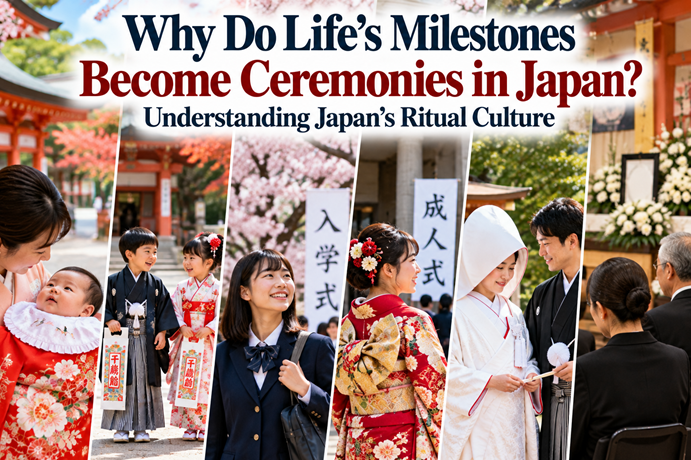
🌏 Why Do Humans Need Ceremonies at All?
A human life is mostly continuous. One day becomes another, one year becomes another, and most changes happen so gradually that there is no obvious moment when one stage ends and another begins. A child does not suddenly become more mature at the exact moment they turn a certain age, and a person does not wake up the morning after graduation feeling like an entirely different person. Yet across cultures, people repeatedly choose certain moments and say, in effect, this one matters.
That is where ceremonies come in.
A baby is welcomed. A child grows older. Someone enters school. Someone leaves school. A young person reaches a socially meaningful age. Two people marry. A family moves into a new home. A new year begins. None of these moments requires a ceremony in a purely practical sense, but humans create ceremonies anyway. We gather people, prepare clothing, arrange a place, follow a sequence, say particular words, give gifts, take photographs, make offerings, share food, sing, pray, bow, shake hands, or simply stand together for a moment. We turn an ordinary point in time into something that can be recognized and remembered.
This is why rituals are not uniquely Japanese. Human beings in every society create rituals around important moments in life. What changes is what people consider a milestone, who takes part, when the ritual happens, whether it is religious, educational, familial, or communal, and how formalized it becomes.
In that sense, rituals put punctuation marks into the flow of life.
Japan is particularly interesting because many different areas of everyday life contain these punctuation marks. There are ceremonies surrounding education, childhood, coming of age, marriage, homes, religious visits, seasonal events, and community life. Some are explicitly religious. Some are strongly connected to schools or municipalities. Some are family traditions.
Some people participate because of faith, while others participate because the event has become part of the rhythm of life. Looking at all of these together can make Japan appear unusually ceremonial, but that impression can be misleading if it turns into the claim that Japanese people care about rituals while everyone else does not. Europe and the United States have their own rich traditions of marking life’s transitions. What becomes fascinating is not who has more rituals, but how different societies decide where to place the punctuation marks.
🕰️ Rituals Turn Continuous Time Into Meaningful Time
Imagine looking at a person’s life without ceremonies. A child is born, grows, enters school, leaves school, becomes an adult, forms relationships, moves into a home, has children, grows older, and eventually dies. The biological and social changes are still there, but there are fewer obvious boundaries between one stage and the next.
Ceremonies create those boundaries.
They tell people that something has changed, even when the physical change is gradual. A graduation ceremony does not magically create a graduate, but it gives a visible ending to years of study. A wedding ceremony does not manufacture a relationship, but it publicly marks a new relationship. A child’s birthday does not produce maturity overnight, but celebrating it tells the family that another year of life has passed. A housewarming does not make a building a home by itself, but it can transform a new address into a shared social memory.
This is one reason ceremonies are so powerful. They do not necessarily cause the transition. They name it.
They also allow other people to participate in that meaning. A transition that happens only inside one person’s mind is private. A ceremony makes it social. Parents, grandparents, teachers, friends, relatives, neighbors, religious communities, and institutions can all say, in their own way, “We recognize this moment with you.”
That is why even very simple rituals can remain in memory for decades.
👶 Birth: Omiyamairi and Baptism Do Not Mean the Same Thing, But They Answer a Similar Human Need
One of the earliest examples can be found after a child is born. In Japan, some families participate in Omiyamairi, a visit to a shrine associated with welcoming and blessing the newborn. The precise timing and customs vary between families and regions, and modern families may approach the tradition very differently from one another.
In Christian communities in Europe and elsewhere, baptism or christening can serve as an important ceremony connected with the arrival of a child into a religious community. The theological meaning is very different from a Japanese shrine visit, and it would be misleading to treat the two as equivalent. One belongs to a Christian religious framework, while the other comes from a Japanese religious and cultural tradition with its own history and meanings.
Yet there is a broader human similarity that is worth noticing. A new child has arrived, and the family does not simply allow the moment to pass unnoticed. A ceremony gathers people around the child and gives the beginning of the child’s life a social and symbolic form.
This distinction between shared function and different meaning is important throughout the entire subject. Rituals across cultures often answer similar human needs without being interchangeable. They can acknowledge birth, belonging, growth, marriage, death, or a new beginning, while the beliefs surrounding those events remain very different.
That is far more interesting than trying to find one exact Western equivalent for every Japanese ceremony.
👧 Growing Up: Shichi-Go-San and European Religious Milestones
The same pattern appears in childhood.
Japan has Shichi-Go-San, a tradition in which children at specific ages are dressed formally and taken to a shrine as families celebrate their growth. The ages themselves are part of the cultural meaning. The child has reached a recognized stage, and the family stops to acknowledge it.
In parts of Europe, especially within Christian families, ceremonies such as First Communion and Confirmation can mark important stages in religious and personal development. These are not simply birthday celebrations. They can represent a child’s or young person’s changing relationship with the religious community.
The comparison becomes interesting because both systems make development visible, but they organize the milestone differently.
Shichi-Go-San is strongly associated with particular childhood ages. First Communion and Confirmation are connected to religious development and participation. One system emphasizes age-based stages of childhood; another may emphasize religious progression. Both demonstrate the same larger human impulse: growth becomes more meaningful when the community recognizes it.
This is one reason rituals can tell us something about a society. To understand its rituals, you have to ask not only what people celebrate, but what they believe is important enough to deserve a ceremony.
🏫 Entering School: Why Japan’s Entrance Ceremony Feels So Distinctive
Among Japanese rituals, the school entrance ceremony is particularly interesting because it turns the beginning of education itself into a clearly visible event.
A child does not simply show up for the first day of school and begin attending classes. The beginning of the school stage can be marked by a formal ceremony in which new students, parents or guardians, teachers, and sometimes older students gather together. There is a sense that the institution itself is saying, “You are entering this community now.”
That is different from the mere existence of a first day.
The first day happens whether you hold a ceremony or not. The ceremony gives that first day a different status.
This is one reason school entrance ceremonies can feel particularly Japanese to foreign observers. Many societies have welcomes, orientations, assemblies, receptions, and first-day traditions, but Japan has developed a particularly recognizable cultural pattern of marking entry into a school through a formal institutional event.
The deeper meaning is not simply that Japanese people like wearing formal clothes or sitting through speeches. The ceremony makes belonging visible. The child is moving from one educational stage into another, and the family is watching that transition happen in front of an institution.
In that sense, the entrance ceremony is not only about starting school.
It is about being formally received into a new community.
🎓 Graduation Is Almost Universal, Yet It Still Looks Different
If the school entrance ceremony reveals something distinctive about Japan, graduation shows something much more universal.
Japan has graduation ceremonies.
The United States has graduations and commencements.
European countries have their own graduation ceremonies and traditions.
The details vary, but the basic human meaning is remarkably similar. A period of education is ending, an achievement is being recognized, and a person is moving toward a new stage.
This is one of the clearest examples of why it is misleading to describe Japanese society as uniquely ceremonial.
Graduation is a ritual almost everywhere because the underlying human problem is universal: how do you mark the end of something that lasted for years?
Yet even when the milestone is shared, the cultural form changes.
Japanese school graduations can place considerable emphasis on the collective experience of the class, the relationship with teachers, the handing over of certificates, speeches, songs, formal clothing, and the emotional sense that an entire school community is closing one chapter together. In the United States, commencement ceremonies can similarly recognize the completion of education, but they may sit alongside a broader collection of social events and celebrations. Prom, for example, is not a graduation ceremony, but it can become one of the major memories surrounding the end of high school.
This is an important distinction. Japan and the United States are not necessarily choosing different milestones here. They can be marking the same milestone through different combinations of ritual and celebration.
The graduation ceremony says, “This stage is officially complete.”
Another event may say, “Let us celebrate what this stage felt like.”
Both can become part of the memory.
💃 Graduation and Prom: One Milestone, Different Kinds of Memory
This is where the comparison between Japan and the United States becomes especially interesting.
A Japanese student may associate the end of school strongly with the graduation ceremony itself, along with club memories, class memories, farewell events, photographs, and perhaps a gathering afterward. An American student may have graduation or commencement, but also remember Prom as a major social event associated with the closing chapter of high school.
Prom is not simply an American version of a graduation ceremony, and treating it that way would miss its character. It is a social and celebratory event, often centered on dressing formally, spending an evening with friends, dancing, photographs, and creating a shared memory of youth. Its significance comes partly from the fact that it represents the social experience of school rather than the formal awarding of a diploma.
This distinction tells us something broader about ritual.
A society does not need one ceremony to perform every function.
One event can mark the official transition.
Another can create emotional memory.
Another can bring friends together.
Another can involve families.
Rituals can therefore form systems.
Japan and the United States may both mark the end of school, but the punctuation marks can be placed at slightly different points along the same sentence.
🎉 Coming of Age: Japan, Sweet Sixteen, and Europe
Coming-of-age traditions make cultural differences even more visible because every society has to answer the same basic question: When does childhood begin to give way to adulthood?
There is no universal answer.
Japan has a very recognizable coming-of-age ceremony associated with young adults, and the age commonly celebrated in these ceremonies remains an important cultural milestone even though legal adulthood and ceremonial adulthood are not exactly the same thing.
In the United States, Sweet Sixteen is a well-known age-based celebration in some families and communities. Sixteen can carry particular social significance, and the celebration can involve parties, formal clothing, family gatherings, gifts, and the feeling that a young person has reached a new stage.
But Sweet Sixteen is not simply the American equivalent of Japan’s coming-of-age ceremony.
The larger social and legal milestones associated with adulthood in the United States are distributed across several ages. Different rights, responsibilities, and cultural expectations arrive at different points, so there is not necessarily one single ceremony that carries the entire symbolic burden of becoming an adult.
European traditions add yet another layer. In Catholic communities, Confirmation can be a major religious milestone. In Germany, traditions such as Jugendweihe have provided a non-religious coming-of-age ceremony for young people. Other European communities have their own local or religious traditions.
The result is fascinating.
The human question is shared.
When does a child become an adult?
The cultural answer is not.
Some societies tie the answer to an age. Others tie it to religious development. Others distribute adulthood across several legal and social milestones. The ceremony reveals where each society chooses to draw the symbolic boundary.
🏠 Japan’s Groundbreaking Ceremony and the Western Housewarming
Japan’s ritual culture becomes even more interesting when we leave the human body and look at buildings.
A home is not a person, yet the creation of a home can also become a ceremonial event.
In Japan, a groundbreaking ceremony before construction can mark the beginning of a building project. The land, the planned construction, the people involved, and the start of the work are brought together in a formal moment.
In the United States and Europe, a housewarming is more familiar as a celebration connected with moving into a new home. Friends and relatives may be invited to see the new house, share food and drinks, and welcome the household into its new space.
These traditions are not the same.
One generally belongs to the beginning of construction.
The other belongs to the beginning of life in the finished home.
Yet again, the underlying human impulse is recognizable.
A house is not treated as merely a physical structure.
Its beginning is given social meaning.
This is a beautiful example of how rituals can place punctuation marks not only in a person’s life, but in the life of a place.
⛩️ New Year: When a Calendar Change Becomes a Ritual
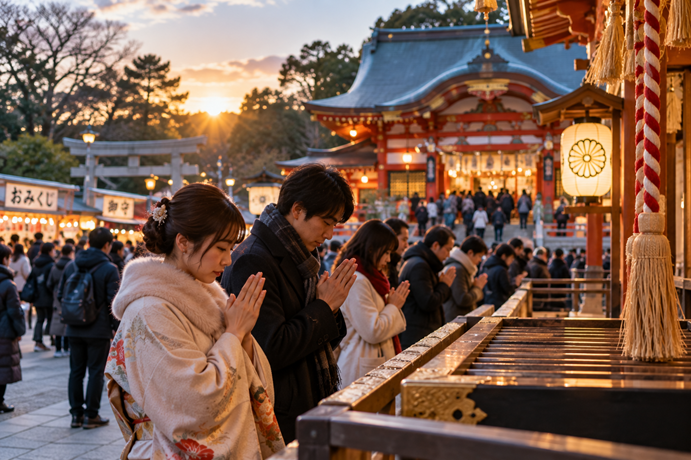
New Year traditions offer another important example because the boundary being marked is not a person’s life stage at all. It is time itself.
In Japan, Hatsumode, the first shrine or temple visit of the new year, has become one of the most recognizable seasonal customs. People may go with family, friends, or on their own. They may pray, make offerings, draw fortunes, obtain charms, or simply participate because beginning the year in this way has become part of their cultural rhythm.
The interesting point is that participation does not always require everyone to interpret the event in exactly the same way.
One person may approach it primarily as a religious act.
Another may think of it as a New Year tradition.
Another may go because their family always goes.
Another may go because they enjoy the atmosphere.
This reveals one of the most interesting features of ritual culture: ritual and religion can overlap without being identical.
Europe has its own New Year traditions, including church services in Christian communities, family gatherings, public celebrations, meals, fireworks, and local customs. But the specific cultural pattern of beginning the year with a first shrine or temple visit is distinctive to Japan.
Again, the shared human function is easy to see.
The old year ends.
The new year begins.
People gather around that boundary and give it meaning.
Another punctuation mark appears.
✝️ Ritual and Religion Are Connected, But They Are Not the Same
It is tempting to divide rituals into two categories: religious rituals and non-religious rituals. In reality, the boundary is often much less clear.
A Japanese family may participate in a shrine-based tradition as part of family culture even if the members do not think of themselves as highly religious. A Christian family may celebrate baptism as both a religious commitment and an important family event. A graduation ceremony may have no formal religious purpose at all, yet it can have a surprisingly solemn structure. A wedding may include religious elements, legal elements, family traditions, and personal choices all at the same time.
This mixture matters because ritual is often stronger when several layers of meaning overlap.
A ceremony can be religious.
It can also be social.
It can also be emotional.
It can also be institutional.
It can also become a memory that people continue to carry long after they stop thinking about the original meaning in detail.
That is one reason it is dangerous to say that one culture is “more ritualistic” than another without asking what counts as a ritual.
If you look only for shrine visits and formal ceremonies, Japan may appear unusually ceremonial.
If you include christenings, confirmations, graduations, weddings, milestone birthdays, civic ceremonies, commemorative events, dances, family celebrations, and other forms of structured social marking, Europe and the United States also reveal a dense ritual landscape.
The difference is not whether rituals exist.
The difference is where they live.
👗 Why Clothes, Photos, Gifts, and Formal Language Matter
Another feature shared by many ritual cultures is the transformation of ordinary behavior.
People dress differently.
They prepare photographs.
They give gifts.
They use special words.
They prepare food.
They gather in specific places.
They follow an order.
These actions may seem superficial when viewed individually, but together they signal that ordinary time has been suspended.
A child wearing formal clothes for Shichi-Go-San looks different from the same child on an ordinary Sunday. A graduate wearing formal clothing looks different from the same student sitting in a classroom the previous week. A young person dressed for a formal coming-of-age celebration looks different from their everyday self.
This physical transformation is part of the ritual.
It tells the participant, “Today is not an ordinary day.”
The same idea appears in Europe and the United States. Graduation gowns, wedding clothes, formal dresses, ceremonial uniforms, religious garments, and special family clothing all perform a similar function.
Clothing does not create the meaning of the ceremony, but it makes the change visible.
You can see the punctuation mark.
👨👩👧 Who Is the Ritual Really For?
One of the deeper questions is whether a ceremony is primarily for the person experiencing the transition or for everyone around them.
A child at an entrance ceremony may be too young to understand the historical and institutional meaning of the event. A newborn obviously cannot understand a birth ceremony at all. A graduate understands much more, but even graduation is partly a message to family, teachers, friends, and the institution.
Rituals work because meaning is shared.
The individual is changing, but other people are acknowledging that change.
Parents may feel the passage of time more strongly than the child does. Teachers may feel the significance of a graduation differently from the student. Grandparents may experience a child’s coming-of-age event as a reminder of an entire family history.
This is another reason rituals can feel emotional.
They are rarely about only one person.
They connect individual time with collective memory.
📸 Why Rituals Create Such Powerful Memories
A normal Tuesday disappears easily.
You wake up.
You go somewhere.
You eat.
You work or study.
You come home.
Another day begins.
A ritual interrupts that ordinary sequence. The clothing is different. The people are gathered. Photographs are taken. Someone gives a speech. Someone hands over a certificate. A family goes somewhere together. Everyone knows that the day matters.
As a result, the memory becomes easier to retrieve.
Years later, people may not remember exactly what happened on the ordinary days surrounding a major transition, but they can remember the ceremony.
The room.
The clothes.
The faces.
The weather.
The flowers.
The music.
The words someone said.
The person standing beside them.
That is another function of ritual.
It does not only mark time while it is happening.
It helps people remember time afterward.
🇯🇵🇺🇸🇪🇺 Japan, the United States, and Europe: The Same Human Question, Different Answers
| Life milestone | Japan | United States | Europe | Shared human function |
|---|---|---|---|---|
| Birth | Omiyamairi and family traditions | Baptism/christening in some Christian families; family celebrations | Baptism/christening in Christian communities and local family traditions | Welcoming a new child and recognizing a new family stage |
| Childhood growth | Shichi-Go-San | Birthday milestones and family traditions | First Communion, Confirmation, and local traditions in some communities | Recognizing growth and changing status |
| Entering school | Formal entrance ceremonies are highly recognizable | First-day events, orientations, assemblies, and school welcomes vary | School and university entry traditions vary by country and institution | Beginning membership in a new educational community |
| Graduation | Formal graduation ceremonies with strong school-community elements | Graduation/Commencement plus other social celebrations such as Prom | Graduation traditions vary widely by country and institution | Closing one stage and moving toward another |
| Coming of age | A recognizable coming-of-age ceremony culture, often associated with age 20 | Sweet Sixteen and multiple legal/social milestones across different ages | Confirmation, Jugendweihe, and other religious or secular traditions | Recognizing growing independence or adulthood |
| Marriage | Religious, civil, and family-based ceremonies | Religious, civil, and highly varied wedding traditions | Catholic, Protestant, civil, and local traditions vary widely | Publicly marking a new relationship and social role |
| New home | Groundbreaking ceremonies can mark the beginning of construction | Housewarming commonly celebrates entering a new home | Housewarming and local traditions vary | Giving social meaning to a new home |
| New Year | Hatsumode and other seasonal traditions | New Year’s celebrations, parties, family gatherings, religious observance | Family, public, religious, and regional traditions vary | Marking the boundary between one year and the next |
The table makes one thing clear: there is no simple line separating a “ritual culture” from a “non-ritual culture.” Every society creates ways of saying that a particular moment matters. What changes is the location of the ritual, its religious or secular framework, its participants, its timing, and its level of formality.
🧭 Why Japan Can Feel Especially Ritualized
If rituals are universal, why can Japan still feel particularly ceremonial to foreigners?
One reason is that Japanese rituals are spread across many different parts of daily and institutional life. School, family, religion, housing, seasonal traditions, local communities, and public institutions can all create recognizable formal moments. A foreign visitor may encounter an entrance ceremony at school, a shrine visit for a child’s growth, a formal graduation, a coming-of-age event, a temple or shrine visit at New Year, and a groundbreaking ceremony for construction, all within completely different areas of life.
Another reason is repetition. A ritual does not have to be rare to feel culturally powerful. When a ceremony happens year after year, generation after generation, it becomes part of the expected rhythm of society. Children encounter it because their parents did. Parents participate because they remember doing it themselves. A ceremony becomes familiar long before anyone starts asking why it exists.
A third reason is the visible structure. Clothing, seating arrangements, greetings, speeches, certificates, bows, photographs, and formal sequences can make the boundaries of an event especially noticeable. The ritual is not merely happening; it looks like a ritual.
But none of this means that Japan has a monopoly on ceremonial life. Europe contains extremely rich religious and civic traditions, while the United States has developed its own mixture of institutional ceremonies, family celebrations, age-based milestones, and social rituals. The interesting difference is that Japan often allows these ritual forms to coexist comfortably with everyday life, including situations where religious and cultural meanings overlap without being identical.
🌏 The Japanese Difference Is Not “More Rituals”
The deeper difference may be less about quantity than about where ritual is placed.
Japan often formalizes transitions that may seem ordinary from a foreign perspective. Starting school becomes an event. Continuing through childhood can be marked at particular ages. Coming of age can be given a public ceremony. The beginning of a building project can receive a ritual. The beginning of the year can be associated with a specific visit and sequence of actions.
In another society, the same underlying transition may be marked differently or divided across several events.
America may separate the formal completion of school from the social celebration of school life. European religious traditions may place more emphasis on stages of faith than on fixed childhood ages. A family in one country may celebrate a milestone mainly at home, while another family participates in a public ceremony.
So perhaps the most useful question is not, “Which society has more ceremonies?”
It is:
What does each society feel deserves a ceremony?
That question leads somewhere much more interesting.
✍️ Rituals Put Punctuation Marks Into the Flow of Life
Think about a sentence with no punctuation.
The words continue one after another without clear pauses.
Human life is not quite like that, but it can feel that way. Days accumulate. Years pass. Children grow. Students move through schools. People change jobs, homes, relationships, and responsibilities. Much of life happens gradually.
Rituals interrupt the flow.
They create a comma.
A pause.
Sometimes a full stop.
Sometimes a new paragraph.
The entrance ceremony says, “This stage begins.”
The graduation ceremony says, “This stage ends.”
The coming-of-age ceremony says, “You have reached another point in life.”
A wedding says, “This relationship now has a new public form.”
A groundbreaking ceremony says, “This new place is beginning.”
A New Year ritual says, “The old year has ended, and another has begun.”
The biological or practical change may have happened before the ritual or may continue afterward. The ritual does not create the entire reality.
What it does is make the transition visible.
It gives people a moment in which to stop moving forward long enough to recognize where they are.
That may be why rituals survive even in highly modern societies.
Technology can change how people communicate. Buildings can change. Schools can change. Families can change. Religious participation can change.
But human beings still seem to need moments when they can say, together, this matters.
🌏 What Japan Can Teach Us About Ritual
Looking at Japanese rituals from this perspective changes the question.
It is not especially useful to say that Japanese people are simply more traditional, more formal, or more attached to ceremonies. Those labels are too broad to explain the actual diversity of Japanese life.
A better observation is that Japan provides many visible examples of something humans do everywhere: turning transitions into shared events.
What makes Japan interesting is the particular arrangement of those events.
Education has ceremonies.
Childhood has ceremonies.
Coming of age has ceremonies.
Religion has ceremonies.
Homes can have ceremonies.
New Year has ceremonies.
Communities have ceremonies.
Some are solemn. Some are joyful. Some are religious. Some are almost entirely cultural. Some people participate enthusiastically, others casually, and some may not participate at all.
That variety matters.
A ceremony does not have to mean that everyone shares the same beliefs.
Sometimes it simply means that people have agreed, at least for a moment, that a particular point in time deserves to be noticed.
And that may be one of the most useful ways to understand Japanese ritual culture.
Japan is not a society in which only Japanese people know how to create ceremonies.
It is a society in which many ordinary transitions have been given recognizable forms.
When you look closely, those forms reveal something universal.
Human beings do not like important moments to disappear into ordinary time.
We stop.
We gather.
We dress differently.
We say something.
We take photographs.
We remember.
Then we continue.
The ceremony ends, but the punctuation mark remains.
🔗 Explore More About Deep Japan and Japanese Cultural Life
To explore more of the deeper ideas behind Japanese everyday culture, continue with the Deep Japan and Culture/Mind series below.
👉 Why Do Japanese People Say “Ganbatte” So Often? The Encouragement—and Pressure—Behind the Phrase
👉 What Does the Language of Japan Reveal About Its Culture? From Respect to Unspoken Meaning
👉 Why Is Humility So Important in Japan? Understanding the Japanese Aesthetic of Modesty (2026 Guide)
👉 Why Is Japanese Gift Wrapping So Detailed? Understanding Japan’s Packaging Culture (2026 Guide)
👉 Why Do Japanese People Say “Sumimasen” So Much? The Word That Means Sorry, Thank You, and More (2026 Guide)
👉 The Nail That Sticks Out: Finding Individuality Within the Group in Japan (2026 Guide)