
🌏 The First Thing I Noticed in an American Kitchen Was the Space
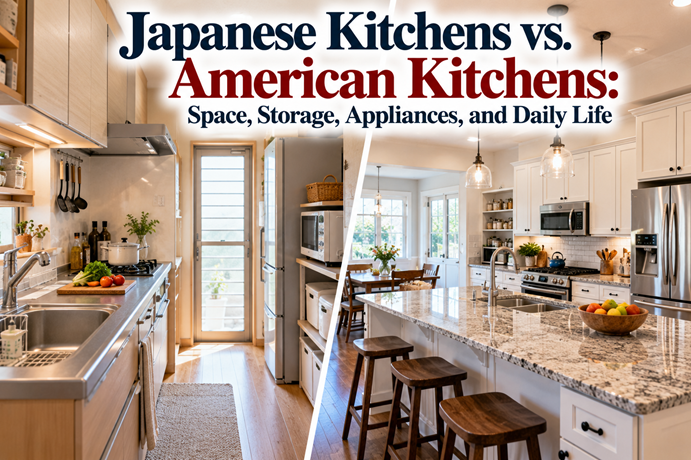
When I first lived in the United States, one of the things that surprised me most was not a particular appliance or cooking method. It was the kitchen itself. It was simply big. There was more room to move, more counter space, more storage, and more space between the major appliances. The cabinets seemed to continue almost endlessly, and the whole kitchen felt as though it had been designed around the assumption that the kitchen would need to hold a lot of things.
Then I started noticing the appliances. The oven was large, and it was built into the kitchen as a substantial piece of equipment rather than feeling like a compact appliance that had been fitted into a limited space. The dishwasher was also built in and large. The microwave could be integrated into the cabinetry or placed above the cooking area rather than taking up valuable counter space. The refrigerator was much larger than the kind I was accustomed to seeing in many Japanese homes, and there was enough storage to keep a surprisingly large amount of food.
At first, these differences just felt like differences in house size. But the longer I lived with them, the more I realized that the kitchen was telling me something about everyday life. The size of the refrigerator affected how much food could be bought at once. The amount of storage affected how much could be kept in the house. The large oven influenced what kinds of cooking felt natural. The dishwasher changed the relationship between cooking and cleanup. Even the garbage disposal under the sink changed what happened to food scraps at the moment they were created.
When I returned to Japanese kitchens, I noticed the opposite side of the same story. Japanese kitchens often use a relatively small space very efficiently. Drawers, cabinets, overhead storage, narrow shelves, appliance racks, and carefully arranged work surfaces all have to cooperate. At the same time, there are uniquely Japanese features that make perfect sense once you think about everyday cooking in Japan, such as the fish grill built into many cooking ranges.
That was when the comparison became much more interesting. It was no longer simply about large kitchens and small kitchens. It was about how a kitchen reflects the way a household shops, stores food, cooks, cleans, and lives.
🏠 A Kitchen Is Designed Around the House Around It
The easiest mistake to make when comparing Japanese and American kitchens is to judge them mainly by size. A larger kitchen naturally feels more spacious, and that can seem more convenient at first glance. But kitchen design is always connected to the amount of space available in the entire home.
In many Japanese homes, especially apartments and condominiums, the kitchen must fit into a relatively compact floor plan. That does not mean that Japanese kitchens are badly designed or that people cannot cook comfortably. Instead, the challenge is different. The kitchen has to perform many tasks without consuming too much of the home’s total space. Cooking, washing dishes, storing food, storing cookware, handling trash, and using appliances all have to happen within a carefully organized area.
This is why Japanese kitchens can contain an impressive amount of equipment in a surprisingly small footprint. A person may have a refrigerator, cooking range, fish grill, sink, microwave oven, rice cooker, toaster, electric kettle, and multiple storage systems all within a relatively short distance of one another. The kitchen may look compact, but the arrangement is often highly practical once you become accustomed to it.
Many American homes give the kitchen more physical room to begin with. That extra space allows appliances to become larger without forcing everything else into a smaller footprint. It also makes it easier to create wide counters, larger cabinets, islands, and separate work areas. What feels like a completely different philosophy may therefore begin with something very simple: the house has more room to give to the kitchen.
This is why comparing the kitchens without looking at the houses can be misleading. A kitchen is not an isolated object. It is one part of a larger housing system.
📦 Storage Changes the Entire Experience
One of the first things that can surprise a Japanese person in an American kitchen is the amount of storage. Large cabinets and drawers can hold cookware, plates, glasses, food, small appliances, and all kinds of things that might require more careful organization in a smaller Japanese kitchen.
In a compact Japanese kitchen, storage often depends on making every available space useful. A drawer under the counter may hold cooking utensils. Another may contain pots or pans. There can be a narrow pull-out section for bottles or seasonings. Overhead cabinets make use of vertical space. Shelves may be fitted above appliances. The area under the sink becomes another storage zone. Even small gaps can acquire a purpose.
This can make Japanese kitchens feel highly optimized. You begin to learn that one drawer is for this, another is for that, and a narrow cabinet that looks almost useless actually holds exactly the items it was designed to contain.
American kitchens can also be carefully organized, of course, but a larger kitchen often provides more room to organize without needing quite the same level of spatial compression. A cabinet can be deep and wide. A pantry can hold large quantities of food. A kitchen island can contain additional drawers and cabinets. The storage system itself can become one of the largest elements in the room.
The difference is therefore not simply “more storage” versus “less storage.” It is two different approaches to the problem of storage. One often starts with a generous amount of space and then organizes it. The other often starts with limited space and finds ways to use nearly all of it.
🍳 The Oven Tells Another Story
One of the clearest differences can be seen in the oven.
In Japan, many households use a combination microwave and oven appliance. This is an efficient solution for homes where counter and floor space are limited. One appliance can perform several functions, and the design allows the household to avoid dedicating a large section of the kitchen to a separate full-size oven.
In many American kitchens, the oven itself is a much more substantial presence. It may be built directly into the range or installed as a large wall unit, and the kitchen often has enough room around it to accommodate that scale without difficulty.
The important difference is not simply capacity. It changes the way the appliance feels in the kitchen.
In an American home, the oven can feel like one of the central architectural elements of the room. It is not something that has been added to the kitchen after the fact. It is part of the kitchen’s basic structure. In Japan, the main cooking area is often more compact, and the oven function may be integrated into a smaller appliance that is expected to perform several jobs.
This can influence cooking habits, but it does not completely determine them. Japanese households absolutely use ovens, and American households cook in many different ways. The point is that the physical design of the kitchen makes some forms of cooking more natural or more convenient than others.
The kitchen does not tell you exactly what people eat.
It tells you what the house is prepared to accommodate.
🔥 Then There Is the Japanese Fish Grill
This is one of those details that can seem completely normal to a Japanese person and unexpectedly specialized to a foreign visitor.
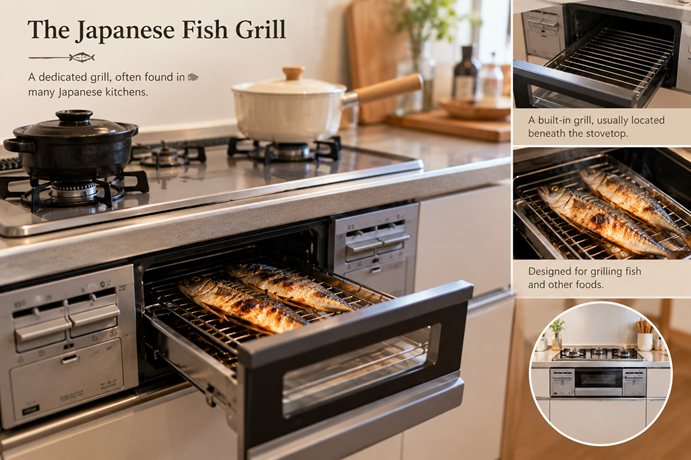
Many Japanese cooking ranges include a grill specifically suited to grilling fish and other foods. It is often located beneath the main stovetop, occupying space that might look unfamiliar to someone who grew up with a different kitchen configuration.
The interesting thing is what this says about everyday cooking. The appliance is not designed around a rare special occasion. It is built into a standard household cooking environment because grilling fish and other foods is familiar enough to justify having dedicated equipment for it.
That does not mean Japanese households are constantly eating grilled fish, and it certainly does not mean every Japanese kitchen has exactly the same setup. But the existence of the fish grill reveals something important about the relationship between cuisine and housing.
A kitchen reflects the kinds of cooking its designers expect a household to perform.
In an American kitchen, a large oven may be one of the most visible signs of that expectation. In a Japanese kitchen, the fish grill can play a smaller but surprisingly distinctive role.
This is one reason kitchen comparisons become more interesting when we stop asking, “Which kitchen has better appliances?” and start asking, “Why are these particular appliances part of the kitchen in the first place?”
🍽️ The Dishwasher Is More Than a Convenience
Another major difference is the dishwasher.
When I lived in the United States, the large built-in dishwasher was one of the features that stood out because it seemed to be treated as a standard part of the kitchen rather than a separate appliance that had to fight for space.
The placement also made sense. It sat directly beside the sink and was integrated into the cabinet line, so dishes could move from the sink into the machine with almost no extra effort. The dishwasher was not just present; the kitchen had been designed around it.
Japanese homes increasingly use dishwashers as well, but the situation can vary much more depending on the house, the kitchen design, and the available space. In a compact kitchen, the size and placement of the dishwasher can become a major design decision. Some homes use built-in models, while others rely on smaller units or do without one.
Again, the interesting difference is not about whether Japanese people wash dishes by hand and Americans use machines. Both countries contain households that do both. The bigger difference is how much physical space the kitchen is prepared to dedicate to the washing process.
A large kitchen can make a full-size dishwasher easy to integrate.
A compact kitchen has to consider whether the dishwasher deserves that space.
That single decision tells you a surprising amount about how the kitchen has been planned.
🗑️ The Garbage Disposal Was a Real Surprise
One of the most memorable differences for me was the garbage disposal.
For someone accustomed to handling kitchen scraps in Japan, the idea of putting certain food waste into the sink and grinding it there can be a genuine surprise the first time you use it. Instead of collecting every small scrap in a container and dealing with it later, the disposal allows certain food scraps to be processed immediately at the sink.
There is something undeniably convenient about that.
When vegetables are being prepared, for example, small scraps do not necessarily have to sit in the kitchen while you continue cooking. The waste can be dealt with on the spot, which keeps the work area cleaner and can reduce the amount of food waste that needs to remain in the household until the next garbage collection.
That changes the rhythm of cooking.
In Japan, food scraps can become part of the household trash system. Depending on local rules and the type of waste, people may drain moisture, bag the scraps, and store them until the appropriate collection day. This creates a small but very real connection between cooking and garbage management.
With a garbage disposal, some of that process happens immediately at the sink.
The difference is therefore much bigger than the appliance itself.
One kitchen system asks, “Where will this food waste go until collection day?”
The other can sometimes answer, “It can be dealt with right now.”
Of course, garbage disposal systems are not universal in the United States, and not all food waste should be put into them. Their use depends on the disposal unit, plumbing system, local infrastructure, and household practice. But the existence of the device itself reveals a different approach to the relationship between cooking and waste.
It was one of those moments when I realized that even something as small as a sink can reflect an entire household system.
🧊 The Refrigerator May Explain the Shopping Cart
The refrigerator was another major surprise, but the more I thought about it, the more it explained something I had already noticed outside the home.
Why could people buy so much food in one shopping trip?
Why did a weekend supermarket run sometimes seem enormous?
Why could someone push a cart through Costco or a large supermarket and fill it with enough food to make a Japanese shopper wonder where it would all go?
The answer is not simply that Americans like to buy a lot.
The house can store it.
A large refrigerator with a substantial freezer provides the physical capacity to bring home more food at once. Large packages, multipacks, frozen goods, drinks, fresh produce, sauces, and other items can be distributed across a refrigerator and freezer that were designed to hold considerably more than a compact unit.
Once you experience that system yourself, the large shopping cart begins to make more sense.
The relationship works in both directions. A large refrigerator makes larger shopping trips easier, while the expectation of larger shopping trips makes a large refrigerator useful.
The connection does not mean that every American household shops in bulk or that every Japanese household shops frequently. Lifestyle, family size, income, neighborhood, transportation, work schedules, and personal preference all matter. But the size and storage capacity of the kitchen clearly make certain shopping patterns easier.
That was one of the things I understood more clearly only after living with the system.
The refrigerator was not just storing food.
It was helping determine how much food the household could comfortably buy at one time.
🛒 Costco Makes More Sense When You Understand the Kitchen
This is why the American kitchen becomes particularly interesting when you connect it to large-format shopping.
Walk through a Costco in the United States and you can see products sold in quantities that would feel excessive if you were imagining a smaller refrigerator, a smaller freezer, and a kitchen with limited storage.
Large packs of food make more sense when there is somewhere to put them.
A household that has enough refrigerator and freezer space can make larger purchases without immediately creating a storage problem.
The kitchen and the supermarket therefore form part of the same system.
The supermarket determines what can be purchased.
The refrigerator determines what can be kept.
The kitchen determines where it can be organized.
The freezer extends the time that food can remain available.
The size of the home makes the entire system easier to accommodate.
Once you look at it this way, the American refrigerator no longer looks like a ridiculously large appliance.
It begins to look like a logical part of a larger lifestyle.
And that is one of the biggest lessons I took from comparing the two countries.
Household appliances are rarely independent objects.
They are connected to shopping, cooking, storage, cleanup, and waste.
🇯🇵🇺🇸 Japanese and American Kitchens at a Glance
| Kitchens | Japanese Kitchens | Many American Kitchens |
|---|---|---|
| Overall space | Often designed to use a relatively compact footprint efficiently | Often more generous in floor, counter, and storage space |
| Storage | Drawers, cabinets, overhead storage, and narrow spaces are used carefully | Larger cabinet systems, pantries, and generous storage are common |
| Main oven | Combination microwave/oven units are common | Large built-in or range ovens are common |
| Fish grill | Built into many Japanese cooking ranges and useful for everyday grilling | Not a standard feature in most kitchens |
| Dishwasher | Available in many homes, but size and installation vary | Full-size built-in dishwashers are common |
| Microwave | Often placed on a counter, shelf, or appliance cabinet | Often integrated into cabinetry or positioned above the cooking area |
| Refrigerator | Size is often balanced against the available kitchen space | Large refrigerators and freezers are common |
| Garbage disposal | Not a standard feature in most Japanese home kitchens | Found in many U.S. homes |
| Shopping and storage | More limited storage can encourage smaller or more frequent shopping trips for some households | Larger refrigerators and freezers work well with larger shopping trips and bulk purchases |
| Kitchen island | Depends strongly on available floor space | Common in many larger kitchens |
| Main design challenge | Making many functions work efficiently in limited space | Organizing a larger space and integrating large appliances |
| Role of the kitchen | Cooking, preparation, storage, cleanup, and efficient use of space | Cooking, preparation, storage, cleanup, and often social or family activity |
The point of the table is not to divide every Japanese and American home into two categories. There are compact American kitchens, large Japanese kitchens, households with no dishwasher, households with very large refrigerators, and almost every variation in between. The useful comparison is the design tendency: Japanese kitchens often have to solve the problem of doing a lot within a limited footprint, while many American kitchens have more space in which to integrate large appliances, storage, and multiple work areas.
🧱 Built-In Appliances Change the Feeling of the Kitchen
Another detail that becomes noticeable after living in both countries is how much of the American kitchen can feel built around the appliances themselves.
The oven is integrated into the cooking area.
The dishwasher disappears beneath the counter.
The microwave may be built into the cabinetry.
The refrigerator can occupy an entire section of the kitchen wall.
The result is that the appliances do not look like individual objects that have been placed around a room.
They look like parts of the room.
This is a subtle but important difference.
In a smaller Japanese kitchen, it is common to become extremely conscious of where each appliance has been placed because every centimeter matters. A microwave, rice cooker, toaster, kettle, or other appliance can compete for counter and shelf space. Apartment kitchens especially may require careful decisions about what can remain visible and where it can be stored.
A larger kitchen has a different luxury: it can absorb the appliances.
The appliances become part of the architecture.
That changes not only appearance but also the way the kitchen is used. When there is enough space for a large appliance without sacrificing the entire workspace, the household has more freedom in deciding what stays permanently installed and what can be moved around.
👨👩👧 The American Kitchen Can Become a Social Space
Large kitchens also change the relationship between cooking and family life.
When there is a wide island or a large amount of counter space, people can stand around the kitchen without necessarily getting in the way of the person who is cooking. Someone can sit at the counter with a drink. Children can work on homework nearby. A family member can talk with the person preparing dinner without standing directly in the cooking area.
This is one reason kitchens in larger American homes can function as social spaces as much as work spaces.
The kitchen can become the center of the house.
That does not mean Japanese kitchens are unsocial. Families in Japan also talk, eat, and spend time around the kitchen. But when the physical space is smaller, the way people gather around it can be different. A compact kitchen may prioritize movement and efficiency, while a larger kitchen can more easily accommodate several activities at the same time.
Again, the house is shaping the behavior.
The difference is not simply cultural preference.
Space creates possibilities.
🍚 Japanese Kitchens Solve a Different Problem
It is easy for someone who has lived in a large American kitchen to return to Japan and think, “Why is this so small?”
But after living with a compact Japanese kitchen for a while, another perspective appears.
Everything is close.
The refrigerator is within easy reach.
The sink, cooking surface, and preparation area are usually tightly connected.
The fish grill is directly below the stovetop.
Storage is organized around the tasks that happen there.
The kitchen may not provide much room for people to wander around, but it often makes the cooking process remarkably direct.
This is the strength of compact design.
You do not necessarily need to walk across the room to move from one task to another.
The kitchen is a concentrated work space.
For some households, that is exactly what they want.
A smaller kitchen is not automatically an inferior kitchen.
It is simply a kitchen that has been asked to solve a different spatial problem.
🥢 The Kitchen Reflects the Food Culture, but Not Perfectly
It is tempting to say that Japanese kitchens are small because Japanese cooking is different or that American kitchens are large because American food requires larger appliances.
Reality is more complicated.
Japanese households cook many kinds of food, including food that requires ovens, frying, boiling, grilling, and microwave cooking. American households also cook an enormous variety of foods, and not every kitchen is large or designed around a huge oven.
The better way to think about it is that kitchen design evolves alongside common household practices.
If a particular appliance is useful to millions of households, it becomes easier to integrate into standard kitchen design.
If homes frequently require a large amount of storage, designers make room for larger cabinets or refrigerators.
If a cooking technique is common, the kitchen becomes better suited to it.
Over time, housing and lifestyle influence one another.
That is why a fish grill or garbage disposal can tell us something about everyday life without needing to represent an entire national cuisine.
The kitchen is an adaptation to how people use their homes.
🛍️ From Shopping to Cooking to Garbage: The Whole System Is Connected
When all of these differences are placed together, the kitchen begins to look less like a collection of appliances and more like a small map of household behavior.
A family goes shopping.
The size of the car and the shopping trip influence how much can be brought home.
The refrigerator and freezer determine how much can be stored.
The cabinets determine where dry goods and cookware go.
The oven, stovetop, microwave, or fish grill shape how food can be prepared.
The dishwasher changes how dishes are handled after the meal.
The garbage disposal, where available, changes how some food waste is handled during cooking.
Everything is connected.
That is why the large American refrigerator made the large Costco shopping cart make sense to me. It was not one strange thing followed by another strange thing. It was one system.
The same is true of the Japanese kitchen.
The compact refrigerator, carefully divided storage, fish grill, relatively small work surface, and efficient layout are not random limitations. They are pieces of a different system.
Once you see the kitchen this way, it becomes much easier to understand why the two countries can feel so different even when both kitchens are doing the same basic job.
🌏 A Kitchen Is a Small Map of Everyday Life
A kitchen looks like a collection of cabinets and appliances, but it quietly contains a great deal of information about the household that uses it.
The size of the room tells you something about how much space the home can dedicate to cooking.
The refrigerator tells you something about how much food can be stored.
The oven tells you what kind of cooking the house is prepared to handle.
The dishwasher tells you how the kitchen deals with cleanup.
The garbage disposal tells you something about how food waste can be handled.
The fish grill tells you that a familiar cooking technique has been built directly into the kitchen.
The cabinets tell you how the house expects people to organize all the things they need.
And the amount of empty space tells you something too.
When I think back to my time in the United States, what surprised me was not one appliance by itself. It was the realization that all of these things belonged to the same design philosophy. The kitchen was large because the house could give it space. The storage was generous because there was room to build it. The refrigerator was large because there was somewhere to put it. The oven, dishwasher, and microwave could be built in because the kitchen was designed to accommodate them. The garbage disposal fit naturally into the sink. Large weekend shopping trips made more sense because there was enough refrigerator and freezer space at home.
Then I came back to Japan and noticed the opposite logic. The kitchen often had less physical space, but nearly every part of that space had a purpose. The fish grill was there because it was useful. Storage was carefully divided. Appliances had to coexist in a smaller footprint. The whole room seemed to ask a different question: how much can we make this relatively small space do?
Neither kitchen needs to be declared the winner.
They are solving different problems.
The American kitchen I experienced often gave the household more room to store, cook, clean, and gather. The Japanese kitchen often demonstrated how much could be accomplished through compact planning and carefully integrated equipment.
And that may be the most interesting thing about comparing kitchens.
You are not really comparing cabinets, ovens, refrigerators, or dishwashers.
You are comparing two ways of organizing everyday life.
The next time you step into a Japanese home kitchen, look beyond the size of the counter. Look at the fish grill, the drawers, the refrigerator, the appliance placement, and the way everything is fitted together. Then think about the shopping basket, the dinner table, the garbage bag, and the weekend routine outside the kitchen. A home does not choose its appliances independently. They are all part of the same story.
🔗 Explore More About Everyday Japanese Homes
For more stories about how Japanese homes work and how everyday domestic habits shape life in Japan, explore the Home Series and related articles below.v
👉 What Is a Kamidana? Understanding the Shinto Altar in Japanese Homes
👉 Opening Windows in Japan: Fresh Air, Seasonal Breezes, and Everyday Home Life
👉 Why Are Washing Machines in Japan So Different? Top-Loaders, Drum Washers, and How Japanese Homes Dry Laundry (2026 Guide)
👉 Why Are Japanese Apartment Balconies So Useful? Laundry, Air Conditioners, and Emergency Escape Routes (2026 Guide)
👉 Why Do Japanese Homes Have Shoji? The Paper Screens That Shape Light & Privacy (2026 Guide)