
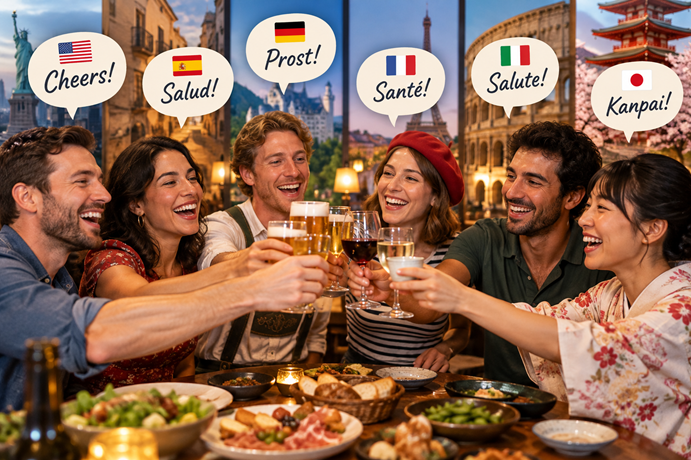
Almost every culture has a moment when people raise their drinks together. In English, someone may say “Cheers!” In Spanish-speaking countries, “Salud!” is familiar, while German speakers may say “Prost,” French speakers “Santé,” and Italians “Salute.” The words are different, and the traditions surrounding them are not identical, but the basic human gesture is surprisingly universal: people gather, lift their drinks, acknowledge one another, and then take a sip together.
Japan has its own word for that moment: Kanpai.
For a visitor, it is easy to think of kanpai simply as the Japanese equivalent of “Cheers.” In many situations, that translation is perfectly useful. But there is a small part of the Japanese custom that deserves more attention. When people are gathering for a meal or a social occasion, it is common for them to wait until the group is ready before taking that first drink. The beer may already be cold. The wine may already be poured. The sake may already be sitting in its cup. A soft drink may already be in someone’s hand. Yet the first sip often waits for one short word.
“Kanpai.”
Then everyone drinks.
That pause may last only a few seconds, but it gives the custom its most interesting quality. Kanpai is not simply about what people are drinking. It is about when a group begins together.
🥂 The Toast Is Universal, but the Meaning Around It Is Not
Raising a glass is hardly unique to Japan, and it would be a mistake to describe kanpai as though Japanese people invented the concept of the toast. Humans in many cultures have developed ways of marking a shared moment with a drink. The expression might refer to health, happiness, friendship, celebration, good fortune, or simply the pleasure of being together. The Japanese Foundation likewise describes toasting as a worldwide custom and identifies kanpai as the Japanese expression used when making a toast.
What makes the Japanese version interesting is not its existence, but its position in the rhythm of a gathering. A group of people can spend several minutes arriving at a restaurant, choosing drinks, looking at the menu, talking about their day, and waiting for everyone to settle into their seats. Physically, the gathering has already begun, but socially it can still feel as though everyone is preparing to begin. Then someone calls for kanpai, and the preparation turns into participation.
That is why translating kanpai as simply “Cheers” does not quite capture everything the Japanese word does in a group setting. The words may perform similar functions, but the small pause before the toast gives kanpai a particular role as a marker of shared time.
⏳ The Most Interesting Part Happens Before the Word
Imagine sitting at a restaurant with several friends. Your drink arrives first, and naturally you want to take a sip. Then you realize one person is still waiting for their beer. Another person has just arrived at the table. Someone is still choosing what to drink. So you wait. Nobody makes a dramatic announcement about why you are waiting. It simply seems obvious that the group has not reached the moment yet.
Eventually everyone is ready.
Someone lifts a glass.
“Kanpai!”
The glasses rise, and the first sip happens.
The actual word is almost the least complicated part of the scene. What matters is the few seconds before it, because that is when individual timing is temporarily put aside. Each person could drink whenever they wished, but they choose to wait until the group can start together.
This is not a huge sacrifice. It is not a profound act of self-denial. It is just a tiny delay. Yet that tiny delay changes the character of the moment. Instead of six people drinking six separate drinks whenever they happen to be ready, six people begin the evening at one recognizable point in time.
That is what gives kanpai more depth than a simple vocabulary lesson.
👥 From Individual Time to Shared Time
This is where the custom connects with a broader aspect of social life in Japan: the relationship between individual actions and shared situations.
It would be much too simplistic to say that Japanese culture is simply “collectivist,” or that Japanese people always put the group before themselves. Daily life does not work that way. Japanese people have personal preferences, private schedules, individual opinions, and their own reasons for being in a restaurant. A group dinner does not erase those individual differences.
But there are moments when people voluntarily coordinate their timing, and kanpai is one of the clearest and most everyday examples.
Before the toast, everyone exists on a slightly different timeline. One person may have come directly from work, another from home, another from somewhere across town. Someone may be hungry, while another person has already eaten a snack. Someone may be eager to try the first dish, while another is still waiting for a drink. Then the group pauses, lifts their glasses, and begins together.
The individual has not disappeared. The individual has simply waited for the group.
That is a much more interesting way of understanding kanpai than treating it purely as etiquette.
🍺 It Does Not Matter What Is in the Glass
Another important point is that kanpai is not fundamentally about alcohol.
Beer may be the most familiar image of a Japanese toast, particularly in an izakaya or company gathering, but there is no requirement that every person drink beer, sake, or any alcohol at all. Wine, cocktails, highballs, sake, juice, tea, soft drinks, and non-alcoholic beverages can all be part of the same shared toast. Japanese language-learning materials also make clear that the modern custom does not require someone to empty an alcoholic drink after saying kanpai.
That is important because it reveals where the meaning really lies. If the essence of kanpai were alcohol, then the custom would become much less meaningful when someone chose not to drink. Instead, the gesture survives quite naturally because the beverage is secondary to the moment.
One person can hold beer, another wine, another sake, and another a soft drink. Their choices remain individual. The toast gives them one small thing to share.
This is also why it makes more sense to think of kanpai as a social signal than as a drinking command.
🍽️ Why Does It Often Happen Before the Meal?
Kanpai is especially noticeable before a group meal because eating together often has its own period of preparation. People arrive at different times, menus are passed around, drinks are ordered, dishes begin appearing, and conversations overlap. The table is occupied, but everyone has not necessarily reached the same point.
The toast gives the gathering a recognizable beginning.
This does not mean that Japanese people say kanpai before every meal. A person eating breakfast at home alone does not need to raise a glass before touching their food, and an ordinary family dinner is not automatically turned into a formal toast. The custom becomes most visible when people are gathering together for a shared occasion, whether that means friends meeting at an izakaya, coworkers having dinner after work, relatives celebrating something, or guests attending a larger event.
In those situations, the gathering itself matters. Kanpai acknowledges that there is now a group, and the group is ready to begin.
The food can already be on the table. That does not necessarily mean the shared occasion has officially started.
The toast supplies that moment.
🕰️ Kanpai Is a Marker in Time
One of the most useful ways to think about kanpai is as a kind of social clock.
A gathering has a beginning, even if people have technically been sitting together for several minutes. There is often a difference between “everyone has arrived” and “we are starting.” Kanpai can occupy that space between the two.
Before it, the group is assembling.
At it, the group synchronizes.
After it, the group gets on with the evening.
This is why the toast can be so brief and still feel important. The word itself does not need to carry a complicated message because the surrounding situation already provides the meaning. Everyone understands what has happened. The waiting is over. The first sip can begin.
In that sense, kanpai resembles other small signals people use to mark transitions in everyday life. A meeting begins when someone says, “Let’s get started.” A performance begins when the curtain rises. A race begins when the starting signal is given. Kanpai performs a much smaller version of that function at a table.
It marks the transition from not yet to now.
🌍 Cheers, Salud, Prost, Santé, Salute—and Kanpai
Looking at other languages makes the Japanese custom even more interesting because it shows how universal the basic human idea is.
“Cheers,” “Salud,” “Prost,” “Santé,” and “Salute” are not simply translations of one perfectly identical ritual. Each belongs to its own linguistic and cultural environment. Some are strongly associated with health or goodwill, while the English word “toast” can also refer to the broader act of honoring someone or something through a speech and drink.
Kanpai fits into that larger family of expressions.
So there is no need to present the Japanese custom as though it were fundamentally different from what people do elsewhere. It is not.
A group of Americans saying “Cheers,” Spanish speakers saying “Salud,” Germans saying “Prost,” French speakers saying “Santé,” Italians saying “Salute,” and Japanese people saying “Kanpai” are all recognizing a similar social idea: we are sharing this moment together.
The interesting differences begin once you look beyond the word and observe what happens around it.
🥢 The Pause Makes the Toast Matter
The first sip is something an individual could easily take independently. The drink belongs to you. Your thirst belongs to you. Your schedule belongs to you.
Yet you wait.
That small act is what turns drinking into a shared event.
It is tempting to describe this as simple etiquette, and in some contexts it certainly functions that way. Japanese language education materials explicitly describe waiting for the toast before drinking as common at parties and gatherings. But etiquette is only the surface. The more interesting question is why the custom feels so natural in the first place.
The answer may be that the toast creates a moment of synchronization that everyone can understand without explanation.
The group does not need to be emotionally close. Six coworkers who barely know one another can still say kanpai. Relatives who see each other only a few times a year can do it. A group of friends can do it. People attending a celebration can do it.
The toast does not create a deep relationship.
It simply creates a common starting point.
And sometimes that is enough.
🍶 Sake Does Not Own Kanpai
Because kanpai is so closely associated with Japanese drinking culture, it is easy to assume that the custom is somehow inseparable from sake.
Historically, sake certainly has a deep connection with Japanese social and ceremonial life, but modern kanpai is much broader than sake. Japanese drinking culture includes beer, wine, shōchū, whisky-based drinks, sake, and many other beverages, while social gatherings increasingly include non-alcoholic choices as well. The key feature of the toast is therefore not the identity of the beverage but the shared act surrounding it.
This also helps explain why kanpai continues to make sense when the people around the table have very different drinking habits. Someone may choose alcohol; someone else may not. One person may prefer sake; another may dislike it. One person may order a soft drink because they are driving.
The glasses can still rise together.
The individual choices remain individual.
The moment is shared.
🎉 Kanpai Does Not Require a Special Occasion
Another reason the custom is so durable is its flexibility.
It can appear at major celebrations, but it does not require a major celebration. A wedding, farewell party, company event, birthday, or anniversary may have a more formal toast, while a casual evening with friends may require nothing more than someone lifting a glass and saying the word.
That flexibility is important because it shows that kanpai is not a rigid ceremony.
It is a small social mechanism that can adapt to the atmosphere around it.
At one table, there may be a speech. At another, there may be laughter and almost no preparation at all. At one gathering, the participants may all know one another well. At another, they may be coworkers who have only met because of the occasion.
The toast can accommodate all of these situations because its central function is so simple: it gives the group a moment to begin together.
🗣️ Sometimes the Words Before Kanpai Are Longer Than the Kanpai Itself
At more formal gatherings, the toast may be preceded by a greeting or short speech. Someone might welcome the participants, mention why everyone has gathered, express gratitude, or say something about the occasion. The toast then provides the clear point at which the speech ends and the shared activity begins.
This is another way to see the relationship between time and kanpai.
The speech belongs to one person’s words.
The toast belongs to everyone.
A representative may speak on behalf of the occasion, but when kanpai is called, everyone participates.
The transition from one person speaking to everyone raising a glass is what gives the moment its social weight.
The word is short precisely because all the explanation that might be needed has already happened.
🍻 And Then the Group Opens Up
After kanpai, something interesting often happens.
The group becomes less synchronized.
People begin talking more freely. A conversation develops between two people at one end of the table while another conversation starts elsewhere. Someone reaches for a dish, another orders another drink, and someone else begins telling a story to the person sitting beside them.
The group has started together, but it does not remain synchronized.
This may be the most revealing part of the whole custom.
Kanpai does not demand that everyone continue doing everything together. It creates a shared starting point, and then individual interactions take over.
The common beginning makes room for personal conversation.
The group comes together first, then breaks naturally into smaller relationships.
That is why calling kanpai simply a “rule” misses something important. A rule explains what people should do. The social role of kanpai explains why that moment feels right.
🌿 The Individual and the Group Meet for a Few Seconds
There is a Japanese phrase, 個と集, that can be useful as an idea even though it should not be turned into a grand theory of Japanese society. Kanpai provides a tiny example of the meeting point between the individual and the group.
Every person at the table remains an individual. They choose their own drink, arrive from their own life, and continue their own evening afterward.
But for a few seconds, everyone agrees to coordinate.
Nobody loses their individuality.
They simply adjust their timing.
That is why the pause before the toast matters more than the word itself. The glass is yours, but the beginning is shared.
The drink is individual, but the moment is collective.
That balance is subtle, ordinary, and easy to miss.
⏰ Kanpai as a Shared Clock
Imagine six people arriving at different times from different places. At 7:00 p.m., none of them has exactly the same relationship with the evening.
At 7:15, perhaps they are all sitting together.
At 7:20, everyone has a drink.
Then someone says kanpai.
For a brief moment, 7:20 becomes the same point in time for everybody.
The evening has officially become a shared experience.
That is why I think “shared clock” is a better metaphor for kanpai than “drinking etiquette.”
Etiquette explains why you wait.
A shared clock explains what the waiting accomplishes.
It gives everyone the same starting point.
🏮 The Same Idea Can Frame the End of a Gathering
Although kanpai is most strongly associated with the beginning of a gathering, the broader act of raising a glass can also be used to mark an important point later in an event. A toast can celebrate an achievement, honor a person, recognize a milestone, or give a group a moment to pause and acknowledge what has happened.
In that sense, the toast is not necessarily tied only to the first minute of eating or drinking.
It can frame time.
Something begins.
Something important happens.
Something comes to an end.
The group pauses and acknowledges it together.
This is another reason the physical act of raising a glass is so powerful despite being so simple. It gives people a visible way to say, “This moment matters.”
The drink is there, but the real object of attention is the moment itself.
🍵 The Meaning Survives Without Alcohol
Perhaps the strongest evidence for this is the fact that the toast still works when alcohol disappears.
A table can contain beer on one side and soft drinks on the other. Someone can drink sake while another person drinks sparkling water. Someone may be taking medication, driving, training for a sporting event, or simply not enjoying alcohol.
Nothing prevents that person from participating in the shared toast.
This is important because it separates kanpai from the idea that Japanese socializing is fundamentally about drinking alcohol.
The custom can survive because the underlying action is social rather than chemical.
You do not have to drink the same thing.
You only have to share the moment.
🌏 Kanpai Is Not “More Japanese” Than Cheers
It is tempting, especially in articles about Japan, to search for the feature that supposedly makes a Japanese custom uniquely Japanese.
But kanpai is actually a good example of why that approach can be misleading.
People all over the world toast.
People everywhere find ways to mark shared occasions.
People everywhere enjoy doing something together before beginning something together.
The Japanese version is not interesting because Japan alone possesses this custom.
It is interesting because the Japanese form shows how a very universal human behavior fits into Japanese social rhythms.
That is a much more useful way to understand culture.
The similarities are real.
The differences are real.
Neither needs to be exaggerated.
🥂 The Most Japanese Part May Be the Waiting
If you remember only one thing about kanpai, it probably should not be the word itself.
It should be the pause.
The few seconds when everyone waits for everyone else.
The drinks are already there.
The people are already sitting together.
The conversation may already have started.
But the first sip waits.
Then the glasses rise.
“Kanpai!”
The group drinks.
That tiny sequence is almost too ordinary to notice, but it expresses an interesting social idea: individual time can pause so shared time can begin.
Afterward, everyone returns to their own conversations, preferences, and personalities. The group does not remain perfectly synchronized. It does not need to.
The synchronization was needed only for the beginning.
🌸 From a Word to a Way of Starting Together
The literal meaning of kanpai comes from the characters 乾杯, traditionally understood as “drying” the cup, but modern usage does not require someone to empty their drink. The Japan Foundation specifically notes that despite the literal sense, people do not need to finish the entire drink; after the toast, they take a sip and then continue at their own pace.
That difference between literal meaning and actual everyday use is itself revealing.
Language changes.
Customs change.
Drinking habits change.
What remains useful is the social function.
People still need a moment to recognize that an occasion has begun.
Kanpai provides that moment with almost no effort.
One word is enough.
🌏 Why Kanpai Still Matters in Modern Japan
Modern Japanese life is changing, and drinking habits are changing with it. The kinds of drinks people choose are more varied, non-alcoholic options are increasingly ordinary, and the old image of every gathering as a table full of beer no longer describes every social occasion.
Yet kanpai remains remarkably adaptable.
That makes sense once we stop defining it as a command to drink alcohol.
It is better understood as a small social signal that says, we are here, we are ready, and we are beginning this moment together.
The drink can change.
The occasion can change.
The people can change.
The word remains.
And perhaps that is why kanpai has such staying power.
🥂 From Cheers to Kanpai
So, yes, kanpai can be translated as “Cheers.” Just as “Salud,” “Prost,” “Santé,” and “Salute” can perform similar roles in other languages, the Japanese word belongs to a much larger human tradition of raising a drink and marking a shared moment.
But translating the word does not fully explain the experience.
The deeper story is the short period before kanpai, when people wait for one another instead of starting separately. That pause turns the first sip into something shared. It gives a group a common starting point, even when the people at the table have arrived from different places, chosen different drinks, and brought completely different days with them.
That is why kanpai is more interesting than a simple piece of Japanese vocabulary.
It is a small marker in time.
It is a moment when individual timing pauses and group timing takes over.
The beer, wine, sake, or soft drink in your hand remains yours. Your evening remains yours. Your conversation remains yours.
But for a few seconds, everyone agrees on one thing.
Now we begin.
And perhaps that is the quiet appeal of kanpai: not that Japan has a special word for raising a glass, but that an ordinary drink can become a shared starting point simply because everyone waits for one another.
🌏 Continue Exploring Japanese Food Culture
Japanese food culture is not only about what appears on the plate. The moments before a meal, the way people share food and time, and the seasonal ideas surrounding a dish can reveal just as much about everyday life in Japan.
👉Tsukimi Soba in Japan: How the Autumn Moon Became a Bowl of Soba (2026 Guide)
👉 Japanese Yatai: The Food Stalls That Bring Japanese Streets to Life (2026 Guide)
👉 Sanma: Why Pacific Saury Became the Taste of Autumn in Japan (2026 Guide)
👉 Japanese Shotengai and Food Culture: Eating Your Way Through Local Neighborhoods (2026 Guide)
👉 What Do Japanese People Eat at Summer Festivals? The Food, Memories, and Magic of Yatai (2026 Guide)
👉 What Do Japanese People Eat for Breakfast? A Complete Guide to Japan’s Morning Meal (2026 Guide)
👉 Why Does Starbucks Feel Different in Japan? 10 Surprising Differences You Should Know (2026 Guide)