
🌏 Introduction: Will Your Electronics Work in Japan?
There is a particular kind of travel anxiety that tends to appear shortly before an international trip. Your passport is ready, your flights are booked, your hotel is confirmed, and then you suddenly look at the phone charger on your desk and wonder, “Can I actually plug this into the wall in Japan?” It is a small question, but it matters more than it may seem. Your phone may contain your maps, reservations, boarding passes, translation tools, train information, restaurant bookings, and communication apps, while your laptop or camera may be just as important depending on the purpose of your trip. A problem with electricity is therefore not simply an inconvenience. Running out of power while traveling can turn a small technical issue into a surprisingly serious problem.
The good news is that Japan’s electricity system is relatively easy for most modern travelers to understand once two separate questions are kept apart: Does my plug physically fit the Japanese outlet, and can my device accept Japan’s voltage? These are not the same question. A plug adapter solves the first problem. It does not solve the second.
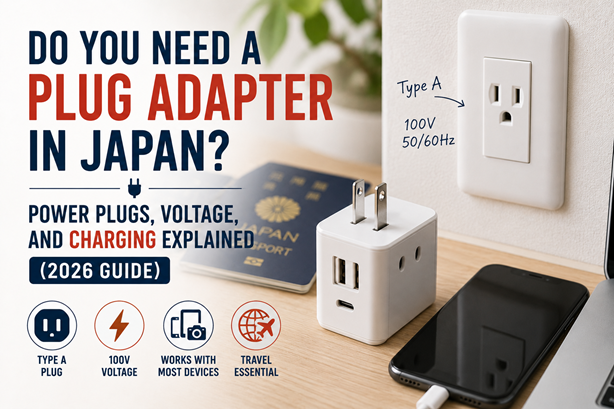
Japan uses a standard household voltage of 100 volts AC, with a frequency of 50Hz in eastern Japan and 60Hz in western Japan. Japanese outlets primarily use Type A, the familiar two-flat-pin configuration also used in North America, although grounded plug and outlet configurations also exist. For many travelers carrying modern phones, laptops, tablets, cameras, and other USB-powered electronics, the voltage is less of a problem than they may expect because many current chargers accept a broad input range such as 100–240V. The physical shape of the plug, however, can still prevent the charger from fitting the Japanese outlet at all. Current laptop and USB-C chargers from major manufacturers, for example, commonly specify 100–240V and 50–60Hz input.
The situation becomes different when you bring high-power appliances such as hair dryers, curling irons, straighteners, or other heating devices. These products are much more likely to have voltage limitations, and simply attaching a travel plug adapter does not make a 220–240V-only appliance compatible with Japan’s 100V supply.
So the real question is not “Does Japan use a different kind of electricity?” It is “What exactly are you bringing, and what does the label on its charger or appliance say?”
🎯 Quick Answer: Will Your Devices Work in Japan?
For most travelers, smartphones, laptops, tablets, cameras, and other modern USB-powered electronics are usually straightforward to use in Japan because their chargers often accept a wide input range such as 100–240V. The bigger question is whether your plug physically fits Japan’s Type A outlets. Hair dryers, straighteners, curling irons, and other high-power appliances require more careful checking because they are more likely to be single-voltage or otherwise have different power requirements.
| What you’re bringing | Plug adapter | Voltage check | Japan travel advice |
|---|---|---|---|
| 📱 Smartphone charger | Depends on plug | Usually 100–240V | Usually easy |
| 💻 Laptop charger | Depends on plug | Usually 100–240V | Usually easy |
| 📷 Camera charger | Depends on plug | Usually 100–240V | Usually easy |
| 🎧 Earbuds / USB devices | Depends on charger | Usually 100–240V | Usually easy |
| 💇 Hair dryer | Often | Important | Check carefully |
| 💇 Straightener / curling iron | Often | Important | Check carefully |
| 🪒 Electric shaver | Depends | Check label | Usually manageable |
| ⚡ Electric kettle | Often | Important | Usually leave at home |
The quickest way to check is to look at the INPUT information printed on the charger or appliance. If you see something like 100–240V, 50/60Hz, the device is designed to accept Japan’s electrical supply from a voltage and frequency perspective. You may still need a plug adapter if the physical plug shape is different. For high-power appliances such as hair dryers, however, do not rely on the plug adapter alone; check the voltage rating carefully before packing it.
🔌 What Plug Type Does Japan Use?
Japan’s standard travel-plug shape is Type A, with two flat parallel pins. If your normal charger already uses this shape, you may be able to plug it directly into a Japanese outlet. Travelers from the United States and Canada will therefore find the physical shape familiar, although a three-prong grounded plug may not fit into a typical two-slot Japanese outlet. Japan Guide notes that Japanese outlets can accommodate common two-pin plugs, while grounded configurations also exist.
For travelers coming from countries using Type C, E, F, G, I, or other plug shapes, the issue is usually much simpler than the word “electricity” makes it sound. Your charger may be perfectly capable of operating on Japan’s 100V supply, but the pins simply do not fit into the wall. In that situation, you need a plug adapter, not necessarily a voltage converter.
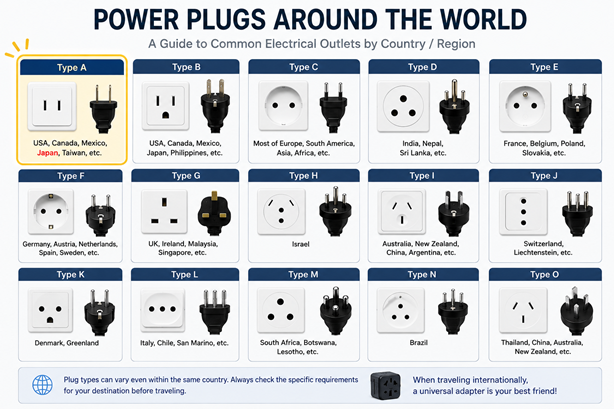
The important thing to remember when looking at a worldwide plug chart is that plug standards can vary within countries and that the specific device and outlet matter. The image is a quick visual reference, not a substitute for checking the actual plug on the charger you are carrying.
⚡ Japan Uses 100V: What Does That Actually Mean?
Japan’s household electricity supply is 100V, which is lower than the standard voltage used in many other countries. The United States and Canada commonly use around 120V, while the UK, Australia, New Zealand, and much of continental Europe use around 220–240V. Japan is therefore unusual enough that voltage should always be checked when bringing appliances from overseas.
For most travelers, however, the number “100V” is less important than the tiny information printed on the charger or power adapter they already own. Look for a line labeled something like INPUT, followed by a voltage range. If it says 100–240V, 50/60Hz, the charger is designed to accept the full range and can generally be used in Japan from a voltage perspective. Dell’s current USB-C AC adapters, for example, specify 100–240V input and 50–60Hz, while Sony lists 100–240V, 50–60Hz on several of its chargers.
That tiny label is therefore more useful than memorizing the electrical standards of dozens of countries. Before leaving for Japan, turn over the charger or power brick and look for the word INPUT. If the range includes 100V, the voltage requirement is generally satisfied. You may still need a plug adapter if the physical pins are different, but you do not automatically need a transformer.
If the label says only 220–240V, the situation is completely different. Japan supplies 100V, so the appliance is not designed for that voltage range. This is where travelers need to stop and check before plugging it in. Dell’s international charging guidance similarly explains that equipment marked 100–240V can be used worldwide with the appropriate plug adapter, while single-voltage equipment requires much closer attention to the destination’s voltage.
📋 Japan Voltage Compared With Other Countries
The following comparison is useful when deciding whether your device requires a voltage check before your trip. Voltage standards can have regional or appliance-specific details, so treat the table as a travel reference rather than a substitute for checking your equipment’s input rating.
| Country / Region | Typical Household Voltage | Japan Comparison | What Travelers Should Check |
|---|---|---|---|
| 🇯🇵 Japan | 100V | — | Type A plug is standard/common |
| 🇺🇸 United States | 120V | Slightly higher | Plug shape and device input |
| 🇨🇦 Canada | 120V | Slightly higher | Plug shape and device input |
| 🇬🇧 United Kingdom | 230V | Much higher | Plug adapter and voltage rating |
| 🇪🇺 Most of Europe | 220–240V | Much higher | Plug adapter and voltage rating |
| 🇦🇺 Australia | 230V | Much higher | Plug adapter and voltage rating |
| 🇳🇿 New Zealand | 230V | Much higher | Plug adapter and voltage rating |
| 🇰🇷 South Korea | 220V | Much higher | Plug adapter and voltage rating |
| 🇨🇳 China | 220V | Much higher | Plug shape and voltage rating |
| 🇸🇬 Singapore | 230V | Much higher | Plug adapter and voltage rating |
Japan’s 100V supply and its 50Hz/60Hz regional frequency division are confirmed by JNTO, while the higher-voltage standards in common source markets are reflected in international travel and electrical guidance.
🔋 Smartphones, Laptops, Tablets, and Cameras Are Usually the Easy Part
For the average international visitor, the devices most likely to come to Japan are also the devices least likely to cause voltage problems. Your smartphone, laptop, tablet, wireless earbuds, camera battery charger, smartwatch, and similar electronics are generally powered through compact AC adapters designed for international input ranges. The important word is generally. You should still check your own charger rather than assuming that every product in a category is automatically dual-voltage.
The reason is that your phone itself is not what you plug directly into the Japanese outlet. The chain is usually the wall outlet, followed by the travel plug adapter if necessary, then the AC or USB charger, then the charging cable, and finally the phone. The component that needs to accept the Japanese mains voltage is the charger or power adapter. That is why looking at the small print on the charger is so useful.
A typical modern charger may say something like INPUT: 100–240V ~ 50/60Hz. When you see that, Japan’s 100V supply falls within its rated input range. Current USB-C laptop adapters show how common this design has become; for example, Dell’s 60W and 100W USB-C adapters list 100–240V AC and 50–60Hz input. Sony likewise lists 100–240V and 50–60Hz input on several of its chargers.
This is why a traveler from Europe may arrive in Japan, connect a simple Type C-to-Type A plug adapter, and charge a laptop without needing a heavy voltage converter. The charger handles the voltage difference internally. The adapter simply changes the physical connection between the plug and the wall.
That distinction is one of the most useful things to understand before your trip.
🔌 Plug Adapter vs. Voltage Converter: They Are Not the Same Thing
A plug adapter changes the physical shape of the connection. It allows a plug designed for one outlet configuration to fit into another. It does not change the electricity coming from the wall.
A voltage converter or transformer changes the electrical voltage supplied to a device. This is a completely different job.
Imagine that you bring a British charger with a Type G plug to Japan. The charger says 100–240V on its label. The Japanese wall outlet is Type A. Your problem is physical, not electrical. A Type G-to-Type A plug adapter solves it, and the charger’s own input range handles the 100V supply.
Now imagine that you bring a European hair dryer that says 220–240V only. You can attach a Type C-to-Type A adapter, and the plug will physically fit the Japanese outlet, but the appliance is still expecting a much higher voltage. The adapter has not changed that. This is exactly the situation in which a traveler can mistakenly think, “I have the adapter, so I’m ready.”
You may have solved the shape problem while leaving the voltage problem untouched.
That is why the safest habit is to check the plug first and the INPUT rating second.
💻 A 30-Second Japan Power Check
Before you leave for Japan, you can usually answer most of your electricity questions in less than a minute. Look at the plug on each device you intend to bring and compare its shape with Japan’s Type A outlet. Then look at the charger or power brick and find the INPUT line. If it says 100–240V and 50/60Hz, you can generally use the charger in Japan from a voltage and frequency perspective. If the plug shape is different, add the appropriate plug adapter. If the charger is single-voltage and does not include 100V within its rated range, do not assume a plug adapter will solve the problem.
That simple check is much more useful than carrying a large transformer “just in case.”
It also prevents a common travel mistake: checking the specifications of the phone or laptop while ignoring the charger. The device may have been designed for worldwide use, but the external power supply is the part that connects to the wall.
💇 Hair Dryers Are a Different Story
If there is one category of device that deserves much more caution than your phone or laptop, it is the hair dryer.
Hair dryers, curling irons, straighteners, travel irons, and similar heating appliances often consume much more electricity and are more likely to be single-voltage or to have a narrower voltage range. Japan’s official tourism guidance specifically notes that dual-voltage hair dryers, travel irons, and shavers may work across regions, while other appliances may require a step-down transformer in Japan. Japan Guide similarly warns that heating appliances such as hair dryers may not work properly or may even be damaged when used with incompatible voltage.
This is why you should not treat a hair dryer like a phone charger.
A modern laptop charger may be a compact 60W or 100W device designed for 100–240V input. A hair dryer can be a high-power appliance designed to turn a large amount of electrical energy into heat in a very short period. Tokyo Electric Power’s appliance guidance illustrates the scale of the difference, with a typical hair dryer around 1,200W compared with much lower-power electronics.
If your hair dryer says 220–240V only, connecting it to a Japanese outlet with a simple plug adapter does not make it compatible with 100V. If it says 100–240V, it is a different story. And if you are staying in a hotel or ryokan, checking whether a hair dryer is already provided may be easier than bringing a heavy appliance in the first place. The goal is not to make your luggage more complicated than necessary.
💡 What About the 50Hz and 60Hz Difference?
Japan has another electrical feature that can sound alarming when you first hear about it: the country does not use one frequency nationwide. Eastern Japan, including Tokyo, uses 50Hz, while western Japan, including Nagoya, Kyoto, and Osaka, uses 60Hz.
For most travelers carrying modern electronic chargers, this is not something they need to worry about. Chargers designed for international use commonly specify 50/60Hz, and the frequency difference does not normally create a problem for phones, laptops, cameras, tablets, or USB chargers. It can matter for certain specialized or older devices, however, which is another reason to check the label rather than rely on assumptions. Japan Guide notes that most equipment is not affected by the country’s frequency difference, while certain timing devices can be an exception.
If your Japan trip includes Tokyo and Osaka, you therefore do not need to pack two different chargers because you have crossed an invisible 50Hz/60Hz boundary. Your modern phone charger does not suddenly become an eastern or western Japan device. What matters is whether its rated input includes the relevant voltage and frequency.
🏨 What About Hotels in Japan?
The power situation can feel different once you arrive at your hotel. Many rooms have multiple outlets, and modern accommodation may also provide USB charging ports, but the exact setup varies considerably by property and room type. You should not assume that every bedside table will have several convenient USB-C outlets just because your home does.
This becomes particularly relevant when one traveler has accumulated several devices. A phone, laptop, camera battery, smartwatch, earbuds, and perhaps another phone can quickly turn one or two wall outlets into a small logistical problem.
This is where a multi-port USB-C charger can be more useful than packing several separate charging bricks. You still need to solve the plug shape if your charger uses a foreign plug, but once you have a suitable adapter and a multi-port charger, several low-power devices can share one connection.
That is a convenience issue rather than a uniquely Japanese electrical requirement. Japan’s standard simply creates the need to make sure that the connection and voltage are compatible in the first place.
🚄 What About Charging While Traveling Around Japan?
Your hotel is not the only place where you may need power. Long travel days can turn a full phone battery into a surprisingly limited resource once you use maps, translation, photography, tickets, reservations, messaging, and mobile data continuously. If you are navigating an unfamiliar city while relying heavily on your phone, charging capacity becomes part of travel planning rather than just a comfort.
JNTO notes that some newer Shinkansen trains have outlets near window seats and that some restaurants and fast-food chains also offer outlets. Availability varies, however, so it is better to think of public charging as a useful opportunity rather than something you can guarantee throughout the day.
That is another reason a simple charging setup matters. The ideal solution is not necessarily to carry more electronics. It is to make the electronics you already carry compatible with Japan and easy to charge.
🧳 Do You Need a Universal Travel Adapter?
A universal travel adapter can be useful for someone visiting several countries on the same trip, because it combines multiple plug shapes into one device. But if Japan is your only destination and all you need is to connect one or two chargers, a smaller Type A-compatible adapter may be all you need.
The important thing is not to buy an adapter simply because the package says “universal.” Check what it actually does. A plug adapter changes the pin configuration; it does not necessarily convert voltage, regulate power, or provide USB charging. Some sophisticated travel adapters combine several functions, but those features should be understood rather than assumed.
For a Japan trip, the simplest setup can often be the best: a charger that accepts 100–240V, 50/60Hz, plus a plug adapter that allows your country’s plug to connect to a Japanese Type A outlet.
You do not need to turn a small charging problem into a suitcase full of electrical equipment.
🇺🇸 Travelers From the United States and Canada
Travelers from the United States and Canada often have an easier starting point because their standard two-flat-pin plugs resemble Japan’s Type A configuration. Their household voltage is also relatively close to Japan’s 100V system, at around 120V.
That does not mean every North American device should be assumed compatible. A grounded three-prong plug may not fit a typical Japanese two-slot outlet, and individual appliances still need to be checked. A modern laptop charger marked 100–240V is generally straightforward, while a specialized heating appliance requires closer attention.
In other words, being from North America reduces the plug-shape problem, but it does not eliminate the usefulness of checking the equipment label.
🇬🇧 Travelers From the UK and Ireland
The UK uses a very different plug design, so travelers will normally need a Type G-to-Type A plug adapter to connect British chargers to Japanese outlets. The voltage difference is much larger as well: the UK standard is around 230V compared with Japan’s 100V.
For a modern dual-voltage phone or laptop charger marked 100–240V, this usually means that you need the plug adapter but not a voltage converter. The charger’s own electronics are designed to accept the Japanese supply.
For a single-voltage appliance designed only for 220–240V, however, the situation changes. A hair dryer or straightener marked only for 220–240V cannot simply be plugged into Japan with a shape adapter and expected to perform normally.
🇪🇺 Travelers From Europe
The same basic principle applies to travelers from most of continental Europe, where household voltage is commonly around 220–240V and plugs such as Type C and Type F are widely used. The physical plug shape is different from Japan’s common Type A outlet, so a plug adapter is usually needed. The voltage is also very different, but for a modern dual-voltage charger marked 100–240V, the charger’s input range is normally wide enough to include Japan’s 100V supply.
Again, the difference between a phone charger and a heating appliance is critical. A USB-C laptop charger designed for 100–240V is a very different electrical product from a 230V-only hair dryer. The fact that both are “electronics” does not make their power requirements equivalent.
🇦🇺 Travelers From Australia and New Zealand
Australia and New Zealand commonly use Type I plugs and around 230V, so travelers from these countries generally need a physical plug adapter for Japanese Type A outlets and should check the voltage rating of each appliance. Modern chargers with 100–240V input are usually the easy case. Single-voltage appliances are the ones that require careful attention.
This illustrates why nationality alone is not enough to determine what you need. The country you come from provides a useful starting point, but the label printed on the device gives the final answer.
🧠 The Three Things You Actually Need to Check
For most travelers, the entire Japan electricity problem can be reduced to three questions. First, does my plug physically fit Japan’s outlet? Second, does my device or charger accept 100V? Third, does it accept Japan’s 50Hz/60Hz frequency as required?
If the plug does not fit but the charger accepts 100–240V and 50/60Hz, you need a plug adapter.
If the device only accepts a higher voltage, you have a voltage-compatibility problem and need to consider an appropriate transformer or, more realistically for many travelers, whether bringing a different device would be simpler.
If the charger accepts 100–240V and 50/60Hz and the plug fits, you generally have the simplest possible situation: plug it in and charge.
This is why the tiny label on the charger is more valuable than a generic statement such as “you need a converter in Japan.”
🔥 Why a Transformer Is Often the Wrong First Answer
Travel guides sometimes make voltage differences sound as though every traveler from a 220–240V country needs a transformer. That can lead to unnecessary luggage, expense, and confusion.
A transformer is a serious electrical device. Its suitability depends on the equipment being powered and its power requirements. High-power appliances such as hair dryers can require substantial capacity, and a small converter intended for low-power electronics should not automatically be assumed capable of safely running a large heating appliance.
For travelers carrying modern dual-voltage electronics, the better answer is usually not “bring a transformer just in case.” It is check the charger first.
If it says 100–240V, there is no reason to convert Japan’s 100V into 230V just so your charger can convert it back internally. The charger was designed to accept the range already.
This is one of the clearest examples of why understanding the difference between the plug and the voltage can simplify your packing.
📱 Your Phone May Be the Most Important Thing to Keep Powered
A dead phone is inconvenient anywhere, but it can be particularly disruptive during international travel. In Japan, your phone may serve simultaneously as your map, translator, train reference, reservation screen, camera, communication device, ticket, eSIM interface, and source of information when plans change.
That means power management deserves more attention than the size of the problem initially suggests.
The good news is that the devices most travelers rely on for these functions are often exactly the devices most likely to use globally compatible chargers. Current USB chargers from major manufacturers commonly specify wide input ranges such as 100–240V and 50–60Hz.
So the Japan charging problem is often simpler than it first appears.
Your charger may already understand Japan. Your plug may simply need a translator.
🌏 The Real Japan Power Checklist
Before you close your suitcase, look at the actual chargers and appliances you are bringing rather than relying on memory. Your phone charger may already say 100–240V. Your laptop charger may say the same. Your camera charger may also support 100–240V. Your hair dryer may be the one item that does not.
That small inspection can tell you whether your trip requires only a plug adapter or whether a particular appliance needs a more serious solution.
It also prevents one of the most common misunderstandings about international electricity: an adapter is not a transformer.
The adapter changes the shape.
The transformer changes the voltage.
And for many modern travelers, once the plug shape is solved and the charger is confirmed as 100–240V, the complicated part of Japanese electricity is essentially finished.
🌏 Why Japan’s Electricity Is Less Complicated Than It Sounds
Japan’s 100V electrical system, its Type A outlets, and its 50Hz/60Hz regional split may sound like a long list of technical details when you first start researching a trip. In practice, most travelers can solve the problem with one simple habit: identify the physical plug, then read the input specification on the charger or appliance.
For a phone, laptop, tablet, camera, or other modern USB-powered device, the result will often be straightforward. For a hair dryer, curling iron, straightener, or other heating appliance, you need to be more cautious. And if you are traveling through several countries, remember that the adapter you use in Japan may not be the adapter you need at your next destination.
The important thing is not to memorize every electrical standard in the world.
It is to understand what your own equipment needs.
That is the difference between arriving in Japan wondering whether the outlet will work and arriving knowing exactly what to plug in.
🔗 Continue Exploring Japan
Preparing for Japan involves more than understanding the power outlets. Once your devices are ready, the next questions are often how to stay connected, how to move around Japan, what to do with luggage, and how to make the first few hours after arrival easier.
👉 Best eSIM for Japan Travel: Compare Plans, Data & Providers (2026 Guide)
👉 eSIM vs Pocket WiFi in Japan: Which Is Better for Your Trip? (2026 Guide)
👉 International Roaming in Japan: Is It Worth It? Costs, Pros & Cons (2026 Guide)
👉 Best Apps for Traveling in Japan (2026): 6 Essential Apps Every Tourist Needs
👉 How to Use Trains in Japan: IC Cards, Shinkansen, and JR Pass Explained (2026 Guide)
👉 Suica vs Welcome Suica vs PASMO: Which IC Card Should Tourists Choose? (2026 Guide)
👉 How to Use Visit Japan Web: Skip Paper Forms and Save Time at the Airport (2026 Guide)
👉 What Can You Bring Into Japan? Customs Rules Every Traveler Should Know (2026 Guide)