
📶 How Can You Stay Connected in Japan?
For most international visitors, there are four practical ways to get mobile internet in Japan: an eSIM, a physical SIM card, a Pocket WiFi rental, or international roaming through your existing mobile provider. Each solves the same basic problem—getting online—but they work in very different ways.
| eSIM | Physical SIM | Pocket Wi-Fi | International Roaming | |
|---|---|---|---|---|
| Best for | Most modern solo travelers | Phones without eSIM | Families and groups | Maximum convenience |
| Setup | Digital installation | Replace SIM card | Pick up or receive device | Usually activate with carrier |
| Phone compatibility | eSIM-compatible phone | Unlocked phone | Almost any Wi-Fi device | Carrier dependent |
| Multiple users | Usually one phone | Usually one phone | Several devices | Usually one phone |
| Japanese phone number | Usually no | Plan dependent | Usually no | Your existing number |
| Main advantage | Convenient and no physical SIM | Simple physical alternative | Share one connection | No new SIM needed |
| Main disadvantage | Requires compatible device | Requires SIM replacement | Device to carry and charge | Can be expensive |
| Best for Japan travel | ⭐⭐⭐⭐⭐ | ⭐⭐⭐ | ⭐⭐⭐⭐ | Depends on carrier |
There is no universal winner. An eSIM is often best when you value freedom and simplicity, while Pocket WiFi can be a better fit when several people or devices need to share one connection. But the number of travelers is only one part of the decision.
Your data usage, number of devices, whether you separate from your group, battery needs, and how much you want to carry can all change the answer. For most travelers, however, the real choice comes down to eSIM vs Pocket WiFi.
⚖️ eSIM vs Pocket WiFi: What Is the Real Difference?
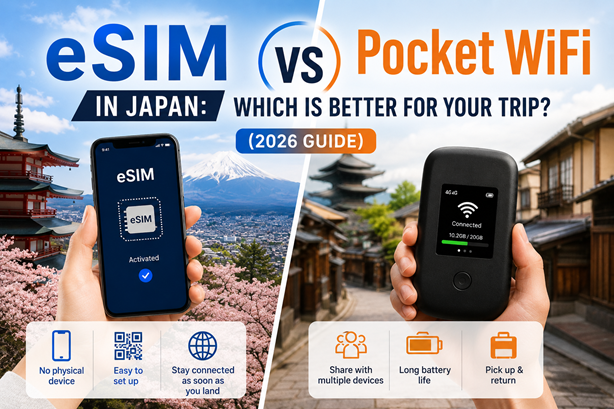
At first glance, eSIM and Pocket WiFi may seem like two ways of doing exactly the same thing. In reality, they change the way you carry, share, and use your internet connection.
An eSIM turns your compatible smartphone into the device that connects directly to a Japanese mobile network. There is no separate router, no pickup counter, and no device to return. Once the eSIM is installed and activated, your phone connects to the mobile network just as it would with a physical SIM.
A Pocket WiFi works differently. You rent a small wireless router that connects to a Japanese mobile network and creates a private WiFi connection around you. Your phone, tablet, laptop, and sometimes other family members’ phones can connect to that single device.
That difference leads to the simplest way to think about the two options.
eSIM is mainly about personal freedom and simplicity. Pocket WiFi is mainly about sharing one connection across multiple people or devices.
Neither is automatically better.
📱 What Is an eSIM?
An eSIM is a digital SIM built into a compatible smartphone. Instead of physically inserting a Japanese SIM card, you purchase a mobile data plan and install it digitally, usually by scanning a QR code or following the provider’s setup instructions.
Once activated, the eSIM connects your phone to a supported Japanese mobile network. Your regular SIM can often remain active for calls and texts, depending on your phone and home carrier, while the eSIM handles mobile data.
For a solo traveler, this can be extremely convenient. You arrive in Japan with your phone already capable of connecting to the internet, without needing to find a rental counter or carry another device.
The biggest advantage is not necessarily price. It is freedom.
You do not need to remember to bring a separate router. You do not need to charge another battery. You do not have to stay close to another person carrying the WiFi device. And there is nothing to return when your trip is over.
An eSIM is particularly attractive when you want to use Google Maps, translation apps, train information, restaurant searches, messaging, and other travel tools directly from your phone without adding another piece of equipment to your luggage.
Of course, an eSIM is not perfect for everyone. Your phone must support eSIM, and hotspot or data-sharing capabilities can vary by provider and plan. If several people need to connect their own phones or you regularly use a laptop and tablet, a Pocket WiFi may be more convenient.
If you want to understand the different eSIM providers, plans, data amounts, networks, and prices available for Japan, see our complete guide:
👉 Best eSIM for Japan Travel: Compare Plans, Data & Providers (2026 Guide)
📡 What Is a Pocket WiFi?
A Pocket WiFi is a small portable wireless router that connects to a mobile network and creates a WiFi hotspot. Instead of putting the mobile connection directly into your phone, you connect your phone or other devices to the router.
This makes Pocket WiFi particularly useful when more than one person or more than one device needs internet access.
Imagine a family of four traveling together. Instead of purchasing and installing a separate data plan on every phone, the family can connect their phones to one Pocket WiFi device. The same connection can also be used by a tablet or laptop.
That sounds simple, but there is a trade-off.
The Pocket WiFi becomes another item you need to remember.
It needs to be carried throughout the day. Its battery needs to be charged. If the device runs out of battery, everyone connected to it loses their internet connection. And if members of a group separate, the people who leave with no Pocket WiFi connection will need another way to get online.
This is why Pocket WiFi is not simply an older or more complicated alternative to eSIM. It solves a different problem.
Pocket WiFi is designed to share connectivity.
And when sharing is important, that can be a major advantage.
📊 eSIM vs Pocket WiFi: Side-by-Side Comparison
| Feature | eSIM | Pocket WiFi |
|---|---|---|
| Physical device | None | Separate router |
| Phone compatibility | Requires eSIM-compatible phone | Works with WiFi-enabled devices |
| Multiple phones | Usually less convenient for sharing | Excellent |
| Multiple devices | Depends on hotspot support | Excellent |
| Laptop connection | Possible | Easy |
| Tablet connection | Possible | Easy |
| Carrying | Nothing extra | Router must be carried |
| Charging | Uses your phone battery | Separate battery required |
| Group sharing | Limited | Excellent |
| Traveling separately | Excellent | Less convenient |
| Pickup in Japan | Not required | Usually required or arranged |
| Return after trip | No | Usually required |
| Setup | Usually simple | Pick up and connect |
| Lost-device concern | Very low | Possible |
| Best strength | Freedom and simplicity | Sharing and multi-device use |
This table shows why the answer cannot simply be “eSIM for solo travelers and Pocket WiFi for groups.”
The number of travelers matters, but it is only one part of the decision.
👥 The Number of Travelers Is Not the Only Factor
Consider two couples traveling in Japan.
The first couple spends almost every minute together. They visit the same attractions, eat together, take the same trains, and return to the hotel together. A Pocket WiFi could work very well because both people can share one connection throughout the day.
The second couple is also traveling together, but they occasionally split up. One person wants to spend two hours shopping in Ginza while the other visits a museum. Later, they meet again at the hotel.
In this situation, an eSIM can be more convenient because each person has an independent connection.
The same applies to families. A Pocket WiFi may be excellent when parents and children stay together throughout the day, but it becomes less convenient when family members separate.
Friends traveling together face the same choice.
If everyone stays together, sharing one Pocket WiFi can be economical and convenient. If people frequently split up, each person having independent mobile data can provide much more freedom.
So instead of asking only “How many people are traveling?”, ask a more useful question:
“Will everyone who needs internet stay together most of the time?”
That question often gives you a better answer.
💻 What About Multiple Devices?
The number of devices you use can be just as important as the number of people traveling.
Suppose you are traveling alone but use an iPhone, iPad, and laptop every day. You may also want to upload photos, work remotely, watch videos at your hotel, or transfer large files.
An eSIM can still work because many smartphones can create a personal hotspot. However, hotspot support, data-sharing limits, battery consumption, and provider policies can vary.
A Pocket WiFi is designed around this kind of use. You connect multiple devices to the router and carry on using them without changing the SIM or eSIM on each device.
This means a solo traveler with several devices may actually have a good reason to choose Pocket WiFi.
The reverse is also true. A family of four who mainly uses Google Maps, messaging, translation, and occasional web browsing may prefer four individual eSIMs if everyone wants to remain independent.
The important question is therefore not simply how many devices you own, but how many devices need to be online at the same time and how you want to share the connection.
📊 How Much Data Do You Need?
Data usage is another area where there is no universal answer.
A traveler who mainly uses Google Maps, train apps, messaging, translation, restaurant searches, and occasional web browsing may use far less data than someone who streams video, uploads large amounts of photos and video, works remotely, or uses cloud services throughout the day.
If you are traveling alone and use a moderate amount of data, an eSIM plan with an appropriate data allowance can be very simple.
If several people are sharing one connection, however, data consumption can rise quickly. Four people using the same Pocket WiFi for maps, social media, video, photo uploads, and other services can consume much more data than one person traveling alone.
This is why “unlimited” does not automatically mean “better.” What matters is whether the plan’s actual usage conditions match your travel habits.
For an eSIM, think about your own daily usage.
For Pocket WiFi, think about the combined usage of everyone and every device connected to it.
That distinction is important.
🔋 Battery Life Can Change the Decision
Battery management is one of the most overlooked differences between eSIM and Pocket WiFi.
With an eSIM, your smartphone is your primary communication device. Your phone battery is therefore particularly important, but you do not have a second communication device that needs charging.
With Pocket WiFi, you have two batteries to think about: your phone and the Pocket WiFi router.
That can be an advantage or disadvantage depending on your habits.
If your Pocket WiFi has a strong battery and you carry a power bank, it can keep several devices connected throughout the day. But if the router runs out of power, everyone sharing it loses the connection.
There is also a practical issue. You need to remember where the Pocket WiFi is.
It may be in your backpack, jacket pocket, hotel room, or with another member of your group. That sounds trivial until someone needs an online train route immediately and discovers that the person carrying the router is already several streets away.
With an eSIM, the connection stays with your phone.
That is one reason many travelers value eSIM even when Pocket WiFi can be cheaper for a group.
🎒 How Much Do You Want to Carry?
Japan is a country where you can easily spend an entire day walking, taking trains, visiting temples, shopping, eating, and moving between neighborhoods.
The less you need to think about your equipment, the easier your day can feel.
An eSIM adds virtually nothing to your physical luggage.
A Pocket WiFi adds one more device, charger, and sometimes a carrying case. None of these items is particularly heavy, but they are still something to remember.
For travelers who do not mind carrying technology, this is not a major issue.
For someone who already has a phone, camera, power bank, passport, wallet, and other travel essentials, eliminating one additional device can be surprisingly pleasant.
This is one of the less obvious advantages of eSIM.
🗺️ What Happens When You Separate From Your Group?
This may be the strongest argument for choosing eSIM when traveling with other people.
Imagine three friends traveling through Tokyo. One wants to visit Akihabara, another wants to shop in Harajuku, and the third wants to return to the hotel.
If they share one Pocket WiFi, the device must stay with someone. The others cannot rely on that WiFi connection after separating.
With individual eSIMs, everyone has their own mobile connection.
They can use maps, messaging, translation, train information, ride-hailing services, and other online tools independently.
For this reason, freedom of movement can sometimes matter more than price.
If your group is likely to stay together, Pocket WiFi becomes more attractive.
If independence is important, eSIM often has the advantage.
📡 Renting a Pocket WiFi in Japan: How Does It Work?
If you decide that Pocket WiFi fits your travel style, you usually do not need to bring a WiFi router from your home country. For most international visitors, the simpler option is to rent a Japan-specific Pocket WiFi before or during the trip.
The process is usually straightforward. You reserve the device online, choose how you want to receive it, use it throughout your trip, and return it before you leave Japan.
1. Reserve your Pocket WiFi
Most travelers arrange their Pocket WiFi online before arriving in Japan. You choose the rental period, data plan, and pickup or delivery method. Reserving in advance can make the arrival process easier because your device is already arranged before you leave home.
2. Pick it up or have it delivered
Depending on the provider, you may be able to pick up your Pocket WiFi at an airport, collect it from a self-service machine, or have it delivered to your hotel or another location in Japan.
The exact options depend on the company, so check the pickup location carefully when making your reservation. This is especially important if you are arriving late at night or flying into an airport where a particular provider does not have a counter.
3. Connect your devices
Once you have the Pocket WiFi, turn it on and connect your smartphone, tablet, laptop, or other WiFi-enabled devices. If you are traveling with family or friends, several devices can usually share the same connection.
This is one of the biggest advantages of Pocket WiFi: you do not need to install a separate mobile data plan on every device.
4. Use it throughout your trip
Keep the Pocket WiFi with you while traveling and make sure it has enough battery for the day. If several people are sharing the connection, remember that everyone needs to stay within the router’s usable range.
Carrying a power bank can also be useful, especially if you expect to spend a full day sightseeing or if several devices will be connected.
5. Return the device
At the end of your trip, return the Pocket WiFi according to the provider’s instructions. Depending on the service, you may return it at an airport counter, a designated return box, a self-service machine, or by mail.
The return method is worth checking before you book. A convenient pickup location is useful, but an inconvenient return process can make the final day of your trip unnecessarily stressful.
For this reason, when comparing Pocket WiFi services, look at pickup, return, rental period, data allowance, and convenience together, rather than choosing based on price alone.
📡 Which Pocket WiFi Rental Services Should You Consider?
There is no single Pocket WiFi company that is perfect for every traveler. Pickup locations, return methods, data plans, network arrangements, rental periods, and prices can vary.
The better approach is to look at what each service does particularly well.
📡 NINJA WiFi — Flexible Japan Travel Rental
NINJA WiFi is a Japan-focused rental service designed for international visitors. It offers several data options, including unlimited plans, and provides pickup options at major Japanese airports as well as other delivery methods.
This makes it particularly interesting for travelers who want a traditional Pocket WiFi rental service with several plan choices and convenient arrival arrangements.
NINJA WiFi is worth considering if you want to reserve your device before arriving in Japan and pick it up as part of your arrival process.
📡 Japan Wireless — Convenient Delivery and Return
Japan Wireless focuses specifically on connectivity for visitors to Japan and offers Pocket WiFi rental alongside SIM and eSIM options.
One of its useful features is the range of delivery and return options. Depending on your reservation, the device can be delivered to locations such as hotels, airport post offices, or other addresses in Japan, while return can be handled using the provided return method.
This can work well for travelers who prefer to have their Pocket WiFi waiting for them rather than spending time arranging connectivity after arrival.
📡 WiFiBOX — Best for Self-Service Convenience
WiFiBOX takes a different approach. Instead of relying entirely on traditional staffed rental counters, it uses self-service machines at airports and other locations.
For travelers who dislike waiting in line or want a quick pickup process, this can be particularly attractive.
Another useful feature is that WiFiBOX machines are available at various locations, making pickup and return more flexible depending on your itinerary. The service is designed for connecting multiple devices, which makes it a natural option for families, couples, and travelers carrying laptops or tablets.
📡 Sakura Mobile — A Japan-Focused Connectivity Option
Sakura Mobile is another Japan-focused provider that offers travel SIM, eSIM, and Pocket WiFi services. Its English-language service is designed specifically for international visitors, making it useful for travelers who want to arrange Japanese connectivity before their trip.
Its Pocket WiFi can be shared across multiple devices, while pickup and return options vary depending on the airport and reservation method. This makes Sakura Mobile particularly interesting for travelers who want a Japan-focused company offering several connectivity options rather than a service dedicated only to WiFi rental.
📊 Pocket WiFi Services at a Glance
| Provider | Best For | Pickup / Delivery | Return | Main Strength |
|---|---|---|---|---|
| NINJA WiFi | Flexible airport rental | Airports / other options | Varies by reservation | Multiple plan choices |
| Japan Wireless | Delivery and easy return | Hotels / airports / other locations | Japan Post / designated methods | Japan-focused rental |
| WiFiBOX | Self-service convenience | Self-service machines | WiFiBOX locations | Quick pickup and return |
| Sakura Mobile | Japan-focused connectivity | Airport / delivery options | Varies by location | SIM, eSIM, and WiFi options |
Prices and availability can change, so it is best to check each provider’s current official information before booking.
More importantly, do not choose a Pocket WiFi provider before deciding that Pocket WiFi itself is right for your trip. The rental company is the second decision, not the first.
🎯 Which One Is Better for Your Japan Trip?
The easiest way to decide is to think about how you actually travel rather than looking for one universal winner.
| Your Travel Style | Better Starting Point | Why |
|---|---|---|
| Solo traveler using one phone | eSIM | Simple and nothing extra to carry |
| Solo traveler with phone + laptop + tablet | eSIM or Pocket WiFi | Depends on hotspot and multi-device needs |
| Couple staying together | eSIM or Pocket WiFi | Both can work well |
| Family staying together | Pocket WiFi | One connection can be shared |
| Friends who stay together | Pocket WiFi | Easy group sharing |
| Friends who often separate | eSIM | Everyone remains independently connected |
| Traveler who hates carrying extra devices | eSIM | Nothing additional to carry |
| Heavy multi-device user | Pocket WiFi | Designed for several connected devices |
| Traveler who values maximum freedom | eSIM | Connection stays with your phone |
| Traveler who wants one shared connection | Pocket WiFi | Multiple users can connect |
| Traveler with an eSIM-incompatible phone | Pocket WiFi or physical SIM | eSIM may not be available |
| Traveler who already has an affordable roaming plan | Roaming may work | No new service may be necessary |
The most important lesson is that the number of travelers is only one factor.
A family of four that always stays together may find Pocket WiFi extremely convenient. A family of four that frequently separates may prefer individual eSIMs.
A solo traveler with only a smartphone will often find an eSIM wonderfully simple. A solo traveler working from a laptop all day may appreciate the flexibility of a Pocket WiFi.
A couple may choose either option depending on whether they want to share one connection or maintain independent connectivity.
There is no wrong answer.
The best connection method is the one that fits the way you actually plan to travel.
🧭 So, Which Should You Choose?
If your priority is freedom, simplicity, and having your internet connection directly on your phone, an eSIM is usually the more natural choice. You do not need to carry another device, worry about returning it, or stay near another person carrying the connection.
If your priority is sharing one connection among several people or devices, Pocket WiFi can be an excellent option. It is particularly useful for families, groups that stay together, and travelers who regularly connect laptops, tablets, and multiple smartphones.
The decision is therefore not really about which technology is “better.”
It is about which inconvenience you would rather avoid.
With an eSIM, you avoid carrying and managing a separate router, but you may need separate plans for multiple people or devices.
With Pocket WiFi, you can share one connection across several devices and people, but you have another device to carry, charge, and return.
Once you look at the decision this way, choosing becomes much easier.
📱 If You Choose eSIM, What Should You Buy?
If you have decided that eSIM fits your travel style better, the next question is no longer eSIM vs Pocket WiFi. It is which eSIM provider and data plan make sense for your trip.
That is a different decision, and we have a separate guide that goes much deeper into it.
Our complete eSIM guide compares major providers, data plans, prices, Japanese networks, hotspot support, unlimited options, and different travel styles so you can choose an eSIM based on how you actually use your phone in Japan.
👉 Best eSIM for Japan Travel: Compare Plans, Data & Providers (2026 Guide)
🌏 Continue Exploring Japan
Staying connected is only one part of preparing for Japan. If you are planning your trip, these guides cover other practical things that can make your journey easier, from airports and trains to everyday travel tools and essential preparations.
👉 Best Apps for Traveling in Japan (2026): 6 Essential Apps Every Tourist Needs
👉 How to Use Trains in Japan: IC Cards, Shinkansen, and JR Pass Explained (2026 Guide)
👉 Haneda vs Narita Airport: Which Is Better for Tokyo? (2026 Guide)
👉 How to Use Visit Japan Web: Skip Paper Forms and Save Time at the Airport (2026 Guide)
👉 What Should You Do With Your Luggage in Japan? Storage, Delivery, and Travel Tips (2026 Guide)