
🌏 Introduction
On the last day of the school term in July, an unusual scene unfolds across Japan.
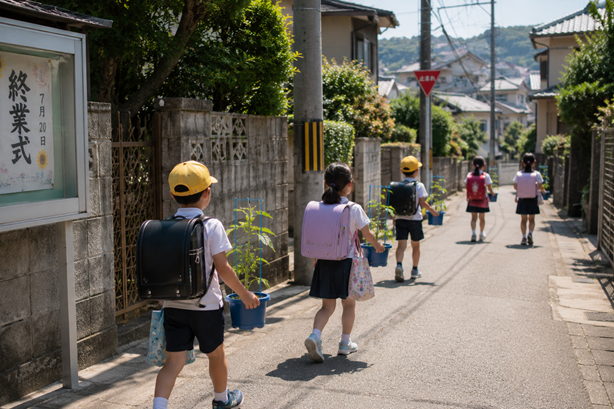
As the final bell rings and summer vacation begins, hundreds of elementary school children leave through the school gates carrying enormous blue flower pots. Many of the pots seem almost as large as the children themselves. Some students wrap both arms around them while others stop every few minutes to rest before continuing their journey home. Parents often come to help, but many children insist on carrying the pots themselves, determined to bring home the plant they have spent weeks caring for.
To Japanese people, this is one of the most familiar sights of early summer. It quietly signals that the long summer holiday has begun.
For many international visitors, however, the scene raises an immediate question.
Why are children taking flowers home from school?
The answer reveals something far more meaningful than a gardening project.
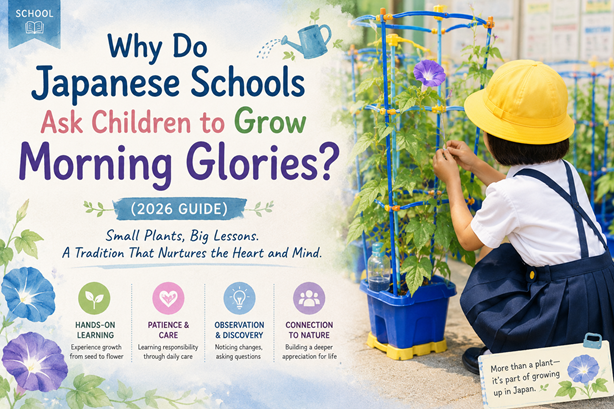
Across Japan, first-grade elementary school students are asked to grow morning glories, known as asagao (朝顔) in Japanese. Throughout the summer, they water the plant every morning, observe its growth, record the weather, draw pictures of new flowers, and keep a daily journal of its changes. At first glance, it may seem like a simple science assignment. In reality, it is one of the earliest and most memorable lessons in Japanese education.
The morning glory is not chosen because it is beautiful or easy to grow. It is chosen because one small flower can teach children lessons that no textbook ever could.
🌸 More Than Just a Flower
When people think about school education, they often imagine mathematics, reading, science, or history. Plants rarely come to mind. Yet in Japanese elementary schools, growing a morning glory is considered just as valuable as learning from a classroom lesson because the experience teaches children through everyday actions rather than lectures.
From the moment each student receives a small seed, the responsibility becomes entirely their own. Teachers explain how to plant it, how much water it needs, and where it should be placed, but after that the plant depends on the child. If they remember to care for it, the seed gradually sprouts, climbs its support, produces leaves, and eventually rewards their effort with colorful flowers. If they forget for several days during the hot Japanese summer, the plant immediately begins to struggle.
This simple relationship between care and growth is easy for even six-year-old children to understand. They do not learn responsibility because someone explains the definition. They discover it because a living plant responds directly to their actions.
That approach reflects an important characteristic of Japanese education. Rather than teaching every lesson through words, schools often create experiences that allow children to reach their own understanding. Morning glories become teachers in their own quiet way, showing that small daily efforts can lead to remarkable results over time.
🌱 Learning Responsibility One Morning at a Time
Responsibility is one of those qualities that adults often tell children is important, yet it can be surprisingly difficult to explain. Japanese schools approach the challenge differently by allowing children to experience responsibility instead of simply hearing about it.
Every morning during the growing season begins with the same routine. Before the day becomes too hot, children fill a watering can, carefully pour water around the roots, and take a moment to see what has changed since yesterday. Sometimes a new leaf has appeared. Sometimes the vine has climbed a little higher. Occasionally the first flower opens, turning weeks of patient care into a moment of excitement.
These changes happen slowly enough that children begin to appreciate the value of consistency. Missing a single day may not seem important, but repeated neglect quickly becomes visible. Likewise, watering the plant faithfully every morning produces healthy growth that children can see with their own eyes.
This lesson extends far beyond gardening. Whether learning a musical instrument, practicing handwriting, studying mathematics, or playing sports, meaningful improvement rarely comes from one extraordinary effort. It comes from doing small things well every day. The morning glory introduces this idea long before children are old enough to understand it in abstract terms.
Perhaps that is why so many Japanese adults still remember growing their own morning glories decades later. They may have forgotten the exact height of the plant or the number of flowers it produced, but they remember waking up each morning with the quiet understanding that something was depending on them.
📖 Watching, Recording, and Discovering
Growing the plant is only part of the project. Observing it carefully is equally important.
Throughout the summer vacation, many schools ask children to keep an observation journal. Each day they record what they notice, often writing about the height of the vine, the number of flowers that have opened, the shape of the leaves, or the appearance of new buds. Many children also draw pictures of the plant, comparing today’s sketch with one they completed several weeks earlier. Some teachers encourage students to include the day’s weather and temperature as well, helping them recognize how sunlight, heat, and rainfall influence growth.
To adults, these activities may seem simple. For children, however, they develop an entirely new way of seeing the world.
Instead of looking only for dramatic changes, students learn to notice the small differences that occur from one day to the next. They begin asking questions. Why did more flowers bloom after yesterday’s rain? Why did some leaves become larger than others? Why does one bud open while another remains closed?
These moments of curiosity are exactly what Japanese teachers hope to encourage. Observation becomes the starting point for independent thinking, while drawing and writing transform those observations into lasting memories. Without realizing it, children are strengthening their scientific thinking, improving their writing skills, and developing patience through a single daily activity.
Most importantly, they begin to understand that learning is not limited to classrooms. Sometimes the greatest discoveries are waiting just outside the front door, growing a little taller every morning.
🌞 Why Morning Glories Bloom in the Morning
Of all the flowers that Japanese schools could have chosen, the morning glory is perhaps the most thoughtful.
Its Japanese name, asagao (朝顔), literally means “morning face,” a name inspired by the flower’s habit of opening its blossoms shortly after sunrise. During the hottest days of summer, the flowers display their brilliant colors in the cool morning air before gradually closing as the temperature rises. By afternoon, many of the blossoms have already begun to fade.
For children, this creates an important routine without anyone having to enforce it.
If they want to see the flowers at their most beautiful, they need to wake up early. If they wait until lunchtime, the blossoms that opened at dawn may already be gone. The flower itself quietly teaches a lesson that no classroom rule could achieve.
This becomes especially meaningful during Japan’s long summer vacation. Without the structure of school, many children around the world begin staying up later at night and sleeping well into the morning. Japanese parents face exactly the same challenge. Yet the morning glory gives children a gentle reason to get out of bed.
They wake up, carry a watering can into the garden or onto the balcony, admire the newly opened flowers, write a few notes in their observation journal, and only then begin the rest of their day. What might otherwise feel like a chore gradually becomes part of a comforting summer routine.
Perhaps the most beautiful aspect of this tradition is that it encourages discipline without relying on strict instructions. Rather than repeatedly telling children, “You should wake up early,” the school introduces a flower that quietly rewards those who do. It is a gentle approach that reflects a broader philosophy found throughout Japanese education: good habits are often nurtured through meaningful experiences rather than enforced through constant reminders.
❤️ Learning to Care for Life
Although a morning glory is only a small plant, for many first-grade students it is the first living thing they have ever been fully responsible for.
Unlike a toy, a notebook, or a schoolbag, a plant responds to the care it receives. When children water it consistently, the leaves become greener, the vine grows taller, and new flowers appear one after another. If they forget for several days during the heat of summer, the changes are just as obvious. The leaves begin to droop, the soil dries out, and the plant struggles.
These experiences introduce children to an important truth about life: every living thing depends on care.
The lesson extends beyond gardening. As children begin to notice the needs of their morning glory, many also become more aware of the birds visiting the garden, the insects climbing the vines, and the changing weather that affects every living creature. A single flower often becomes the starting point for a much wider curiosity about nature.
There is also an emotional dimension to the experience. The excitement of seeing the first flower bloom after weeks of patient care creates a genuine sense of accomplishment. Children discover that their own daily efforts have helped something beautiful come into existence. It is a quiet achievement, but one that often leaves a lasting impression.
Japanese schools understand that empathy cannot simply be taught through lectures. It grows through experience. By caring for one small plant every day, children begin developing the kindness, patience, and respect for life that will later influence how they treat both people and the natural world.
🏫 A Summer Memory That Lasts a Lifetime
Ask many Japanese adults about their elementary school days, and there is a good chance they will smile when someone mentions morning glories.
They may not remember every page of their observation journal or every sentence they wrote during that first summer vacation. They may have forgotten exactly how many flowers bloomed or how tall the vine eventually became. Yet many vividly remember carrying that large blue flower pot home on the final day of school, carefully watering it every morning, and feeling excited whenever a new blossom appeared.
Some memories stay with us not because they were extraordinary, but because they quietly became part of everyday life.
For many Japanese people, the sight of morning glories blooming in early summer still brings back memories of childhood. It reminds them of hot July mornings, buzzing cicadas, watering cans filled from the garden hose, and the simple satisfaction of watching something grow a little more each day.
This lasting emotional connection reveals something important about Japanese education. Schools are not only trying to teach knowledge that will appear on examinations. They are also creating experiences that become part of children’s memories for years to come. Long after multiplication tables have been forgotten, the feeling of nurturing a living plant often remains.
In that sense, the morning glory project is far more than a seasonal assignment. It is a small tradition that quietly shapes how children remember both nature and their first years of school.
✨ Conclusion
To many visitors, a child carrying an oversized flower pot home from school may seem like a curious summer tradition.
In reality, it represents one of the most thoughtful lessons in Japanese education.
By asking children to grow a single morning glory, schools teach far more than basic gardening. They encourage responsibility through daily care, curiosity through careful observation, patience through steady growth, and compassion through the experience of nurturing another living thing. Even healthy routines are woven naturally into the project, as children wake early each morning to see the flowers at their most beautiful.
None of these lessons require long lectures or complicated textbooks. They emerge naturally from the quiet relationship between a child and a flower.
Perhaps that is why this tradition has remained a cherished part of elementary school life for generations. It reminds us that education is not always about learning more facts. Sometimes it is about becoming a little more thoughtful, a little more patient, and a little more aware of the living world around us.
One flower, cared for over a single summer, can teach lessons that last a lifetime.
🌏 Continue Discovering Japanese School Life
If you enjoyed learning about Japan’s unique approach to education, you may also enjoy these articles exploring the traditions, values, and everyday experiences that shape school life across the country.
👉Why Do Japanese Students Clean Their Own Classrooms? The Lesson Behind School Cleaning Time
👉What Is a Japanese School Trip? Why Shūgaku Ryokō Becomes a Lifetime Memory (2026 Guide)
👉What Is Japanese School Lunch? Why Kyushoku Is More Than Just Food (2026 Guide)
👉Why Is Japanese Sports Day Such a Powerful Childhood Memory? Understanding Undokai
👉School Uniforms in Japan: More Than Just a Dress Code (2026 Guide)
👉Why Do Japanese Children Walk to School by Themselves? (2026 Guide)
👉Why Do Japanese Schools Have Swimming Classes? (2026 Guide)