
🧳 The Best Packing Question Is Not “How Many Days Am I Staying?”
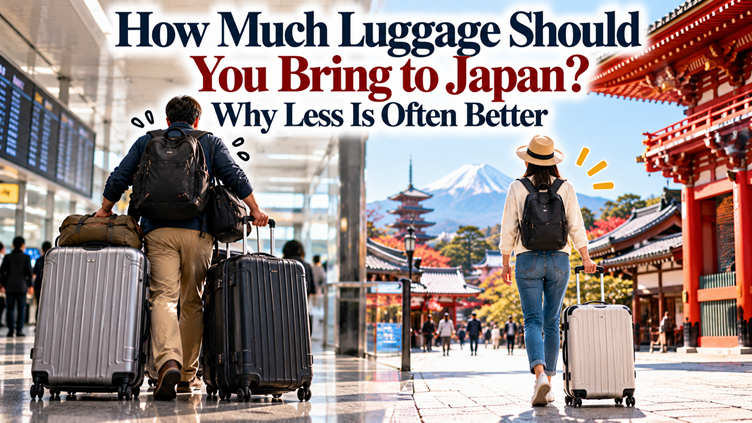
One of the hardest parts of preparing for a trip to Japan is deciding how much luggage to bring. A one-week trip sounds like one week of clothes, a two-week trip sounds like two weeks of clothes, and a longer trip can make the suitcase seem almost impossible to close. But there is a better way to think about packing for Japan. The important question is not simply how many days you will be away. It is how often you will need to carry your luggage from one place to another.
That difference matters because Japan is a country where travelers often move themselves rather than moving their luggage separately. You may leave a hotel in the morning, walk to a station, take an escalator or stairs, find the correct platform, board a train, change trains, walk through another station, take a Shinkansen, walk to a hotel, and then repeat the whole process again a few days later. None of these individual movements is necessarily difficult, but together they can make a large suitcase surprisingly tiring.
This is very different from the way many people experience road trips in the United States. When I lived in the United States, I often felt that packing was easier because the car solved part of the luggage problem. I could put more clothes and other items into the trunk, leave them there while traveling, and take only what I needed into the hotel. Hotels also commonly had laundry facilities, so there was no strong reason to pack enough clothes for the entire trip. The result was a strange paradox: I could travel for several days while carrying very little, even though I technically had a lot of luggage with me.
Traveling around Japan creates a different equation. Your suitcase is not sitting in the trunk while you move between destinations. For much of the trip, you are the luggage transportation system. That is why traveling comfortably in Japan often means packing much less than you initially think you need.
For a typical trip that focuses on cities, sightseeing, trains, and hotels, one medium-sized suitcase with roughly four days of clothing is a very useful starting point, even when the trip itself lasts a week, ten days, two weeks, or longer. That is not a universal rule, and winter travel, skiing, hiking, children, formal events, and other special circumstances can change the calculation. But once you realize that you can wash clothes during the trip and that many hotels provide basic amenities, the amount you actually need to carry can become surprisingly small.
🌏 Japan Rewards Travelers Who Pack for the Journey, Not Just the Destination
There is a psychological trap when packing for Japan. You imagine all the things you might need once you arrive, but you do not always imagine what it will be like to transport those things across the country. A large suitcase feels harmless when it is sitting open on your bedroom floor. It feels very different when you are pulling it across a station concourse, lifting it onto a train, moving through a crowded platform, or trying to keep it out of the way while other passengers are getting on and off.
This is why the best packing strategy for Japan begins with movement. Think about where the suitcase will be at every stage of the trip. Will you have a car? Probably not, especially in Tokyo, Kyoto, Osaka, and other major destinations. Will a hotel employee carry it for you every time you change cities? Usually not. Will you always have an elevator directly where you need one? Not necessarily. Will every station have a completely empty escalator when you arrive? Definitely not.
The more often the suitcase has to move with you, the more valuable every kilogram becomes.
This is also why a suitcase that seemed perfectly manageable when you left home can become irritating after several days. You are not simply carrying its weight once. You are carrying it repeatedly, lifting it over small steps, steering it around people, fitting it into different spaces, and thinking about where it is every time you change transportation.
A lighter suitcase therefore does more than reduce physical effort. It reduces the number of things you have to think about.
👕 Why Four Days of Clothes Can Be Enough
For many visitors, the biggest source of unnecessary luggage is clothing. People often make the assumption that the number of days on the itinerary should determine the number of outfits in the suitcase. A ten-day trip becomes ten days of clothes. A two-week trip becomes two weeks of clothes. Once you include different shirts, trousers, underwear, socks, sleepwear, jackets, shoes, and extra items for unexpected weather, the suitcase becomes enormous.
But travel clothing does not have to be one-time clothing.
You can wear something, wash it, dry it, and wear it again.
That simple fact changes the entire calculation.
For a typical city trip in Japan, four days of everyday clothes can be a very practical baseline. You may arrive with several outfits, wear them during the first part of the trip, use a hotel or nearby laundry facility, and then continue with clean clothes. By the end of the trip, the same clothing has served far more days than the original four.
The important thing is not that four days is a magical number. It is simply long enough to give you variety and flexibility without forcing you to bring a huge amount of clothing. You can adjust the amount depending on the season, your personal habits, the length of your trip, and whether you will have easy access to laundry. The principle is what matters: pack for the next laundry cycle, not for the entire vacation.
This is particularly useful for longer trips. A fourteen-day journey does not automatically require fourteen days of clothing. In fact, the longer the trip becomes, the more useful laundry becomes, because carrying two weeks of clothing simply does not make much sense when the same clothes can be washed along the way.
🧺 Laundry Changes the Mathematics of Packing
Laundry is one of the most important reasons travelers can reduce their luggage for Japan. Many hotels, particularly business hotels and other accommodation designed around practical travel, offer coin-operated washing machines and dryers, although availability varies by property. Other hotels may have laundry services or can direct guests to a nearby laundromat.
This means you do not need to assume that the clothes you pack at the beginning must remain clean and unused until you get home.
The first few days can be approached as one cycle. Then you wash. The next few days become the next cycle. You are effectively extending the usefulness of every piece of clothing you brought.
This is exactly what made travel in the United States easier for me as well. When I knew that a hotel had laundry facilities, I did not have to think of clothing as something I needed in proportion to the number of nights. I could think of it as something I could reuse. The same basic idea works in Japan, except that the importance of doing laundry becomes even greater because you are likely to carry the suitcase much more frequently.
Before you leave home, it is worth checking the laundry facilities at the hotels you have already booked, especially if you are traveling during a busy period. Do not assume that every property has exactly the same facilities. The goal is simply to know where your next laundry opportunity will be.
Once you know that you can wash clothes, your suitcase suddenly becomes much easier to control.
🏨 Hotel Amenities Can Remove More From Your Suitcase Than You Expect
Another common mistake is bringing things from home that you may not actually need to carry across Japan. Depending on the hotel, basic amenities can include shampoo, conditioner, body wash, toothbrushes, toothpaste, towels, and sleepwear or nightwear. Some properties provide these items in the room, while others make them available in an amenity area where guests take only what they need.
This does not mean you should blindly leave every personal-care item at home. Everyone has different preferences, and some travelers need specific products for their skin, hair, medication, or other personal requirements. The better approach is simply to check the hotel information before packing. If the hotel already provides something you are comfortable using, there is little benefit in carrying a full-sized version of it across the country.
The same logic applies to towels. Travelers who have never visited Japan sometimes imagine that they need to carry towels because they are expecting a long journey. For normal hotel travel, that is usually unnecessary. The hotel is already designed to support the traveler.
This is one of the most useful packing principles for any destination, but it is particularly helpful in Japan because the smaller your suitcase becomes, the easier every train transfer and station walk becomes.
The goal is not to own less.
The goal is to avoid carrying something that your destination already provides.
🚆 The Real Problem With Heavy Luggage Is the Japanese Train Journey
A large suitcase becomes a much bigger problem once you are inside Japan’s transportation system. Japan has an excellent rail network, but using it comfortably requires movement. A traveler may walk through a large station, use an escalator, climb stairs, wait on a platform, board a train, transfer to another line, and continue walking after getting off.
On a simple journey, this is easy.
With a large suitcase, it can become tiring surprisingly quickly.
Tokyo stations are particularly good at demonstrating this. A station that looks like one place on a map can contain multiple platforms, corridors, underground areas, connecting lines, and long walking routes. Your destination may be technically “the same station” while still requiring quite a bit of physical movement.
Kyoto, Osaka, Yokohama, Nagoya, Fukuoka, and other cities have their own versions of the same problem. Japan is highly connected by rail, but that does not mean every trip is a short walk from one platform to another.
This is why luggage should be considered part of your transportation plan.
A small suitcase does not merely feel lighter.
It fits your trip better.
🚉 A Crowded Train Changes Everything
The other reason to keep luggage small is crowding. Japanese trains are not always crowded, and many trips are perfectly comfortable, especially outside peak commuting times. But busy urban trains can become extremely crowded, and large luggage can make the experience considerably more stressful.
Imagine standing inside a busy train while holding a large suitcase. You are trying not to block the door, not to hit another passenger, and not to interfere with people getting on or off. The suitcase cannot disappear. You have to constantly think about where it is.
Now compare that with a smaller suitcase that stays close to you.
The difference may be surprisingly large.
This is one of the reasons visitors should not think about luggage only in terms of hotel rooms. The most difficult part of having too much luggage may happen before you even reach the hotel.
A suitcase that occupies too much physical space can turn a simple train journey into something you have to manage rather than something you can simply experience.
🧍♂️ One Person With Two Large Suitcases Has a Practical Problem
There is also a limit to how much one person can physically control.
One large suitcase is manageable.
Two large suitcases plus a backpack is another situation entirely.
You now have to decide which hand carries which bag, where the backpack goes, how to enter the train, how to use an escalator, where to stand, and how to get through narrow spaces. Even if the luggage is technically allowed, that does not mean it is pleasant.
This is particularly important when a traveler is changing hotels frequently. Every hotel change turns the luggage problem into a transportation problem again.
A person traveling alone should think especially carefully before bringing multiple large suitcases. A family has more people who can divide the load, but even then, several giant suitcases can become difficult when everyone is moving through a station at the same time.
The best luggage is often not the luggage with the greatest capacity.
It is the luggage you can control without thinking about it.
🏃 Japan Can Easily Become a 10,000-Step Day
Another part of this calculation is walking.
Many visitors to Japan are surprised by how much walking naturally appears in a normal sightseeing day. You may walk from your hotel to the station, from the station to a shrine, through a neighborhood, around a shopping district, between attractions, and back to the hotel. Even when you use trains for most transportation, you may still end up walking well over 10,000 steps during a full day of sightseeing.
That changes the importance of what you bring.
After a long day of walking, a heavy suitcase becomes more annoying.
A suitcase with awkward wheels becomes more annoying.
A bag that forces you to stop and rearrange everything becomes more annoying.
Even a backpack that is slightly too heavy can begin to feel surprisingly uncomfortable.
This is why comfort should be the goal of packing for Japan. You are not trying to win a packing competition. You are trying to arrive at the end of the day with enough energy left to enjoy your evening.
👟 Your Shoes May Matter More Than Your Extra Clothes
This is one thing I would emphasize strongly: bring comfortable shoes.
A traveler can spend an enormous amount of time thinking about which shirt to bring and almost no time thinking about what it will feel like to walk for several hours on pavement, through stations, across shopping streets, around temples, and through parks.
For a typical Japan trip, comfortable walking shoes can be much more important than an extra pair of fashionable shoes.
This does not mean everyone needs a special travel shoe. It means you should bring something that you already know is comfortable for long periods of walking. A pair that feels fine for a 20-minute walk at home may not feel fine after a 10,000- or 15,000-step sightseeing day.
There is also the problem of trying to break in new shoes during the trip. Japan is not the place where you want to discover on your second day that a new pair of shoes causes blisters.
A well-fitting, comfortable pair of walking shoes can contribute more to the quality of your trip than several extra outfits sitting inside your suitcase.
The same principle applies to your luggage itself. Good wheels matter. A handle that extends smoothly matters. A suitcase that is easy to steer matters. Your travel experience is affected not only by what you pack but by how easily you can move everything you packed.
🧳 One Medium Suitcase Can Be a Very Good Starting Point
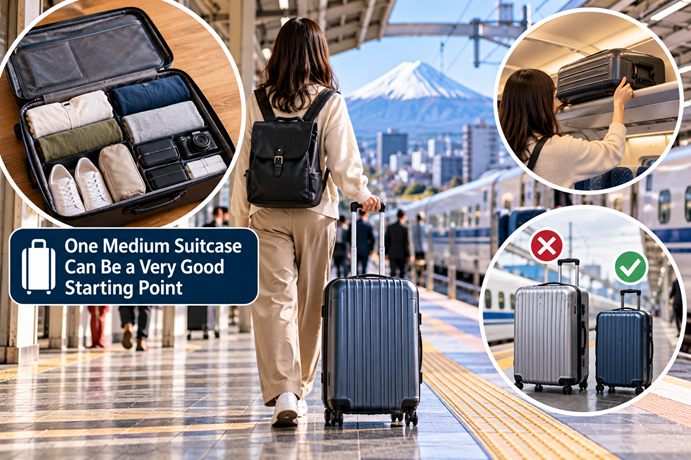
For many international travelers visiting Japan for a week or two, a medium-sized suitcase can be a very practical compromise. It is large enough to carry several days of clothing, personal items, electronics, and whatever else you genuinely need, but small enough to remain manageable on trains and through stations.
The exact dimensions depend on your airline, trip, and personal needs, so there is no universal “Japan suitcase size.” The important point is to resist the instinct to buy or bring the largest suitcase simply because there is empty capacity available.
Empty space is tempting.
You look at a large suitcase and think, “I might as well take it. I have the room.”
That is how a suitcase becomes much heavier than necessary.
A medium suitcase encourages better decisions. You begin asking whether something is really necessary. You start considering laundry. You stop packing “just in case” versions of everything. You become more selective about shoes, jackets, toiletries, and extra clothing.
Paradoxically, a smaller suitcase can make planning easier because it forces you to think clearly.
🧥 Winter Is the Biggest Exception
The four-day clothing approach works best when you are packing normal everyday clothes for a typical urban trip. Winter can complicate the calculation considerably.
If you are visiting Hokkaido, northern Japan, or mountainous areas during cold weather, winter clothing is physically larger. A heavy coat, thick sweaters, gloves, scarves, warm layers, and winter shoes can consume much more suitcase space than summer clothing.
This does not mean the lighter-packing strategy stops working. It means you need to think more carefully about what can be worn repeatedly and what should be carried. Wearing your bulkiest outer layer during transportation can save significant suitcase space. Choosing layers that can be combined in different ways can also be more effective than bringing many thick individual pieces.
The same principle applies in reverse during summer. Japanese summers can be hot and humid, so clothing can become sweaty more quickly and laundry may become more important. Lightweight clothing that dries easily can be more useful than bringing a large number of heavy outfits.
The season changes the details.
The basic philosophy stays the same.
🧴 Toiletries: The “I Might Need It” Problem
Toiletries are another place where suitcases become unnecessarily large. Travelers often imagine every possible scenario: full-size shampoo, conditioner, body wash, multiple skincare products, several types of medicine, large cosmetic bags, extra towels, and other things that may not be needed.
This is where the hotel check becomes valuable.
If your accommodation already provides shampoo, conditioner, body wash, toothbrushes, toothpaste, towels, and sleepwear, you can remove several bulky items from your packing list. For the items you genuinely need, smaller containers are usually enough for a normal trip, especially when you are staying in hotels and can replenish products locally if necessary.
The exception is anything medically necessary or highly specific to you. Prescription medicines, personal medical equipment, and products that you cannot easily replace should always be treated differently. Those are not optional packing items.
The question is not “Can I buy this in Japan?”
The question is “Would I be comfortable being without this?”
For ordinary hotel amenities, the answer is often yes.
🎒 Your Day Bag Is More Important Than You Think
Keeping the suitcase small does not mean you should carry everything with you during sightseeing. In fact, one of the best ways to travel comfortably is to separate your luggage into two completely different categories: the suitcase that moves between hotels and the small day bag that moves with you during sightseeing.
Your day bag should remain light because that is the bag you will carry through the city for hours. It might contain your phone, wallet, passport when necessary, portable battery, tissues, medication, water, and a few other essentials. The suitcase should contain everything else.
This distinction helps because the objects you need at the hotel do not need to be on your back while you are visiting a temple or walking through a neighborhood.
The same philosophy applies to clothing. You do not need access to every shirt you own while you are standing in front of a famous shrine. You need your day bag to contain what you need for the day.
A light day bag paired with a manageable suitcase is much easier than trying to make one enormous backpack do everything.
🚚 Japan Gives You Another Option: Send the Luggage
There is one more reason you do not necessarily need to carry everything yourself: luggage delivery.
Japan has well-developed luggage forwarding services that allow travelers to send suitcases from one hotel to another or to other destinations. The exact service, timing, cost, and eligibility depend on the provider and route, so it is important to confirm the details with the hotel or service beforehand. But the broader point is that you do not always have to choose between “carry everything” and “leave everything behind.”
You can also change your behavior during the trip.
Perhaps you arrive with your medium suitcase.
You buy souvenirs.
The suitcase becomes fuller.
Instead of dragging everything through multiple train connections, you send it ahead.
That can be much easier than trying to keep every suitcase with you at every moment.
The best packing strategy is therefore not always “own less.”
It is move less.
That is a subtle but very important distinction.
🛍️ Souvenirs Are Another Reason to Start Light
There is another practical advantage to packing lightly: Japan is a dangerous place for an already-full suitcase.
You may intend to bring home nothing.
Then you see something at a department store.
Then a beautiful food gift appears.
Then you find a traditional craft.
Then you buy snacks for your family.
Then you discover something in a station shop that you did not expect.
Suddenly your suitcase is full.
Starting with some unused capacity gives you flexibility. But there is a difference between useful empty space and bringing an enormous suitcase simply because you expect to shop. A medium suitcase with several days of clothing can provide a surprising amount of room once clothing is washed and worn again during the trip.
This also gives you another reason to keep unnecessary packaging to a minimum. You are not only carrying the object itself. You are carrying its packaging around Japan until you finally get home.
The lighter the initial suitcase, the more freedom you have later.
🚉 The Japanese Train Changes the Meaning of “Travel Light”
There is a phrase that sounds obvious until you actually experience it: travel light.
In some destinations, traveling light means saving baggage fees or making the flight easier.
In Japan, traveling light often means reducing the number of times you have to think about your suitcase.
You can get off the train without worrying about whether someone will trip over it.
You can walk through a station without stopping every few minutes.
You can use an escalator without feeling like the suitcase is taking up half the available space.
You can walk from the station to the hotel.
You can enter a convenience store without wondering where to leave a giant case.
You can explore a neighborhood after checking out without feeling that your luggage is controlling your movements.
This is why a smaller suitcase can actually make the trip feel larger.
You become more willing to walk.
You become more willing to take a small detour.
You become more willing to explore a street you did not plan to visit.
Your luggage stops determining your itinerary.
🧠 The Best Packing Rule for Japan: Ask What You Will Carry
The most useful question before a Japan trip is not, “How many outfits should I bring?” It is not even, “How many days will I be away?”
Ask this instead:
How much of this am I actually willing to carry through Japan?
That question changes everything.
A large bottle of shampoo suddenly seems unnecessary.
Fourteen days of clothing suddenly seems excessive.
A third pair of shoes becomes questionable.
An extra jacket that might be useful for one evening starts to look less attractive.
A second large suitcase becomes much harder to justify.
At the same time, comfortable shoes become extremely important.
A lightweight jacket becomes valuable.
Four days of clothing starts to make sense.
Laundry becomes part of the itinerary rather than something you have to avoid.
And a luggage-forwarding service becomes a tool rather than an emergency backup.
This is the difference between packing for a calendar and packing for a journey.
🌏 A Comfortable Japan Trip Is Not a Competition to Pack More
There is a strange idea that packing thoroughly means packing for every possible problem. Travelers imagine rain, cold, hot weather, stains, unexpected dinners, shopping, toiletries, souvenirs, and every other possibility, and then try to prepare for all of them at home.
But Japan is not a desert island.
You will have shops.
You will have hotels.
You will have pharmacies.
You will have laundry.
You will have convenience stores.
You will have transportation.
You will have restaurants.
You will have opportunities to solve small problems after you arrive.
That means you do not need to bring an entire backup version of your normal life inside your suitcase.
Of course, there are exceptions. Special medical requirements, baby equipment, outdoor sports, formal occasions, winter travel, and other circumstances can justify more luggage. But for an ordinary sightseeing trip, carrying less is often the smarter choice.
The goal is not to see how little you can survive with.
The goal is to make the journey comfortable.
👟 Pack for Your Feet, Not Just Your Suitcase
If there is one thing I would tell a first-time visitor to Japan, it is this: think about your feet before you think about your wardrobe.
A day in Tokyo, Kyoto, Osaka, or another major destination can easily involve more walking than you expected. Stations are large. Tourist areas are spread out. Temples and shrines can have long approaches. Shopping districts invite wandering. Parks can be much bigger than they look on a map. Even after you return to your hotel, you may realize that you have walked well over 10,000 steps without specifically planning to do so.
That means the quality of your shoes can affect your experience far more than the number of shirts in your suitcase.
Comfortable shoes allow you to keep exploring.
Uncomfortable shoes make every additional destination feel like a decision.
The same principle applies to luggage. A suitcase that is easy to roll is better than one that technically holds more. A bag that fits beside you is better than one that constantly gets in someone else’s way. A backpack that does not strain your shoulders is better than one that carries every item you own.
Travel comfort is built from small decisions.
Packing is one of them.
🧳 So, How Much Luggage Should You Bring to Japan?
For a typical international visitor taking a city-focused trip through Japan, one medium suitcase with around four days of clothing is an excellent starting point. That does not mean four total outfits and nothing else. It means you can build a small rotation of clothes, wash them during the trip, and reuse them rather than carrying enough clothing for every day. Add a light day bag, comfortable walking shoes, the personal items you genuinely need, and whatever seasonal equipment your particular trip requires.
The most important thing is to avoid turning that starting point into a rigid rule. A traveler spending two weeks skiing in Hokkaido obviously needs different equipment from someone spending ten days in Tokyo, Kyoto, and Osaka. A family with young children has different needs from a solo traveler. Someone attending a wedding needs different clothing from someone sightseeing in casual clothes. Japan has many climates and many styles of travel, so the right amount of luggage depends on what you are actually doing.
But for the ordinary visitor, the principle is remarkably consistent: you probably need less than you think.
Your clothes can be washed.
Your hotel may already provide many basic amenities.
Your destination has stores.
Your luggage can sometimes be forwarded.
And, most importantly, you are going to move around.
The suitcase that looks impressively prepared in your bedroom may feel very different after you have pulled it across a large station, carried it up a few steps, squeezed onto a busy train, walked another kilometer to the hotel, and then done it all again three days later.
Japan is one of those countries where lighter luggage can genuinely improve the trip.
It gives you freedom.
It reduces fatigue.
It makes trains easier.
It makes stations easier.
It makes walking easier.
And it leaves more energy for the thing you actually came to Japan to do: experience the country.
🌏 The Best Luggage Is the Luggage You Barely Think About
Packing for Japan is not really about trying to fit your entire life into one suitcase. It is about deciding what deserves to move with you and what can be left behind, washed, borrowed, replaced, or provided by the place where you are staying. That is why the most useful packing strategy is not to count vacation days and multiply them by the number of shirts you own. It is to understand the infrastructure of the destination and let that infrastructure work for you.
The United States taught me that a car and a hotel laundry can make a surprisingly large amount of luggage feel almost invisible. Japan taught me the opposite lesson: when trains, stations, escalators, stairs, walking, and crowded urban spaces become part of the journey, luggage suddenly becomes very visible. The less you carry, the less the suitcase controls your day.
Four days of clothing can be washed.
Hotel amenities can reduce the number of toiletries you need.
A medium suitcase can be easier to manage than a huge one.
A luggage delivery service can remove a difficult transfer.
Comfortable shoes can protect the energy you need for a long sightseeing day.
And after a few days, you may discover something that experienced travelers already know: the best packing decision was not something you put into the suitcase.
It was something you decided not to put in.
🔗 Explore More Practical Advice for Life in Japan
For more practical information that helps make everyday travel in Japan easier and more comfortable, explore the Life in Japan series below.
👉 Which Side Should You Stand on an Escalator in Japan? Tokyo, Osaka, and the World
👉 Staying at a Japanese Ryokan: What to Know About Dinner, Yukata, Tatami, and Onsen Etiquette
👉 How Much Japanese Yen Do You Need in Japan? Cash, Cards, and How Much to Carry
👉 Why Is Smoking in Japan So Different? Smoking Areas, Hotels, Restaurants, and City Streets (2026 Guide)