
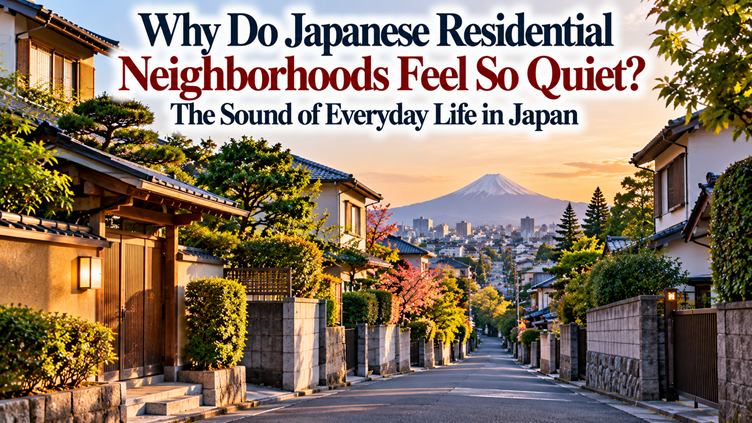
🌏 A Quiet Neighborhood Is Not Necessarily an Empty Neighborhood
One of the first things many visitors notice after spending some time away from the main tourist areas of Japan is something that is surprisingly difficult to photograph: the quietness of an ordinary residential neighborhood. Not the silence of a mountain, not the stillness of a temple garden, and not the quiet atmosphere of a rural village, but the everyday quiet of a place where people are actually living. There are houses, apartment buildings, bicycles, parked cars, children going to school, laundry hanging outside, deliveries arriving, and people coming and going, yet when you walk through many Japanese residential streets, the overall soundscape can feel remarkably subdued.
There is something slightly strange about that experience. At first, you may think that a quiet neighborhood should feel empty, but a Japanese residential street often does not feel empty at all. It feels inhabited without constantly announcing that fact. You may hear the faint sound of a car moving down a narrow street, a bicycle passing behind you, a door closing somewhere, birds in a tree, or a distant voice from inside a house, but there may be very little sound that seems to dominate the entire street. Instead of one large continuous noise, you notice small pieces of everyday life. The result is not complete silence. It is something closer to a background of human presence.
That distinction matters because Japanese residential neighborhoods are not universally or magically quieter than residential neighborhoods in other countries. In fact, my own experience tells me exactly why we should be careful about making that claim. I have lived in the United States and in Toronto, and the residential neighborhoods where I lived were also extremely quiet. They were genuinely peaceful places, especially at night, and there was nothing about them that made me think, “North America is noisy while Japan is quiet.” That would be an unfair and inaccurate comparison. The neighborhoods themselves, their distance from major roads, the types of homes, the number of residents, and the character of the surrounding area all mattered.
And yet, after living in different places, I began to notice something slightly different about the quietness of Japanese residential neighborhoods. The difference is not necessarily how quiet they become at night. A good suburban neighborhood in the United States or Toronto can become almost completely still after dark. The more interesting difference is what happens during the day, what kinds of sounds are considered ordinary, and how strongly people seem to regulate the amount of sound they introduce into the shared space around their homes.
That is where the story becomes much more interesting than the simple idea that “Japanese people are quiet.”
🏠 The Quietness Begins With an Awareness of Other People
One important part of Japanese neighborhood culture is a strong awareness that sound does not stop at your own front door. A television may be inside your house, a washing machine may be inside your apartment, and a conversation may be taking place among your own family members, but the sound can still travel through floors, walls, windows, and open streets. This is particularly noticeable in apartment buildings, where everyday sounds such as loud conversations, music, children running, vacuum cleaners, washing machines, doors, and late-night bathing can become sources of conflict between neighbors. Japan’s Ministry of Land, Infrastructure, Transport and Tourism specifically advises residents of apartment buildings to be especially careful about everyday noise during the night and early morning.
The important point is not that Japanese people never make noise. Of course they do. Families have children, people watch television, friends visit, people have parties, dogs bark, construction happens, and streets can suddenly become very loud. What matters is the social idea that there is a boundary between the sound that belongs inside your own life and the sound that you impose on the lives of people around you.
That distinction can shape behavior long before a situation becomes a formal complaint. Someone may lower their voice in a hallway, avoid using a washing machine very late at night, close a door more gently, or think twice about making unnecessary noise in a narrow street. The reasoning is not always spoken aloud. People simply grow up with the idea that a home exists inside a neighborhood, and that the neighborhood is shared with other people.
This is one reason it is tempting to describe Japanese neighborhoods as unusually considerate about sound, but even here, comparison is important. The basic principle is not uniquely Japanese. In quiet American and Canadian residential neighborhoods, people also understand that excessive noise can disturb neighbors. Most people who have lived in a good residential area in Toronto or the United States know that playing loud music late at night, shouting outside after midnight, or creating unnecessary noise in a peaceful neighborhood can be considered inconsiderate.
So the deeper question is not, “Why are Japanese people the only people who care about noise?” They are not. The better question is, “How does consideration for other people’s sound environment become visible in ordinary daytime life?”
That is where Japanese residential neighborhoods become particularly interesting.
☀️ The Curious Part Is That the Neighborhood Can Be Quiet in the Daytime
Nighttime quiet is not especially surprising. Almost anywhere, a residential neighborhood becomes quieter when most people are asleep. Streets empty, businesses close, children go inside, and traffic falls away. This is true in Japan, Toronto, the United States, and countless other places around the world.
The daytime is more revealing.
Walk through a Japanese residential neighborhood on an ordinary weekday morning or afternoon and you may notice that the street seems surprisingly calm even while ordinary life is happening all around you. There is movement, but not necessarily much noise. A person carries groceries home. A bicycle passes. A delivery vehicle stops briefly. Someone leaves for work. A child returns from school. A neighbor opens a gate. Yet the overall soundscape can remain remarkably restrained.
Part of this is cultural, but part of it is physical. Japanese residential neighborhoods often contain narrower streets, smaller individual plots, a mixture of detached houses and low-rise apartment buildings, walls and fences, bicycles, planted areas, and homes located relatively close together. The neighborhood is not simply a collection of large private properties separated from one another by wide lawns. This means that there are fewer opportunities to create large amounts of outdoor space that belong entirely to one household.
There is also a difference in the kind of outdoor maintenance that a neighborhood requires. When I lived in the United States, one sound that could easily become part of suburban life was the sound of lawn maintenance. Depending on the neighborhood, you might hear a lawn mower, a leaf blower, hedge trimmer, or other equipment moving from one property to another. These sounds are not signs of disrespect or bad manners. They are simply part of maintaining a particular kind of residential landscape.
In Japan, many residential neighborhoods do not have the same continuous pattern of large front lawns that you find in some North American suburbs, so the soundscape is different from the beginning. Japanese homes certainly have gardens, plants, trees, and outdoor maintenance, but the physical landscape itself does not always produce the same sequence of mechanical outdoor sounds.
This is an important lesson when thinking about neighborhoods. A soundscape is created not only by people’s personalities or manners but also by the physical environment in which those people live.
🔇 Silence Is Created by Many Small Decisions
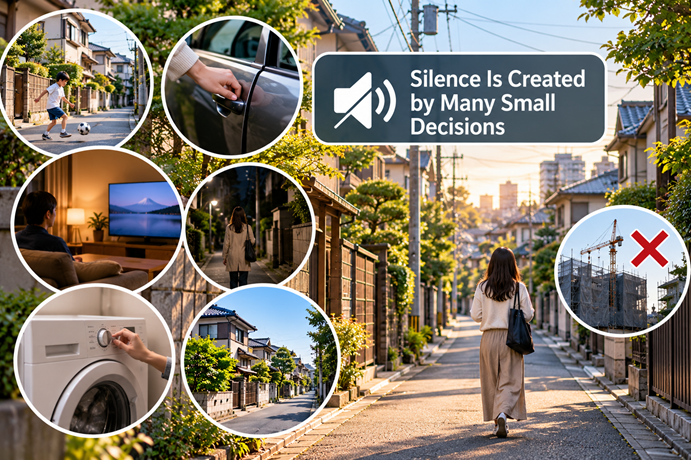
When people talk about Japan’s quietness, they often imagine one big cultural rule that says, “Do not make noise.” Real life is much more complicated than that. Neighborhood quietness is produced by hundreds of tiny decisions made by ordinary people.
A person decides not to shout across the street. Another closes the car door without slamming it. Someone avoids running a noisy machine very late at night. A family may keep a television at a moderate volume. A person walking home may naturally lower their voice when entering a narrow residential street. None of these actions is particularly dramatic, and most people would not even think of them as part of “Japanese culture” in a conscious sense. They are simply ways of behaving in a shared environment.
This is why the phrase “not disturbing others” is more useful than the phrase “being quiet.” Being quiet sounds like a personality trait, as though Japanese people naturally prefer silence. Not disturbing others is different. It is a social relationship. It asks you to notice that your behavior exists in the same environment as somebody else’s life.
That idea can be found in many cultures, of course. Toronto and the American neighborhoods where I lived also had strong expectations about nighttime noise and neighborhood peace. The difference I noticed in Japan was more subtle. It was the extent to which that awareness seemed to remain part of ordinary daytime behavior.
Japanese residential life also exists within a broader environment where sound is regularly treated as a matter of public comfort. Japan’s environmental noise standards explicitly distinguish residential areas from mixed commercial and industrial areas and establish different daytime and nighttime standards, reflecting the idea that the sound environment of residential districts deserves protection.
That does not mean every Japanese residential neighborhood meets some ideal of silence. It certainly does not. Roads can be noisy, construction can be loud, children play, motorcycles pass, and densely populated neighborhoods can produce plenty of sound. The point is that quietness is recognizable as something worth preserving.
And once you start noticing that, you begin to see the neighborhood differently.
🚶 A Japanese Residential Street Often Feels Quiet Because the Sound Is Fragmented
One of the most interesting features of a Japanese residential neighborhood is that the soundscape is often fragmented rather than continuous.
Imagine walking through a neighborhood in the morning. You hear a bicycle bell somewhere behind you. Then nothing. A car approaches slowly and disappears. You hear a gate slide open. Somewhere inside a house, perhaps a television is playing quietly, but the sound does not dominate the street. A bird calls from a tree. Someone says something to another person. A delivery truck arrives, makes its delivery, and leaves.
The sounds exist, but they do not necessarily compete for control of the neighborhood.
This creates a particular psychological feeling. Instead of feeling as though you are surrounded by activity, you feel as though you are moving through a place where many small lives are unfolding separately.
That is why I think “quiet” is not quite enough to describe the experience. The feeling is closer to quiet with presence.
A completely empty street can be silent, but it may not feel alive. A busy commercial district can be full of life, but it may be overwhelmingly noisy. A Japanese residential neighborhood can sit somewhere between those two extremes. You sense that people are behind the doors, beyond the fences, above the shops, or around the corner, but they are not constantly projecting their presence outward.
There is something almost private about the public space.
The street belongs to everyone, but the details of people’s lives tend to remain inside their homes.
That is a very different experience from a neighborhood where the front yard is a major social space, where people spend long periods outdoors, or where household activity naturally spills into the street.
🌳 The Physical Shape of the Neighborhood Matters More Than We Sometimes Realize
It is easy to explain neighborhood culture entirely in terms of manners, but the architecture and geography of a residential area are just as important.
A Japanese residential neighborhood can change dramatically within a few hundred meters. A busy road suddenly becomes a narrow side street. A row of small apartment buildings gives way to detached homes. A convenience store disappears and the street becomes almost entirely residential. A school, temple, small park, or neighborhood shrine appears between houses. A narrow road bends around the existing shape of the city rather than following a large suburban grid.
This creates a series of small changes in the sound environment.
A busy road might have constant traffic. Ten minutes away, a residential street might have almost none. Near a school, the sound may change dramatically during arrival and dismissal times. Around a small local park, children may create the loudest part of the afternoon. On another street, the sound may almost disappear.
So when foreigners say, “Japan is so quiet,” they may actually be responding to a particular type of urban transition: the sudden disappearance of commercial or transportation noise as you move deeper into residential space.
This is one reason the neighborhood should not be treated as a single environment. It has layers.
The main road is one layer. The station area is another. The shopping street is another. The residential street is another. The tiny lane behind the houses is another.
And each has its own sound.
🌙 Night Reveals the Social Contract
If daytime reveals how quietly people live, nighttime reveals the strength of the neighborhood’s social contract.
After around the time when most people have returned home, a Japanese residential neighborhood can become incredibly calm. The road is still there, houses are still occupied, and lights remain visible behind curtains, but the outward expression of daily life becomes much smaller.
This is partly because people are asleep or preparing for sleep, but there is another element: the recognition that nighttime is a particularly sensitive period for sound. The expectation that you should not disturb neighbors becomes stronger because people are more likely to be resting. This is not unique to Japan, but Japanese apartment guidance explicitly highlights the nighttime and early-morning period as one requiring particular care about everyday sounds.
I remember experiencing this kind of quiet in the United States and Toronto as well. There were nights when the neighborhood felt almost completely still, and I never thought of that as unusual. Looking back, however, those experiences are useful because they prevent an overly romantic explanation of Japan. Quiet neighborhoods are not an exclusively Japanese phenomenon.
What is interesting is how similar the basic expectation can feel across different cultures while the physical soundscape around it changes.
In other words, the idea that you should not keep your neighbors awake is nearly universal. The interesting question is what happens before the sound becomes loud enough to be considered a problem.
🏡 Japanese Quietness Is Not the Absence of Community
At this point, it is easy to make another mistake and imagine that a quiet Japanese neighborhood must therefore be socially distant or lonely. But quiet streets and strong community connections are not opposites.
In fact, many Japanese neighborhoods contain small systems of social interaction that are almost invisible unless you pay attention. People recognize familiar faces. Children walk through the same routes to school. Local events bring residents together. Neighborhood associations organize activities and communicate information. Someone may know that the elderly person living two houses away has not been outside for several days. A local shop owner may recognize customers who have lived nearby for years. During festivals or community events, the same streets that seem almost silent on an ordinary afternoon can suddenly become filled with people.
This is why the quietness of a Japanese residential neighborhood should not be interpreted as a lack of human connection.
It can mean almost the opposite.
People do not necessarily need to fill the street with sound in order to know that they are part of the same community.
There is a subtle distinction between being socially connected and constantly performing that connection in public space.
A quiet neighborhood can therefore be highly social without being highly expressive.
This becomes especially noticeable during local festivals, school events, neighborhood cleaning activities, or seasonal gatherings. The sound level can change dramatically when the community has a reason to come together. Then, after the event ends, the neighborhood returns to its quieter everyday rhythm.
The contrast makes the normal quietness even more noticeable.
🧠 What Does This Quietness Say About Everyday Life in Japan?
Perhaps the most interesting question is not why Japanese neighborhoods are quiet, but what that quietness tells us about the way people think about shared space.
One possibility is that Japanese everyday life often places importance on the boundary between what belongs to me and what affects everyone around me. Your home is your private space, but the sound leaving that home enters a shared environment. Your car may be your property, but the way you park it affects the street. Your children may be your family, but their behavior takes place in a community. Your household may be separate, but the neighborhood is not simply a collection of completely independent households.
This does not mean Japanese people are always thinking consciously about these boundaries. Culture rarely works that way. Most people are not walking down the street thinking, “I must now fulfill the Japanese cultural principle of minimizing sound.” They are simply behaving according to habits that became normal through family life, school, apartment living, neighborhood expectations, and years of seeing how other people behave.
And this is where neighborhood culture becomes fascinating. Culture is often easier to see in something people do without thinking than in something they deliberately explain.
A quiet neighborhood is one of those things.
🇯🇵 Is Japan Really Quieter Than North America?
The honest answer is: sometimes, in some ways, but not universally.
A quiet residential neighborhood in Toronto can be just as peaceful as a quiet neighborhood in Japan. A well-located American residential area can be incredibly calm, especially at night. Depending on where you live, you may hear almost nothing other than wind, birds, or an occasional passing car.
That personal experience matters because it prevents the conversation from becoming a simplistic cultural ranking. There is nothing inherently “better” about a Japanese street being quiet, just as there is nothing inherently worse about hearing a lawn mower in an American suburb. These sounds are products of different housing forms, landscapes, routines, infrastructure, and lifestyles.
The comparison becomes useful only when we ask what kind of quietness each environment produces.
In some North American suburbs, a large private property can create physical distance between households. The distance itself helps protect privacy and reduce everyday interaction. In Japan, where homes may be closer together and streets narrower, privacy may depend more heavily on how people manage their behavior within a shared environment.
That is not an absolute rule, and there are countless exceptions, but it offers a useful way to think about the difference.
One neighborhood can be quiet because people are physically far apart.
Another can be quiet because people live close together but carefully control the sound that crosses between them.
Both are forms of residential quietness.
And that distinction is far more interesting than simply asking which country is quieter.
🍃 The Feeling of “Almost Silence”
There is another reason Japanese residential neighborhoods can leave such a strong impression on foreign visitors: the contrast with the rest of the city.
A visitor may spend the morning surrounded by trains, station announcements, commercial districts, traffic, restaurants, shopping streets, and crowds. Then, after turning onto a residential road, the sound suddenly falls away.
Nothing dramatic has happened.
There is no entrance sign announcing that you are entering a quiet zone. There is no wall separating one world from another. The city simply becomes quieter one street at a time.
That transition is one of the most characteristic experiences of everyday Japanese life.
You walk from the noise of the city into a neighborhood where the sound of life becomes much smaller.
You can still hear people, but you hear them indirectly.
You can still see homes, but most of life is taking place behind them.
You can still sense activity, but it does not demand your attention.
This is why I think the best word is not silence but presence.
A Japanese residential neighborhood can feel almost silent while still feeling inhabited.
It is quiet because life has not disappeared.
It is quiet because life is being lived without constantly spilling into the shared space around it.
🌏 The Sound of Japan May Be More About Consideration Than Silence
When people talk about Japanese culture, they often focus on visible things: bowing, removing shoes, eating etiquette, trains, temples, uniforms, seasonal traditions, or formal manners. Sound is much harder to see, so it is easy to overlook.
But sound may tell us something profound about everyday life.
The quietness of a residential neighborhood is not produced by one rule or one national characteristic. It comes from a combination of physical space, housing patterns, transportation, population density, neighborhood design, household routines, and social expectations. Most importantly, it comes from the awareness that your everyday behavior occupies the same environment as somebody else’s everyday life.
That principle is not uniquely Japanese. I experienced it in the United States. I experienced it in Toronto. Quiet residential neighborhoods exist all over the world, and the peacefulness of those places should not be minimized simply to make Japan look special.
What feels distinctive in Japan is the way this quietness can continue through the daytime, even in relatively dense residential areas, and the way many small acts of restraint combine to create a shared soundscape. It is not the silence of having no neighbors. It is the quietness of having neighbors and recognizing that they are there.
Perhaps that is why walking through a Japanese residential neighborhood can sometimes feel almost strangely peaceful. You are not alone. The neighborhood is not empty. Behind the windows, doors, curtains, balconies, and walls, hundreds of ordinary lives are continuing.
But most of those lives are allowing the people next door to continue theirs as well.
And that may be the real sound of everyday life in Japan: not silence, but consideration made audible through everything you do not hear.
🔗 Explore More of Real Japan Navigator’s Neighborhood Series
👉 Why Are There Jizo Statues on Japanese Street Corners?
👉 Why Do Japanese Neighborhood Shopping Streets Still Matter? More Than Places to Shop
👉 Why Are Japanese Neighborhoods So Different Near Train Stations? The Hidden Structure of Everyday Japan (2026 Guide)
👉 What Happens on Garbage Morning in Japan? The Everyday Scene in a Japanese Neighborhood (2026 Guide)