
🌏 Introduction: A Small Question at Almost Every Checkout
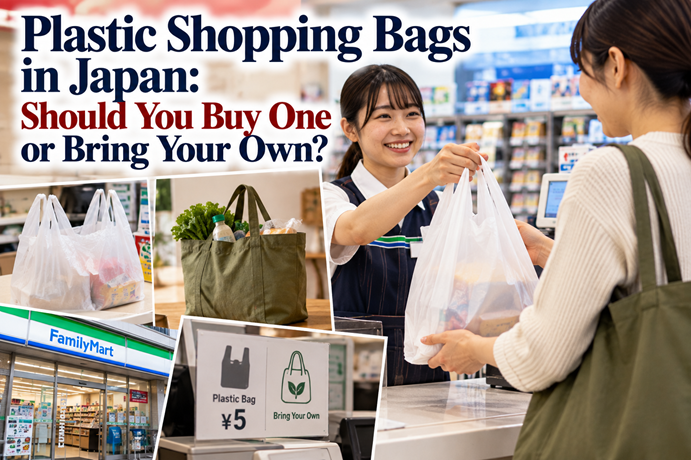
If you shop at a supermarket, convenience store, or drugstore in Japan, you will quickly encounter a small but important question: do you need a shopping bag? Since Japan introduced a nationwide charge for many plastic shopping bags in July 2020, receiving a bag is no longer something you can automatically expect to be free. Depending on the store, the cashier may ask whether you need a bag, how many you want, or what size you need.
For visitors, this can be a minor surprise. You may have bought only a drink and a snack at a convenience store, or stopped at a supermarket to pick up dinner. The cashier finishes scanning your items and asks something in Japanese. You realize that the question concerns a bag, but you are not sure whether one is included in the price or whether you need to request it separately.
For people who live in Japan, the same question becomes part of everyday life. You might keep a folded tote in your backpack, leave a larger bag in the car, or carry an insulated shopping bag when buying chilled or frozen food. You may sometimes buy a plastic bag when you forget to bring one. There is no need to get everything right every time, but knowing what to expect makes shopping easier.
The short answer is simple: bringing a reusable shopping bag is usually convenient, but you can still buy a bag when you need one. Many stores charge a small amount for plastic shopping bags, often around ¥3–¥5 for common sizes, although prices and available options vary by retailer. Paper bags and certain types of plastic bags may be treated differently, so it is best not to assume that every bag in every shop follows exactly the same rule.
There is also a bigger story behind this everyday change. Japan’s bag charge was introduced not only to make shoppers pay for something they previously received for free, but also to encourage people to reconsider whether they need a disposable bag in the first place. The policy connects an ordinary checkout decision with wider concerns about plastic waste, resource use, and environmental responsibility.
This guide explains how plastic shopping bags in Japan work, what cashiers may ask you, how to answer naturally, what the rules are intended to achieve, and why carrying a reusable bag can be useful beyond avoiding a small fee. It also looks at the practical experience of shopping in Japan as a visitor or resident, where a simple habit can make daily errands feel much more straightforward.
📖 Table of Contents
- Why Do Plastic Shopping Bags Cost Extra in Japan?
- How Much Does a Shopping Bag Cost?
- What Will the Cashier Ask You?
- How to Answer at the Checkout
- What Happens If You Do Not Have a Bag?
- Are All Shopping Bags in Japan Subject to the Charge?
- Why Reusable Bags Became Part of Everyday Shopping
- Choosing a Reusable Bag That Actually Works
- A Personal Note: Using American Grocery Bags in Japan
- Does Bringing Your Own Bag Help the Environment?
- Practical Shopping Tips for Visitors and Residents
- Conclusion: A Small Habit That Makes Shopping Easier
🏷️ 1. Why Do Plastic Shopping Bags Cost Extra in Japan?
Japan introduced a nationwide charge for many plastic shopping bags on July 1, 2020. Before then, some retailers already charged for bags, and some local initiatives had encouraged shoppers to bring their own. The 2020 policy made charging for covered plastic shopping bags a nationwide requirement for retailers under the relevant rules.
The policy was part of a broader effort to reduce excessive plastic use. Plastic is lightweight, durable, and convenient, which explains why it became common in packaging and shopping. However, producing and disposing of plastic also involves resource use and creates waste-management challenges. Plastic pollution, including waste that reaches the sea, has become a concern in Japan and internationally.
The Japanese government explained that charging for plastic shopping bags was intended to make consumers reconsider a habit that had often felt automatic. When a bag is handed over without a separate charge, people may accept it even when they could easily carry their purchases another way. Adding a price creates a moment to decide whether the bag is necessary.
That point is important. The policy is not simply a rule that makes shopping more expensive. Its intended role is also educational: it encourages a change in everyday behavior and supports efforts to reduce unnecessary disposable plastic.
The policy is connected with concerns about marine plastic waste and climate change, but it is worth being precise about what a bag charge can achieve. Charging for bags does not solve plastic pollution on its own, and it does not mean every plastic product is covered by the same rule. It is one measure within a much larger effort to use resources more carefully, reduce waste, and improve how materials are handled.
The change also asks consumers to think differently about convenience. A disposable bag is useful, especially when carrying several items or protecting purchases from rain. The aim is not to suggest that bags are never needed. Instead, the policy makes the choice more visible: if you already have a suitable bag, you can use it again; if you need another bag, you can usually buy one.
Since the policy began, bringing a reusable bag has become a familiar option for many shoppers. Some people carry compact foldable bags, while others keep larger totes ready for supermarket trips. Not everyone remembers every time, and shopping habits differ from person to person. Still, the checkout question has made the decision about bags a more visible part of daily shopping.
💴 2. How Much Does a Shopping Bag Cost?
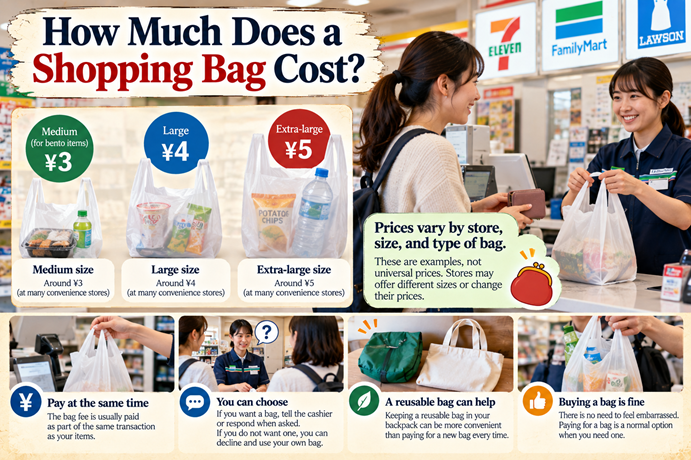
The cost depends on the retailer, the size of the bag, and the type of bag offered. At many convenience stores, common plastic shopping bags cost a few yen each. For example, some major convenience-store chains list prices of around ¥3 for medium or bento-sized bags, ¥4 for large bags, and ¥5 for extra-large bags. These are examples, not universal prices: stores may offer different sizes or change their prices.
A few yen is a small amount for a single purchase, but the fee can become noticeable if you buy bags repeatedly. Someone who visits a convenience store several times a week may decide that keeping a reusable bag in a backpack is more convenient than repeatedly paying for disposable ones. For a visitor, the practical benefit may be more important than the money saved: you can leave the store without needing to decide whether the fee is worth paying every time.
The charge is usually paid as part of the same transaction as the items you buy. You do not generally need to visit a separate counter or buy a bag in advance. If you want one, tell the cashier or respond when asked. If you do not want one, you can decline and place your purchases in your own bag after payment.
It is useful to think of the price in yen rather than assuming that every store will charge the same amount in foreign currency. Exchange rates change, and a fee that seems negligible to one shopper may matter to someone else. The important point is that bags are not automatically free at many retailers, and the price can vary.
Some shoppers worry that they will be judged for buying a plastic bag after the policy was introduced. There is no need to feel embarrassed. Paying for a bag is a normal option when you need one. You might have forgotten your reusable bag, purchased more items than expected, or bought something too large to carry comfortably. The system gives you a choice; it does not require you to manage every shopping trip perfectly.
If you are buying groceries, consider how much you need to carry before deciding. A small bag may be enough for a drink and a snack, but a larger shop may require more than one bag. If you have a reusable bag with you, it can help to open it before packing your purchases so that you can judge whether everything will fit safely.
🗣️ 3. What Will the Cashier Ask You?
One of the most useful things to learn before shopping in Japan is how to recognize a question about bags. You do not need fluent Japanese to handle this part of the checkout. Even learning a single phrase can make a routine transaction less stressful.
A cashier may ask:
「袋はご利用ですか?」 — Fukuro wa goriyō desu ka?
This is a polite way of asking whether you would like a bag.
You may also hear:
「袋は必要ですか?」 — Fukuro wa hitsuyō desu ka?
This means, “Do you need a bag?”
Another common expression is:
「レジ袋はお付けしますか?」 — Reji-bukuro wa otsuke shimasu ka?
This asks whether the cashier should include a checkout bag. The exact wording varies by store and employee, so do not worry if the question you hear is slightly different from the examples above.
At a busy convenience store, the question may come quickly while the cashier is scanning your items. If you are unfamiliar with Japanese, you might initially hear only the word fukuro (袋), meaning “bag,” or reji-bukuro (レジ袋), meaning “checkout bag.” Recognizing either word can help you understand what is being asked.
You may also encounter a screen at a self-checkout or a prompt from the cashier asking whether you want a bag. In some stores, you choose the option yourself; in others, the employee handles the transaction. The layout and wording differ, but the decision is essentially the same.
It is worth remembering that the cashier is not asking an unusual personal question. They are confirming which service or item you want before completing the sale. The exchange is a routine part of the checkout process, much like asking whether you need a receipt or whether you would like your purchases packed separately.
If you are unsure, you can answer in English or simply indicate your reusable bag. In tourist areas, some staff may understand basic English, but you should not expect every employee to speak it fluently. A short Japanese response is often the easiest solution.
💬 4. How to Answer at the Checkout
If you want a plastic shopping bag, you can say:
「袋をお願いします。」 — Fukuro o onegaishimasu. — “A bag, please.”
If you want to be more specific, you can say:
「袋を一枚お願いします。」 — Fukuro o ichimai onegaishimasu. — “One bag, please.”
The counter ichimai is used for flat items such as sheets of paper and bags. You do not need to master Japanese counters to shop successfully, but this is a useful expression if you want to request one bag clearly.
If you do not need a bag, you can say:
「袋はいりません。」 — Fukuro wa irimasen. — “I don’t need a bag.”
A shorter answer is:
「大丈夫です。」 — Daijōbu desu. — “I’m okay, thank you.”
In this context, daijōbu desu often means that you do not need the bag. However, Japanese expressions can depend on context, so if you are worried about being misunderstood, fukuro wa irimasen is more explicit.
If you have brought your own reusable bag, you can say:
「マイバッグがあります。」 — Mai baggu ga arimasu. — “I have my own bag.”
You may also simply show the cashier your bag or place it where it can be seen. You do not need to explain where you bought it or why you are using it. Carrying a reusable bag is an ordinary shopping choice.
These phrases are especially useful at convenience stores, supermarkets, and drugstores, where the bag question is a familiar part of the transaction. If you are shopping at a clothing store, department store, or gift shop, the employee may ask about a shopping bag for a different reason, and the store’s policy may differ.
Do not worry about pronouncing every word perfectly. The goal is to communicate your choice. If you say fukuro and point to your bag, the employee will often understand what you mean. A polite tone and a clear response are more useful than trying to deliver a long sentence under pressure.
🧺 5. What Happens If You Do Not Have a Bag?
Forgetting your reusable bag is not a problem. You can usually purchase a plastic shopping bag if you need one, provided the store offers the size and type you want. This is one reason the fee should be understood as a choice rather than a penalty. You are allowed to buy a bag when carrying your purchases without one would be inconvenient.
At a convenience store, the situation may be especially simple. If you buy only a drink, a sandwich, or a small snack, you might decide to carry the items without a bag. If you buy several items, food that could leak, or something you want to keep separate from your other belongings, a bag may be useful.
Some shops use a small sticker to indicate that an item has been purchased when a bag is not needed. Practices vary by store and situation, so do not assume that every cashier will apply a sticker to every item. If you are unsure whether you should take an item directly or wait for it to be marked, follow the cashier’s instructions.
At a supermarket, you may have more groceries than you can comfortably carry in your hands. A reusable bag can make packing easier, but if you forget it, you can request one or buy an available alternative. Some supermarkets provide packing areas where customers can organize their purchases after paying. The exact arrangement depends on the shop.
A useful habit is to keep a small foldable bag in a backpack, handbag, or coat pocket. That way, you do not have to remember to pick one up every time you leave home or your hotel. If you live in Japan, leaving a spare bag near the door or keeping one with your everyday belongings can reduce the chance of forgetting it.
Visitors can use the same approach. A reusable bag does not need to be a special Japanese product or an expensive accessory. A sturdy tote from home, a compact bag purchased locally, or a bag you already own may be perfectly adequate. The most useful bag is one that is easy to carry and available when you need it.
There is no reason to turn a forgotten bag into a stressful experience. Buy one if you need it, carry your purchases if they are manageable, or make a note to bring your reusable bag next time. The purpose of a practical habit is to make life easier, not to create a new source of guilt.
🛍️ 6. Are All Shopping Bags in Japan Subject to the Charge?
Not every bag is necessarily covered by the nationwide plastic shopping-bag charge. The rules apply to specified types of plastic shopping bags, and there are exceptions for certain bags that meet particular criteria. Some retailers also charge for paper bags under their own policies, even though the nationwide requirement is specifically concerned with covered plastic shopping bags.
This distinction matters because shoppers sometimes assume that every bag must be charged for by law. In reality, the rules depend on the material, purpose, and applicable criteria. Some plastic bags designed to meet specified environmental requirements may be exempt, and some bags used for particular purposes are treated differently. These details can be technical, so shoppers do not need to memorize all the regulations to buy groceries.
The practical advice is straightforward: check the price shown in the store or ask the cashier if you are unsure. If a bag has a charge, the store should make that clear through its checkout process or displayed information. Do not assume that a paper bag will always be free, because a shop may charge for paper packaging as part of its own policy.
You may also notice that the handling of packaging differs across retailers. A clothing shop may offer a paper shopping bag, while a supermarket provides plastic bags in several sizes. A bakery may use a paper bag for bread, and a convenience store may offer a plastic bag suitable for several food items. The type of packaging is influenced by the product and the store’s own practices.
There is an important difference between a law that requires a charge for certain bags and a retailer’s decision to charge for other packaging. If you want to understand the legal details, the Japanese government’s official plastic-bag policy page provides the policy background and related guidance. For everyday shopping, however, you can simply look for the displayed price and decide whether you need the bag.
The rule also does not mean that all plastic packaging has disappeared from Japanese shopping. Food packaging, product wrappers, containers, and many other forms of plastic remain part of retail life. The bag charge focuses on one familiar category of disposable plastic, making it easier for shoppers to notice and reconsider a specific habit.
🌱 7. Why Reusable Bags Became Part of Everyday Shopping
Reusable shopping bags existed in Japan before the nationwide policy began in 2020. Some shoppers had long used their own bags, and certain local governments and retailers had already encouraged customers to reduce disposable bag use. The nationwide charge made the decision more visible to a wider group of shoppers.
One reason reusable bags are practical is that they can be used repeatedly without requiring a new bag for every shopping trip. A compact bag can be folded and stored in a backpack, handbag, or pocket. Larger bags can carry groceries, clothing, books, and other purchases. Once bringing a bag becomes a habit, it can feel like a natural part of getting ready to go out.
The shift also changes the way people think about small purchases. In the past, a shopper might have accepted a bag for one or two items simply because it was available. When the bag has a separate price, the shopper has a reason to pause and ask whether it is needed. That moment of consideration is central to the policy’s stated purpose.
For people who live in Japan, this can become part of the routine of leaving home. Some keep one bag permanently in a work backpack, while others carry a small one for unexpected purchases. People who regularly shop for groceries may prefer a larger bag that can hold several items. The choice depends on how a person travels and what they usually buy.
For visitors, carrying a reusable bag is particularly helpful because shopping may be spread across the day. You might buy a drink at a convenience store, pick up souvenirs, stop at a drugstore, and then visit a supermarket for snacks. A single bag that can be reused throughout the day reduces the need to request a new one at every stop.
Reusable bags can also become reminders of places people have visited. Some are sold as souvenirs, featuring local designs, shop logos, or illustrations. Others are chosen because they are sturdy, easy to wash, or large enough for regular grocery shopping. A bag does not need to be marketed as an eco-product to be useful for repeated use.
The important point is not that everyone must own a collection of reusable bags. One suitable bag that you remember to carry may be more useful than several that stay at home. If you already own a tote or backpack that can safely carry your purchases, you may not need to buy anything new.
🧊 8. Choosing a Reusable Bag That Actually Works
A reusable bag is most helpful when it fits the way you shop. A small foldable bag is convenient for unexpected purchases, but it may not be comfortable for a large grocery run. A large tote can hold more, but it may take up space when empty. An insulated bag can help keep chilled items cool for a limited period, although its effectiveness depends on the insulation, outside temperature, length of the journey, and whether the bag is opened repeatedly.
For everyday convenience-store shopping, a compact bag may be enough. It can carry a few drinks, snacks, or small household items without adding much weight to your daily belongings. If you walk around a city for hours, a bag that folds into its own pouch can be especially practical.
For supermarket trips, size and strength become more important. A bag should be able to carry the weight of groceries without putting too much strain on its handles. A wide opening makes it easier to pack items, while a flat base can help keep containers upright. If you often buy bottles, cartons, or heavy groceries, a sturdy bag may be more comfortable than a very thin one.
An insulated bag can be particularly useful if you regularly buy chilled foods or frozen products. It provides an extra layer of insulation, but it should not be treated as a substitute for proper temperature control during a long journey. If you are buying food that must remain cold, think about how long you will be away from home and whether additional cooling is needed.
Cleaning is another practical consideration. Reusable bags can become dirty from spills, damp produce, or food packaging. Choose a bag that can be wiped clean or washed according to its care instructions. Allow it to dry properly before folding it away, particularly if it has been used to carry chilled groceries or items that might leave moisture inside.
You do not need to buy the most expensive bag. A practical bag that is comfortable to carry, easy to clean, and appropriate for your usual purchases is often the best choice. Before purchasing a new one, consider whether you already have a tote, backpack, or insulated carrier that can serve the same purpose.
🇺🇸 9. A Personal Note: Using American Grocery Bags in Japan
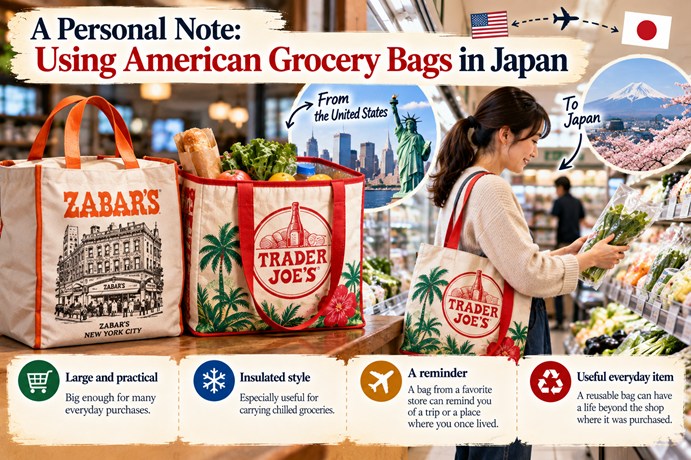
One of the useful things about a reusable shopping bag is that it does not have to be bought in the country where you use it. I have bags from Zabar’s and Trader Joe’s in the United States, and I continue to use them in Japan. They are large enough for many everyday purchases, and the insulated style is especially practical when I want to carry chilled groceries.
That experience illustrates a simple point: a reusable bag can have a life beyond the shop where it was purchased. A bag from a favorite grocery store may remind someone of a trip or a place where they once lived, but it can also be a genuinely useful everyday object. The logo is a personal detail; the repeated use is what makes the bag practical.
A larger bag can be helpful when shopping for several items at once. Instead of carrying multiple small bags, you can place more purchases together, provided the bag is strong enough and the items can be packed safely. An insulated bag can be useful for groceries that need extra protection from warm weather, although the length of the trip still matters.
The same approach works for people moving to Japan. You do not need to replace your existing belongings with products specifically marketed to Japanese consumers. If you already own a durable shopping bag, bring it along and see whether it suits your routine. You can always choose a different size later if your shopping habits change.
For visitors staying in a hotel or short-term accommodation, a reusable bag can also be useful for carrying snacks, drinks, souvenirs, and small purchases throughout the day. It may save you from carrying several separate bags as you move between shops. A foldable tote is easy to pack in luggage, while a larger bag may be useful if you plan to shop for groceries or bring home bulky items.
The best bag is not necessarily the newest, most fashionable, or most environmentally branded one. It is the bag that you will actually use. Reusing something you already own can be a sensible choice, especially when it remains in good condition and meets your needs.
🌍 10. Does Bringing Your Own Bag Help the Environment?
Using a reusable bag can reduce the number of disposable shopping bags you take, but the environmental impact is more complicated than simply comparing a reusable bag with a plastic one. Reusable bags also require materials, manufacturing, transport, and eventual disposal. Their overall impact depends on what they are made from, how often they are used, and what they replace.
This does not mean reusable bags are pointless. It means that repeated use matters. A durable bag that you carry regularly can replace many disposable bags over time. Buying several new bags and rarely using them, on the other hand, may not be the most resource-conscious choice. If you already have a suitable bag, continuing to use it is often a sensible first step.
The broader environmental objective is to reduce unnecessary consumption and manage resources more carefully. Japan’s policy encourages people to reconsider whether they need a disposable shopping bag, rather than suggesting that one small change will solve every environmental problem. Plastic waste, marine pollution, and climate change involve many activities and materials beyond shopping bags.
There are other practical ways to avoid unnecessary packaging. You can decline a bag when you do not need one, use your own bag when it is convenient, and avoid taking extra packaging that you will immediately throw away. At the same time, it is reasonable to use a bag when it protects your purchases or makes carrying them safer.
It is also important to keep reusable bags clean. A bag used for groceries may come into contact with food packaging, moisture, or spills. Washing or wiping it when needed helps keep it suitable for future use. A bag that is difficult to clean or no longer strong enough for its purpose may eventually need to be replaced.
The environmental value of a reusable bag is therefore connected to ordinary behavior: remembering to carry it, using it repeatedly, and keeping it in good condition. It is not necessary to treat every shopping trip as a test of environmental virtue. A realistic habit that works over time is more useful than an ideal rule that becomes difficult to follow.
🧳 11. Practical Shopping Tips for Visitors and Residents
The easiest way to get used to shopping in Japan is to make the bag decision part of your normal checkout routine. Before paying, think about whether you already have a suitable bag, whether your purchases will fit, and whether you need to keep certain items separate. You do not need to plan every detail in advance, but a few small habits can make the process smoother.
If you are visiting Japan, keep a foldable tote in your day bag. You may not need it for every purchase, but it is useful when you buy several items or decide to stop at a shop unexpectedly. If you are staying for a longer period, consider carrying a larger bag for grocery shopping and a smaller one for everyday errands.
If you live in Japan, think about where you are most likely to forget your bag. Someone who walks to the supermarket may leave one near the entrance, while a person who commutes by train may keep a compact one in a work bag. There is no single best system; the aim is to make the bag available without requiring much extra effort.
At the checkout, listen for fukuro or reji-bukuro. If you need a bag, ask for one. If you do not, say fukuro wa irimasen or use another clear response. If you have your own bag, you can show it to the cashier. The transaction is routine, and you do not need to apologize for either choice.
For supermarket shopping, check whether the store provides a separate packing area. If it does, you can pay first and then organize your purchases in your reusable bag. Follow the store’s arrangement, and avoid blocking the checkout while you repack. If you are buying chilled or frozen food, consider how long it will take to get home and whether an insulated bag would be useful.
When shopping for clothing, souvenirs, or gifts, do not assume that the same bag rules apply to every store. Some retailers charge for paper bags, some offer different packaging options, and some may provide special wrapping for gifts. Look at the displayed information or ask if you are unsure.
Finally, remember that buying a plastic bag is still an ordinary option. The point of bringing a reusable bag is to make shopping easier and reduce unnecessary disposable bags when practical, not to make every forgotten bag a problem. A flexible routine is more likely to become a lasting habit.
🎯 12. Conclusion: A Small Habit That Makes Shopping Easier
Plastic shopping bags in Japan are no longer automatically free at many stores. Since July 2020, a nationwide policy has required retailers to charge for covered plastic shopping bags, with the aim of reducing excessive use and encouraging people to reconsider a familiar habit. Prices vary, but common bags at convenience stores may cost only a few yen.
For visitors, the most useful thing to know is that the cashier may ask whether you need a bag. Recognizing the word fukuro and learning a simple response can make the checkout process easier. For people who live in Japan, keeping a reusable bag in a backpack, handbag, or shopping bag can turn the question into a quick, familiar decision.
A reusable bag does not have to be a special purchase. It can be a tote you already own, a compact bag that folds away, or a larger insulated bag for groceries. What matters is whether it fits your needs and whether you will actually use it. A bag that stays at home offers little practical benefit, while one you carry regularly can become part of your everyday routine.
The environmental purpose of the policy is broader than saving a few yen. It encourages people to think about disposable items that once seemed automatic and to consider whether they are necessary. That small pause cannot solve plastic waste on its own, but it makes resource use more visible in an ordinary moment of daily life.
So, should you buy a plastic shopping bag or bring your own? Bring a reusable bag when it is convenient, and buy a bag when you genuinely need one. Once you get used to the routine, it becomes a simple part of shopping in Japan—and one more small detail that helps everyday life feel familiar.
🔗 Explore More of Life in Japan
Shopping habits are just one part of understanding everyday life in Japan. Explore more practical explanations of Japanese routines, services, and daily customs in the Life in Japan section of Real Japan Navigator.
👉 How Much Luggage Should You Bring to Japan? Why Less Is Often Better
👉 Which Side Should You Stand on an Escalator in Japan? Tokyo, Osaka, and the World
👉 Staying at a Japanese Ryokan: What to Know About Dinner, Yukata, Tatami, and Onsen Etiquette
👉 How Much Japanese Yen Do You Need in Japan? Cash, Cards, and How Much to Carry