
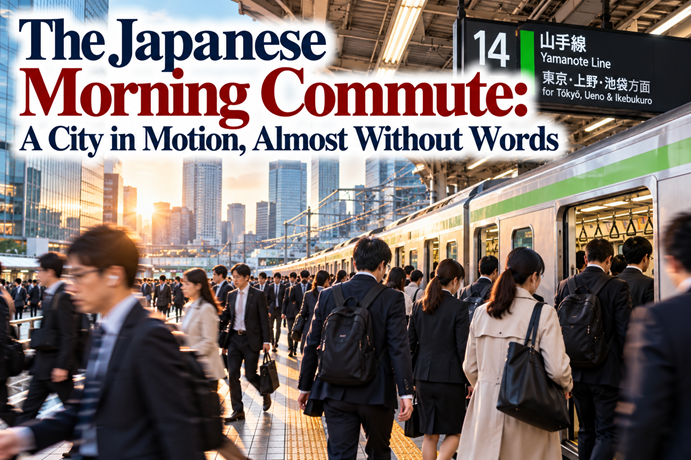
🌱 Introduction: When an Ordinary Street Begins to Move
The Japanese morning commute is more than a journey from home to work or school. In many urban neighborhoods, it is a daily transformation that gradually changes the character of the streets. A road that feels quiet in the early morning begins to fill with people walking toward railway stations, students gathering at crossings, buses stopping along familiar routes, and office workers moving steadily through the city. Within a relatively short period, individual journeys become a shared rhythm that connects residential neighborhoods with the larger urban world.
The scene is especially noticeable in cities such as Tokyo and Osaka, where railway networks connect residential areas, commercial districts, schools, and major business centers. People may leave their homes at different times and travel from very different places, yet their movements often converge at the same stations and intersections. Some walk from an apartment building to a local station, others ride a bicycle to school, and still others board a bus that connects their neighborhood with a railway line. Farther along the route, passengers arrive at larger stations and continue on foot toward offices, universities, shops, and other workplaces.
What makes this everyday scene interesting is not simply the number of people. It is the way the city seems to organize itself around their movements. People walk in the same direction without necessarily knowing one another. Crowds gather at ticket gates and then separate onto different platforms. A bus pulls away while another group waits at the next stop. At a major station, streams of passengers emerge from underground passages and spread across the surrounding streets.
There is often remarkably little conversation compared with the amount of activity taking place. The soundscape may consist mainly of footsteps, traffic, crossing signals, station announcements, and the movement of vehicles. Yet this quietness is not universal, and it does not mean that people are unfriendly or that nobody talks. Friends chat, students laugh, parents speak with children, and colleagues sometimes meet along the way. The atmosphere changes according to the location, time, crowd, and people present.
By following the Japanese morning commute from a residential street to a business district, we can see how transport, urban design, school and work routines, and everyday consideration for others shape a familiar part of Japanese life. Rather than treating the commute only as a crowded train ride, this is a closer look at the city as it comes into motion.
🏘️ 1. The Residential Neighborhood Before the Rush
The morning commute often begins far from the dramatic crowds that appear in photographs of major Japanese stations. It starts on ordinary residential streets, between apartment buildings, detached houses, small shops, and local roads that connect homes to public transportation. In the earliest part of the morning, some streets may still feel relatively calm. A few people walk dogs, shopkeepers prepare their premises, and residents leave home carrying bags, backpacks, or briefcases. As the morning advances, the number of people heading in the same general direction gradually increases.
In many neighborhoods, the railway station acts as a natural destination. Streets that branch between homes may eventually lead to the same station entrance, even when residents live in different blocks. People who have never met can therefore become part of the same daily stream. One person walks quickly because a train is approaching, another follows a familiar route at an unhurried pace, and a student adjusts a backpack while waiting for a friend. The movements are individual, but the larger pattern is shared.
The physical scale of the neighborhood helps shape this experience. Some residents live within a short walk of a station, while others have a longer journey or need to take a bus first. In densely developed areas, a railway station may sit among apartment buildings, small restaurants, convenience stores, clinics, and other businesses serving local residents. In other places, the walk to the station passes through quieter streets with fewer commercial buildings. There is no single Japanese residential landscape, but the relationship between home and transport is especially visible in many urban areas.
The morning also reveals how the same street can serve different purposes at different times. A narrow road used mainly by residents during the evening may become a route for students and workers in the morning. A crossing that seems insignificant at midday can become a point where several streams of pedestrians meet. The neighborhood has not physically changed, but its function becomes more apparent as people begin using it together.
These observations are useful because they place commuting within the ordinary environment where people live. A railway system does not begin at the station platform. For many people, the journey starts at the front door, continues along a familiar street, and passes through a series of small decisions about timing, direction, and movement. The daily commute is therefore part of neighborhood life before it becomes part of the transport network.
🚶 2. Walking Together Without Traveling Together
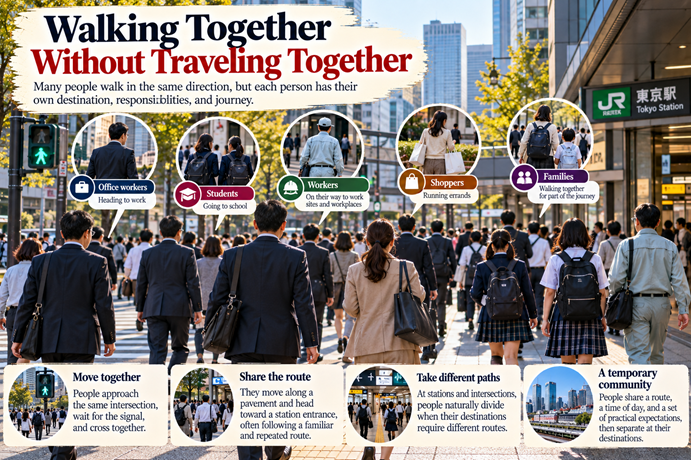
One of the most recognizable features of a Japanese urban morning is the sight of many people walking in the same direction while remaining absorbed in their own journeys. Office workers may carry similar bags or wear similar business clothing, while students travel in school uniforms or casual clothes depending on their school. Other residents wear work uniforms, carry shopping bags, or walk alongside family members. The crowd is made up of people with different destinations, responsibilities, and schedules.
From a distance, the group can appear almost coordinated. People approach the same intersection, wait for the pedestrian signal, and begin crossing together. They move along a pavement, turn toward a station entrance, and divide naturally when different routes become available. Most do not need to discuss where to go. Familiarity with the neighborhood and the repeated structure of the journey make the route feel routine.
This apparent coordination should not be mistaken for a single shared purpose. Two people walking side by side may be colleagues, friends, or strangers who happen to be heading toward the same station. A parent may accompany a younger child for part of the journey before turning back. Students may travel in groups, while other students walk alone or meet classmates near the school. The crowd contains many small social worlds, even when everyone appears to be moving as part of one larger flow.
The way people use space also becomes noticeable. On a busy pavement, someone may move aside to let another pedestrian pass. People often adjust their pace when approaching a narrow section or avoid stopping directly in the path of others. Such behavior is not performed perfectly by everyone, and crowded streets can still be awkward. Nevertheless, the need to share limited space encourages small adjustments that allow the group to keep moving.
The result is a distinctive contrast: people are physically close, but their journeys remain largely personal. They share the same pavement without needing to establish a relationship with everyone around them. This is not uniquely Japanese; similar patterns appear in many busy cities. What makes it meaningful in Japan is how clearly these movements connect with the country’s dense railway-oriented urban environments.
The morning street is therefore neither a gathering of friends nor an anonymous crowd in the simplest sense. It is a temporary community of movement. People share a route, a time of day, and a set of practical expectations, then separate when their destinations require it.
🚌 3. Buses Connect the Streets to the Railway Network
Trains are central to commuting in many major Japanese cities, but the journey does not always begin with a walk directly to a railway station. Buses also play an important role in connecting residential areas with stations, schools, commercial centers, and other destinations. Their presence can be especially clear in neighborhoods where the railway line does not pass close to every home or where walking to the station would take considerable time.
A morning bus stop can become a small meeting point. People arrive at different moments, stand in a loose line or wait near the designated boarding area, and watch for the approaching vehicle. Some know exactly when their bus is due because they use the same service every weekday. Others check a timetable or glance toward the road. When the bus arrives, passengers board and the waiting group becomes smaller, only to grow again as more people approach the stop.
The buses themselves form part of the neighborhood’s changing rhythm. A vehicle moves along a residential road, stops to collect passengers, and continues toward a station or another connection. Traffic conditions, road layout, and the particular service determine how smoothly it travels. Unlike a railway, a bus shares the road with other vehicles, so its journey can be affected by congestion. Its usefulness lies partly in reaching places that railways do not directly serve.
At some stations, bus terminals and railway entrances are close together. Passengers can transfer between the two modes of transport without traveling far, while others continue on foot or use a bicycle for part of the journey. The network is not always seamless, and transfers can require waiting or navigating a busy station forecourt. Still, the combination of trains, buses, walking, and cycling allows different parts of a city to connect.
This matters when considering the Japanese morning commute as a citywide scene rather than a single train ride. A passenger boarding a train may have already spent twenty minutes walking and waiting for a bus. Another may have cycled to the station and parked a bicycle nearby. Someone else may walk from home to a local railway line, change trains, and then walk another ten minutes to the office.
The visible crowd at a station is the result of these different journeys coming together. What appears to be one large mass of commuters is actually the final meeting point of many separate routes. Understanding this makes the transport landscape easier to appreciate: the station is not an isolated structure but a junction connecting the daily lives of surrounding neighborhoods.
🎒 4. Students and Workers Share the Morning
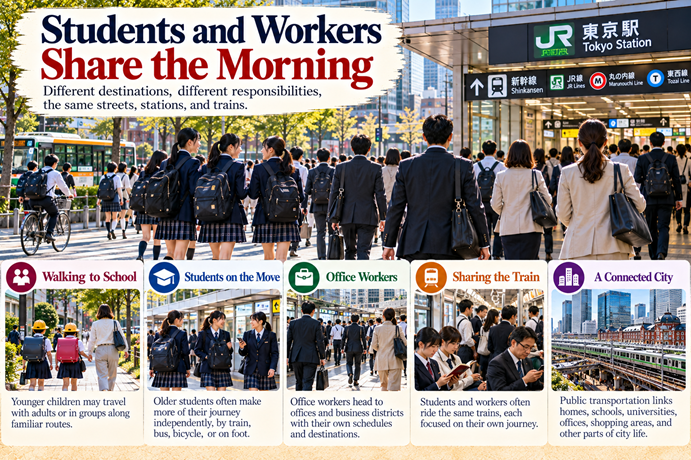
The morning flow is not made up exclusively of office workers. Students are also an important part of the streets, stations, and buses, and their presence can give a neighborhood a different atmosphere depending on the time of day and the location of nearby schools.
In some areas, groups of students walk together along familiar routes. Younger children may travel with adults or in groups, while older students often make more of their journey independently. Some use bicycles, others walk, and many rely on trains or buses when their schools are farther away. Their routines are shaped by school start times, the distance between home and school, local transport connections, and individual circumstances.
Office workers have different destinations and schedules, but their journeys often overlap with those of students. A narrow pavement may carry people heading toward a station alongside students going in another direction. At a railway platform, passengers bound for offices may stand near teenagers traveling to school. Inside a crowded carriage, the same space can contain people preparing for meetings, students reviewing notes, workers looking at their phones, and passengers simply trying to get through the journey.
The overlap illustrates how public transportation connects different stages of everyday life. A railway line is not only a route to business districts. It also links homes with schools, universities, vocational institutions, shopping areas, and public facilities. The same train can serve several purposes during one journey, and the composition of passengers changes as it moves through the city.
The differences between students and workers are also visible in small details. A student may be carrying sports equipment or a school bag, while an office worker holds a laptop case or a briefcase. Groups of friends may talk more freely while walking together than they do when separated inside a packed train. Adults may glance at the time, read messages, or walk quickly because they have a fixed arrival time. These are tendencies rather than rules, and individual behavior varies widely.
It is tempting to describe the morning as a perfectly disciplined procession, but real life is less uniform. Someone forgets something and turns back. A student runs to catch a bus. A worker pauses to buy a drink. Friends stop to talk, and people sometimes arrive late. The pattern is recognizable precisely because it is repeated, not because every person follows it flawlessly.
Looking at students and workers together also prevents a narrow interpretation of commuting as a purely corporate ritual. The morning movement connects education, employment, family routines, and local infrastructure. It is one of the moments when the different parts of urban society become visible in the same public space.
🚉 5. The Station: Where Individual Journeys Converge
As the morning advances, the flow of pedestrians often becomes more concentrated near railway stations. A local street may feed into a station entrance, while bus passengers arrive from another direction and people transfer from a bicycle parking area or nearby road. The station brings these journeys together, creating a busy environment in which movement must be coordinated across entrances, ticket gates, stairs, escalators, corridors, and platforms.
At a small station, the process may feel relatively straightforward. Passengers enter through a limited number of gates and move toward a platform serving one or two lines. At a major interchange, the experience can be much more complex. Several railway companies may operate services from the same broad station area, while subway lines and connecting passages run underground. Different entrances can lead to different platforms, and the route between two trains may involve a substantial walk.
Despite this complexity, regular commuters often move with confidence. They know which entrance is closest to their usual platform, where to stand on the escalator, and which corridor provides the most convenient connection. Their familiarity reduces the need to stop and make decisions at every junction. A visitor, by contrast, may need to read signs, consult a map, or pause to work out which direction to follow.
The difference is not simply that one group is more capable than the other. Regular commuters have accumulated practical knowledge through repetition. They have learned the layout of their route, the usual position of the train doors, and the walking distance between the platform and the exit. What looks like effortless navigation is often the result of doing the same journey hundreds of times.
Station design and signage help support the flow. Platform markings indicate where passengers should queue, signs identify lines and exits, and announcements provide information about arriving trains or service changes. Station staff may be present to assist passengers and manage movement, particularly at busy locations. These systems do not remove every difficulty, but they make a large volume of movement more manageable.
The station also reveals a central feature of the Japanese morning commute: the balance between repetition and coordination. Each person is following an individual plan, yet the station works only when people share the available space. Passengers who stop suddenly near ticket gates can obstruct those behind them, while people who move toward the platform or exit without blocking the passage help maintain the flow.
For the neighborhood, the station is more than a transport facility. It is the point where local movement becomes part of a wider urban network. The quiet residential streets and the crowded office district may seem like separate worlds, but the station connects them through the repeated journeys of thousands of people.
🚆 6. Inside the Crowded Train: Close Together, Mostly Quiet
For many people unfamiliar with Japan, the contrast between crowding and quietness is one of the most striking features of the morning commute. During peak periods on some urban lines, passengers may stand close together, sometimes with very little personal space. Yet the carriage can remain comparatively quiet. People look at their phones, read, listen to audio through headphones, close their eyes, or gaze out of the window. Conversations occur, but they may be less prominent than the density of the crowd suggests.
The quietness has several possible explanations, and it is important not to reduce it to a single national personality trait. A commuter train is a shared space in which sound travels easily, particularly when passengers are standing close together. Many people are tired, concentrating on the day ahead, or using the journey as a brief period of rest. Keeping one’s voice down is a familiar form of consideration in this setting, while loud conversations or phone calls can attract unwanted attention.
The repeated nature of commuting also matters. A person who travels the same route every weekday may see the journey as routine rather than as a social occasion. They may not feel a need to interact with strangers, just as people in other cities often use public transport as personal time. A quiet carriage allows passengers to remain occupied with their own thoughts even while sharing a small physical space with many others.
However, the image of a completely silent Japanese train is exaggerated. Friends and family members do talk. Children can be noisy, passengers sometimes laugh, and people may have quiet conversations with companions. The level of noise differs according to the line, time, passenger mix, and degree of crowding. A local train in one area may have a different atmosphere from a packed commuter service in central Tokyo. Long-distance trains also operate under different expectations from ordinary urban commuter trains.
The important observation is not that nobody speaks, but that many passengers appear to make an effort not to dominate the shared environment. This behavior is supported by public messaging and familiar railway manners, although the expectations are social conventions rather than a universal legal prohibition on conversation. People do not always behave in the same way, and the quietness should not be treated as evidence that Japanese society has no spontaneity or warmth.
Inside the train, the morning commute becomes an unusual combination of physical closeness and social distance. People may be only a few centimeters apart, but they rarely need to acknowledge one another directly. The shared journey works through small adjustments: making room, avoiding unnecessary noise, allowing others to leave the train, and continuing toward the next stop.
🏙️ 7. Emerging into the Office District
The morning scene changes again when passengers arrive at major stations near business districts. The movement that was concentrated inside trains spreads into corridors, ticket gates, underground passages, sidewalks, and office-building entrances. People who traveled together for several stops suddenly divide into different streams, each heading toward a particular exit or street.
In some districts, a large station sits beneath or beside office towers, shopping complexes, hotels, and restaurants. Underground passages connect buildings and railway entrances, allowing pedestrians to travel through parts of the district without crossing at street level. Elsewhere, commuters emerge directly onto busy roads and follow the pavement toward their workplaces. The precise layout varies, but the transition from station to street can be remarkably rapid.
At first glance, the crowd may seem to be moving as one body. People leave the ticket gates, choose different corridors, and adjust their pace around others. A group turns toward a high-rise office building, while another continues toward a university or commercial street. Some passengers hurry, some walk at a steady pace, and others stop briefly to check their phones or buy breakfast. The apparent uniformity dissolves into individual routines as soon as the available routes branch out.
This transition also reveals the relationship between transport and urban development. In many Japanese cities, railway stations are surrounded by businesses and facilities that serve both commuters and local residents. Office buildings, shops, restaurants, department stores, and pedestrian routes can cluster around stations because so many people pass through them every day. The station is therefore not merely a place to board a train; it can be a center of commercial and social activity.
Yet not every office worker steps out of a train and immediately enters a tower. Some walk through ordinary streets, cross busy roads, or continue by bus. Others work in smaller offices located above shops or in mixed-use buildings. The image of a modern business district is only one part of urban Japan, and commuting destinations are as varied as the neighborhoods from which people travel.
The most noticeable change is the direction of movement. In residential areas, the morning stream often converges toward stations. Near a major station, it spreads outward toward workplaces and other destinations. A few kilometers can separate these scenes, but they form two halves of the same daily pattern.
The city seems to inhale and exhale through its transport network: people leave their homes, gather at stations, travel together, and then disperse into the places where the day will unfold. This is a metaphor rather than a literal description of a perfectly synchronized city, but it captures the way commuting connects places that might otherwise appear unrelated.
⏰ 8. Why the Morning Has Such a Distinct Rhythm
The Japanese morning commute follows recognizable patterns because many people’s schedules overlap. Schools and workplaces often have expected arrival times, while train and bus services operate according to timetables. When a large number of people need to reach their destinations within a similar period, the demand for transport becomes concentrated. This is a basic feature of urban commuting, not something unique to Japan.
In major metropolitan areas, railways make it possible for large numbers of people to travel between residential districts and central areas without relying entirely on private cars. The result is a visible concentration of passengers at stations and on certain routes. Japan’s urban railway networks are extensive, but the experience differs according to the line, city, and distance traveled. Some services become extremely crowded during the busiest periods, while others are less intense or serve areas with different transport patterns.
The timing is also shaped by the structure of the day. Students need to arrive before classes begin, and many employees have work schedules that encourage travel during the same morning window. Some people have flexible hours, work remotely on certain days, or begin their shifts earlier or later. These arrangements can spread demand across a wider period, but they do not eliminate the underlying pattern where many journeys overlap.
Transport services and station layouts are designed to handle recurring passenger flows. Train frequencies, platform arrangements, entrances, and pedestrian routes all influence how people move. Passengers also learn from experience. Someone who uses a station daily may know when a particular platform becomes busy, which exit shortens the walk to work, or how long a transfer usually takes. These habits make the routine more predictable, although delays, weather, and unexpected disruptions can change it quickly.
The rhythm is not identical every day. Weekends and public holidays usually have different commuting patterns from ordinary weekdays, and school holidays can change the number of students on certain routes. Bad weather may affect walking, cycling, buses, and trains. A major event or service disruption can redirect people through unfamiliar exits or onto alternative lines. Even the same station can feel very different at 7:30 in the morning and at 10:30.
These variations are a reminder that the morning rush is a pattern rather than a permanent condition. It emerges from the interaction of work, education, transport schedules, and urban geography. When those factors change, the street changes with them.
🧭 9. Familiar Routes and the Knowledge of Everyday Life
A daily commute can look repetitive from the outside, but regular commuters build a detailed practical understanding of their surroundings. They learn where the pavement narrows, which crossing takes longer, where a bus stop is located, and how to reach the station entrance that best suits their route. Much of this knowledge is acquired without formal instruction. People simply repeat the journey and gradually become familiar with the small details that make it easier.
The knowledge can be surprisingly specific. A passenger may know which carriage usually stops closest to an exit at a familiar station, although this depends on the train and platform arrangement. Another person may choose a particular street because it has fewer crossings, even if the distance is similar. Someone who catches the bus may know where to stand to board efficiently or which service is more convenient when the weather is bad. These are small decisions, but they influence the shape of everyday life.
The commute also links people to the businesses and services around their route. A bakery near the station may serve customers on their way to work. A convenience store may see a regular flow of people buying drinks, breakfast, or other essentials. A coffee shop near an office district may become a familiar stop for some commuters, while others pass it without slowing down. The commercial environment grows around repeated movement, and the movement in turn supports local businesses.
Not every commuter follows the same route every day. Some people change jobs, move house, or alter their schedules. Others work from home on certain days or use different transport depending on the weather. Still, the repeated journey creates a form of local familiarity that can be easy to overlook. The neighborhood becomes known not only through where people live, but also through the paths they take to leave it.
This familiarity helps explain why a crowded station may feel straightforward to one person and confusing to another. The regular commuter is not necessarily seeing every sign or consciously planning every turn. Much of the route has become habitual. A newcomer, by contrast, must pay attention to the details that experienced passengers no longer need to think about.
For someone trying to understand Japanese urban life, the useful insight is that daily routines produce knowledge of place. The city is not experienced only through landmarks or official maps. It is also learned through repeated walks, transfers, crossings, and small decisions made at nearly the same time each weekday.
🤝 10. Shared Space and Small Acts of Consideration
A crowded morning creates practical challenges because many people need to use the same limited space. Pavements, ticket gates, stairs, bus doors, and train carriages cannot expand simply because demand increases. The way people respond to one another therefore affects whether the movement feels manageable.
Consider a narrow passage near a station. If one person stops in the middle to check a message, others may need to slow down or move around them. If that person steps to the side, the passage remains open. The action is small, but it changes the experience of everyone nearby. Similar adjustments happen when passengers allow others to leave a train before boarding, avoid blocking doors, or move their bags out of the way in a crowded carriage.
These behaviors are often described as manners, but they can also be understood as practical responses to shared space. When many people depend on the same transport system, unnecessary obstruction creates difficulties for others. Small acts of consideration help reduce friction, even when strangers do not speak to one another or explicitly acknowledge what has happened.
This does not mean every Japanese commuter is perfectly considerate. People sometimes push, stop abruptly, take up too much space, or become impatient when a train is delayed. Crowding can make even familiar routines uncomfortable. The point is not to present a flawless society, but to notice how repeated interactions create expectations about how public spaces should be used.
The quietness of some trains fits into this wider pattern, but it is only one part of it. Making room on a pavement, moving away from a ticket gate before stopping, and keeping a conversation at a reasonable volume all involve awareness of other people nearby. These actions do not require friendship or personal closeness. They are ways of sharing an environment with people whose lives may be entirely unknown.
There is also a difference between following a rule and responding to a situation. Signs and announcements can tell passengers where to queue or remind them not to obstruct an entrance. But a busy station contains countless moments that cannot be managed by a sign. People must notice when a path is blocked, when someone needs to pass, or when their own movement is affecting the people around them.
The Japanese morning commute offers many ordinary examples of this negotiation. It is not always graceful, and it is not exclusive to Japan. Yet the repeated need to coordinate movement makes public consideration visible in a way that can be difficult to notice when the streets are quiet.
🌦️ 11. The Morning Commute Is Not the Same Everywhere
It is easy to form a single image of the Japanese morning commute: crowded trains, people in business clothes, orderly queues, and quiet carriages. That image reflects real experiences in some urban areas, but it cannot describe the whole country. Japan includes large metropolitan regions, smaller cities, suburban neighborhoods, rural communities, and places where daily travel depends much more heavily on cars.
Tokyo and Osaka have extensive railway networks and dense areas of employment and education. In some locations, large numbers of commuters converge on a limited set of lines or transfer through major stations. Other cities have different patterns of public transportation, while some neighborhoods are less densely connected to railways. The balance between trains, buses, cars, bicycles, and walking changes with local geography and the destinations people need to reach.
Even within a single city, the commute varies considerably. A person who lives beside a station may have a short walk and a direct train ride. Someone living farther from the railway may take a bus, cycle, or drive to a station. Another commuter may work near home and travel mostly on foot. Not everyone has a long commute, and not everyone experiences the most crowded trains.
The atmosphere also changes with the time of day. The busiest period on one line may differ from that on another, and a train can become less crowded after passengers leave a major interchange. Some people travel before the peak, while others have flexible working hours. School schedules, shift work, remote work, and public holidays all affect the number and composition of passengers.
Weather and season add further variation. Rain can make umbrellas and narrow pavements more difficult to navigate. Hot weather may change how people dress and how comfortable they feel walking to the station. In winter, some areas experience cold mornings or snow that affects roads and rail services. The same route can therefore offer a different experience according to conditions outside.
Recognizing this variation makes the article’s central observation more accurate. The Japanese morning commute is not a single national ritual performed in exactly the same way by everyone. It is a family of daily patterns shaped by local transport, urban form, school and work schedules, and individual circumstances. The recognizable rhythm emerges most clearly in many busy urban areas, but its details depend on where and when one observes it.
🪟 12. What the Quiet Crowd Reveals—and What It Does Not
A crowd moving through a station without much conversation can encourage strong interpretations. Some observers see discipline, others see social pressure, and others interpret the quietness as a sign of respect for people nearby. Each explanation may capture part of the experience, but none should be treated as a complete account of Japanese society.
A more careful approach begins with what can actually be observed. People share a route, move through crowded spaces, and often avoid drawing unnecessary attention to themselves. Some speak quietly, while others remain occupied with their phones or thoughts. The transport system brings strangers into close physical proximity, and the situation encourages behavior that allows the journey to continue with limited disruption.
The reasons behind those behaviors are more varied. A passenger may be quiet because they are tired, because they prefer not to talk to strangers, because they are concentrating on a message, or because they believe loud conversation would disturb other passengers. Another may simply be accustomed to the atmosphere of their regular train. It is rarely possible to infer an individual’s motives from their outward behavior alone.
The same caution applies to ideas such as harmony or consideration. These concepts can be useful when discussing social expectations in Japan, but they should not become catch-all explanations for every public behavior. Japanese people have different personalities and preferences, and their conduct changes according to the situation. Quietness on a commuter train does not tell us everything about how someone behaves with friends, family, or colleagues.
Nor does the absence of conversation mean that the crowd lacks social connection. Some passengers are traveling with classmates or coworkers. People may recognize familiar faces without speaking, or help someone who appears confused. A small interaction can occur even in a generally quiet environment. Social life does not disappear simply because most passengers are focused on their own journeys.
What the morning crowd reveals most clearly is how people adapt to a shared setting. A railway carriage is not a living room, an office meeting, or a café. It is a temporary environment with limited space, a moving timetable, and many people trying to reach different destinations. Expectations about noise, movement, and personal space develop within those conditions.
That distinction is important for understanding everyday Japan. Rather than using one crowded train to define an entire culture, it is more useful to ask how the situation shapes behavior, which expectations people appear to share, and where individual differences remain visible. Observation becomes more revealing when it leaves room for complexity.
🏡 13. The Neighborhood Is Part of the Commute
It may seem that commuting begins when someone boards a train, but the neighborhood is involved long before that point. The route from home to the station determines how people encounter their local environment, which streets become busy, and which businesses receive passing customers. The morning commute is therefore not separate from neighborhood life. It is one of the daily activities that gives the neighborhood its changing character.
A street near a station may be quiet at one time and crowded at another. A convenience store may receive a brief wave of customers before the next train departure. A small café may open its doors as workers begin walking past. Bicycle parking areas fill with vehicles, and bus stops become temporary gathering points. These changes can be modest, but together they reveal the relationship between homes, transport, and local commerce.
The neighborhood also influences how people travel. A short and direct walk may encourage residents to use the railway, while a longer distance or less convenient route may make a bus or bicycle more attractive. The location of crossings, the width of pavements, the presence of slopes, and the arrangement of buildings can all affect the journey. These details are easy to miss when attention is focused only on the train itself.
In turn, commuting shapes how people experience their surroundings. A resident who passes the same shop every morning may become familiar with its opening hours or seasonal displays without ever entering it. Someone may notice a new construction site, a changed bus timetable, or a shop that has closed because it alters a familiar route. Daily travel becomes a way of observing neighborhood change.
The morning flow also connects people who might otherwise have little contact. Residents of different apartment buildings use the same crossing, students pass the same shops as office workers, and bus passengers converge with pedestrians near a station. These encounters do not necessarily produce relationships, but they make the neighborhood a shared environment rather than a collection of isolated homes.
For the Neighborhood Series, this is the important perspective: ordinary places become easier to understand when we observe how people use them. A station entrance is not just an architectural feature. A pavement is not just a route between two points. Each becomes part of a daily pattern that links individual lives to the wider city.
The Japanese morning commute makes those connections visible because the movement is concentrated in time. For a brief period each weekday, the neighborhood shows how it fits into the routines of the people who live, study, and work there.
✨ Conclusion: A City in Motion, Almost Without Words
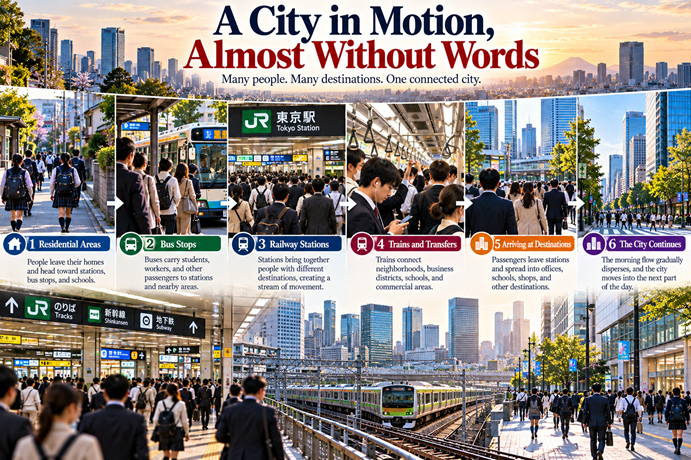
The Japanese morning commute is often associated with crowded trains, but the journey is much larger than the time spent inside a carriage. It begins on residential streets, gathers people at bus stops and railway stations, moves through a network of trains and transfers, and spreads again as passengers arrive near schools, offices, and commercial districts.
Along the way, the city changes character. Quiet streets become pedestrian routes, stations become meeting points for separate journeys, and business districts fill with people moving toward their destinations. The same people may repeat the pattern day after day, relying on familiar routes and small adjustments that help them share limited space with others.
The relative quietness of many commuter trains is part of this scene, but it should not be mistaken for an absence of social life or a simple expression of national character. People behave differently according to the setting, and the commute itself encourages a particular kind of interaction: many strangers travel close together while remaining focused on their own journeys.
What makes the morning especially revealing is the way separate routines combine into a recognizable urban rhythm. Workers, students, families, transport staff, shopkeepers, and other residents contribute to the movement, even though they rarely share a single destination. The city functions through countless individual journeys that intersect for a few minutes and then separate again.
To understand Japan through everyday life, it is worth looking beyond famous landmarks and dramatic scenes. Sometimes a familiar residential street, a bus pulling up to a stop, or a stream of passengers leaving a station offers a clearer view of how a city works. The morning commute shows how transport infrastructure, daily schedules, neighborhood design, and shared expectations come together in ordinary life.
And when the crowd finally disperses into schools, offices, shops, and other destinations, the streets begin to settle into a different rhythm. The city has not become still. It has simply moved into the next part of the day.
🏘️ Continue Exploring Japan’s Neighborhoods
The morning commute is just one part of the everyday rhythm of a Japanese neighborhood. The streets people walk through, the spaces they share, and the small details of daily life all reveal something about how Japanese communities function.
To discover more about the world beyond Japan’s famous landmarks, explore other stories in our Neighborhood Series, where ordinary scenes offer a deeper look at Japanese life and culture.
👉 Why Are Japanese Towns So Walkable? How Railways Shaped Everyday Life in Japan
👉 Why Do Japanese Residential Neighborhoods Feel So Quiet? The Sound of Everyday Life in Japan
👉 Why Are There Jizo Statues on Japanese Street Corners?
👉 Why Do Japanese Neighborhood Shopping Streets Still Matter? More Than Places to Shop