
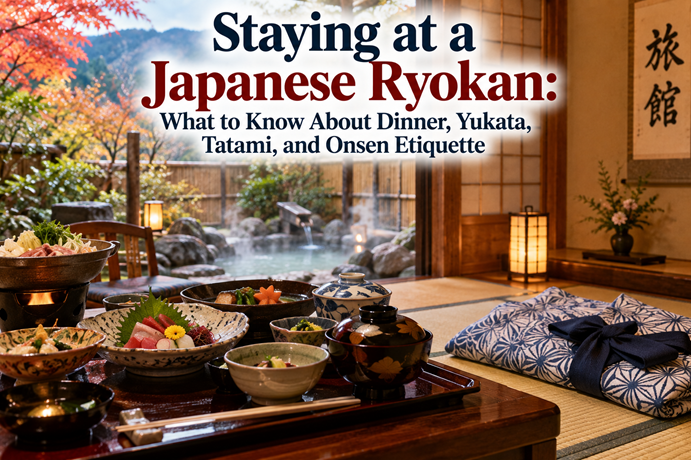
🏯 A Ryokan Is Not Just a Japanese-Style Hotel
There is a big difference between staying at a traditional Japanese ryokan and staying at an ordinary hotel in Japan, and the difference begins before you even enter the room. A modern hotel is designed to make the guest experience relatively familiar no matter where they come from. You check in at a front desk, take an elevator, enter your room, and largely manage your own stay. A traditional ryokan works differently. The room, dinner, bath, clothing, sleeping arrangements, and even the timing of your arrival can all be connected into one continuous experience, often with staff interacting with you more closely throughout the evening.
That closeness is one of the reasons I would strongly recommend staying at a traditional ryokan at least once during a trip to Japan. You are not simply sleeping somewhere that happens to have Japanese decoration. You are temporarily entering a different way of experiencing accommodation.
You may remove your shoes at the entrance, step onto tatami, change into a yukata, eat a multi-course dinner prepared around the evening schedule, take a communal hot-spring bath, and return to your room to find that the futon has been prepared while you were away. In some ryokan, a staff member may greet you personally, explain the room and bath, serve part of the meal, and later return to prepare the sleeping area. The distance between guest and staff is therefore much smaller than what many visitors associate with a standard hotel.
That does not mean every ryokan operates in exactly this way. Modern ryokan can be quite different from one another, and some combine traditional architecture and food with hotel-style service. But the more traditional the property, the more important it becomes to understand the rhythm of the stay before you arrive.
🕔 Arrive Early Because Dinner Is Part of the Stay
One of the biggest mistakes a first-time ryokan guest can make is treating check-in time as if it were completely independent from the rest of the reservation. At a large international hotel, arriving several hours late may simply mean that you missed some time in your room. At a traditional ryokan that includes dinner, arriving late can affect the entire evening because the staff, kitchen, and dining schedule have been organized around your arrival.
Many dinner-inclusive ryokan expect guests to arrive in the late afternoon, often with check-in beginning around 15:00 and with guests expected to arrive by roughly 17:00 to 18:00 so that dinner service can begin on time. The exact time varies by property, so the reservation information is more important than any universal rule. What matters is that you should treat the ryokan’s arrival time as part of the meal reservation, not merely as a room-access time.
This becomes particularly important because a traditional multi-course dinner cannot necessarily be held indefinitely for a guest who has not arrived. The kitchen may begin preparing individual courses based on the expected serving time, and staff may need to coordinate the dining room or guest room, food preparation, service, and later room preparation. If you arrive substantially later than the agreed time, the ryokan may be unable to provide the full dinner service, and depending on the booking conditions, the meal may be treated as missed rather than simply served late.
This does not mean that being delayed automatically means you lose dinner. Trains can be delayed, flights can arrive late, weather can interfere with travel, and ryokan staff understand that unexpected problems happen. The important thing is communication. If you know that you are going to be late, contact the ryokan as soon as possible. A simple message or phone call can allow the staff to decide whether the dinner time can be adjusted or whether another arrangement is possible. Arriving silently hours late is very different from warning the property in advance.
This is one of the first ways a ryokan differs from a hotel. At a hotel, your late arrival may affect almost nobody except you. At a traditional ryokan, your arrival can affect the timing of several people whose work is already organized around your meal.
🍱 Dinner Is Part of the Ryokan Experience
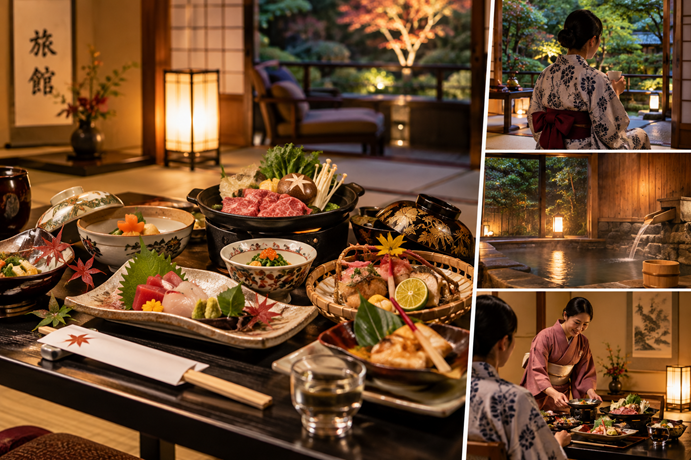
For many traditional ryokan, dinner is not an optional extra that happens to be available in the building. It is one of the main reasons people stay there. A multi-course dinner may use seasonal and regional ingredients, and the meal can be presented in several stages rather than arriving on the table all at once.
This is also why the evening has a particular rhythm. While you are checking in, changing into your yukata, settling into the room, or taking a bath, the kitchen and service staff are preparing for dinner. If the meal is served in your room, the staff may enter and arrange dishes and tableware. If the meal is served in a dining room, you may be shown to your seat and served course by course. The precise style depends on the ryokan, but the underlying idea is similar: your dinner is being prepared as part of your stay, not simply ordered from a menu whenever you feel like eating.
This is one reason arriving at 20:00 without contacting the ryokan can create a problem. The meal may have been planned around an earlier service period, and ingredients or dishes may no longer be suitable for the same style of presentation later in the evening. Again, this is not about a hotel being unfriendly. It is about how the service itself is structured.
If you know before booking that you will arrive late because your train or flight lands in the evening, look for a ryokan that offers a stay without dinner or confirm in advance whether late dinner can be accommodated. A ryokan is not necessarily the right place to book when you want complete freedom over your evening schedule.
👘 The Yukata Is Not Just a Bathrobe
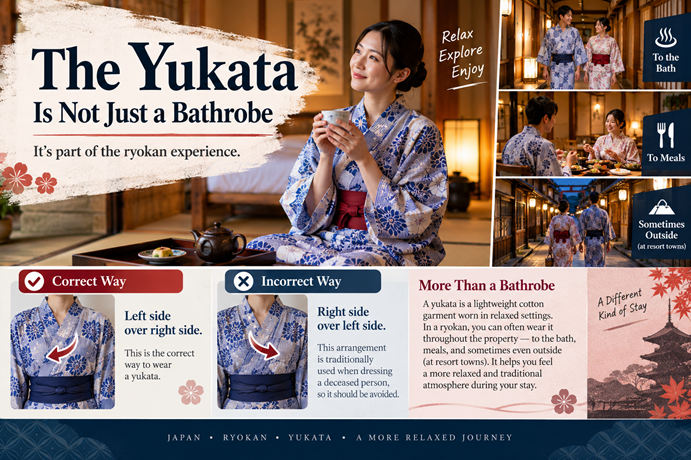
Once you enter a traditional ryokan, you will often find a yukata waiting in the room. Foreign visitors sometimes assume that it is simply a Japanese version of the bathrobe found in a Western hotel. It is more than that.
The yukata is a lightweight cotton garment traditionally worn in relaxed settings, and in a ryokan it becomes part of the experience of moving between your room, the bath, meals, and other parts of the property. In many ryokan you can wear it throughout the building, including while going to the communal bath or dining area. At some hot-spring resorts, guests can also wear yukata outside the ryokan while walking around the resort town, although this depends on the property and local custom, so you should follow the instructions of your accommodation.
There is one rule that is especially important: the wearer’s left side should overlap the right side when you put on a yukata. The opposite arrangement, with the wearer’s right side over the left, is traditionally associated with dressing a deceased person. This is why getting the overlap correct matters even though the yukata is casual clothing.
The easiest way to remember it is to put the right side against your body first and then bring the left side across it. After that, secure the garment with the accompanying belt or sash. It may feel strange at first if you have never worn one, but the staff can usually help if you are unsure.
The beautiful thing about a yukata in a ryokan is that it changes the feeling of the stay. You are no longer dressed as though you are preparing to go out into a city. You have changed into clothing intended for relaxation, and your movement around the property becomes more informal.
🏯 Tatami Changes the Way You Use the Room
Then there is the tatami room, which may require a completely different way of thinking about space.
If your room has tatami flooring, the surface is not simply another type of floor that can be treated like carpet. The woven surface is designed to be walked on without outdoor footwear, and this is why shoes and slippers are normally removed before stepping onto tatami. If you have been wearing the slippers provided for the corridor, leave them at the entrance of the tatami room and step inside in socks or bare feet.
This can be surprisingly easy to forget when you are carrying luggage. One moment you are walking down the hallway in slippers, and the next you are standing beside your suitcase wondering whether you can simply roll it across the room. It is better not to. Wheels can damage the surface, so a suitcase should be lifted or handled carefully rather than dragged across tatami.
The same idea applies to the raised alcove known as the tokonoma. A traditional tatami room may contain a hanging scroll, flower arrangement, or another decorative feature in this special space. It is not simply an empty shelf where you can put your backpack or luggage. The area is designed for appreciation and display, so personal belongings should stay elsewhere in the room.
These details may seem unusually formal to someone accustomed to a modern hotel room, but they make more sense once you understand that the room itself has been designed around materials, objects, and spaces with different roles. The tatami is not just flooring, and the tokonoma is not simply storage.
🛁 The Onsen Has Rules Because Everyone Shares the Water
For many visitors, the hot spring is the most exciting part of a ryokan stay. It can also be the part that causes the most anxiety because the bathing experience is different from using a private hotel bathroom.
The basic principle is simple: wash your body before entering the communal bath. The washing area comes first, and the hot spring water comes afterward. The purpose is to keep the shared bathing water clean for everyone. You normally bathe without swimwear, leave your clothes in the changing area, and use the small towel provided for washing or modesty outside the bath.
The towel should not go into the water. You can place it beside the bath or fold it on top of your head, as long as it does not fall into the water. Long hair should also be kept away from the bathwater.
Once you understand this sequence, the experience becomes much less intimidating. Shower first, enter the bath clean, keep the towel and hair out of the water, and respect the quiet environment around you.
One of the most important things to check before booking a ryokan with an onsen is its tattoo policy. Rules vary considerably between facilities, and although tattoo-friendly hot springs have become more common, some communal baths still restrict entry for guests with tattoos. Some allow covered tattoos, some offer private baths, and some do not allow tattooed guests to use the public bath at all. The rules belong to the individual facility, so do not assume that one ryokan’s policy applies to another. Checking before you arrive is far easier than discovering the restriction after you have already checked in.
For travelers with tattoos, this can actually affect which ryokan you choose. A private bath attached to the room or a reservable private onsen can completely change the experience because you no longer have to rely on the rules of a communal bath.
🛌 What Happens to Your Room While You Are Having Dinner?
One of the most surprising moments for first-time ryokan guests can happen while they are not even in their room.
You leave for dinner.
You return later.
And the room has changed.
The low table may have been moved.
The bedding has appeared.
The futon has been laid out on the tatami.
Your room is suddenly ready for sleep.
Traditionally, staff such as the nakai would enter the room while guests were dining or otherwise away and prepare the futon. In modern ryokan, the precise service style varies, and some properties may have guests prepare their own bedding or use different room arrangements. But the traditional model involves staff taking care of this transition from daytime room to sleeping space.
This is one of the clearest examples of how close the relationship between guest and accommodation staff can be in a traditional ryokan. The room is not necessarily treated as a sealed private space that no staff member enters unless something goes wrong. The accommodation is actively involved in preparing the room for different stages of your stay.
That can feel surprising to someone accustomed to a hotel where housekeeping happens on a schedule and the guest generally controls the room throughout the evening.
The ryokan model is more integrated.
The room becomes dining space.
Then it becomes living space.
Then it becomes sleeping space.
The staff help transform it.
🤝 The Staff Are Much Closer to the Guest Than at a Typical Hotel
This may actually be the most important thing to understand before staying at a traditional ryokan.
You are not simply renting a room.
You are entering a service environment in which staff may interact with you repeatedly throughout the evening. Someone may welcome you at arrival, explain the room, guide you toward the bath, serve dinner, explain unfamiliar dishes, clear the meal, prepare the futon, and help with your departure the following morning.
This is a much closer form of hospitality than many modern hotels provide.
It does not mean every ryokan has highly personalized service. Large ryokan can operate more like hotels, and some properties use self-service systems to reduce the amount of direct interaction. But the traditional model deliberately puts the guest and staff closer together.
That is part of what makes the experience distinctive.
The staff are not simply there to answer questions at a distant front desk.
They are part of the rhythm of the stay.
And that is also why small acts of consideration from the guest matter. Keeping your belongings reasonably organized, following the property’s instructions, respecting the tatami and bath rules, arriving on time, and communicating delays all make the service easier to provide.
The relationship works in both directions.
💴 Do You Need to Tip at a Ryokan?
For most travelers, no. Tipping is generally not part of ordinary Japanese hotel or ryokan culture in the way it is in some countries, and you do not need to calculate a percentage for your room attendant or dinner service.
There is a historical custom known as kokorozuke, a small expression of appreciation sometimes associated with very traditional hospitality, but this is not something foreign visitors should assume they need to provide. Ordinary gratitude and a simple thank-you are perfectly appropriate.
There may also be other charges that have nothing to do with tipping. Depending on the location and the accommodation, guests may encounter a local bathing tax associated with the use of hot springs. The amount and collection method vary by municipality and property, so it is sensible to check your reservation details and have some cash available when staying at a hot-spring ryokan.
This is another reason a little physical yen can be useful. You may have already paid the main accommodation bill by card and still encounter a small local charge during the stay.
🌙 A Ryokan Has a Different Rhythm From a Hotel
When you put all of these things together, the difference becomes clear.
At a conventional hotel, you largely decide how to spend your evening. You can arrive late, eat at a different time, stay in your room, order something later, and generally structure the experience around your own schedule.
A traditional ryokan has more of a rhythm.
You arrive.
You settle into the room.
You change into a yukata.
You may take a bath.
Dinner begins around a planned time.
The room changes while you are away.
You return and find the futon ready.
You sleep on the tatami.
Breakfast follows the next morning.
The experience is less about controlling every detail yourself and more about allowing the accommodation to guide you through a sequence of Japanese hospitality.
That is precisely why some travelers love it and why others may initially find it unfamiliar.
You are not simply staying in a room.
You are participating in a style of hospitality.
🌸 Why You Should Stay at a Traditional Ryokan At Least Once
A modern hotel can be extremely comfortable, convenient, and efficient. There is nothing wrong with choosing one, especially when your trip is busy and you want maximum flexibility. But a traditional ryokan offers something quite different.
The room itself becomes part of the experience.
The floor is different.
The clothing is different.
The dinner is different.
The bath is different.
The sleeping arrangement is different.
The relationship with the staff is different.
Even the timing of the evening is different.
That combination is difficult to reproduce simply by staying in a hotel room decorated with Japanese artwork.
A genuine ryokan experience asks you to slow down and accept a different rhythm for one night. You arrive before dinner rather than at the last possible moment. You put away your shoes. You sit on tatami. You change into a yukata. Someone may serve you dinner. You soak in an onsen. You return to find your futon waiting.
For a traveler trying to understand Japan beyond sightseeing, that sequence is valuable because it turns Japanese customs from things you observe into things you actually experience.
🇯🇵 The Secret Is to Stop Treating a Ryokan Like a Hotel
Perhaps the easiest way to avoid problems is to remember one sentence:
A traditional ryokan is not simply a hotel with Japanese rooms.
Once you understand that, almost everything else makes sense.
The early arrival is connected to dinner.
Dinner is connected to the work of the kitchen and service staff.
The yukata is connected to the relaxed rhythm of the stay.
The tatami rules are connected to the materials and design of the room.
The onsen etiquette is connected to sharing the same water.
The futon service is connected to the transformation of the room from daytime space into sleeping space.
The lack of tipping is connected to a different service culture.
The extra local bathing charge, when applicable, is connected to the region and hot-spring environment rather than to tipping.
Nothing is particularly complicated once you understand the system.
The problem comes when you expect a ryokan to behave exactly like the hotel you stayed in the night before.
It does not.
And that is the point.
🌏 A Traditional Ryokan Is an Experience of Being Looked After
There are few mainstream accommodation experiences in which the relationship between guest and accommodation can become as close as it does in a traditional ryokan. That does not mean Japanese hospitality is automatically better than hospitality elsewhere. Traditional guesthouses, inns, bed-and-breakfasts, and family-run accommodations around the world can also create intimate relationships between hosts and guests.
What makes the traditional Japanese ryokan distinctive is the particular combination of service, room, food, clothing, bathing, architecture, and timing.
The staff may know when you arrived because dinner depends on it.
They may enter your room because the futon needs to be prepared.
They may serve food directly because dinner is part of the stay.
They may explain the bath because communal bathing has its own customs.
They may expect you to move through the property in a yukata because the entire environment is designed for relaxed movement within the inn.
The distance between “hotel staff” and “guest” becomes smaller.
That is why staying at a ryokan can feel less like simply booking accommodation and more like temporarily stepping into a different form of Japanese everyday hospitality.
And perhaps that is the best reason to try it.
You do not stay at a traditional ryokan simply to sleep in a tatami room.
You stay there to experience what happens when the room, the meal, the bath, the clothing, the staff, and the rhythm of the evening are all designed as one experience.
Once you understand that, your first ryokan stay becomes much easier.
And much more memorable.
🌏 Continue Exploring Life in Japan
Japan becomes easier to understand when you look beyond sightseeing and experience the everyday spaces, routines, and customs that shape life here.
👉 Which Side Should You Stand on an Escalator in Japan? Tokyo, Osaka, and the World
👉 How Much Japanese Yen Do You Need in Japan? Cash, Cards, and How Much to Carry
👉 Why Is Smoking in Japan So Different? Smoking Areas, Hotels, Restaurants, and City Streets (2026 Guide)
👉 Japanese Hotel Amenities: What Can You Take Home? Amenities, Facilities, and Ryokan vs Hotel (2026 Guide)
👉 Arriving in Japan Late at Night: How to Make the Most of Your First Night (2026 Guide)