
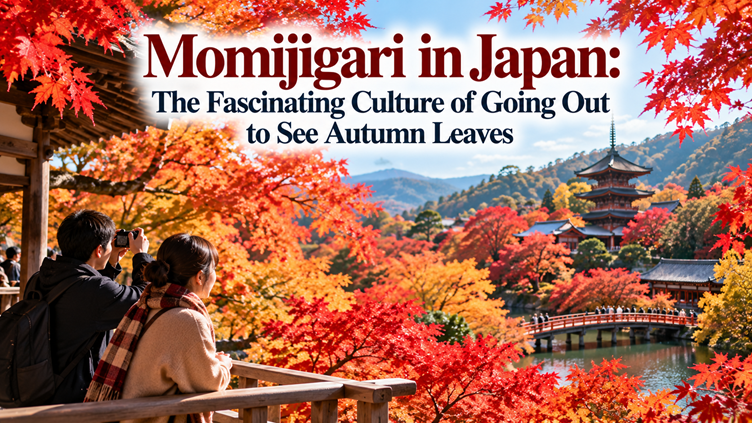
🌏 When Autumn Becomes Something Worth Going Out to See
Autumn arrives quietly in Japan. The temperature begins to fall, the sunlight changes, mornings become cooler, and somewhere in the landscape the first leaves begin to turn. At first, almost nothing seems different. One tree may have a few yellow leaves while another is still completely green. A few days later, orange appears in another part of the landscape, and eventually patches of deep red begin to emerge. Then, almost without anyone deciding that it has happened, autumn becomes visible everywhere. This is the season of Momijigari in Japan, a tradition of going out to appreciate autumn leaves rather than simply encountering them by chance.
The word may literally sound strange to an English speaker because “gari” means hunting, but no one is hunting the trees. The idea is to go out in search of beautiful autumn foliage, choosing a place and a time when the seasonal colors are worth seeing. That simple act of leaving home to look at leaves is what makes Momijigari interesting. It is not merely a description of a natural phenomenon. It is a cultural habit of turning seasonal change into something people deliberately make time to experience.
Japan is certainly not the only place with beautiful autumn foliage. Europe has its golden forests, North America has its enormous displays of red, orange, and yellow, and Canada has some of the most unforgettable autumn landscapes anywhere. Yet Japan has developed a particularly recognizable culture around the act of going out to look at autumn leaves. People travel to mountains, gardens, temples, shrines, lakes, parks, and even city streets when the colors reach their best moment.
They may take photographs, drink tea, eat seasonal food, walk through a garden, or simply stand and look. The activity can be highly organized or completely casual. What matters is that the changing leaves become a reason to go somewhere and pay attention.
🍁 What Does Momijigari Actually Mean?
Momijigari is often translated as “autumn leaf viewing” or “autumn foliage hunting,” but neither translation fully captures the feeling of the Japanese expression. “Hunting” here is metaphorical. You are going out to search for something beautiful, much as you might go into a landscape looking for a particular plant or animal, but the object of the search is a seasonal sight rather than something to capture or take home. The word therefore contains an interesting idea: beauty is not simply waiting in front of the house. You go looking for it.
That idea is important because it changes the relationship between people and seasonal nature. Everyone can see that leaves are changing, but Momijigari turns seeing into an activity. A person can say, in effect, “The leaves should be beautiful now. Let’s go and see them.” That small decision gives the landscape a different status. The autumn forest is no longer merely the background of everyday life. It becomes the destination.
The tradition also reveals something about Japanese attitudes toward seasonal timing. Autumn leaves are temporary. The color changes from day to day, the trees do not all peak simultaneously, weather can alter the appearance of the landscape, and a beautiful scene can disappear quickly once wind and rain arrive. Seeing the leaves therefore involves timing. You are not simply visiting a place. You are trying to arrive during a particular moment in the life of that place.
That sense of temporary beauty is central to the experience.
🕰️ A Tradition With a Very Long History
The appreciation of autumn foliage in Japan has a history that reaches far beyond modern tourism. Autumn leaves appear frequently in classical Japanese poetry, especially poetry from the early literary traditions of the Japanese court. Writers did not simply mention leaves as decorative scenery. The changing colors of trees became a way of thinking about autumn, time, beauty, memory, separation, and the passing of things.
By the time of the Heian period, aristocratic culture included outings and gatherings in which people appreciated seasonal landscapes, composed poetry, and associated natural beauty with refined social experience. The act of going out to see autumn scenery gradually became part of a broader seasonal culture. Later, as urban life expanded and travel became more accessible, the appreciation of autumn foliage spread far beyond elite circles. During the Edo period in particular, seasonal excursions became increasingly accessible to ordinary townspeople, and illustrated guides and popular culture helped turn famous scenic locations into destinations.
This history matters because it shows that Momijigari is not simply an old word attached to a modern sightseeing activity. The idea that nature should be deliberately visited, looked at, talked about, remembered, and connected with literature has deep roots in Japanese culture. Modern people may arrive by train or car, carry a smartphone, and share photographs online, but the underlying action is surprisingly old: the season has changed, and that change is worth going out to see.
🎨 The Beauty of Japanese Autumn Is Often a Mosaic
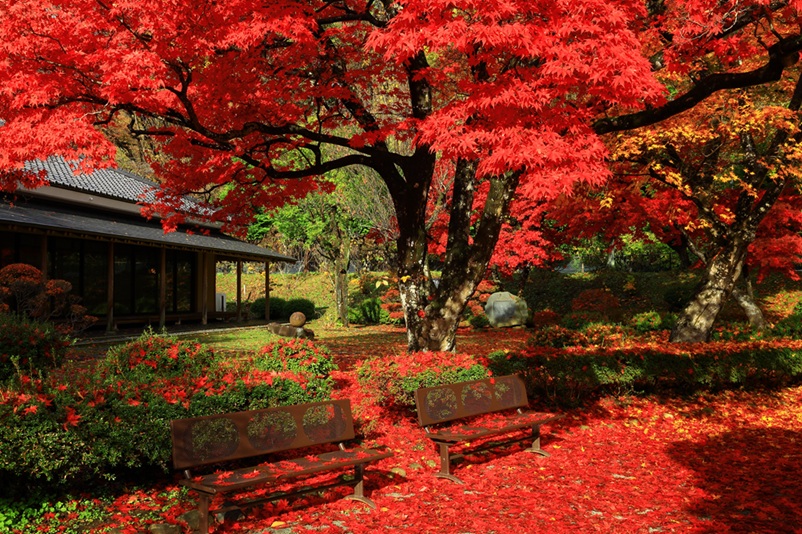
One of the things that makes Japanese autumn foliage especially striking is that it is often not one color.
Red is there.
Yellow is there.
Orange is there.
Green is still there.
Sometimes brown and gold appear among them as well, and the exact mixture changes constantly as autumn progresses. One tree may already be deep red while the tree beside it is still green. A hillside can contain several stages of the season at the same time. A garden may combine bright red maple leaves with yellow ginkgo, evergreen trees, dark rocks, water, moss, and wooden buildings.
That is why I think “mosaic” is a useful way to describe Japanese autumn scenery.
The beauty is often created by the mixture.
If an entire landscape were exactly the same shade of red, the experience would be completely different. What makes many Japanese autumn scenes so visually rich is the interaction between different trees reaching different stages of seasonal change. The eye moves from one color to another, then back to a green area that has not changed yet. The landscape seems to contain several versions of autumn at the same time.
This is also why visiting the same place a week later can produce a completely different view. The season is not a switch that turns from summer to autumn on one particular day. It moves across the landscape gradually.
🌳 It Is Not Just Maple
When people outside Japan hear about Japanese autumn leaves, they often think of maple trees, and Japanese maple is certainly one of the stars of the season. But Japanese autumn scenery is much broader than maple alone. Ginkgo trees create brilliant yellow landscapes, while various deciduous trees contribute orange, brown, bronze, and other shades. Different species respond differently to temperature, daylight, location, elevation, and local conditions, so an autumn landscape is rarely just a field of identical trees.
This variety becomes particularly noticeable in places where different elevations come together. A mountain road can show changing colors at different heights, while a valley below may still be green even though higher slopes have already begun to turn red and gold. As the season progresses, the areas of peak color move through the landscape. What people sometimes call the “autumn foliage front” is therefore almost like a slow wave moving across Japan.
That helps explain why autumn leaf viewing can continue for many weeks without the entire country changing color simultaneously. A visitor can experience early autumn colors in one region and later colors in another. Even within the same general area, elevation and exposure can change the timing.
So when people say that they are going to see the autumn leaves, they are not always talking about a single type of tree. They are often going to see an entire landscape at a particular stage of transformation.
🏯 Why Temples and Shrines Make the Colors Feel Different
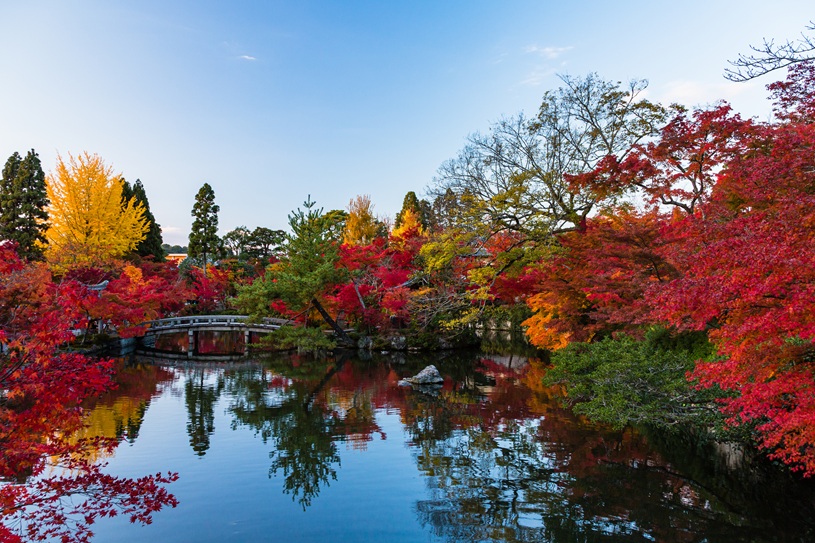
One reason Japanese autumn scenery can feel particularly distinctive is that the trees are often experienced together with architecture.
A maple tree beside a temple roof looks different from a maple tree beside an ordinary apartment building. A red maple reflected in a pond looks different from one lining a mountain road. Ginkgo leaves falling across a shrine path create a different mood from ginkgo leaves covering a city sidewalk.
This is why some of Japan’s best-known autumn destinations are not forests in the wilderness. They are gardens, temples, shrines, historical districts, bridges, ponds, and carefully designed landscapes.
Japanese garden design often makes deliberate use of borrowed scenery, water, stone, pathways, framed views, and seasonal planting. Autumn foliage can therefore become part of a larger composition. The viewer is not necessarily looking at the tree alone. The tree is interacting with the building, the water, the pathway, the sky, and the surrounding vegetation.
This is also why autumn viewing in a Japanese garden can feel different from looking at a forest in North America. Both can be spectacular, but the relationship between nature and constructed space is different.
The same red maple can become an entirely different visual experience depending on what surrounds it.
⛩️ Shrines and Temples Turn Autumn Into a Cultural Landscape
At a shrine or temple, the autumn leaves also interact with cultural memory. A pathway beneath red leaves is not simply a pleasant place to walk. The visitor may already associate the location with architecture, religious history, gardens, ceremonies, or literature. The autumn scenery adds another layer to a place that already has meaning.
This is one reason Japanese people may deliberately return to the same temple or garden in different seasons. The place does not have only one appearance. Spring cherry blossoms create one landscape, summer greenery another, autumn foliage another, and winter another again. The physical location remains the same, but the seasonal version changes.
Momijigari therefore fits naturally into a broader Japanese habit of revisiting places through the calendar.
The question is not simply, “What is this place?”
It is also, “What does this place look like now?”
That is a very different way of experiencing landscape.
🏙️ Autumn Exists in the Middle of Tokyo, Too
Another reason Momijigari is interesting is that you do not have to escape the city to experience it.
Tokyo has enormous areas of concrete, glass, roads, trains, and high-rise buildings, yet autumn appears there too. Parks, university campuses, residential streets, shrine grounds, gardens, and avenues can all become seasonal landscapes. The contrast between modern urban infrastructure and changing trees can be especially beautiful because the colors stand out so strongly against the built environment.
The ginkgo avenue at Meiji Jingu Gaien is perhaps one of the clearest examples. Rows of ginkgo trees form a long, highly recognizable urban landscape in which brilliant yellow leaves and the straight geometry of the avenue work together. The scene is not a wilderness. It is a designed city space, and that is precisely why it is interesting.
The same basic idea appears in many cities. People do not need to travel to a remote mountain to experience autumn. The season can appear along a road, in a neighborhood park, beside a station, or in a public garden.
This tells us something important about Momijigari.
The culture is not necessarily about escaping civilization and returning to untouched nature.
It is about finding seasonal beauty wherever the landscape makes it visible.
🏔️ From Gardens to Mountains
At the other end of the scale are the famous mountain landscapes of Japan. Places such as Hakone and Nikko’s Irohazaka offer a very different kind of autumn experience from an urban avenue or a temple garden. Here the scale becomes much larger. Instead of examining one tree, visitors can watch whole slopes change color, sometimes from a viewpoint above a valley or along a winding mountain road.
Irohazaka is particularly memorable because the road itself becomes part of the autumn experience. The route rises and curves through mountain scenery, allowing visitors to see different views as they move through the landscape. Hakone offers another combination of mountains, lakes, forests, and transportation routes that makes autumn foliage part of a broader seasonal excursion.
The important point is that Momijigari does not require one fixed format. You can walk through a garden. You can visit a temple. You can drive through mountains. You can sit beside a lake. You can walk down a city avenue.
What connects these experiences is not the location.
It is the decision to make the changing leaves the reason for being there.
🚶 Going to See the Leaves Changes the Way You Look at Them
There is something psychologically interesting about deliberately going out to see autumn leaves. If you pass a tree while commuting to work, you may notice the color for a second and continue walking. But when you decide that today is the day to see the autumn leaves, your attention changes. You begin looking at individual trees. You notice which ones are turning first. You compare colors. You look at the sky behind the branches. You notice reflections on water. You see leaves on the ground as part of the scene rather than as something that needs to be swept away.
The same landscape becomes more visible because you have given yourself permission to pay attention to it.
That may be one of the deeper meanings of Momijigari.
It creates time for noticing.
Modern life is very good at making people move from one task to the next. A seasonal viewing tradition interrupts that rhythm. You are not necessarily going somewhere because you have a practical reason to be there. You are going because the landscape has changed, and you want to see the change while it is still there.
That is a small but meaningful cultural habit.
📷 The Smartphone Did Not End Momijigari; It Changed It
Today, of course, people take photographs of autumn leaves constantly. A beautiful maple tree can become a smartphone image within seconds. People may share views with friends, upload photographs, or search for the most visually attractive locations.
At first glance, this might seem very different from the old tradition of poetry and seasonal appreciation. But the basic behavior is surprisingly similar. People still notice that the season has changed, still choose a place, still go there deliberately, and still try to preserve the experience in another form.
The poem has become a photograph.
The seasonal outing has become a digital memory.
The illustrated guidebook has become a map application and social-media post.
Technology has changed the tools, but not necessarily the underlying desire to mark the season.
There is also something revealing about the photograph itself. People often photograph the entire composition rather than a single leaf. They want the color against the temple roof, the red trees around the pond, the yellow avenue disappearing into the distance, or the mountain covered in several shades of autumn. Once again, the attraction lies in the relationship between elements.
🍂 The Timing Is Part of the Experience
Cherry blossoms are famous for their brief season, but autumn leaves create a different kind of anticipation. The trees do not all change simultaneously, which means the season unfolds over time. People begin watching the weather, checking local conditions, and hearing that the colors have started to appear somewhere nearby. The timing becomes part of the experience.
This is another reason Momijigari is more than “looking at trees.”
The viewer is paying attention to a process.
Green becomes yellow.
Yellow becomes deeper.
Orange appears.
Red becomes more intense.
The leaves fall.
The ground changes.
The branches become increasingly visible.
Eventually, the season passes.
The beauty is partly in the transformation itself.
A photograph can preserve the moment, but it cannot stop the process. That temporary quality may be one reason autumn foliage has such a strong emotional effect. You are seeing something that is beautiful partly because it will not remain in exactly that form.
🌏 Japan Does Not Have a Monopoly on Beautiful Autumn
It is important not to turn an article about Japanese autumn into a claim that Japan has the world’s greatest fall foliage.
It does not need that claim.
Europe has extraordinary autumn landscapes, from golden forests to mountains covered in changing leaves. The United States has remarkable autumn scenery across many regions, and Canada is famous for spectacular displays of red, orange, and yellow across enormous areas of forest.
I have experienced some of those landscapes myself, and the memories are very different from my memories of autumn in Japan. Canada in particular left a deep impression on me. Traveling through the Maple Route gave me an experience of autumn that remains part of my personal memory, and I think experiences like that enrich a person’s life precisely because they are different from what you have known before.
That is why comparing Japan with Canada, the United States, or Europe should not be about deciding which autumn is more beautiful. The landscapes are different because the trees, geography, climate, history, and relationship between people and nature are different.
Canada can give you vast forests of red maple.
Europe can give you extraordinary golden landscapes.
The United States can give you enormous regional variations in autumn color.
Japan can give you a mixture of red, yellow, orange, and green woven into mountains, gardens, temples, shrines, lakes, roads, parks, and cities.
The beauty comes from the landscape and the way people experience it.
🍁 Japan’s Autumn Is Often About Mixture, Not Uniformity
This may be the most important visual idea in understanding Japanese autumn.
The most memorable scene is not always the forest that turns completely red.
Sometimes it is the red tree beside a yellow one, with green behind them and dark moss underneath. Sometimes it is a bright yellow ginkgo against a gray road and blue sky. Sometimes it is orange foliage reflected in still water. Sometimes it is a single red maple tree framed by the roof of a temple.
The colors are not necessarily competing.
They are layered.
That layered quality is what I mean by mosaic.
And it explains why autumn viewing can remain interesting even after you have seen countless photographs of Japanese foliage. The same general ingredients can form completely different compositions depending on the place, the weather, the timing, the angle of view, and which trees have changed first.
You are never really looking at “Japanese autumn” as one fixed image.
You are looking at one particular moment in one particular landscape.
🧘 A Culture of Seasonal Attention
Momijigari also fits into a broader pattern in Japanese culture: the practice of paying attention to seasonal change.
There are foods for particular times of year.
There are flowers associated with particular months.
There are traditional celebrations connected to seasonal cycles.
There are sounds associated with summer and autumn.
There are changes in clothing, ingredients, weather, and daily routines.
Autumn leaves belong to this larger system.
The important thing is not that Japanese people uniquely notice the seasons. People everywhere do. Farmers, gardeners, hikers, artists, poets, and families around the world have always noticed seasonal change.
What is distinctive is the extent to which seasonal awareness has become embedded in ordinary cultural vocabulary and behavior. There are words for seasonal experiences, traditional foods associated with the calendar, and established habits of going out specifically to appreciate seasonal scenery.
Momijigari is one of the clearest examples because the activity has almost no practical purpose.
You are not harvesting the leaves.
You are not collecting them.
You are not cutting them down.
You are looking.
That is enough.
🍂 Why “Looking at Leaves” Became Worth the Journey
This may be the most interesting question behind Momijigari.
Why travel at all?
Why spend time getting to a mountain, garden, temple, shrine, or city avenue just to look at something that is already happening everywhere around you?
Part of the answer is that beautiful experiences often become more meaningful when they require attention. Going somewhere deliberately creates anticipation. You prepare. You travel. You arrive. You look. Because you chose the experience, you notice more.
There is also a social element. Families go together. Couples go together. Friends make seasonal outings. Older people revisit places they remember from previous years. A child sees autumn leaves differently from a parent who remembers visiting the same place decades earlier.
The landscape becomes part of personal memory.
That is another reason Momijigari has survived modern life. It does not require people to reject technology or return to an ancient lifestyle. It only asks them to stop for a moment and notice that the world around them has changed.
🌳 From Ancient Poetry to Tokyo Streets
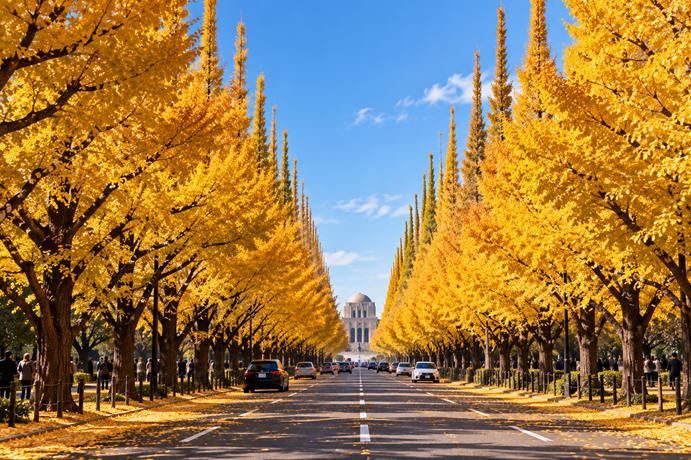
The extraordinary thing about Momijigari is the distance it has traveled without losing its essential character. In earlier periods, people could admire autumn foliage in the context of poetry, aristocratic gatherings, seasonal literature, and carefully designed landscapes. Later, ordinary townspeople gained greater opportunities to travel and visit famous viewing places. Today, people may take the train to a mountain resort, drive to Hakone, walk beneath the ginkgo trees of Meiji Jingu Gaien, visit a temple with a famous garden, or simply stroll through a neighborhood park with a smartphone in hand.
The tools have changed completely.
The landscape around people has changed enormously.
The reason for looking has changed in some cases, too.
But the basic action remains surprisingly simple.
Autumn has changed the landscape.
You noticed.
You went to see it.
🌏 More Than Autumn Leaves
Momijigari is often translated as autumn leaf viewing, but that translation can make it sound like a sightseeing activity with little cultural depth. In Japan, the idea has a longer history and a wider meaning. It connects seasonal change with travel, landscape, literature, gardens, religious sites, family outings, photography, memory, and the simple act of giving attention to something temporary.
The leaves themselves do not need to be extraordinary in a global sense. Europe has magnificent autumn forests. North America has magnificent autumn forests. Canada gave me some of the most memorable autumn scenery I have ever seen, and those landscapes remain deeply meaningful to me. Japan does not need to compete with them.
What makes Momijigari interesting is the cultural decision to make autumn foliage something worth actively seeking.
A person sees the first red leaves and knows the season is changing.
A family decides to visit a temple.
Friends plan a trip to the mountains.
Someone walks through a city avenue filled with yellow ginkgo leaves.
A photographer waits for the right morning light.
An older person returns to the same garden they have visited many times before.
The leaves are temporary, but the act of noticing them creates memory.
Perhaps that is the deeper meaning of Momijigari. It is not really about hunting leaves. It is about hunting for a moment in time.
Autumn gives Japan a landscape that changes almost visibly from week to week, and Momijigari gives people a reason to pay attention to that change. The red maple, the yellow ginkgo, the orange leaves, the green trees that have not changed yet, the mountain road, the shrine path, the temple garden, the city avenue, and the distant hillside all become parts of a seasonal story.
And then, just as quickly as it arrived, the season moves on.
The leaves fall.
The landscape changes again.
But the memory remains.
🔗 Explore More About Japanese Autumn and Seasonal Culture
For more stories about how Japan experiences the changing seasons through food, landscapes, traditions, and everyday life, continue with these related articles.
👉 Christmas in Japan: KFC, Strawberry Cake, Christmas Eve, and the Sudden Switch to New Year
👉 Japanese Chrysanthemums in Autumn: 7 Fascinating Stories Behind Japan’s Seasonal Culture
👉 Japan’s Rice Harvest: Golden Rice Fields, Autumn Landscapes, and the Culture of Harvest
👉 The Sounds of Autumn in Japan: Bell Crickets, Crickets, and the Season’s Changing Landscape (2026 Guide)
👉 The Scent of Autumn in Japan: How Smells Tell Us the Season Has Changed (2026 Guide)