
🌏 Introduction
Packing for a trip is always a balancing act. Bring too many clothes, and your suitcase quickly becomes heavy and difficult to carry. Pack too little, and you may find yourself worrying about running out of clean clothes halfway through your journey.
For many travelers, laundry is one of those practical details that often gets overlooked during the excitement of planning a vacation. Yet it can have a surprisingly large impact on your trip, especially if you are staying in Japan for a week or longer.
I have experienced this myself whenever I travel abroad. Before booking a hotel, one of the first things I check is whether there is somewhere nearby to wash my clothes. Knowing that laundry facilities are available means I can travel with a much lighter suitcase, leaving extra space for souvenirs and making it easier to move between cities.
Fortunately, Japan is one of the easiest countries in the world for travelers who need to do laundry.
Whether you are staying in a business hotel, a traditional ryokan, or an apartment for several weeks, there is almost always a practical solution nearby. Modern hotels often provide coin-operated washing machines, many accommodations offer professional laundry services, and clean, well-maintained coin laundromats can be found throughout cities and residential neighborhoods.
If this is your first visit to Japan, the machines and payment systems may look unfamiliar at first. You might also wonder whether you need to bring detergent, whether laundromats are safe at night, or how long the entire process takes.
The good news is that doing laundry in Japan is usually much easier than many visitors expect.
In this guide, you’ll learn the different ways to wash your clothes while traveling, how much you can expect to pay, what kind of machines you’ll find, and a few practical tips that can make your trip even more comfortable.
🧺 Why Knowing About Laundry Can Make Your Trip Easier
Many first-time visitors to Japan plan their luggage around the length of their trip.
If you are staying for three or four days, packing enough clothes is usually simple. However, once your journey extends to a week, ten days, or even several weeks, the amount of clothing you need increases dramatically. Shirts, socks, underwear, and lightweight summer clothing can quickly fill an entire suitcase before you have even packed souvenirs or travel essentials.
This is where laundry becomes one of the simplest ways to make traveling easier.
Instead of bringing enough clothes for every single day, many experienced travelers pack for only four or five days and wash their clothes once or twice during their trip. Doing so allows them to travel with a much lighter suitcase while still having clean clothes throughout their vacation.
This approach is especially useful if your itinerary includes several cities. Carrying a lighter suitcase through train stations, hotels, and airports makes every transfer easier. It also leaves extra space for the things many visitors enjoy buying in Japan, whether that’s clothing, snacks, stationery, or gifts for family and friends.
Fortunately, Japan’s laundry facilities are designed to make this possible. Most machines are easy to use, many include English instructions, and the overall process is straightforward even for travelers who have never visited Japan before.
Rather than treating laundry as an inconvenience, many visitors discover that it becomes just another simple part of everyday travel.
🏨 The Three Main Ways to Do Laundry in Japan
Travelers in Japan generally have three convenient options for washing their clothes. The best choice depends on your budget, the length of your stay, and how much time you have available.
| Comparison | Hotel Coin Laundry | Hotel Laundry Service | Public Coin Laundry |
|---|---|---|---|
| Best for | Most travelers | Business travelers and formal clothing | Long stays and budget travelers |
| Typical cost | ¥300–¥800 | ¥500–¥2,000+ per item | ¥500–¥1,200 |
| Washing time | About 30–40 minutes | Same day or next day | About 30–40 minutes |
| Drying time | About 30–60 minutes | Included | About 30–60 minutes |
| Payment | Coins or sometimes cashless | Room charge or credit card | Usually cash, though some stores accept cashless payment |
| Detergent | Usually included automatically | Included | Usually included automatically or sold in a vending machine |
| Convenience | Excellent | Very convenient but expensive | Excellent for longer stays |
As you can see, most travelers find that either a hotel coin laundry or a public coin laundromat offers the best balance between cost and convenience. Professional hotel laundry services are certainly the easiest option, but they are generally intended for business travelers who need shirts, suits, or dresses cleaned and pressed quickly.
For casual travel, washing your own clothes is usually the most economical choice.
🏨 Using Hotel Coin Laundry
One of the biggest advantages of staying in Japan is that many hotels already have laundry facilities inside the building.
Business hotels, which are popular with both domestic and international travelers, frequently provide coin-operated washing machines on one of the guest floors. Even many mid-range hotels now include them because they are useful for tourists staying several nights.
Using these machines is usually very straightforward. After placing your clothes inside, you simply select the washing course, insert the required payment, and wait for the cycle to finish. Many modern machines automatically add detergent, so there is no need to bring your own.
Some newer hotels have made the process even more convenient. Instead of walking down repeatedly to check whether your laundry has finished, guests can sometimes view the machine’s status directly on the television in their room. Others provide information through a smartphone app, allowing you to see whether the machines are available before leaving your room.
Because there are often only a few machines in each hotel, they can become busy during the evening when many guests return from sightseeing. If possible, using the laundry early in the morning or later at night may help you avoid waiting.
For many travelers, however, hotel coin laundry is the easiest option because there is no need to leave the building at all.
👔 When to Use a Hotel Laundry Service
Some hotels also offer a traditional laundry service in addition to self-service machines.
Instead of washing your own clothes, you simply place them in a laundry bag provided by the hotel, fill out a form, and leave everything with the front desk. Depending on the hotel and the time of day, your clothes may be returned later that afternoon or the following day.
This service is significantly more expensive than using a coin-operated machine because the price is usually charged for each individual item rather than for an entire load of laundry.
For that reason, many leisure travelers choose not to use it for everyday clothing.
There are, however, situations where it can be extremely useful.
If you are attending a wedding, an important business meeting, or another formal event during your stay in Japan, having a dress shirt professionally cleaned and pressed can save both time and effort. It is also a convenient choice for delicate fabrics that you would rather not wash yourself.
Although it is not the most economical option, hotel laundry service offers maximum convenience for travelers who value comfort over cost.
🏪 Using Public Coin Laundries
If your hotel does not have a washing machine, or if you are staying in Japan for an extended period, a public coin laundromat is an excellent alternative.
Coin laundries are common throughout Japan and can be found in large cities, suburban neighborhoods, and even many small towns. Unlike in some countries, where laundromats may be difficult to find outside city centers, Japan has embraced self-service laundry as part of everyday life. Students, office workers, families, and travelers all use the same facilities, making them a familiar sight in many communities.
Many modern laundromats are open from early morning until late at night, while some operate twenty-four hours a day. Inside, the environment is usually bright, clean, and well maintained. Air conditioning is common, and it is not unusual to find vending machines, comfortable seating, free Wi-Fi, or even small cafés nearby, allowing customers to relax while waiting for their laundry to finish.
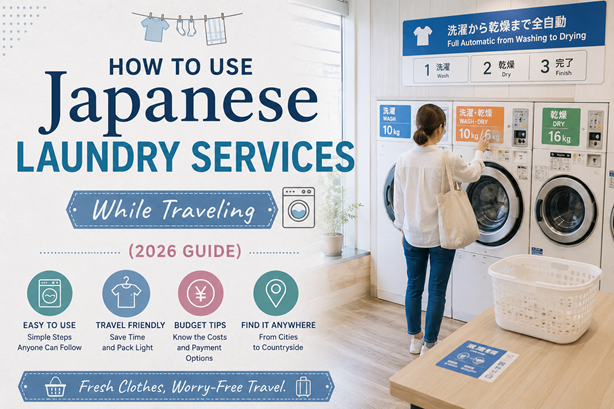
Using the machines is generally simple, even if you cannot read Japanese. Many newer machines include English instructions or use clear illustrations that guide you through each step. In many cases, all you need to do is place your clothes inside, select the appropriate course, insert your payment, and press the start button.
For travelers who plan to spend several weeks exploring Japan, public coin laundries often provide the best balance between convenience, flexibility, and cost.
🌀 Understanding the Different Types of Machines
One feature that surprises many first-time visitors is that Japanese laundromats usually offer more than one type of machine.
The first type is a standard washing machine, which washes your clothes but does not dry them. After the washing cycle finishes, you move your clothes into a separate dryer. This system is familiar to many travelers and works well if you are washing a large amount of clothing.
The second type is a dedicated dryer. Japanese dryers are generally powerful, although drying times vary depending on the amount and thickness of your laundry. Lightweight summer clothing may be dry within thirty minutes, while towels, jeans, and hoodies often require additional time.
The third option has become increasingly popular throughout Japan in recent years: the washer-dryer combination machine.
These machines complete both the washing and drying cycles without requiring you to transfer your clothes. After placing your laundry inside and selecting the appropriate program, you simply return when everything is finished.
For travelers, this is often the most convenient choice because it saves time and eliminates the need to monitor two separate machines. Although the total cycle is longer than washing alone, the convenience often outweighs the extra waiting time, especially if you plan to enjoy a nearby café or continue sightseeing before returning.
👟 Yes, You Can Even Wash Your Sneakers
One feature that many international visitors find surprising is the sneaker laundry machine.
Although not available in every laundromat, these specialized machines are becoming increasingly common across Japan. They are designed specifically for athletic shoes and casual sneakers, making them particularly useful after long days of sightseeing.
The washing machine gently cleans the shoes while protecting their shape, and a separate drying machine uses carefully controlled heat to dry them more effectively than simply leaving them in your hotel room overnight.
If you have been walking through Tokyo, Kyoto, or Osaka for several days, your shoes may appreciate the same refresh that your clothes receive.
Of course, expensive leather shoes or delicate footwear should be cleaned according to the manufacturer’s recommendations, but for ordinary sneakers, these machines provide a surprisingly convenient service that many travelers never expect to find.
🧴 Do You Need to Bring Detergent?
This is one of the most common questions travelers ask before using a Japanese laundromat.
Fortunately, the answer is usually no.
Most modern washing machines automatically dispense the correct amount of detergent during the wash cycle. This means you can simply place your clothes inside and begin washing without purchasing anything extra.
Some older machines still require detergent to be added manually. In these cases, there is often a vending machine inside the laundromat where small packets of detergent and fabric softener can be purchased for a modest price.
If you are unsure whether detergent is included, look for signs near the machine or ask a member of the hotel staff if you are using a hotel laundry room. Fortunately, situations where travelers need to bring their own detergent have become increasingly uncommon.
💴 Bringing Cash Is Still a Good Idea
Japan has become much more cashless in recent years, and many restaurants, shops, and hotels now accept credit cards, mobile payments, and IC cards.
Laundry facilities, however, have not changed quite as quickly.
Many public coin laundromats still rely on cash, especially coins, although newer locations increasingly support electronic payment systems. Hotel laundry rooms also vary depending on the property. Some accept cashless payment, while others continue to use traditional coin-operated machines.
For this reason, it is wise to carry a small amount of cash whenever you plan to do laundry.
Having several ¥100 coins and a few ¥500 coins available will make the process much smoother, particularly if you visit an older laundromat outside major tourist areas. Even if your preferred payment method is a credit card or smartphone wallet, keeping some cash on hand can save unnecessary frustration.
🔒 Are Japanese Coin Laundries Safe?
Some travelers feel slightly nervous the first time they consider using a public laundromat abroad.
Leaving your clothes unattended may seem risky if you are unfamiliar with the area or the local customs.
In Japan, however, coin laundries are generally considered safe places to use.
Most stores are brightly lit, equipped with security cameras, and located in neighborhoods where local residents regularly do their own laundry. Because they serve the community rather than only tourists, they tend to be clean, orderly, and well cared for.
That said, it is always sensible to take normal precautions. Valuable items such as passports, wallets, cash, electronics, or jewelry should never be left inside your laundry. It is also good practice to return when your cycle is scheduled to finish rather than leaving your clothes unattended for an extended period.
Japan has earned a reputation as one of the safest countries in the world, and many travelers find that using a public laundromat feels perfectly comfortable. Even so, a little common sense goes a long way wherever you travel.
🌏 Conclusion
Laundry may not be the most exciting part of planning a trip to Japan, but it is one of those small practical details that can make a surprisingly big difference.
Knowing that clean, convenient laundry facilities are widely available allows you to pack lighter, move more comfortably between destinations, and enjoy longer journeys without worrying about running out of fresh clothes.
Whether you choose the convenience of a hotel coin laundry, the professional service offered by your hotel, or a neighborhood laundromat used by local residents, you will find that doing laundry in Japan is generally simple, affordable, and traveler-friendly.
Even features that may seem unusual at first, such as washer-dryer combination machines or sneaker washing machines, quickly become part of the experience. Rather than being something to worry about, they often become another example of the practical conveniences that make traveling in Japan a little easier.
So, instead of filling your suitcase with clothes “just in case,” pack a little lighter, leave some extra room for souvenirs, and travel knowing that staying fresh during your journey is easier than you might expect.
🔗Continue Exploring Life in Japan
If this guide has helped you feel more confident about doing laundry while traveling in Japan, you may also enjoy learning more about other practical aspects of everyday life during your visit.
👉How to Use Coin Lockers in Japan: Sizes, Prices, and Travel Tips (2026 Guide)
👉What Should You Do With Your Luggage in Japan? Storage, Delivery, and Travel Tips (2026 Guide)
👉What Should You Do If You Get Sick or Injured in Japan? A Practical Guide for Travelers (2026 Guide)
👉How to Buy Medicine in Japan: What Travelers Need to Know (2026 Guide)
👉Where to Stay in Japan: Best Areas, Hotels & Booking Tips (2026 Guide)