

🌿 Introduction: The Streets Beyond the Main Streets
Japanese alley culture is not only about narrow streets, traditional buildings, or charming places to eat. It is also about the experience of walking through a place where everyday life becomes visible in small, often unplanned ways. A row of potted plants, a bicycle beside a doorway, a window opened to let in fresh air, or a collection of household objects near an entrance can reveal something about the people who live there. Nothing may be intended as a display, yet the street begins to feel connected to the lives behind its walls.
I have always enjoyed walking through alleys, including the ones I encountered while living in Toronto. I liked leaving the main streets behind and exploring the smaller routes running between buildings, whether in the downtown area or in residential neighborhoods. The atmosphere felt different. The streets were quieter in some places, the buildings seemed closer, and ordinary details became easier to notice. Instead of looking at a city from the outside, I felt that I was getting a small glimpse of how people actually lived there.
There was also a personal thought that stayed with me as I walked. I knew that I would eventually have to return to Japan, and I sometimes wondered what life was like for the people who could continue living in those Toronto neighborhoods. What did their ordinary days look like? How long had they lived in their homes? What did they see when they looked out of their windows? Their lives were taking place around me, but I knew almost nothing about them.
That feeling is part of what makes an alley memorable. A main street often presents a city through its shops, traffic, public buildings, and recognizable landmarks. An alley offers a different perspective. It brings you closer to the boundary between public space and private life, while reminding you that the lives you glimpse belong to people whose stories you may never know.
Japan has its own distinctive forms of narrow streets, including residential roji and the small restaurant lanes known as yokocho. Their histories and functions vary, and not every alley looks the same. Yet many offer an opportunity to observe the relationship between buildings, streets, and daily routines. To understand their appeal, it helps to look beyond the idea of an attractive hidden corner and consider what happens when the ordinary lives of a neighborhood come into view.
🚶 1. Why an Alley Feels Different from a Main Street
A main street usually tells you what a place does. Shops display their products, signs identify businesses, vehicles move toward destinations, and pedestrians follow routes designed to carry people efficiently. Even when a main street has historical buildings, its public-facing functions often dominate what a passerby notices first.
An alley can reveal a different layer of the same city. The buildings may be smaller, entrances may sit close to the pavement, and the boundary between a home and the street may feel less visually distant. You might notice shoes near a doorway, a watering can beside a plant, or a bicycle parked in a space that is barely wider than the bicycle itself. These details are not necessarily unique to Japan, but they can make the relationship between a building and the people living inside it feel immediate.
The difference is partly a matter of scale. On a wide road, a person can see the street as a whole, with buildings forming a backdrop. In a narrow lane, the surrounding walls, windows, doorways, and objects occupy more of the field of vision. The walker notices smaller details because the environment is physically closer. A quiet sound from a home or the appearance of a familiar household object can become part of the experience of the street.
There is also a difference in pace. Main streets often encourage people to keep moving toward a destination, particularly where traffic is heavy or pedestrian routes are busy. An alley may invite a slower walk because there is less to navigate and more to notice. This is not always true: some narrow streets are busy shortcuts, and some are used by delivery vehicles or residents in a hurry. Still, when the pace slows, the surroundings can become more legible.
The appeal does not depend on every alley being beautiful or old-fashioned. Some are plain, poorly maintained, or unremarkable. Others contain modern apartment buildings, utility equipment, parked bicycles, and practical signs of urban life. These ordinary details matter because they show that the alley is not a stage set. It is a working part of a neighborhood.
Walking through an alley can therefore feel different from viewing a city as a collection of destinations. Instead of asking what there is to see, the walker begins to notice how a place is inhabited.
🪴 2. When Private Life Reaches the Street
One of the most revealing features of some Japanese residential alleys is the way small traces of private life appear along a public route. Potted plants may stand beside a doorway. A bicycle may be parked against a wall. A resident may sweep the area outside the entrance, while another arranges flowers or checks on a plant before leaving home. The objects and activities are ordinary, but together they make the street feel connected to the people who use it every day.
This relationship can be understood as an overlap between public and private space. The street is a route that others may use, but the buildings along it are homes or workplaces with their own routines. The space immediately outside a doorway may not be fully private, yet it is closely associated with the person who lives or works behind that entrance. Everyday objects sometimes occupy this in-between area, making the boundary feel less visually absolute.
The arrangement is not necessarily an expression of a strong neighborhood community. Someone may place a plant outside simply because it receives better light there. A bicycle may be parked in the most convenient available space. A resident may clean the entrance out of personal habit rather than because other neighbors do the same. It is important not to infer an entire social relationship from a single object.
Even so, the cumulative effect can be meaningful. Several homes along one lane may display different signs of occupation, each reflecting the preferences and circumstances of its residents. One doorway has carefully arranged plants, another has a simple umbrella stand, and another offers almost no visible indication of the people inside. The variety makes the street feel inhabited rather than uniform.
Japanese urban research has examined how household objects such as plant boxes and bicycles are used in alley spaces and how these uses relate to the organization of shared space. The important point is not that every alley has the same social rules, but that the physical environment can become part of the way residents express and negotiate everyday life.
For a passerby, these details create a quiet sense of proximity. You are still outside, and the lives behind the doors remain private, but you can see small traces of the people who inhabit the place. The alley offers a glimpse without giving you the whole story.
🌏 3. Walking Through Toronto and Imagining Other Lives
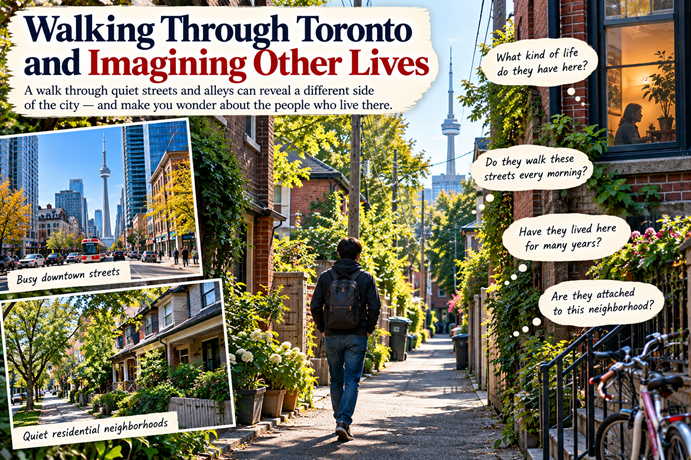
My memories of Toronto are an important part of how I think about alleys. I enjoyed walking through both downtown streets and residential neighborhoods, particularly when I could leave the main road and follow a smaller route. The attraction was not simply that the streets were quiet or that the buildings looked different. I liked the sense that I was seeing a part of the city that was not arranged primarily for visitors.
As I walked, I often wondered about the people who lived in the homes around me. I knew that I would eventually return to Japan, while the people behind those windows might continue living in the same neighborhood for years. What kind of life did they have there? Did they walk along the same streets every morning? Did they know the people in the neighboring homes? Were they attached to the area, or was it simply where they happened to live at that point in their lives?
I could not answer these questions. The street did not reveal whether someone had lived there for decades or moved in recently, whether a household was full of activity or usually quiet, or what experiences had shaped the people inside. Yet the uncertainty made the walk more interesting rather than less. The alley gave me enough information to imagine a life, while leaving the most important details unknown.
This experience was different from looking at a famous landmark. A landmark usually comes with a story that a visitor is expected to understand. A residential alley often offers no explanation at all. The buildings are not necessarily famous, the objects are not arranged for photographs, and the people who live there may have no interest in being observed. The walker must accept that the place has meaning beyond anything they can immediately see.
That feeling also made me more aware of my own position. I was living in Toronto, but I knew that my stay would not necessarily be permanent. The people I imagined behind the windows might have a different relationship with the city. Some might have deep roots there; others might also be newcomers, temporary residents, or people considering their own next move. I could not know. The difference between my life and theirs was not simply national identity, but the uncertain relationship that anyone can have with a place they call home.
This is why I do not want to describe the appeal of Japanese alleys as something that exists only in Japan. My affection for them developed partly through walking in another country. Toronto taught me that a small street can make a city feel more personal because it brings the observer close to ordinary life without making that life fully accessible.
When I think about Japanese alleys, I bring that memory with me. The cultural details are different, but the basic experience is familiar: walking through a place, noticing traces of everyday routines, and wondering about the lives unfolding just beyond the street.
🏡 4. The Meaning of Roji in Japanese Neighborhoods
The Japanese word roji (路地) commonly refers to a narrow lane or alley, although the exact form and function of a particular roji can vary. Some are passages between homes; others form part of older residential districts or lead into spaces shared by several buildings. A roji may be a route people use to reach their homes, a connection between streets, or a small space closely associated with a group of neighboring households.
The word should not be treated as a single architectural blueprint. Japanese cities developed in different ways, and the lanes found in Kyoto do not necessarily resemble those in Tokyo or other regions. Some alleys are associated with older wooden buildings, while others sit among more recent housing. Some are open and easy to pass through; others are narrow, have limited access, or end without connecting to another street.
What many of these spaces share is their human scale. Buildings can stand close to the path, entrances may be directly visible, and small changes in the street are easy to notice. In some places, the distance between the home and the public route is short enough that a resident’s daily activities leave a visible trace. The alley becomes part of the immediate environment of the home rather than merely a line on a map.
This closeness can encourage familiarity, but it does not automatically create community. Residents may know one another well, greet each other occasionally, or have little interaction beyond sharing the same route. Some people appreciate the intimacy of a small neighborhood, while others value privacy and prefer to keep their daily lives separate. The design of the space creates possibilities for interaction, not a guarantee that everyone will use it in the same way.
The relationship between roji and the surrounding buildings is also important. A lane can connect a home to a larger street, but it can also define a small residential environment with its own rhythm. The sounds, objects, and movement along it may differ from those on the main road. A delivery person may pass through, a resident may pause at the entrance, and a pedestrian may notice the changing plants or seasonal decorations along the way.
The term is useful because it directs attention away from the idea of an alley as an inferior or leftover street. A narrow lane may be essential to how a neighborhood works, even if it does not carry much traffic or appear on tourist maps. Its value lies partly in the way it connects buildings and lives at a smaller scale.
🕰️ 5. History, Longhouses, and the Changing City
Japanese alleys have different histories, so it would be misleading to explain them all as direct descendants of one traditional system. Nevertheless, older urban housing provides important context for understanding why narrow shared spaces became part of life in some Japanese neighborhoods.
In the Edo period, many towns contained nagaya (長屋), long rows of relatively small dwellings that could house multiple households. Such housing was one part of a much larger urban system, and conditions varied by neighborhood, occupation, income, and the design of the property. In some arrangements, residents shared access routes and facilities. Everyday tasks, movement, and social contact could therefore take place close to the homes themselves.
It is tempting to imagine these settings as uniformly close-knit communities in which everyone helped everyone else. The historical reality was more complicated. Residents had different resources, relationships, and responsibilities, and the use of shared space depended on local arrangements. Still, when households lived close together and used the same paths or facilities, daily life necessarily involved a degree of spatial proximity.
That proximity is relevant to the modern alley because it shows how the arrangement of homes and routes can influence everyday interactions. A shared lane may make neighbors more visible to one another, but visibility is not the same as intimacy. People can share a physical environment without having identical values or close personal relationships.
Japan’s urban landscape changed substantially through modernization, war, reconstruction, economic growth, and redevelopment. Some older districts retained narrow lanes and buildings that reflected earlier patterns of development. Other areas were rebuilt, widened, reorganized, or replaced with newer housing and commercial structures. As a result, today’s alleys are not a single preserved image of the past. They are parts of cities that have continued to change.
The history of postwar drinking districts provides another example. Some small restaurant areas developed from the makeshift markets and commercial spaces that appeared during the difficult years after World War II. Others have different origins or changed significantly over time. Their later development into recognizable dining and drinking districts reflects a mixture of local circumstances, business activity, redevelopment pressures, and changing tastes.
For this reason, the history of an alley should be understood locally. A residential roji, a traditional lane in Kyoto, and a postwar drinking alley in Tokyo may all be narrow, but they should not automatically be assigned the same origin or social function. Their similarities are interesting, but their differences matter just as much.
The Agency for Cultural Affairs explains how Japan’s preservation system supports historically significant groups of buildings and townscapes. Its overview of Preservation Districts for Groups of Traditional Buildings shows that historic environments are protected for their collective value, not merely because an individual building is old. Such policies help explain why some traditional streetscapes remain visible, although they do not mean every alley is protected or unchanged.
An alley can carry traces of history without being a museum. Its buildings may have been repaired, its residents may have changed, and its uses may have shifted. The street remains meaningful because people continue to live or work around it, not simply because it resembles an earlier era.
🍶 6. Residential Roji and Yokocho: Two Different Experiences
The word alley can refer to several kinds of Japanese spaces, but two useful examples are residential roji and the small dining or drinking streets often called yokocho (横丁). They can share a narrow physical form, yet the experience of walking through them can be very different.
A residential roji is primarily part of the environment in which people live. Its visible details may include entrances, plants, bicycles, household objects, and signs of routine maintenance. People may pass through on their way home or use the space to reach another street. The atmosphere often comes from the ordinary presence of homes and the knowledge that private lives continue just beyond the route.
A yokocho, by contrast, is commonly associated with a cluster of small businesses, especially restaurants, bars, and izakaya. Some have compact premises with a limited number of seats, and the proximity of customers, staff, and neighboring establishments can make the experience feel unusually intimate. Conversations may carry from one doorway to another, and the atmosphere may change significantly between the afternoon and evening.
The small scale of these establishments can shape the social experience. A customer may sit close to the person serving the food, hear conversations nearby, or notice the activity of another shop just across the narrow passage. In some places, regular customers and owners develop familiar relationships. In others, businesses welcome newcomers and visitors. There is no universal rule that every tiny bar is exclusive or that every customer becomes part of a close community.
Nor should every yokocho be romanticized as a preserved fragment of old Japan. Some have historic buildings and long-established businesses, while others have been renovated, redeveloped, or adapted for contemporary customers. Their commercial success can bring new energy, but it can also change prices, clientele, and the character of the area.
The distinction matters because a visitor’s experience of a drinking alley is not the same as a resident’s experience of a residential lane. One is often encountered as a destination for eating, drinking, and socializing; the other is part of the everyday environment of people who live nearby. Both can reveal something about urban life, but they do so in different ways.
For the Neighborhood Series, the residential alley remains the central subject. The yokocho offers a useful contrast: it shows how a narrow street can become a place of public social activity, while the residential roji brings attention to the less obvious relationship between homes and the surrounding street.
🌳 7. The Human Scale of Narrow Streets
The physical dimensions of a street influence how people experience it. On a wide road, buildings may appear distant, traffic can dominate the soundscape, and pedestrians often follow designated paths. In a narrow alley, the surrounding walls and entrances are closer, and a person may notice changes in the pavement, the position of a plant, or the sound of a door opening.
This is sometimes described as a human-scale environment. The term does not mean that narrow streets are always comfortable or that wider streets are inherently unfriendly. Rather, it draws attention to the relationship between the size of a space and the way people perceive and use it. A route designed mainly for fast movement can produce a different experience from one where people walk close to homes and other pedestrians.
A narrow lane can make walking feel more immediate because the surroundings are easier to read at close range. The walker sees individual doorways instead of only a row of buildings. A small change, such as a new plant or a repaired gate, may become noticeable because the visual field is limited. Even an ordinary wall can feel different when it stands close enough to reveal its texture, materials, and signs of use.
However, narrowness also has practical consequences. Two people may need to adjust their positions to pass one another. A parked bicycle can reduce the available space. Emergency access, accessibility, and the movement of deliveries can be difficult in some lanes. The same physical features that create intimacy can also produce inconvenience or safety challenges.
It is therefore better to understand human scale as a trade-off than as a simple design ideal. A narrow street may offer a close relationship between buildings and pedestrians, but its suitability depends on how it is used, who needs to access it, and what facilities are available. The experience of a resident carrying groceries is different from that of a visitor strolling through the area.
This is another reason to avoid treating every alley as a charming discovery. The street is part of a functioning environment, and the needs of residents must take priority over the curiosity of passersby. Its appeal is most meaningful when the visitor recognizes that the space has a practical role in people’s lives.
🤝 8. Familiarity, Privacy, and the Limits of Community
Because some alleys bring homes close together, it is easy to assume that they naturally produce stronger neighborhood relationships. The physical setting can make repeated encounters more likely, but relationships depend on much more than distance. Residents may share a path for years without becoming friends, while others may develop strong ties through local activities, shared responsibilities, or personal connections.
A small lane can make certain forms of contact easier. People may see a neighbor while taking out household waste, tending plants, or leaving home in the morning. A brief greeting can become familiar over time, and a resident may notice when something unusual has happened nearby. These interactions can contribute to a sense of recognition, even when they remain casual.
At the same time, the visibility of everyday life can feel intrusive. A resident may not want strangers stopping near the entrance, looking into windows, or photographing household objects. What seems charming to a visitor may simply be the private environment of someone else’s home. The fact that a detail can be seen from the street does not mean it was placed there for public appreciation.
This tension is part of what makes the boundary between public and private space so interesting. The alley may be open to passage, but the homes beside it remain private. A respectful visitor can notice the street without treating its residents as exhibits. Walking slowly is not the same as lingering directly outside someone’s doorway, and taking an interest in a neighborhood does not require photographing every detail.
The relationship between familiarity and privacy also varies by place. Some lanes have a strong sense of shared responsibility, while others are primarily routes between homes. Some have active neighborhood associations; others may contain residents with little interaction. Changes in housing, age, work patterns, and population can also affect how people use the street.
The most accurate way to describe alley life is therefore not to claim that it embodies a perfect community. It offers a physical setting in which everyday life can become visible and encounters can occur. How people respond to those possibilities depends on the people themselves and the circumstances in which they live.
🌙 9. Safety and the Reality Behind the Romantic Image
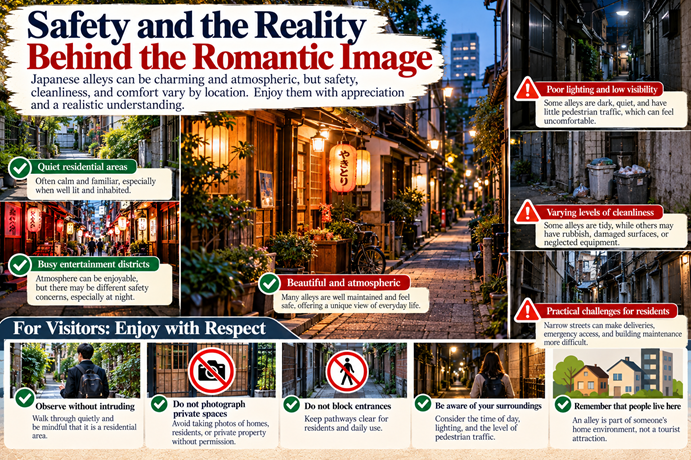
Japanese alleys are sometimes described as places where people can wander freely, even at night. Some residential lanes do feel calm and familiar, and a person may find the atmosphere reassuring. But safety varies by location, lighting, visibility, traffic, time of day, and the presence of other people. It would be inaccurate to suggest that every Japanese alley is safe simply because it is in Japan.
A narrow route can have advantages and disadvantages. In a residential area, nearby homes may make a lane feel inhabited, and people may recognize regular activity around them. In another location, a lack of lighting, limited visibility, or little pedestrian traffic may make the same kind of space feel uncomfortable. A busy entertainment district can also have different concerns from a quiet residential street.
Cleanliness should be treated with similar care. Some alleys are maintained by residents, businesses, or local arrangements; others may contain rubbish, damaged surfaces, or neglected equipment. The appearance of a street reflects its use, management, and resources rather than a single national habit. A tidy alley is worth appreciating, but it should not be used to claim that every Japanese backstreet is uniformly clean.
The romantic image of an alley can also hide the practical challenges of living there. Limited access may complicate deliveries or emergency response. Older buildings may require repairs, and narrow streets can create difficulties for people with mobility needs. Residents may face pressure when redevelopment changes property values or when visitors bring noise and crowds into a previously quiet area.
A more thoughtful appreciation recognizes both the beauty and the constraints. The same lane can be meaningful to residents, attractive to a passerby, and difficult to maintain. Its character is not simply a visual quality; it is the result of a place being used and managed over time.
For visitors, the basic principle is straightforward: observe without intruding. Avoid blocking entrances, looking into homes, or photographing people and private spaces without permission. If an alley appears to be a residential access route, treat it as part of someone’s home environment rather than as an attraction designed for visitors.
🪟 10. What an Alley Lets Us See—and What It Keeps Hidden
An alley can reveal many small details, but it cannot tell the whole story of the people who live there. A plant may suggest that someone enjoys gardening, but it does not explain the person’s daily routine. A bicycle may indicate how someone travels, but it does not reveal their occupation or personal history. A carefully maintained entrance shows attention to the space, but not necessarily the relationship between the household and its neighbors.
This gap between observation and knowledge is important. The mind naturally turns visible details into stories. We see a row of shoes and imagine a family returning home. We notice a light in an upstairs window and picture someone preparing dinner. We pass a small house and wonder whether its residents have lived there for decades. These imaginings can make walking more engaging, but they remain possibilities rather than facts.
The experience is not a problem to solve. In fact, part of the appeal lies in accepting that a place can be meaningful without becoming fully knowable. We do not need to learn the private histories of strangers to recognize that their lives are taking place around us. The street can prompt curiosity without requiring access.
This is where my memories of Toronto connect with the experience of walking through Japanese neighborhoods. I was interested in the lives around me precisely because I could not see everything. The alley offered a limited view, and that limit made me conscious of the distance between observing a place and belonging to it.
In Japan, the same feeling can arise when walking past ordinary homes. A resident may be watering plants, a bicycle may be parked beside a doorway, or the sound of a household activity may briefly reach the street. The scene is not necessarily unusual. Its significance comes from the fact that it belongs to a life continuing beyond the moment when a passerby notices it.
A neighborhood is made up of countless such lives. Some are visible in public spaces, while others remain entirely private. The alley brings the two closer together without eliminating the boundary between them. It allows the walker to sense the presence of other lives while leaving their independence intact.
✨ Conclusion: A Small Street, Someone’s Whole World
The culture of Japanese alleys is not only a story about architecture, traditional neighborhoods, or hidden places to eat. It is also a way of seeing how the ordinary details of a street connect with the lives of the people who inhabit it. A plant beside a doorway, a bicycle near a wall, or a narrow path between homes can make the relationship between the built environment and everyday life feel immediate.
My affection for alleys developed in part while walking through Toronto. I enjoyed leaving the main streets behind and imagining the lives of people who lived in the neighborhoods around me. Knowing that I would eventually return to Japan made those walks particularly memorable. I wondered what life was like for the people who could continue living there, and I carried those questions with me long after the walks themselves had ended.
That experience reminds me that the appeal of a small street is not limited to one country. Cities everywhere contain places where daily life becomes visible in fragments. Japan’s roji have their own histories, forms, and relationships with surrounding homes, while yokocho offer a different kind of intimacy through small businesses and social activity. Neither should be reduced to a single image of Japanese culture.
The most important distinction is between looking at a street and noticing the lives connected to it. A main road may show us how a city moves, while an alley can bring us closer to the ordinary world behind its buildings. It does not tell us everything about that world, and it should not. The people who live there are not part of the scenery; they are living their own lives.
Perhaps that is why an ordinary alley can remain in the memory. We may forget the exact route or the arrangement of the buildings, but remember the feeling of walking through a place where other lives seemed close enough to imagine and private enough to remain unknown.
A small street may be only a short passage between two larger roads. For someone who lives there, however, it can be part of an entire world.
🏘️ Continue Exploring Japan’s Neighborhoods
The culture of alleys is only one part of the everyday landscape of Japan. Utility poles, laundry, shade, vending machines, and the experience of walking through a residential neighborhood can all reveal how people use and share the spaces around their homes.
Continue exploring the Neighborhood Series to discover more about the ordinary details that shape Japanese life.
👉 The Japanese Morning Commute: A City in Motion, Almost Without Words
👉 Why Are Japanese Towns So Walkable? How Railways Shaped Everyday Life in Japan
👉 Why Do Japanese Residential Neighborhoods Feel So Quiet? The Sound of Everyday Life in Japan
👉 Why Are There Jizo Statues on Japanese Street Corners?