
🎄 Introduction: When the Nights Begin to Glow
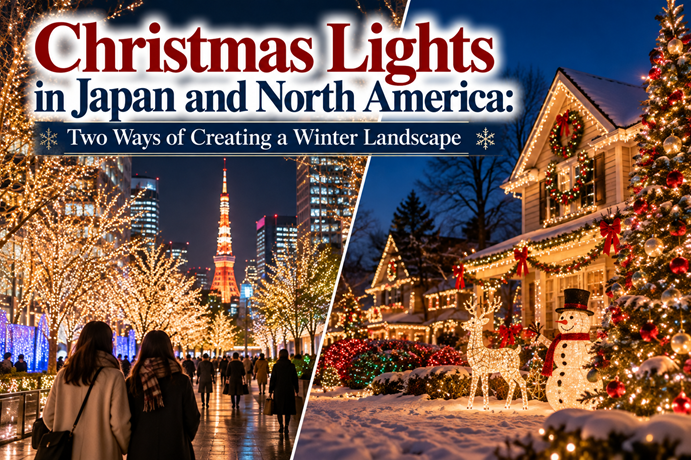
As the days grow shorter and the evenings become colder, familiar places begin to look different. Trees sparkle with tiny lights, streets take on a warmer glow, and buildings that appear ordinary during the day become part of a winter landscape after sunset. Christmas lights are among the most recognizable signs of the season, but the way people use light to transform their surroundings can reveal something surprisingly interesting about everyday culture.
In Japan, winter often brings spectacular illuminations to shopping districts, railway stations, public parks, commercial complexes, and waterfront areas. Entire streets may be lined with illuminated trees, while plazas become gathering places beneath enormous Christmas trees. Visitors walk through tunnels of light, stop to photograph glowing installations, and enjoy an evening that feels quite different from an ordinary journey through the city.
In North America, particularly in many residential communities in Canada and the United States, a different kind of winter landscape often emerges. Individual houses become part of the seasonal scenery. Rooflines are outlined in colored lights, evergreen trees glow in front gardens, wreaths appear on doors, and elaborate displays sometimes cover entire lawns. As neighboring households decorate their properties, ordinary streets can become festive places to visit.
Neither approach belongs exclusively to one region. Japan has beautifully decorated homes, and North American cities organize large-scale public illuminations. Nevertheless, the contrast between the two can be striking, especially for someone who has experienced Christmas in both places.
The difference is not simply about which country uses more lights or which decorations look more impressive. It is about where the lights appear, who creates the atmosphere, how people experience it, and what happens when the Christmas season ends.
In Japan, a visitor can encounter an elaborate winter landscape simply by leaving a railway station and walking through a commercial district. In a North American neighborhood, the same visitor might find that the most memorable decorations are attached to individual homes, each reflecting the preferences of the people who live there.
These observations offer a starting point for a deeper cultural comparison. Rather than treating Christmas lights as a competition between countries, we can look at them as a way of understanding how people use public spaces, express personal identity, participate in community traditions, and mark the passing of the year.
Who creates the winter landscape—the city, the neighborhood, or the individual household?
The answer is not the same everywhere, and that is precisely what makes the comparison interesting.
🌃 Christmas Lights in Japan: When the City Becomes the Display
✨ What Are Winter Illuminations in Japan?
One of the most memorable features of December in Japan is the way familiar urban spaces can change after dark. A street used for commuting and shopping during the day becomes a place where people stop to admire the trees. A plaza outside a railway station turns into a meeting point beneath a large Christmas tree. A commercial district that seems ordinary in the afternoon becomes a carefully coordinated landscape of light in the evening.
These displays are commonly known as winter illuminations, or fuyu no irumineshon . The expression refers to decorative lighting displays that are especially popular during the colder months. Although many are associated with Christmas, not all are limited to the Christmas holiday itself. Some continue through January or February, treating illumination as a broader celebration of winter.
The scale of these events can be considerable. Trees may be wrapped in thousands of lights, pathways may be illuminated in coordinated colors, and installations may combine music, projections, sculptures, and interactive effects. The lights are arranged to create an environment that people can enter and experience, rather than simply a collection of decorated objects.
Consider a business district where rows of trees are illuminated along a main street. During working hours, the area may be associated with offices, deadlines, train transfers, and the steady movement of commuters. After sunset, those same trees become part of a seasonal attraction. Couples stop for photographs, friends arrange to meet beneath the lights, and families walk through the district simply to enjoy the atmosphere.
The physical location has not changed, but its meaning has temporarily expanded. It is still a place for business and transportation, yet it has also become a place for leisure, photography, and seasonal enjoyment.
This is one reason Christmas lights in Japan can feel particularly impressive to visitors from abroad. The experience is often concentrated in locations that are already accessible by public transportation. Someone can leave a station, walk a short distance, and discover an entire district transformed without needing to travel through a residential neighborhood.
🌟 From Ordinary Streets to Seasonal Landscapes
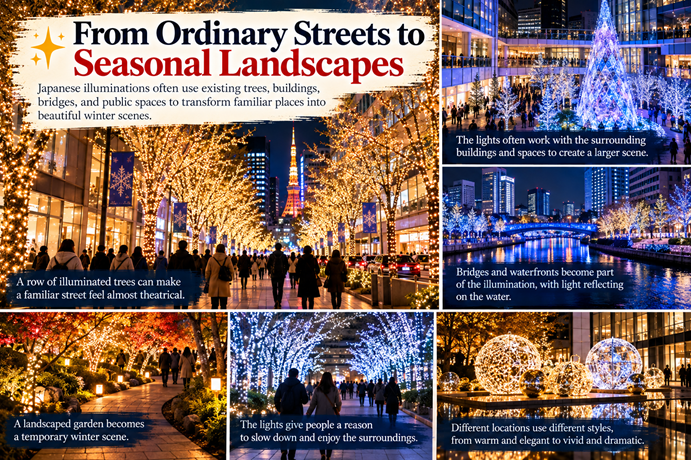
A particularly interesting aspect of Japanese illuminations is their relationship with the city that surrounds them. The displays do not always stand apart from their environment. Instead, they often use existing trees, buildings, bridges, pathways, and open spaces as part of the overall composition.
A row of illuminated trees can make a familiar street feel almost theatrical. Lights reflected on the windows of surrounding buildings can extend the visual effect, while a carefully positioned installation may create a focal point that encourages people to stop and look around. The scenery develops as visitors move through it, revealing different perspectives from one part of the street to another.
This is different from simply placing a Christmas tree in a room. The entire environment contributes to the experience. A tree-lined avenue, a waterfront promenade, or a landscaped garden becomes part of a temporary winter scene.
The transformation can also change the pace at which people experience a place. During the day, pedestrians may move through a district as efficiently as possible, concentrating on their destinations. In the evening, the lights give them a reason to slow down. A route that was previously functional becomes something worth experiencing for its own sake.
For people who live nearby, this can be particularly noticeable. A street that forms part of an everyday journey suddenly becomes somewhere to take visiting friends or family. A familiar station plaza becomes a place to meet for an evening walk. The city offers a different experience without requiring people to travel far from their ordinary routines.
Not every illumination has the same character. Some use warm white or champagne-colored lights to create a restrained and elegant atmosphere, while others favor vivid colors, elaborate sculptures, or dramatic visual effects. The style depends on the location, organizer, budget, and artistic concept.
What many prominent displays share is an emphasis on the overall scene. Individual trees and installations contribute to a larger visual environment, and the arrangement of light is often as important as the decorations themselves.
🏙️ Why Are Illuminations Often Found in Commercial Districts?
Japan’s railway stations and commercial districts provide natural settings for large seasonal displays because they already bring together large numbers of people. Shopping, dining, commuting, and meeting friends often take place in the same areas, making an illumination accessible to people with different reasons for visiting.
A display near a major station can become part of an ordinary evening rather than a special excursion. Someone finishing work may walk through the lights on the way to dinner, while another person may deliberately visit the district to take photographs. Families, couples, tourists, and local residents can all enjoy the same space without necessarily sharing the same purpose.
The display can also contribute to the identity of a district. A commercial area may become known for its winter lighting, attracting visitors who might not otherwise have a reason to explore it in the evening. Nearby restaurants, shops, and cafés may benefit from the additional activity, although the commercial effects differ from one event to another.
This does not mean every Japanese illumination is primarily a marketing project. Public authorities, local organizations, businesses, designers, and community groups may all play different roles in organizing seasonal displays. Some events are closely connected to tourism, while others emphasize local identity, artistic presentation, or remembrance.
The important point is that a prominent illumination often creates a shared destination. People do not have to decorate their own properties to participate in the seasonal atmosphere. They can simply visit a place that has been transformed for everyone to enjoy.
🌎 Christmas Lights in North America: When the Neighborhood Becomes the Display
🏡 The Christmas Landscape Begins at Home
In many parts of Canada and the United States, Christmas lights can be experienced in a more residential setting. Rather than concentrating only on commercial districts and public attractions, decorations often begin at the front of individual homes.
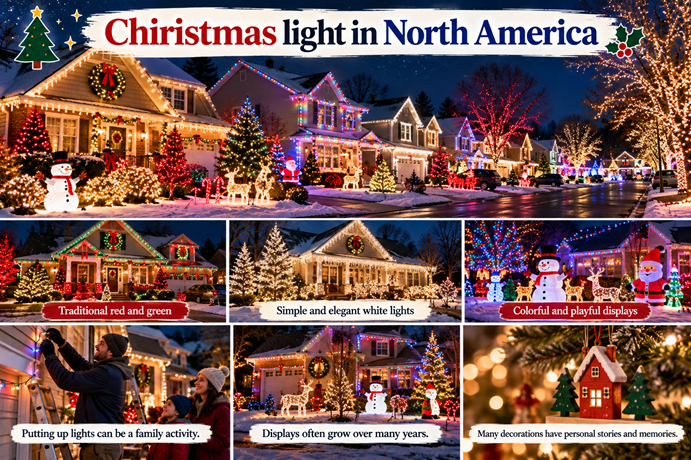
A family might outline its roof with white lights, place illuminated figures beside the front door, decorate an evergreen tree in the garden, or hang lights along a porch railing. Another household might choose a quieter arrangement, with a wreath, a few strings of warm lights, and candles or lamps in the windows. Further down the street, someone else might create a much more elaborate display featuring multiple colors, moving figures, or synchronized music.
As these individual choices accumulate, the neighborhood itself takes on a festive character. No single household needs to decorate an entire street. Each family contributes a small part of the landscape, and the combined effect can be surprisingly extensive.
For someone walking or driving through a residential neighborhood in December, the experience is different from visiting a large illumination event. The decorations are attached to places where people actually live. Behind the lights are front doors, garages, driveways, gardens, and windows that offer glimpses of ordinary domestic life.
The landscape may be less visually uniform than a professionally designed installation, but that variety is part of its character. One home may be understated, the next playful, and another almost theatrical. A neighbor’s display might be traditional and symmetrical, while a different household prefers cartoon characters, oversized ornaments, or a deliberately humorous arrangement.
The decorations communicate something about individual taste. They also make the neighborhood itself feel different, even when the houses and roads remain unchanged.
🎅 Every House Can Tell a Different Story
One of the most appealing aspects of residential Christmas lights is that each home can express its own personality. A household may choose traditional red and green decorations, while another prefers a display made almost entirely of white lights. Some families decorate carefully every year, while others add something new whenever they find an ornament they particularly like.
The result is not always visually perfect. Lights may hang unevenly, decorations may be old-fashioned, and a display may grow gradually over several years rather than being planned as one complete design. Yet these details can contribute to a sense that the decorations belong to the people who live there.
A particular figure might have been purchased when the children were young. A string of lights may have been used for many winters and repaired rather than replaced. A family might have a tradition of adding one new decoration every year, gradually building a display that reflects its history.
For some households, putting up Christmas lights is itself an important seasonal activity. Adults may work outside in the cold to attach lights to the roof, children may help choose decorations, and family members may debate whether to use white lights or colored ones. The activity can become part of the ritual that marks the beginning of the holiday season.
These traditions are not universal, and the level of participation varies considerably. Some households decorate extensively, while others do very little or do not celebrate Christmas at all. Nevertheless, residential decorations are a familiar and highly visible feature of the season in many North American communities.
🚗 Discovering Christmas Lights on an Ordinary Evening
Residential Christmas lights can also change the way people move through their neighborhoods. Families may take an evening drive to see decorated houses, walk along streets known for elaborate displays, or visit a particular home that has become popular with local residents.
In these situations, the decorations create a shared experience without changing the fundamental character of the place. The street remains residential, and the houses remain private homes, but the lights give people a reason to pay attention to their surroundings.
A family might drive through a familiar neighborhood and discover that several homes have added decorations since the previous weekend. Children may look forward to seeing a particular display, while adults may appreciate the creativity or effort involved. A house that would normally pass unnoticed becomes a seasonal landmark.
Some homeowners create displays that attract visitors from outside the immediate area. Lights may be synchronized with music, elaborate figures may fill the front garden, or an entire property may be decorated around a particular theme. In some communities, these displays become informal attractions that people return to every year.
Yet the appeal of residential lights does not depend entirely on spectacular displays. A few lights around a doorway can make a street feel welcoming, while a simple illuminated tree can provide a pleasant view for people passing by.
This is an important difference in emphasis. A major Japanese illumination often transforms a designated destination into a coordinated visual experience. In a North American residential neighborhood, the scenery can emerge through many small decisions made by the people who live there.
🌱 Public Space and Private Space: Two Different Starting Points
🏙️ One Landscape Is Planned as a Shared Experience
The contrast between Japanese illuminations and North American residential decorations becomes clearer when we consider the distinction between public and private space.
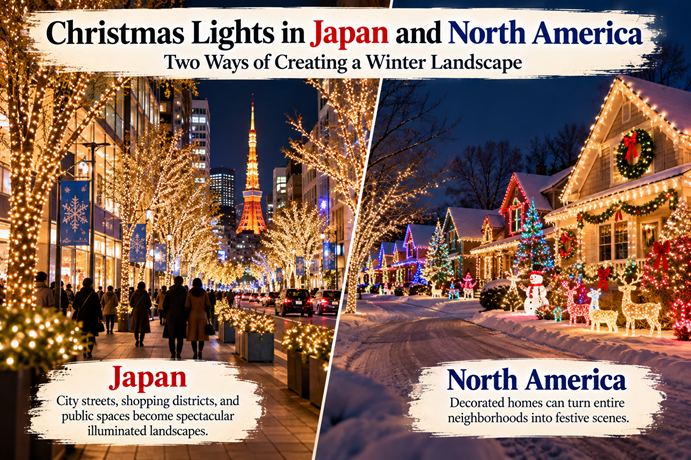
In Japan, some of the most prominent Christmas displays occupy places used by large numbers of people. Shopping streets, station plazas, public parks, waterfronts, and commercial complexes become seasonal destinations. The display is often planned as a unified experience, and visitors encounter it as part of the city.
The organizers may determine the location of the lights, the visual theme, the route visitors follow, and the placement of major installations. The result is a coordinated environment that can be enjoyed by people who have no involvement in its creation.
Visitors generally participate by walking through the area, taking photographs, meeting friends, or enjoying nearby shops and restaurants. They do not need to know who designed the installation or who is responsible for maintaining it. The experience is available to them simply because the city or the event organizer has created it.
This model makes it possible for a large number of people to share the same seasonal scenery. A visitor may arrive alone, with a partner, or with a group of friends, but the surrounding landscape is common to everyone.
🏡 The Other Landscape Grows Through Individual Choices
In many North American residential communities, decorations begin with individual homes. A family decides how to decorate its property, and neighboring households make their own decisions. The street becomes festive through the accumulation of these separate contributions.
This approach does not necessarily produce a single visual theme. Instead, the character of the neighborhood develops through variety. Each house can contribute something different, and the overall atmosphere emerges from the combination.
The distinction is not that Japanese people are uninterested in decorating their homes, or that North Americans do not enjoy public displays. Both societies have decorated houses, municipal festivals, shopping-center displays, and privately organized events. The difference is better understood as one of emphasis and visibility rather than an absolute national division.
Imagine two winter evenings. On the first, you leave a railway station in Japan and walk along a street lined with illuminated trees. The lights are coordinated, the surrounding buildings reflect their glow, and people gather at designated viewpoints to take photographs. The city has provided a temporary setting for everyone to share.
On the second, you walk along a residential street in Canada. One house has white lights along the roof, another has a colorful display in the front garden, and a third has only a wreath on the door. The scenery is created by individual households, each contributing according to its preferences.
Both experiences can be beautiful, but they invite different kinds of attention. The first encourages you to appreciate the composition of a larger space. The second encourages you to notice the differences between households and the personality of a neighborhood.
🤝 Does One Approach Create a Stronger Sense of Community?
At first glance, public illuminations might appear more communal because they bring large numbers of people into the same place. Residential decorations might appear more individual because each household chooses its own style. However, this contrast becomes more complicated when we consider what people actually do.
A public illumination creates a shared experience through access. People who have never met can walk beneath the same lights, stop at the same tree, and take photographs in the same location. The event provides a common setting without requiring visitors to know one another or contribute to the installation.
Residential decorations create a shared experience through visibility and participation. A household’s choices become part of a street that other people can enjoy, and neighbors can contribute to a collective atmosphere without coordinating every detail.
The first form of community is often temporary and open to a broad audience. The second can develop gradually through repeated encounters in a familiar place.
Neither model guarantees stronger social relationships. A crowded illumination event may be enjoyed anonymously, and a decorated neighborhood may contain people who barely know one another. Nevertheless, both demonstrate how seasonal lighting can make ordinary spaces feel shared.
The most useful distinction is therefore not between collective Japan and individualistic North America. It is between different ways of arranging opportunities for people to participate in seasonal scenery.
✨ Why Japanese Illuminations Feel Like Carefully Designed Experiences
🌳 Light Changes the Way We See Familiar Places
Japan’s urban illuminations often have a strong visual identity. A district may choose a particular color palette, a garden may use light to emphasize the shapes of trees, or a commercial complex may create an installation around a seasonal theme. These choices can make an entire area feel like a temporary work of design.
Part of the appeal comes from the relationship between light and the existing cityscape. Illumination designers are not working with a blank canvas. They must consider trees, buildings, pathways, bridges, plazas, and the way people move through the space. A display can change how those elements are perceived without physically altering them.
A row of trees, for example, may become the central feature of a street once the branches are illuminated. A building’s exterior can appear warmer or more dramatic when the lighting around it changes. Reflections on water may extend the visual effect beyond the original installation.
The design can also influence how people move. A line of lights may draw visitors forward, while a large tree or sculpture creates a natural stopping point. Brighter areas invite attention, and quieter sections offer a different atmosphere. In a well-planned display, the visitor experiences a sequence of views rather than a collection of unrelated decorations.
This emphasis on composition helps explain why some Japanese winter illuminations are popular even among people who are not especially interested in Christmas. The attraction can be understood as an evening landscape, an art installation, or a seasonal transformation of the city.
🌉 Yokohama: A Winter Landscape Beyond One Christmas Tree
Yokohama offers a useful example of how urban illumination can extend beyond a single decorated tree. The city’s winter events have included lighting along streets and waterfront areas, displays around commercial buildings, and installations in different parts of the city.
The waterfront is particularly interesting because light interacts with the surrounding architecture and open spaces. Illuminated buildings can be reflected in the water, while the broad views of the harbor create a sense of distance that is different from a narrow shopping street. The result can be a winter landscape in which the city itself becomes part of the display.
Individual events and schedules change from year to year, but the broader pattern is worth noticing: different locations can participate in a shared winter atmosphere while maintaining their own character.
For official visitor information, see the Yokohama winter illumination information.
It would be a mistake, however, to conclude that every Japanese display is restrained or artistically sophisticated. Some are commercial, some are extravagant, and some may look more impressive in promotional photographs than they do in person. Japanese illumination culture includes a wide range of styles, from subtle lighting that complements a landscape to elaborate installations designed to attract attention.
The important point is that many prominent displays are experienced as coordinated environments. Their visual effect comes not only from the number of lights but from the way they are arranged in relation to the surrounding space.
🎅 Christmas in Japan: A Different Kind of Holiday
🍰 A Season That Can Be Enjoyed Without a Religious Celebration
The meaning of Christmas provides essential context for understanding the different forms of decoration.
In Japan, Christmas is widely visible in shops, restaurants, public spaces, advertisements, and popular culture, but it is not generally observed as a national religious holiday in the same way that it is in many Christian-majority countries. Christmas Day is not a Japanese public holiday, and December 25 is usually a normal working or school day unless it falls on a weekend or coincides with an individual institution’s schedule.
For many people, Christmas in Japan is primarily a seasonal and largely secular occasion. Christmas trees, cakes, gift exchanges, special meals, romantic dates, and winter illuminations are familiar features of the period, although individual households differ in how they celebrate.
The holiday has developed a distinct local character. Some people associate Christmas Eve with a romantic evening, while others enjoy a meal with family or friends. Children may look forward to presents, and shoppers encounter seasonal products in department stores and supermarkets. None of these practices describes everyone, but together they contribute to Christmas’s visible place in contemporary Japanese life.
This context helps explain why public illumination events can become so prominent. A person does not need to observe Christmas as a religious festival to appreciate the atmosphere created by illuminated trees and streets. The lights can be enjoyed as part of winter leisure, urban entertainment, or a seasonal outing.
🌎 Christmas in North America Has Many Different Meanings
The comparison with North America should still be made carefully. Canada and the United States contain people from many religious and cultural backgrounds, and not every household celebrates Christmas. Even among those who do, the holiday may be religious, secular, family-centered, social, or a combination of these.
Nevertheless, Christmas has a well-established role as a major holiday period in many North American communities. For many families, the season includes decorating the home, preparing for gatherings, exchanging presents, and spending time with relatives. Residential decorations fit naturally into a holiday that often extends into domestic life.
This broader context can influence where decorations are concentrated. In Japan, a public display can provide much of the seasonal atmosphere for people who do not plan elaborate celebrations at home. In North America, home decorations may be one part of a wider domestic holiday routine.
The relationship is not a simple cause and effect. Public illuminations in Japan have also developed through commercial investment, urban planning, technology, and local traditions. Residential lights in North America are shaped by housing, consumer culture, climate, family habits, and many other factors. Religion alone cannot explain the difference.
What matters is that the lights exist within different seasonal settings. A decoration does not have a fixed cultural meaning independent of the place where it appears. The same illuminated tree may be a public attraction in one setting and part of a family’s private celebration in another.
🎍 December 25 and the Remarkable Transition to New Year
🔄 When Christmas Decorations Give Way to New Year
One of the most revealing differences between Japan and North America is what happens after Christmas.
In Japan, the transition from Christmas to New Year can feel remarkably quick. A shopping center that displayed Christmas trees and Santa Claus figures may soon replace them with decorations associated with the New Year. Seasonal packaging changes, shops begin promoting traditional foods, and the atmosphere shifts toward oshōgatsu (お正月), the Japanese New Year holiday.
This is not simply a matter of removing decorations. The end of December is a major cultural transition. Many people prepare for the year ahead by cleaning their homes, completing work before the holiday period, arranging travel to see family, buying special foods, or planning visits to shrines and temples. The precise customs differ among households, but New Year has a significance that Christmas does not generally hold for the population as a whole.
As a result, Christmas decorations may disappear soon after December 25, even though some winter illuminations continue into January or beyond. The Christmas-specific atmosphere can end while the broader season of winter lighting remains.
This distinction is important. It would be inaccurate to say that all Japanese illuminations switch off immediately after Christmas. Many events are explicitly planned to continue through the winter, and some change their theme after December 25. The transition is often about the meaning and presentation of the season, not necessarily the disappearance of every light.
🎄 Why Christmas Lights May Remain in North America
In North America, Christmas decorations frequently remain in place after December 25. Some households remove them shortly after the holiday, while others leave them up through the end of the year or into early January. In many communities, the period between Christmas and New Year continues to feel like part of the same holiday season.
This difference can be striking to someone who has experienced both countries. In one place, the visual language of Christmas may be replaced quickly by the language of New Year. In another, Christmas lights may remain visible during the quieter days after the main celebration, when families are visiting relatives, relaxing at home, or preparing to return to ordinary routines.
The timing reflects more than decoration preferences. It reflects the position Christmas occupies within each society’s calendar.
For many people in Japan, New Year is the central traditional holiday of the season. Christmas is visible and enjoyable, but it leads into a celebration with a different history and a deeper connection to longstanding Japanese customs.
In North America, Christmas itself is often a central event in the holiday calendar. New Year is important too, but its traditions and social meaning differ from the family gatherings, gift exchanges, and religious observances associated with Christmas.
The lights therefore tell a story about time as well as space. They reveal not only where a society chooses to create a festive landscape but also how long that landscape belongs to a particular celebration.
🏘️ Homes, Neighborhoods, and Everyday Life
🪟 A Decoration Can Become Part of the Street
Residential Christmas lights are interesting because they blur the boundary between private life and shared space. A house belongs to the people who live there, but its decorations can be seen by everyone passing along the street.
A family may decorate its property for personal reasons: to celebrate Christmas, create a festive atmosphere for children, welcome relatives, or maintain a tradition. Yet the result extends beyond the household. Neighbors see the lights, pedestrians enjoy them, and visitors may deliberately travel to the area.
The home remains private property, but its appearance contributes to a collective landscape.
This does not mean that every decorated house is intended to attract an audience. Many displays are simply part of a family’s own celebration. The fact that others can enjoy the lights is a consequence of their visibility rather than necessarily the main purpose of the decoration.
The same principle applies to more modest displays. A wreath on the door, a string of lights around a window, or a small illuminated tree may be enough to make a house feel different from the rest of the year. The effect is not determined only by scale.
🚶 When the Lights Become Part of an Ordinary Route
In a residential neighborhood, people may encounter Christmas lights without planning a special outing. They might pass a decorated home while walking a dog, going to the supermarket, or returning from work. The scenery becomes part of the background of the season.
This differs from the experience of visiting a major illumination event, where people often go specifically to see the display. A large installation can be memorable because of its scale, design, or dramatic effect. A residential display may be memorable because it belongs to a familiar street or forms part of a repeated seasonal routine.
One experience is often framed as an outing. The other can become part of everyday life.
The contrast also affects how people remember the lights. Someone may remember a Japanese illumination because of the enormous tree in the center of a plaza or the way a waterfront looked after sunset. Someone else may remember a North American neighborhood because a particular family decorated its house every December, year after year.
Neither experience is inherently more meaningful. They simply connect memory to place in different ways.
🤲 Respecting the Difference Between a Display and a Home
There is one practical point worth remembering when visiting residential Christmas displays. A house that looks like an attraction is still someone’s home.
Visitors should respect privacy, avoid blocking driveways, follow parking rules, and remain in public areas unless they have been invited onto the property. Taking photographs of the decorations from a public street is different from entering someone’s garden or approaching windows.
This distinction reinforces one of the cultural themes of the comparison. Public illuminations are generally arranged for visitors, whereas residential decorations exist within private life, even when they are visible to the wider community.
The enjoyment of the lights does not remove the need to respect the people who created them.
🌟 Are Japanese Illuminations More Beautiful Than North American Christmas Lights?
🎨 Beauty Depends on What You Want to Experience
It is tempting to compare the two traditions by asking which country has the better Christmas lights. The question is understandable, especially when one place offers enormous public installations and another offers elaborate residential displays.
However, the answer depends on what someone wants to experience.
If you enjoy coordinated lighting, carefully planned visual compositions, and the transformation of a city after dark, Japanese winter illuminations can be extraordinary. They allow visitors to experience light on a large scale, often in locations that are easy to reach by public transportation. The surrounding architecture, trees, and streets become part of the display.
If you enjoy individual creativity, neighborhood character, and the personal details of family traditions, residential Christmas lights in North America can offer something different. Each house provides a small expression of taste, and the overall scenery develops through variation rather than uniformity.
The comparison is not between professional quality and amateur quality. Many North American cities organize impressive public displays, and many Japanese households decorate their homes. Both countries contain a wide range of approaches.
Nor is the difference simply about how many lights are used. A relatively restrained display may be more effective than an enormous one if it suits the surrounding landscape. A colorful residential garden may feel more inviting than a polished installation to someone who values personality and familiarity.
✨ Different Landscapes Create Different Emotions
Beauty also depends on context. Warm lights against bare winter branches can feel elegant in a quiet street. A brightly colored display may be joyful in a family neighborhood. Reflections on water can create a sense of calm, while a busy plaza filled with music and movement can feel energetic and festive.
These experiences are not interchangeable, and they do not need to compete.
A useful way to compare the traditions is to ask what each setting makes possible. Japanese urban illuminations can make a shared public space feel extraordinary. North American residential lights can make the places where people live feel festive and expressive.
One approach often emphasizes the visual transformation of a larger environment. The other often emphasizes the contribution of individual households to a familiar environment.
Both can be beautiful because they create different relationships between light, place, and people.
🌱 What These Winter Landscapes Reveal About Culture
🌏 Beyond the Stereotype of Collective Japan and Individualistic North America
The contrast between Christmas lights in Japan and North America is useful precisely because it should not be treated as a simple national personality test.
It would be too easy to say that Japan prefers collective experiences while North America values individual expression. Such a statement may sound convincing, but it reduces complex societies to a convenient stereotype. Japanese households decorate their own homes, North American cities create coordinated public events, and people in both places enjoy a mixture of individual and shared experiences.
A more revealing question is how different forms of seasonal decoration fit into the environments where they are most visible.
In Japan, dense urban districts, major railway stations, commercial centers, and public spaces provide natural locations for displays that many people can visit. An illumination can become part of a district’s identity and attract visitors without requiring every household to decorate its own property.
In many North American residential communities, detached houses, front yards, porches, and visible rooflines provide opportunities for household decoration. The street itself can become a canvas on which individual contributions accumulate.
These are practical and historical factors as well as cultural ones. Housing patterns influence what can be decorated. Transportation affects how people reach seasonal attractions. Commercial investment determines where large displays are installed. Climate influences the types of outdoor decorations that are practical and how long they can remain in place.
Cultural meaning emerges through the interaction of these conditions rather than from a single national trait.
🏠 Public Space and Private Space as Cultural Clues
The distinction between public and private space offers a useful lens through which to view other aspects of daily life. A public setting can provide a shared experience for people who do not know one another, while a home can express personal habits and preferences. Seasonal decorations make this relationship visible because they temporarily alter the appearance of places that people use throughout the year.
In Japan, an illuminated street may become a place where strangers share a moment of enjoyment. The display does not need to represent a common religious belief or family tradition. It creates a common experience through the use of public space.
In a North American neighborhood, a decorated home can contribute to a shared atmosphere while retaining its personal character. The decorations may be chosen by one household, but their visual effect extends beyond the property line.
Neither model is completely public or completely private. Each combines individual decisions, shared spaces, and wider social expectations in a different way.
The timing of the decorations adds another layer. Japan’s rapid shift from Christmas to New Year illustrates how different celebrations can occupy distinct places in the seasonal calendar. North American Christmas lights that remain visible after December 25 demonstrate how the holiday atmosphere can continue beyond the main day itself.
The lights are therefore more than decoration. They are a visible expression of how people use space, mark time, and create opportunities for shared enjoyment.
🚶 Experiencing Both Traditions With Fresh Eyes
👀 What to Notice in Japan
If you experience winter in Japan, try looking beyond the most famous illumination sites. Notice how lights change the atmosphere of a familiar station plaza, shopping street, or row of trees. Consider whether the display feels like an attraction in its own right or an extension of the neighborhood around it.
Pay attention to how people use the space. Some may arrive specifically to see the lights, while others encounter them on the way home from work. Friends may gather to take photographs, couples may arrange an evening walk, and families may stop to enjoy a seasonal outing.
Notice what happens after December 25, when some Christmas decorations disappear but winter lighting continues. The transition can reveal how Christmas and New Year occupy different places in Japan’s seasonal calendar.
These details are often more revealing than the size of the display. They show how the lights become part of everyday urban life and how people incorporate seasonal experiences into their ordinary routines.
🏡 What to Notice in North America
In North America, take time to notice residential streets as well as major public displays. Look at the differences between houses, the small details in front gardens, and the ways decorations reflect individual preferences.
A modest display can reveal as much about the character of a neighborhood as a spectacular one. The lights may be connected to family traditions, personal taste, or the simple desire to make a home feel festive. The process of decorating may matter as much as the finished result.
Also notice how the neighborhood changes as more houses begin to participate. A single decorated home may stand out, while a street with many different displays can become a seasonal landscape in its own right.
The experience is not necessarily about visiting a destination. It may be about seeing familiar places differently because the people who live there have chosen to decorate them.
💡 Look Beyond the Lights Themselves
In both places, remember that the visible decorations represent only part of the story. Behind a public illumination are the people who designed, installed, funded, and maintain it. Behind a decorated house are the residents who decided to participate, selected the lights, and made time to put them up.
The same landscape can also mean different things to different people. A visitor may see a beautiful photograph, a commuter may enjoy a pleasant change on the way home, and a local resident may associate the lights with a familiar annual routine. The physical display is shared, but the experiences are personal.
This is one reason comparisons between cultures are most useful when they move beyond simple lists of differences. It is easy to notice that two places decorate differently. It is more interesting to ask what those differences reveal about how people relate to their homes, their neighborhoods, their cities, and the passing of the year.
Christmas lights make those relationships visible in a way that is easy to appreciate. They require no specialist knowledge, and people do not need to agree about the meaning of Christmas to enjoy them. A person can simply walk through an illuminated street or admire a decorated home and still begin to notice the cultural context surrounding the experience.
🌌 Conclusion: Two Ways of Making Winter Feel Special
Christmas lights transform the darkness of winter, but they do more than make streets and houses look festive. They reveal how people use the places around them to create seasonal experiences.
In Japan, prominent winter illuminations often turn public streets, commercial districts, gardens, and waterfronts into coordinated landscapes. The lights create destinations where people can gather, take photographs, and enjoy a temporary transformation of the city. Many displays also continue beyond Christmas, becoming part of the wider winter season.
In North America, residential Christmas decorations are a familiar feature of many communities. Individual homes contribute their own colors, shapes, and styles to the neighborhood, creating a landscape that can feel personal and varied. The tradition often includes the process of decorating as well as the pleasure of looking at the finished result.
These patterns are not absolute, and neither country can be reduced to a single style. Yet the contrast offers a useful way to understand how seasonal scenery can be created through different combinations of public planning and private participation.
Perhaps the most interesting question is not which country has the brighter lights or the more beautiful displays. It is who creates the landscape and how other people become part of it.
A city can create a shared winter experience by illuminating the streets that everyone uses. A household can contribute to a neighborhood by decorating the place where its members live. Both approaches transform familiar surroundings and invite people to see ordinary spaces differently.
When the nights grow long and the lights begin to appear, winter becomes more than a season of cold weather and shorter days. It becomes an opportunity to gather, to remember, to express personal taste, and to enjoy the places we share.
And that is what makes Christmas lights in Japan and North America so interesting: the same simple idea—bringing light into the darkness—can create two distinct, equally meaningful ways of experiencing winter.
🔗 Explore More of Japanese Culture
Christmas lights reveal how seasonal traditions can shape public spaces, residential neighborhoods, and everyday life. Continue exploring Real Japan Navigator to discover more about the customs, landscapes, and cultural perspectives that make Japan distinctive.
👉 Christmas in Japan: KFC, Strawberry Cake, Christmas Eve, and the Sudden Switch to New Year
👉 Momijigari in Japan: The Fascinating Culture of Going Out to See Autumn Leaves
👉 Japanese Chrysanthemums in Autumn: 7 Fascinating Stories Behind Japan’s Seasonal Culture
👉 Japan’s Rice Harvest: Golden Rice Fields, Autumn Landscapes, and the Culture of Harvest