
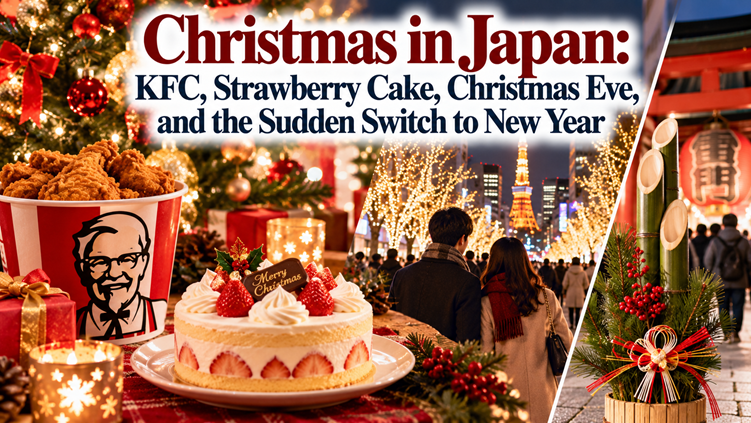
🇯🇵🇺🇸 Japan vs. the United States: How Christmas Feels Different
| Christmas | 🇯🇵 Japan | 🇺🇸 United States |
|---|---|---|
| Main Christmas moment | Christmas Eve often has a strong social and romantic atmosphere, especially among younger people; families and friends also celebrate together | Christmas Day is generally the central family holiday |
| Who people spend it with | Couples, family, or friends depending on age, relationship, and household | Family and extended family are often at the center |
| Public holiday | December 25 is not a national holiday | Christmas Day is a federal holiday |
| Religious meaning | Mostly a secular seasonal celebration for the broader population, alongside Christian religious observances | Strong Christian meaning for many families, combined with secular, family, and commercial traditions |
| City atmosphere | Illuminations, shopping, restaurants, hotel events, Christmas markets, cakes, and special menus create a lively atmosphere | Christmas Day can be much quieter, with families staying home and many businesses closing or operating reduced hours |
| Famous food image | Fried chicken and strawberry shortcake are strongly associated with Christmas culture | Roast turkey, ham, pies, cookies, and family recipes are common, although food traditions vary by household and region |
| School and work | Christmas itself is usually a normal weekday; school winter breaks and company year-end holidays follow their own schedules | Christmas falls inside a broader holiday period for many schools and families, while workplace schedules vary by employer |
| After December 25 | The change can be remarkably fast: Christmas decorations give way to New Year decorations almost immediately | Christmas decorations and lights often remain through the end of the year and sometimes into early January |
| Overall feeling | A highly visible winter festival with strong seasonal, commercial, romantic, family, and social elements | A major family holiday with strong religious, cultural, and seasonal traditions |
At first glance, these two columns might look like they are describing completely different holidays. Yet both are called Christmas, both involve decorations, gifts, special food, family or friends, music, and a sense that the end of December is different from the rest of the year. The surprising part is not that Japan celebrates Christmas differently.
The surprising part is just how completely a Christian holiday has been absorbed into Japanese seasonal life and transformed into something that often feels unmistakably Japanese. Christmas in Japan can mean a romantic dinner on December 24, fried chicken, strawberry cake, glowing city streets, restaurant reservations, and then, almost overnight, a complete switch to New Year. That last part may be the biggest surprise of all.
🎄 Christmas in Japan Does Not Begin With Religion
For many Japanese people, the first image that comes to mind when they hear “Christmas” is not a church service. It may be illuminated streets, Christmas songs in shopping centers, decorated department stores, cakes behind glass counters, fried chicken advertisements, or couples walking through the city on December 24. Children may think about presents, families may order special food, restaurants may prepare limited menus, and young adults may make plans with friends or romantic partners. The atmosphere can begin weeks before December 25, even though December 25 itself is not a Japanese national holiday. In other words, Christmas has become deeply visible in Japanese life without becoming a central religious holiday for most of the population.
This is what makes Christmas in Japan so fascinating. The holiday did not simply arrive as a complete package and remain unchanged. Instead, Japanese society took an imported celebration and gradually gave it new meanings, new foods, new commercial traditions, and a different place in the calendar. The result is not quite an American Christmas, not quite a European Christmas, and not simply a religious celebration. It is its own cultural mixture, built from global influences and Japanese habits.
That does not mean Christian Christmas has disappeared in Japan. Churches and Christian communities certainly celebrate Christmas religiously, and there are Japanese Christians for whom the religious meaning is central. But for the wider population, Christmas is more often encountered as a seasonal and cultural event. This distinction is essential. Japan did not simply convert Christmas into a fake holiday. It created a different social meaning around it.
❤️ Why Does Christmas Eve Feel So Important in Japan?
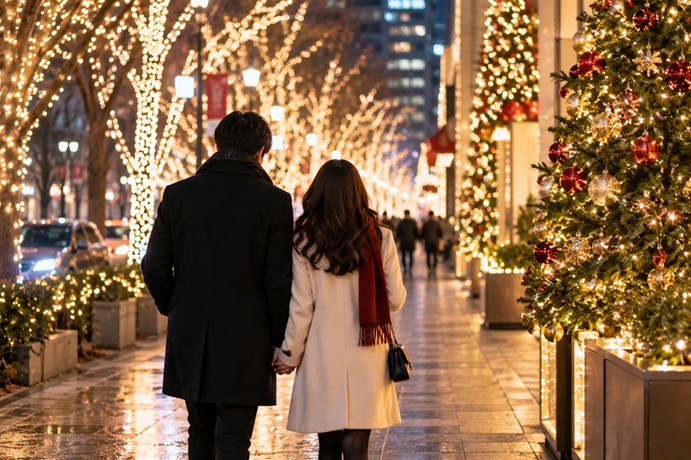
One of the first things an American visitor may notice is that December 24 can feel more important in Japan than expected. Among younger people especially, Christmas Eve can have a strong romantic association. Couples may plan a dinner, visit an illuminated street, stay at a hotel, exchange gifts, or make other special arrangements. Restaurants can offer Christmas menus, hotels can advertise special packages, and popular destinations may become particularly busy that evening. For people who grew up with this pattern, there is nothing especially strange about treating Christmas Eve as a date night.
At the same time, this is not the whole story. Married couples and families may spend Christmas together, friends may organize parties, and some people simply treat the evening as another December night. The image of “Japanese Christmas equals couples” is a cultural stereotype, not a description of every household. What matters is that Christmas Eve has acquired a strong social role in Japan that is not necessarily identical to its role in the United States.
In America, Christmas Eve is certainly important, but the center of gravity often shifts toward the family celebration surrounding December 25. Children may prepare for Santa Claus, families may attend church, relatives may travel to be together, and Christmas Day becomes the major shared holiday. In Japan, the romantic and social energy of the evening of December 24 can be much more visible in public spaces. The difference is not simply who celebrates Christmas. It is when the holiday feels most socially concentrated and what kind of social activity is associated with it.
🏙️ In Japan, Christmas Goes Outside
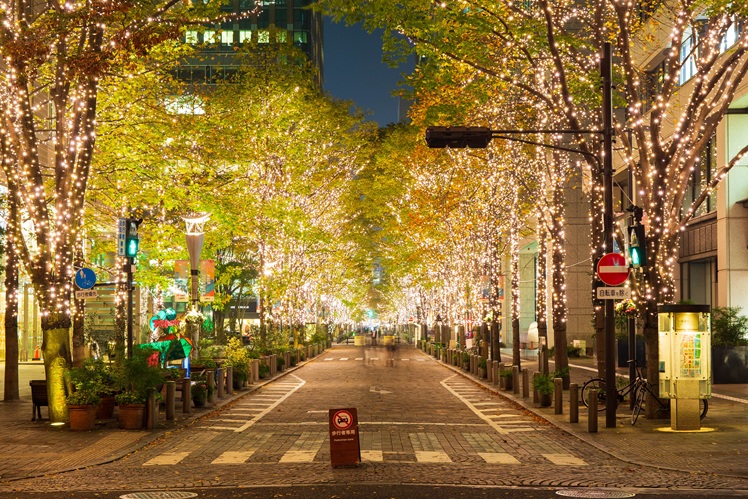
This may be one of the biggest visual differences. During the Christmas season, Japanese cities can become extremely decorative. Department stores, shopping centers, restaurants, hotels, parks, office buildings, and streets may use illumination displays, Christmas trees, ornaments, music, and seasonal signs to create a festive atmosphere. People go out to see the lights, take photographs, eat special meals, shop for gifts, and enjoy the feeling that the city has been temporarily transformed.
In my experience, this creates a striking contrast with Christmas in America. I remember being surprised by how quiet the streets could become on Christmas Day. In Japan, I was accustomed to thinking of Christmas as one of the most visibly decorated and active times of December, so seeing large numbers of shops closed or operating on limited hours, with streets becoming unexpectedly quiet, felt almost like the opposite of what I expected. The difference made me realize that the physical location of Christmas can be completely different from one culture to another.
In Japan, Christmas can pull people outward. They go to illuminated streets, restaurants, shopping districts, hotels, cafés, parks, and entertainment areas. In America, Christmas often pulls people inward, toward the family home or another private gathering. Of course, American cities also have spectacular lights and busy Christmas markets, and some restaurants remain open, while some Japanese people stay home with family on Christmas. Still, the contrast in overall atmosphere can be striking.
The difference is almost like this: Japan often turns Christmas into a city event, while American Christmas often turns the home into the main event.
🍗 Why KFC Became Part of Christmas in Japan
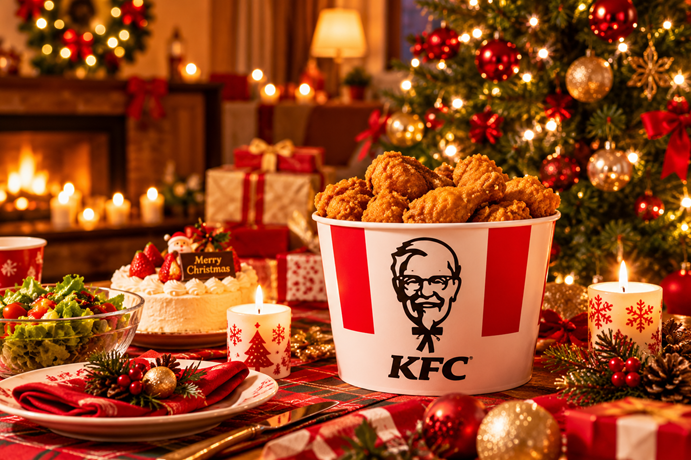
Now we reach the question that surprises almost everyone who encounters Christmas in Japan for the first time: why does fried chicken have such a strong connection with Christmas?
The answer is not that Japanese people have some ancient tradition of eating chicken on Christmas. They do not. The association developed in the modern era through advertising, restaurant marketing, and the gradual repetition of the idea that fried chicken could serve as a convenient and festive Christmas meal. Over time, the campaign became familiar enough that the connection moved beyond advertising. Christmas chicken became part of popular culture.
That transformation is actually more interesting than the food itself. Christmas arrived in Japan without the deeply established family food traditions that already existed in Christian countries. Japan therefore had an open space in which a new Christmas menu could develop. Fried chicken was practical, familiar, relatively easy to share, and could be packaged as a special occasion meal. Once enough people began associating it with December 24 and 25, the association became self-reinforcing. The advertisement encouraged the purchase, the purchase created memories, the memories created expectation, and the expectation made the next year’s Christmas campaign even more recognizable.
Of course, not every Japanese family eats KFC for Christmas. Many families cook at home, order other foods, eat sushi, prepare Western-style meals, or simply have an ordinary dinner. My own family did not necessarily follow the stereotypical KFC pattern either. But that is exactly why the cultural image is interesting. A tradition does not have to be universal to become part of national imagery.
The strange thing about the Japanese Christmas table is that fried chicken can feel “traditional” despite being a modern commercial creation. That tells us something important about how traditions are formed. A tradition does not always begin centuries ago. Sometimes repetition turns a relatively recent idea into something people eventually experience as normal.
🍰 Why Is Strawberry Shortcake Another Christmas Symbol?
If KFC provides the savory side of the Japanese Christmas stereotype, strawberry shortcake provides the sweet side. The familiar image is a light sponge cake covered in whipped cream and decorated with bright red strawberries, often with additional Christmas decorations such as Santa figures or miniature trees. It looks festive, but it also fits naturally into Japanese tastes for light cream, soft sponge, and visually elegant sweets.
The interesting question is why this particular cake became so closely associated with Christmas. Again, the answer lies partly in the way Japan adapted Western-style food into its own confectionery culture. Japanese pastry companies and cake shops helped turn Christmas cake into a seasonal product, and over decades the image became normalized. The cake was not inherited unchanged from European Christmas traditions. It became part of a specifically Japanese Christmas vocabulary.
This creates a fascinating parallel with fried chicken. Japan did not simply copy an existing Western Christmas meal. It selected foods that could fit Japanese retail, dining, family, and gift-giving habits, then gradually attached them to the holiday. As a result, a person can see a bucket of fried chicken and a strawberry-covered cake in December and immediately think, “Christmas,” even though neither item is a universal feature of traditional Christian Christmas cuisine.
That is one of the most revealing things about Christmas in Japan: the holiday is recognizable not only through its original history, but through the objects Japan has chosen to associate with it.
🦃 What Does an American Christmas Table Look Like?
The contrast with the United States becomes especially interesting at the dinner table. Turkey is one of the foods many people outside America immediately associate with American holidays, although the reality is more varied than the stereotype. Families may prepare turkey, ham, roast meats, regional dishes, casseroles, pies, cookies, or recipes inherited from grandparents and great-grandparents. Religious background and family origin can make a major difference, so there is no single American Christmas menu.
But when you sit down to an American holiday meal, there is often a different sense of continuity behind the food. Family recipes may return every year. Relatives may travel long distances to eat together. Certain dishes exist because a grandmother made them, because the family has always served them, or because they belong to a particular regional tradition.
That is one reason roast turkey can feel different from Japanese Christmas chicken. The difference is not simply fried versus roasted. It is the history attached to the meal. One has become a relatively recent national commercial symbol of Christmas in Japan, while the other can be part of a longer family and holiday tradition in the United States. Both can be delicious, both can create strong memories, and both demonstrate how food becomes connected to a festival through repetition.
🎁 Christmas in Japan Can Feel Surprisingly Commercial
There is another reason the Japanese version can look unusual to foreigners. Christmas is highly visible in stores and restaurants, and the commercial atmosphere can become intense. Department stores sell special gifts, bakeries promote Christmas cakes, restaurants offer limited menus, hotels create seasonal packages, and illumination events turn public spaces into temporary winter attractions.
Again, Japan is certainly not unique in commercializing Christmas. American and European Christmas culture is also deeply connected to shopping, gifts, decorations, advertising, and seasonal consumption. The difference is more about the balance of meanings. In Japan, where the religious framework is less central for the broader population, the commercial and seasonal aspects can become especially prominent. The holiday can function almost like a winter festival whose vocabulary happens to come from Christmas.
That is why a foreign visitor may encounter Christmas everywhere in Japan even without encountering much Christianity. A shopping mall can feel intensely Christmas-like without having any religious setting at all. A restaurant can offer a Christmas course without discussing religion. A city can install enormous illumination displays without the event having anything to do with worship.
The symbols have moved beyond their original context.
⛪ Why the Religious Difference Matters
The contrast should not be simplified into “America is religious and Japan is not.” The United States is religiously diverse, many Americans celebrate Christmas mainly as a cultural or family holiday, and many American families do not observe the holiday in identical ways. Likewise, Christians in Japan celebrate Christmas religiously, and some Japanese people participate in church services and other explicitly Christian traditions.
The more useful comparison is the social position of Christmas in mainstream public life. In the United States, Christmas is both a major cultural holiday and a religious holiday with deep Christian roots, and the federal calendar recognizes December 25 as a holiday. In Japan, December 25 is not a national holiday, and Christmas does not occupy the same religious position in the broader population. This allows a very different kind of cultural adaptation to take place.
The Japanese Christmas can therefore emphasize romance, food, illumination, shopping, gift-giving, entertainment, and seasonal atmosphere without requiring participants to engage with Christian theology. The American version can include all of those elements as well, but for many families the religious history of the holiday remains an important part of what Christmas means.
The same word exists.
The cultural layers are different.
🏫 What About School and Work Around Christmas?
Another difference becomes visible when you look at the calendar. Japan does not treat December 25 as a national holiday, so Christmas Day can be a normal school or workday when it falls on a weekday. Japanese schools do have winter vacation, but the start date generally belongs to the broader year-end school calendar rather than being created specifically for Christmas. Many companies also continue operating until their year-end holiday period, which often begins later in December.
In the United States, Christmas falls inside a much more extensive holiday period for many people. School districts commonly schedule winter recess around Christmas and New Year, although exact dates vary considerably. Employers also differ widely. Some workplaces close for several days, some give employees Christmas and New Year’s holidays, and others remain open depending on the industry and company policy.
The important cultural difference is therefore not that every American stops working on December 20 while every Japanese person works until December 29. Reality is much more varied. It is that Christmas itself has a different place within the annual rhythm. In Japan, Christmas exists inside an ordinary working month and then gives way rapidly to the year-end and New Year period. In America, Christmas is embedded within one of the country’s most important holiday seasons.
🎄➡️🎍 The Most Japanese Part May Come After Christmas
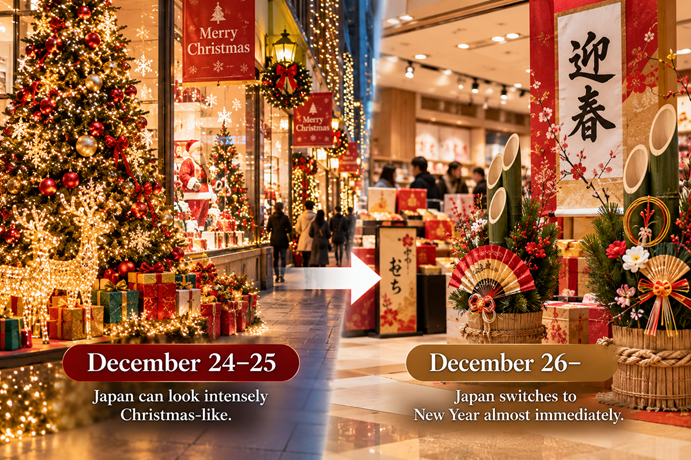
This may be the most fascinating part of the entire article.
On December 24, Japan can look intensely Christmas-like. On December 25, the decorations are still shining, people are eating Christmas cake, restaurants are serving special menus, and the city feels festive. Then the night of the 25th arrives, and something extraordinary can happen.
Japan switches.
Christmas trees begin disappearing.
Christmas music disappears from stores.
Gift displays are replaced.
New Year decorations begin appearing.
Supermarkets change their displays.
Television advertising changes.
Department stores move toward osechi, New Year gifts, and traditional seasonal imagery.
The country seems to turn from Christmas to New Year almost immediately.
This is one of the sharpest examples of how Japanese culture can absorb a foreign tradition without allowing it to disrupt the deeper structure of the Japanese calendar. Christmas arrives, becomes extremely visible for a few weeks, reaches a social peak around December 24 and 25, and then steps aside for one of Japan’s most important traditional periods.
The speed of the transition is almost theatrical.
It is as though the stage set changes overnight.
🎍 Japan Has Another Holiday Waiting Behind Christmas
Part of the reason the transition is so fast is that New Year already has enormous cultural importance in Japan. Unlike Christmas, which arrived from outside Japanese culture, New Year traditions have deep roots in Japanese history, family life, food culture, religious customs, greetings, travel, and seasonal rituals.
That means Christmas does not control the end of December.
It is borrowing a space inside a calendar that already has a major cultural event waiting at the end.
This creates an unusual sequence. Christmas decorations become increasingly elaborate through December, but they are never allowed to become the final word of the year. The decorations, food, advertisements, and atmosphere all have a deadline.
The 26th is not simply “the day after Christmas.”
It is the beginning of the countdown to New Year.
That is one reason the Japanese transition feels so different from the Christmas season I experienced in America.
✨ Why American Christmas Can Feel Quieter and Longer
In America, Christmas can extend much further into the landscape of the end of the year. Decorations may remain outside homes, Christmas trees may stay up, lights may continue shining, and holiday music can remain part of the atmosphere after December 25. Families may celebrate Christmas Day, continue visiting relatives, and then gradually move toward New Year’s Eve.
That creates a very different rhythm.
Japan builds toward Christmas, reaches December 24 and 25, and then changes direction abruptly.
America can feel as though it stays inside Christmas for longer.
I remember being surprised by the quietness of Christmas Day in America because I was used to a very visible Christmas atmosphere in Japan. Yet there was another kind of beauty in that quiet. The streets could feel almost suspended. Fewer people were moving around. Homes became the center of activity. Christmas lights continued to glow even when commercial streets became quieter. It was not less festive. It was festive in a more private way.
That difference stayed with me because it revealed something larger about how holidays work.
A celebration does not need to be loud to be important.
🌟 Two Different Ways of Making Christmas Meaningful
The Japanese and American examples show that a holiday can develop completely different social meanings while retaining the same name and many of the same symbols. Japan has taken Christmas and built a culture around Christmas Eve, romance, family gatherings, fried chicken, strawberry cake, illuminations, restaurant specials, shopping, and winter entertainment. America combines Christmas with family gatherings, religious traditions, holiday meals, gift-giving, decorations, community events, and a much stronger association with December 25 as a public holiday.
Neither one is the “real” Christmas.
That would be the wrong question.
The more interesting question is what each society did with the holiday after it entered everyday life. Japan did not need to reproduce the Christmas traditions of Europe or the United States exactly. It selected some symbols, attached new meanings to them, created new habits, and fitted the holiday into an existing cultural calendar. The result is now so familiar that many Japanese people can experience Christmas as completely normal without considering how unusual the combination would look elsewhere.
KFC became Christmas food.
Strawberry shortcake became Christmas cake.
Christmas Eve became a major night for dates and gatherings.
Illuminations became part of the winter cityscape.
Restaurants turned Christmas into a special dining occasion.
And then, almost immediately, Japan turned toward New Year.
That sequence is not an accident.
It is an example of how culture works.
A tradition arrives from somewhere else, but once people begin using it in their own lives, they reshape it. Eventually, the borrowed tradition can become so familiar that its foreign origin matters less than the meaning it has acquired locally.
🎄 The Strange and Wonderful Logic of Christmas in Japan
Perhaps the most interesting thing about Christmas in Japan is that it does not try to be an exact copy of Christmas elsewhere. It became something else.
The holiday can be romantic rather than primarily family-centered.
It can be secular rather than primarily religious.
It can be a night out rather than a day at home.
It can mean fried chicken rather than turkey.
It can mean strawberry shortcake rather than a traditional Christmas pudding or family dessert.
It can mean a brightly illuminated city rather than a quiet neighborhood.
And then it can disappear almost overnight because another major seasonal tradition is waiting.
That does not make Japanese Christmas culture less authentic.
It shows something much more interesting about culture: traditions change when they cross borders. People do not simply receive them. They reinterpret them according to local tastes, calendars, businesses, family structures, social habits, and memories.
Japan did not simply import Christmas.
Japan made its own Christmas.
And perhaps the most Japanese part of the story is what happens when it is over.
On December 24, the lights are shining.
On December 25, the cake is disappearing.
By the evening, the transformation has already begun.
And before you know it, Christmas has given way to New Year.
🎄➡️🎍
🔗 Explore More About Japanese Seasonal Culture and Food
For more stories about how Japan transforms seasonal traditions into everyday culture, explore these related articles and series.
👉 Momijigari in Japan: The Fascinating Culture of Going Out to See Autumn Leaves
👉 Japanese Chrysanthemums in Autumn: 7 Fascinating Stories Behind Japan’s Seasonal Culture
👉 Japan’s Rice Harvest: Golden Rice Fields, Autumn Landscapes, and the Culture of Harvest
👉 The Sounds of Autumn in Japan: Bell Crickets, Crickets, and the Season’s Changing Landscape (2026 Guide)