
🚶 Why Is There a Small Statue on the Corner?
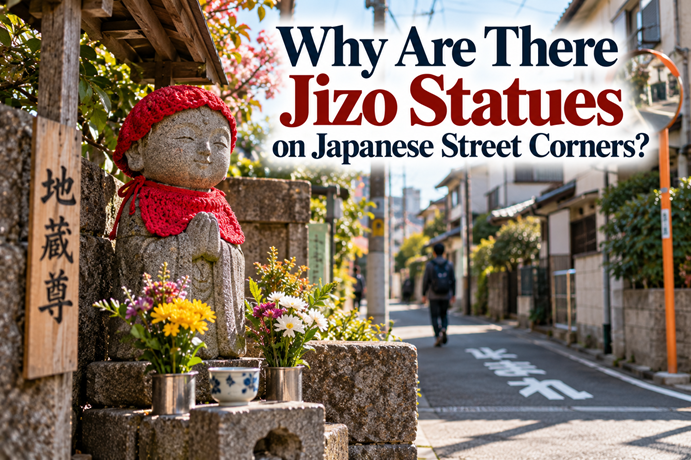
Walk through a quiet Japanese neighborhood and you may suddenly notice something that seems completely out of place. Between two houses, beside a narrow road, near a small intersection, or tucked into a corner beneath a tiny roof stands a small stone statue. It may have a red cap or bib, a few flowers in front of it, perhaps some incense, and sometimes small offerings placed nearby. There may be no temple in sight, no large entrance gate, and no obvious religious building around it. It simply seems to be there, watching over the street.
For someone seeing this for the first time, the natural question is, “Why is there a Buddhist statue on the side of an ordinary residential road?” The answer is much more interesting than simply saying that Japanese people put religious statues outside. Many of these statues are Jizo, a Buddhist bodhisattva who has become deeply connected in Japan with protection, travelers, children, people who have died, and the everyday life of local communities. Jizo is not simply a figure found inside temples. In Japan, the religious figure gradually became part of the physical landscape itself, appearing beside roads, at crossroads, near village boundaries, in cemeteries, and in other places where everyday life and older ideas about protection overlapped.
That is why the little Jizo statue at the corner of a residential street can feel so unusual to a foreign visitor. It is not necessarily a monument that people stop to admire. It may not even have an obvious explanation attached to it. Yet someone is usually looking after it. Someone may clean the small space around it, place flowers there, replace a red bib, or leave an offering. It can be surprisingly easy to walk past without thinking about it, but once you stop and ask why it is there, the statue opens a door into the history of Japanese neighborhoods.
The deeper story is not only about Buddhism. It is about how religious beliefs became embedded in roads, boundaries, travel, children, memory, and community life. A small statue at the corner of a street can be a surviving piece of that much larger history.
🙏 Jizo Is a Buddhist Bodhisattva, Not a Street Decoration
Jizo is a bodhisattva, traditionally known in Sanskrit as Kshitigarbha, and is one of the most widely recognized Buddhist figures in Japan. He is often depicted as a simply dressed Buddhist monk, sometimes carrying a staff and a jewel, rather than as an elaborate or distant divine figure. Over the centuries, Jizo became associated with mercy and protection, particularly toward travelers, children, and the deceased. In Japan, these associations developed into many different local forms of worship, which is one reason there is no single meaning attached to every Jizo statue you encounter.
The image is often remarkably approachable. A small stone Jizo standing beside a road does not necessarily look like a powerful religious monument. It may have a gentle face, a simple robe, and a red knitted cap or bib that someone has placed on it. That appearance is part of the reason Jizo became so closely associated with ordinary people. The figure could be encountered not only by monks and worshippers at a temple, but by someone walking to another village, a farmer working nearby, a child walking home, or a traveler passing through a difficult road.
This closeness to ordinary life is one of the most important things to understand. Jizo was not confined to an abstract religious world. Through Japanese folk beliefs and local practices, the figure came to occupy very physical places in people’s daily lives. A road, a field, a village entrance, a cemetery, or a street corner could all become places where Jizo was present.
🛣️ Why Put Jizo Beside a Road?
The connection between Jizo and roads has a long history. Traditionally, travel was much more difficult and dangerous than it is today. Roads could be long, isolated, exposed to weather, difficult to navigate, and vulnerable to accidents or other dangers. Travelers moving between villages and regions did not have modern maps, illuminated streets, convenience stores, railway stations, or emergency services waiting every few kilometers.
A small roadside Jizo could therefore have a very different meaning from a religious statue inside a temple. It could be a place where a traveler paused, prayed, or simply felt that someone was watching over the journey. Some historic Jizo statues were deliberately placed along old routes and became associated with wayfinding as well as protection. In some places, inscriptions on roadside statues even indicated the direction of different roads, turning the statue into something that was both a religious presence and a practical landmark.
This connection between Jizo and travelers helps explain why roads are such an important part of the story. The statue is not randomly standing beside the road because someone happened to have an empty piece of land there. The road itself is meaningful. It is where people leave one place and enter another. It is where strangers pass through. It is where journeys begin and end.
And that brings us to another important idea: the boundary.
🧭 The Street Corner Was Once More Than a Street Corner
A modern residential intersection is easy to understand. Two roads meet, cars need to turn, pedestrians cross, and houses occupy the surrounding land. But older roads were also part of a much larger mental map.
A road could connect one village with another. A crossroads could mark a decision about which direction to travel. A settlement could have a recognizable entrance or edge. A bridge could mark the point where travelers crossed from one area into another. A mountain pass could separate one community from the next.
These were boundaries in a way that modern urban roads often are not.
People have always been interested in what happens at boundaries. A boundary separates one place from another, but it is also the point where the two meet. In many traditional cultures, such places can become associated with protective beliefs because they are understood as places through which people, dangers, strangers, and unseen influences may pass.
Jizo became one of the figures who could occupy these spaces in Japan. A statue at a road junction or along an old route could be understood as a guardian of people moving through the area. This is why the idea of “the little Jizo at the corner” is more meaningful than it first appears. The corner is not necessarily important because it is a corner. It may preserve the location of an older route, a former village boundary, a place where travelers once stopped, or a community space that has survived even after the surrounding environment changed.
The road has changed.
The houses have changed.
The traffic has changed.
But the Jizo remains.
👶 Why Are Jizo Statues So Closely Associated With Children?
If you have seen Jizo statues in Japan, you may have noticed that many are dressed with red bibs, hats, scarves, or other small pieces of clothing. This is particularly noticeable around statues associated with children’s protection or remembrance.
Jizo developed a particularly strong relationship in Japanese religious culture with children, including children who died young and unborn children. This connection is one reason that Jizo statues can be seen in cemeteries and memorial sites as well as beside roads. Parents and families may pray to Jizo for the wellbeing of children, for protection, or in memory of children who have died.
This side of Jizo’s history is important because it explains why the statues sometimes look almost childlike themselves. A tiny statue wearing a red cap and bib can appear to be a friendly neighborhood figure, but behind that appearance is a much deeper history involving grief, protection, and the hope that vulnerable people will not be forgotten.
The red clothing is therefore not simply decoration. In popular religious practice, red has long been associated with protection, and clothing Jizo can be a personal act of prayer or gratitude. Someone may place a bib on a statue because they want the figure to protect a child, or because they are expressing thanks for a child’s recovery or wellbeing. The meaning can be deeply personal even when the statue itself is located in a completely ordinary public space.
This creates an unusual contrast. A person walking through the neighborhood may see a cute little stone figure. Another person may see a place connected with a private family memory.
The statue can hold both meanings at once.
❤️ A Little Statue Can Carry Someone’s Grief
One of the most moving aspects of Jizo culture is the way public and private memory can overlap.
A Jizo statue may stand in a place where anyone can see it, yet the reason someone placed an offering there may be deeply personal. A family may have prayed for a child’s health. Someone may have remembered a person who died. A traveler may have stopped to pray for a safe journey. A local community may have continued caring for a statue that previous generations regarded as important.
The statue therefore becomes a physical object that carries memories that may not be written down anywhere.
There is something very different about this from a modern memorial plaque with a name and date clearly displayed. The Jizo may not tell you exactly why it is there. You simply encounter it.
This ambiguity is part of its character.
The neighborhood remembers even when the passerby does not know what is being remembered.
🧢 Why Does Jizo Often Wear Red?
The red cap and bib are among the first details foreigners notice. A stone figure may stand quietly for decades, but someone periodically returns to dress it in new clothing. The result can make the statue seem surprisingly alive.
The exact custom varies by place and by the people who care for the statue, so there is no single universal explanation for every red garment. But red has traditionally been treated in Japanese folk practice as a protective color, and red clothing on Jizo can be an expression of prayers for protection, particularly protection of children.
There is also something very human about clothing a stone figure.
People do not dress an object because the object needs clothes in a practical sense.
They dress it because the act itself expresses care.
A new cap or bib means that someone noticed the statue. Someone remembered it. Someone decided that the old clothing should be replaced. Someone spent time making or purchasing something and returning to this particular corner.
That changes the way you see the statue.
It is no longer simply a piece of stone.
It is a place where people continue to perform small acts of attention.
🌺 Who Looks After the Jizo?
This is one of the most interesting questions to ask when you encounter a Jizo statue in a neighborhood.
Who owns it?
Who cleans it?
Who replaces the flowers?
Who removes old offerings?
Who puts on a new red bib?
The answer varies. Many roadside Jizo have historically been cared for by local communities rather than functioning simply as objects managed from a distant temple. In some places, a temple may have a connection to the statue. In others, neighborhood residents or local groups maintain it. There may be a small shelter around the figure, a tiny altar, flowers, incense, or other objects that reveal continuing care.
This is where Jizo becomes especially relevant to the Neighborhood Series.
The statue is not only a religious object.
It can become part of the neighborhood’s shared responsibilities.
The people living nearby may not all have the same religious beliefs. They may not even stop to pray regularly. Yet they may still agree that the little statue should be looked after.
Someone sweeps around it.
Someone leaves flowers.
Someone replaces its clothing.
Someone notices if the roof has become damaged.
The actions are small, but they represent continuity.
🏘️ Jizo Can Become Part of Neighborhood Memory
Imagine a neighborhood that has changed dramatically over the past century.
An old road has become a paved street.
Fields have become houses.
A shop has disappeared.
A school has been rebuilt.
Electricity poles have multiplied.
Cars now travel along a route that was once used by people on foot.
And yet, beside the road, a small stone Jizo remains.
The statue can become a physical link between different versions of the neighborhood.
Children who walk past it today may have no idea how old it is.
Older residents may remember it from their childhood.
A local family may know the story associated with it.
A nearby temple may have records about its origin.
The statue exists in the present while quietly pointing backward.
That is why these small objects can be so valuable when trying to understand Japanese neighborhoods. They do not necessarily appear on the tourist map. They are often not famous. Their importance comes from the relationship between the object and the people who live around it.
🗿 Not Every Small Statue at a Japanese Street Corner Is Jizo
This is an important distinction.
A foreign visitor may see a small stone figure and immediately assume it is Jizo. But Japanese roadsides contain many different kinds of religious and folk monuments, including figures and stones associated with other Buddhist traditions, local beliefs, and roadside deities such as Dosojin.
The distinction can sometimes be difficult even for people who are not familiar with local history because roadside religious objects evolved differently in different regions. Some are clearly identifiable. Others have been weathered for centuries, making the original features difficult to recognize.
Dosojin are particularly relevant because they also have a strong connection with roads, village boundaries, and protection from harmful influences entering a community. They can therefore occupy some of the same physical environments as roadside Jizo without being the same religious tradition.
This is why it is better not to assume that every little stone figure beside a Japanese road is Jizo. The physical setting tells you something, but the figure’s form, inscriptions, local history, and associated customs may be needed to know exactly what it is.
The important cultural point remains the same: Japanese roads have historically been places where religious and protective meanings could be attached to the landscape.
🛤️ Jizo and the Idea of Protecting Travelers
The association between Jizo and travelers is particularly fitting when you think about what travel once meant.
Today, leaving a neighborhood is easy. You check a route on your phone, walk to a station, board a train, and arrive somewhere else within hours. A traveler can cross a mountain or travel from one city to another without ever thinking much about the physical dangers of the road.
Historically, a journey could be very different.
Roads were slower.
Weather could change suddenly.
Finding the correct route could be difficult.
Travelers could become injured or lost.
Long journeys meant leaving familiar people and places behind.
A roadside Jizo could therefore represent something comforting: a guardian waiting along the journey.
The figure does not have to physically escort the traveler.
Its presence itself can provide reassurance.
That is why some Jizo statues became associated with crossroads, old trade routes, mountain paths, and places where people historically passed through.
The statue becomes a point of pause in a world where travel was uncertain.
🌉 The Boundary Between “Us” and “Out There”
The protective role of roadside religious figures becomes even more interesting when you return to the idea of boundaries.
A village has an inside.
Beyond it is somewhere else.
A family has its home.
Beyond the house is the street.
A road leads away.
A traveler is moving toward an unknown destination.
A little Jizo at the edge can symbolically stand between these spaces.
It is not necessarily guarding a physical wall.
It is marking a psychological boundary.
This is one reason Jizo can fit so naturally into neighborhood landscapes. A neighborhood itself is a place with boundaries, even if modern maps do not show them clearly. Residents know which streets feel like “their area.” Children know where they normally walk. Older residents know which shops have always been there. A small religious object can become one of the physical points that anchors that sense of place.
🌙 Imagine Meeting One at Night
There is another reason street-corner Jizo can feel especially mysterious to foreign visitors.
During the day, you may barely notice it. Cars pass. People walk. Bicycles move through the intersection. The statue becomes part of the visual background.
At night, the surroundings become quieter.
A small light may illuminate the shelter.
Flowers may be visible.
The red cap may stand out against the dark.
Suddenly the statue seems much more present.
That feeling is not necessarily connected with fear. It comes from the strange experience of encountering something that feels old and watchful inside an otherwise ordinary modern neighborhood.
The houses may be new.
The cars may be modern.
The streetlights may be LED.
The convenience store may be around the corner.
And yet this small stone figure may represent beliefs and community practices that have existed for generations.
The past is standing beside the road.
🧹 Small Acts of Care Keep the Tradition Alive
Perhaps the most important part of the story is not the theology.
It is the maintenance.
Traditional religious culture can survive not only through temples, books, ceremonies, and formal institutions but through repeated small actions. Someone replaces the flowers. Someone cleans the area. Someone puts a new cap on the statue. Someone teaches a child why the Jizo is there.
These actions can be almost invisible.
Nobody writes an article about the person who swept around the statue.
Nobody takes a photograph of someone replacing a worn bib.
But without those actions, the object would gradually become neglected and disappear from everyday life.
That is how neighborhood culture works.
It is often maintained by people doing small things that do not look important individually.
A garbage collection point is cleaned.
A local shrine is maintained.
A festival decoration is stored for another year.
A shopping street organizes an event.
A Jizo receives a new red cap.
Different activities, same principle.
The neighborhood is kept alive through repetition.
🌱 Jizo in Modern Japan
It would be easy to imagine that roadside Jizo belongs entirely to an old Japan that has disappeared.
But that is not quite right.
Modern Japan is obviously far more secular and technologically developed than the world in which many roadside statues were first established. Yet these small statues can still remain part of the landscape because culture does not necessarily disappear when its original environment changes.
People may not know every religious story connected with a Jizo.
They may not visit a temple regularly.
They may not have a formal religious identity.
They can still feel that the little statue belongs there.
This is an important characteristic of Japanese folk culture. Religious practices can continue at the level of custom, memory, place, family, and neighborhood even when people’s relationship with formal religion becomes more complicated.
The statue survives because it has become part of the landscape.
And once something becomes part of a neighborhood’s landscape, removing it can feel like removing part of the neighborhood’s identity.
🧠 Why the Little Jizo Matters
A Jizo at a street corner does not necessarily tell you one simple story.
It might tell you about travelers.
It might tell you about children.
It might tell you about grief.
It might tell you about a village boundary.
It might tell you about an old road.
It might tell you about Buddhist beliefs.
It might tell you about local customs.
It might tell you about the people who continue to maintain it today.
Sometimes it may tell you several of those stories at once.
That complexity is exactly what makes the figure interesting.
A tourist looking for famous Japanese culture might walk past it without stopping. But a person trying to understand how Japanese neighborhoods developed may see something much more valuable: a small object connecting religion, geography, history, memory, and community.
It is an example of how culture can survive without needing to announce itself.
🏘️ A Neighborhood Is Full of Things You Learn Only by Looking Closely
This is why the little Jizo belongs naturally in a series about Japanese neighborhoods.
Neighborhood culture is rarely found in spectacular buildings.
It is found in small details.
The shop where everyone knows the owner.
The garbage collection point where residents meet briefly in the morning.
The volunteer standing near a school route.
The festival preparations that begin weeks before an event.
The old sign above a store.
The tiny shrine hidden between houses.
And the small Jizo standing quietly at the corner.
Each one tells you something about how people have used the space, cared for it, and remembered it.
The neighborhood is not only the collection of houses.
It is the accumulated memory of the people who have lived there.
🌏 The Quiet Guardian at the Corner
So, why is there a little Jizo on the corner of a Japanese street?
Because for generations, Jizo became a figure associated with protection, especially for travelers and children, as well as with remembrance of people who had died. Because roads and crossroads were important places in older communities, Jizo statues were often placed where people traveled, where routes divided, or where the boundary between places was meaningful. And because local people continued to care for many of these statues, they became part of the physical identity of the neighborhood.
The modern street may have changed completely.
The old road may now be surrounded by houses.
The travelers may have become commuters.
The village boundary may have disappeared from the map.
The children may walk past while looking at their phones.
But the statue remains.
Someone still places flowers there.
Someone still replaces its clothing.
Someone still pauses occasionally to pray.
Someone may simply feel that it would be wrong to let it disappear.
That is what makes the tiny Jizo so interesting.
It does not need to be large.
It does not need a famous temple around it.
It does not need a sign explaining its entire history.
It simply stands at the edge of everyday life, where roads meet and people pass, carrying layers of beliefs and memories that are much older than the houses around it.
The next time you turn a corner in a Japanese residential neighborhood and see a small stone figure wearing a red cap, do not assume that it is just decoration.
Look a little closer.
You may be looking at a small piece of the neighborhood’s memory.
🌏 Continue Exploring the Neighborhood Series
Japanese neighborhoods reveal their character through the ordinary places where people shop, walk, meet, remember, and look after the community around them.
👉 Why Do Japanese Residential Neighborhoods Feel So Quiet? The Sound of Everyday Life in Japan
👉 Why Do Japanese Neighborhood Shopping Streets Still Matter? More Than Places to Shop
👉 Why Are Japanese Neighborhoods So Different Near Train Stations? The Hidden Structure of Everyday Japan (2026 Guide)
👉 What Happens on Garbage Morning in Japan? The Everyday Scene in a Japanese Neighborhood (2026 Guide)
👉 Who Watches Over Japanese Children on the Way to School? The Neighborhood Volunteers You See Every Morning (2026 Guide)