
🌏 Introduction: A “Class Leader” Who Does Not Always Lead From the Front
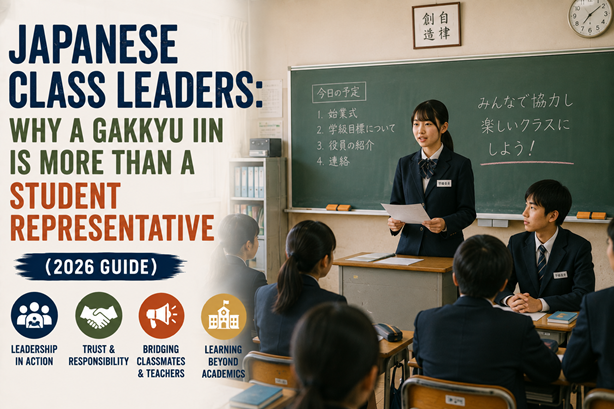
When you hear the phrase “class leader,” it is easy to imagine a confident student standing at the front of the classroom, speaking for everyone else, organizing activities, and perhaps becoming the most visible student in the class. That image can be useful when trying to understand the Japanese gakkyu iin, but it is also misleading. The student who serves as a gakkyu iin is not necessarily the loudest person, the most popular person, the best student, or the person who naturally dominates a group. In many cases, the role is much quieter. It is less about controlling the class and more about helping the class function.
A gakkyu iin is often involved in things such as leading class meetings, helping discussions move forward, organizing information, communicating with teachers, representing the class in school activities, and helping students reach a practical decision when opinions are divided. The exact responsibilities and selection systems vary from school to school, so there is no single nationwide job description that every Japanese student follows in exactly the same way. Some schools divide responsibilities among several class officers or committees, while others give the gakkyu iin a broader coordinating role. What remains interesting is the basic idea behind the role: the class needs someone who can help the group work together.
That makes the gakkyu iin different from a simple “student representative.” A representative can be imagined as someone who carries the class’s opinion outward, speaking to teachers, school administrators, or other students. A gakkyu iin can certainly do some of that, but the role often operates just as much inside the classroom. The student may need to listen to different opinions, help organize a discussion, keep a meeting moving, and make sure the class can reach a conclusion even when not everyone initially agrees.
In that sense, the gakkyu iin may be better understood as a facilitator than as a traditional leader. The goal is not necessarily to make everyone follow one person. It is to help a group of different people move forward together.
🎯 Quick Answer: What Does a Gakkyu Iin Actually Do?
A gakkyu iin is a student who takes responsibility for helping a class operate smoothly. Depending on the school, this can include facilitating class meetings, summarizing or coordinating student opinions, communicating with teachers, participating in school-wide student leadership activities, helping organize class routines, or supporting events and other shared responsibilities. The exact duties vary, but the role often involves both representation and coordination.
The important distinction is that being a gakkyu iin is not necessarily about being “the boss” of the class. The student does not have authority over classmates in the same way a teacher does. A successful class representative often needs to persuade rather than command, listen rather than simply speak, and organize rather than dominate. When the class disagrees, the challenge is not always to decide who is right. Sometimes the challenge is to find a practical way for the group to continue functioning.
That is where the role becomes much more interesting than the English translation “class leader” suggests.
🏫 Why Does a Class Need a Student Coordinator?
A Japanese classroom is not just a place where individual students happen to receive lessons at the same time. In many schools, students also spend a considerable amount of their school day as part of the same class group. They may remain with the same classmates for a substantial part of the school year, share classroom responsibilities, participate in school events together, and organize activities as a group. That means the class occasionally needs to make decisions that do not belong to any one student.
What should the class do for an upcoming event? How should students divide responsibilities? What should be discussed in a class meeting? How should a shared problem be handled? When several opinions emerge, how does the group move forward?
The teacher could simply make every decision, but that would remove an opportunity for students to practice operating a group themselves. The gakkyu iin provides another layer of organization inside the classroom. The student can help structure the discussion, identify what needs to be decided, and make sure the meeting does not simply become a collection of unrelated comments.
That does not mean the class representative always has the answer. In fact, the role can be more useful when the student does not try to provide the answer immediately.
The job can be to ask, “What do we actually need to decide?”
That is facilitation.
🤝 Leadership Inside the Class Can Mean Balancing Different Opinions
One of the most interesting parts of the role is what happens when students disagree. A classroom is obviously not a group of people who think the same way. Some students speak quickly. Some hesitate. Some strongly support an idea. Others think it is impractical. Some may not care about the issue at all. The challenge for the group is that, despite those differences, they still have to share the same classroom.
This is where the gakkyu iin can become a kind of balancing force. The student may listen to the different views, summarize what people are saying, ask for clarification, or help bring the discussion back to the decision that actually needs to be made. That is quite different from standing at the front and declaring what everyone should do.
The role is therefore less about personal power and more about group movement. If the class cannot move from disagreement to a decision, the problem is not necessarily that there is no leader. It may be that nobody is helping the group process its disagreement.
A facilitator works on that problem.
The person does not have to win the argument.
The person has to help the group move.
That difference is subtle, but it is exactly why “class leader” can be an incomplete translation.
🎤 Speaking for Everyone Is Only Part of the Job
Of course, there are moments when the gakkyu iin does act as a representative. The student may attend meetings, communicate with a teacher, participate in student council-related activities, or present something on behalf of the class. In these situations, the representative function is obvious. The student is carrying information or opinions beyond the classroom.
But that outward-facing role is only half of the story.
Imagine a class meeting before a school event. The students may have several competing suggestions. One person wants to do something elaborate. Another thinks it will take too much time. Someone else is worried that certain students will end up doing all the work. The gakkyu iin may need to make sure these concerns are actually heard before the class decides.
In that situation, the student is not representing the class to someone else.
The student is helping the class understand itself.
That may be the most interesting distinction between the Japanese gakkyu iin and the idea of a simple class representative.
🌏 “I Represent You” vs. “Let’s Figure This Out Together”
The English phrase Class Representative can suggest a role focused on speaking on behalf of others. Again, school systems differ internationally, so there is no single model that describes every country or every school. But as a general contrast, the word “representative” naturally emphasizes the relationship between the class and the outside world.
The Japanese gakkyu iin can contain that function, but its role can also be much more internal. The student may be facilitating a class meeting, organizing discussion, coordinating responsibilities, and helping classmates work through disagreement.
A simple way to express the difference is this:
“I represent you.” suggests speaking for the group.
“Let’s figure this out together.” suggests helping the group function.
Real school systems are naturally more complicated than either sentence, but the contrast helps explain why translating gakkyu iin simply as “class representative” can miss something important.
The Japanese role is often less about occupying a position above classmates and more about standing inside the group and helping it move.
👀 The Most Visible Student Is Not Necessarily the Best Choice
This is another reason the role is interesting. Leadership is often associated with visibility. The student who speaks loudly, answers quickly, attracts attention, or naturally takes control of a situation may look like an obvious leader. But a class coordinator needs a different set of skills.
Can the student listen?
Can the student remember what different people said?
Can the student explain one person’s idea to someone who misunderstood it?
Can the student keep a meeting focused?
Can the student recognize when a disagreement is actually about two different problems?
Can the student encourage quieter students to speak?
Can the student help the class finish something even when nobody is especially excited about doing it?
None of those qualities requires a student to be the most visible person in the room.
In fact, a very quiet student can sometimes be an effective coordinator precisely because they are used to listening before speaking.
This is why the gakkyu iin should not be reduced to a personality type. The role is about what the student does, not how impressive the student appears.
🧭 A Facilitator Is Not a Teacher
Another important distinction is authority. A gakkyu iin does not replace the teacher. The teacher remains responsible for teaching, discipline, safety, and the formal operation of the class. The student has a different role.
This distinction is important because a student facilitator cannot simply command classmates to obey. Their influence depends more on communication, trust, organization, and the ability to get others involved.
That can actually make the role more complicated than traditional top-down leadership.
A teacher can say, “This is what we are going to do.”
A student may have to say, “We need to decide this. What do you think?”
The second sentence takes more work.
It requires listening.
It may require negotiation.
And sometimes it means accepting that the group’s final decision is not exactly the idea the gakkyu iin personally preferred.
That is another reason facilitation is such a useful way to understand the role.
🧹 What About Cleaning and Everyday Class Duties?
Japanese school life includes many responsibilities that exist outside formal academic lessons. Students may participate in classroom cleaning, organizing the room, managing routines, or helping with shared tasks. Depending on the school, some of these responsibilities may fall under class officers, while others may be assigned to different committees or rotating student roles. That variation is important because there is no single rule saying every gakkyu iin must personally direct every classroom task.
Still, the overall structure tells us something useful. Japanese schools often ask students to participate in the operation of their shared environment rather than treating the classroom as a space maintained entirely by adults. Class officers and student committees can become part of that structure.
The gakkyu iin may therefore be involved not because the student has special authority, but because someone needs to help coordinate what the group is doing.
Again, the word that keeps coming back is coordination.
🔄 Why Does the Role Often Rotate?
The system for choosing a gakkyu iin varies considerably. Some schools use elections, recommendations, nominations, or other classroom procedures, and the length of the term can differ. In some cases, responsibilities are divided by semester or term, while in others students may hold positions for longer periods. It is therefore better not to assume that every student in Japan follows exactly the same schedule.
But rotating classroom responsibilities can have an interesting educational effect. If the role changes during the year, more students have the opportunity to experience what it means to take responsibility for a group.
That changes the meaning of the position.
It is not necessarily about identifying one permanent “natural leader.”
It can be about giving different students the chance to practice organizing, communicating, and coordinating.
A student who is not naturally outspoken may discover that they can lead a discussion. Someone who assumed they were good at organizing may discover that listening is harder than giving instructions. Another student may realize that solving disagreements requires patience.
In that sense, the gakkyu iin can be less about identifying leaders and more about giving students experience with responsibility.
👦 My Own Memory of Being a Gakkyu Iin
I remember being a class representative almost every year from kindergarten through middle school, or at least that is how it feels when I look back on my childhood. I do not remember thinking of the role as becoming “the leader of the class.” I certainly do not remember imagining myself as someone with authority over everyone else.
What I remember more clearly is the responsibility of having to do things that were connected to the class as a group. There were moments when you had to stand up, speak, organize something, communicate something, or help a class activity move forward. At the time, these things simply felt like part of school. There was no reason to think about them as a lesson in facilitation.
Looking back as an adult, however, the role feels more interesting. It was not really about being above the other students. It was about being inside the group while carrying a little extra responsibility for how the group functioned.
That is probably why the role can be misunderstood when translated simply as “class leader.”
The word leader makes you imagine someone at the front.
My memory is more like someone in the middle.
🧩 A Class Is a Small Social System
A classroom is a surprisingly complicated social environment. There are friendships, rivalries, different personalities, different abilities, different interests, and different levels of confidence. The students did not choose all of the people in their class, yet they have to spend a great deal of time together.
They also have common tasks.
They have to attend classes.
They may have school events.
They may need to make decisions together.
They may have shared responsibilities.
They may disagree.
And eventually, they have to move on.
The gakkyu iin sits inside that system as one of the students who helps it operate.
This is why the role can be seen as a tiny exercise in living with other people. The student does not get to choose everyone else’s opinions. The student does not control the class. The student has to work with the group as it exists.
That is much closer to real life than the image of a perfect leader who always knows what to do.
🤝 Harmony Does Not Mean Everyone Agrees
The Japanese word wa, often translated as harmony, can easily become the subject of simplistic cultural explanations. It is tempting to say that Japanese students are taught to value harmony and therefore the gakkyu iin exists to keep everyone happy. That would be too simplistic.
Harmony in a classroom does not necessarily mean agreement.
Students can disagree.
They can argue.
They can prefer different solutions.
They can even be frustrated with one another.
What matters is whether the group can continue working together despite those differences.
That is where the coordinator role becomes interesting. The gakkyu iin may not eliminate disagreement. The student may simply help prevent disagreement from stopping the class entirely.
The goal is not necessarily to make everyone think the same way.
It can be to help different people move forward together.
That is a much more practical interpretation of harmony.
🗣️ Why Listening Can Be a Form of Leadership
One of the biggest misconceptions about leadership is that it is primarily about speaking. In a classroom, however, the person who speaks the most is not necessarily the person helping the group the most.
A facilitator needs to listen.
If one student speaks very strongly, someone has to understand what the quieter students think. If two students disagree, someone has to understand whether their disagreement is about the actual decision or simply about how they are expressing it. If the class becomes distracted, someone has to bring the conversation back to the original question.
These are quiet skills.
They may not look impressive from the outside.
But they are extremely useful.
This is why a gakkyu iin can sometimes be an effective leader without appearing especially “leader-like.”
The student is not necessarily creating movement through force of personality.
The student is creating movement through organization.
🎒 The Role Can Teach Responsibility Without Being a Lesson
One of the interesting things about school roles is that students do not always realize what they are learning while they are doing them. A child may think that being a gakkyu iin simply means having a particular job for the class. They may not think about communication skills, facilitation, negotiation, responsibility, or group dynamics.
Years later, those experiences can look very different.
The child who had to conduct a class meeting was practicing public speaking.
The child who had to listen to different opinions was practicing negotiation.
The child who had to communicate with a teacher was practicing coordination.
The child who had to help a class complete a shared task was practicing responsibility.
None of those lessons needed to be written on a blackboard.
They were learned by doing.
That is one of the reasons school culture is worth looking at beyond academic subjects.
Children are also learning how to operate within groups.
🌏 More Than a “Student Representative”
This brings us back to the translation problem.
Calling a gakkyu iin a “student representative” is not wrong, but it is incomplete. Calling the student a “class leader” is also understandable, but it can create the wrong image if we imagine a permanent authority figure who directs everyone else.
A better understanding is somewhere in the middle.
The student can represent the class.
The student can help lead activities.
The student can communicate with teachers.
But the student can also facilitate discussion, organize the class internally, manage the practical process of reaching decisions, and help classmates work together.
That is why “more than a student representative” is such an important part of this article’s title.
The gakkyu iin is not simply the person who speaks for the class.
The student can also be the person who helps the class speak to itself.
🌱 Not Every Class Needs the Same Kind of Leader
Another reason the role is interesting is that different classrooms need different things at different moments. A class preparing for a major event may need someone highly organized. A class experiencing conflict may need someone patient and good at listening. A class with little disagreement may need only someone who keeps routine meetings moving.
This means there is no single personality that perfectly defines the ideal gakkyu iin.
The energetic student may be effective in one situation.
The calm student may be better in another.
The student who is good at speaking may be useful when communicating outside the class.
The student who is good at listening may be better when the class itself is divided.
Leadership changes according to the problem.
That is another reason not to romanticize the role. Being a gakkyu iin does not automatically make someone an exceptional leader. It simply gives the student a position in which certain kinds of responsibility become necessary.
🏫 The Classroom as a Small Community
Perhaps this is the deeper reason the role is worth noticing.
A Japanese classroom is not a democracy in the formal political sense, and students are not running their school independently. Teachers remain responsible for education, safety, and formal authority. Yet within that structure, students may still be given opportunities to participate in the operation of their own class.
The gakkyu iin is one part of that system.
The student does not replace the teacher.
The student does not control the class.
The student helps make the class work.
That distinction matters because it reflects a broader idea of responsibility: you do not need to be the person in charge to have responsibility for a group.
A student can contribute to the group simply by helping the group function.
That is a useful idea far beyond school.
🌏 What Makes the Gakkyu Iin Interesting?
The most interesting thing about the gakkyu iin is perhaps how ordinary the role seems. Students may choose someone, perform the duties, and eventually hand the responsibility to someone else. There is no grand ceremony. There may not even be much recognition.
Yet within that ordinary process, a child is practicing something surprisingly complex.
How do you speak in front of a group?
How do you listen when people disagree?
How do you organize a discussion?
How do you communicate with an authority figure?
How do you help a group reach a decision?
How do you carry responsibility without controlling everyone else?
These are not small questions.
They are questions adults continue to face throughout their lives.
🌎 A Different Idea of Leadership
The gakkyu iin does not represent a perfect Japanese model of leadership, and it would be wrong to claim that Japanese schools have solved the problem of how groups should work. School cultures differ enormously, and individual experiences can be very different.
But the role offers an interesting perspective because it reminds us that leadership does not always look like authority.
Sometimes leadership means speaking for people.
Sometimes it means organizing people.
Sometimes it means standing at the front.
Sometimes it means sitting among everyone else and helping the discussion continue.
The Japanese gakkyu iin often occupies that last position.
That is what makes the role easy to overlook and worth examining.
🌏 Conclusion: The Leader in the Middle
A gakkyu iin may be translated as a class leader or student representative, but neither phrase completely captures the role. The student can represent the class to teachers or other groups, but much of the interesting work can happen inside the classroom itself. The gakkyu iin may facilitate meetings, help organize discussions, communicate information, coordinate responsibilities, and help classmates move forward when their opinions do not completely match.
The student does not necessarily need to be the loudest person.
The student does not necessarily need to be the most popular person.
The student does not necessarily need to dominate the room.
In fact, some of the most useful qualities may be quieter ones: listening, organizing, explaining, balancing, and knowing when to speak and when to let someone else speak.
That is why the word facilitator can sometimes describe the role better than the word leader.
A gakkyu iin is not necessarily the person who stands above the class and tells everyone what to do. The student is often still simply another member of the class, sitting among the same classmates and sharing the same daily experience. The difference is that, for a period of time, that student carries an additional responsibility for helping the group work.
I remember experiencing that responsibility myself many times as a student, and at the time I never thought of it as practicing leadership. Looking back, it feels more like learning how to help a group function without being in control of it. That is a surprisingly useful skill, and perhaps one of the more interesting things hidden inside an ordinary school role.
The real lesson may not be “How do you become the leader?”
It may be “How do you help a group move forward when everyone in it is different?”
And that is why the gakkyu iin is more than a student representative.
A gakkyu iin does not always lead the class from the front. Sometimes, the more important job is helping everyone move forward together.
🌎 Continue Exploring Japanese School Culture
If this article made you curious about the everyday roles and routines that shape Japanese school life, continue exploring the School Series and the wider Culture/Mind section of Real Japan Navigator.
👉 The First Day Back: Why Japanese Schools Begin the New Term With an Opening Ceremony (2026 Guide)
👉 Stand, Bow, Sit: Why Japanese Students Bow to Teachers at the Start of Class? (2026 Guide)
👉 Why Do Japanese Schools Display Students’ Work on the Walls? (2026 Guide)
👉 Why Do Japanese Students Eat Lunch in Their Classrooms? (2026 Guide)
👉 Why Do Japanese Students Change Into Indoor Shoes at School? (2026 Guide)
👉 Why Do Japanese Students Spend So Much Time in School Clubs? (2026 Guide)