
🌏 Introduction
Every culture repairs certain things. Antique furniture is carefully restored in Europe, vintage watches are repaired in Switzerland, and family heirlooms are passed from one generation to the next in many parts of the world. In recent years, repair cafés and sustainability movements have encouraged people around the globe to fix broken items rather than immediately replacing them. Japan is certainly not the only country where people value repair.
Yet while living overseas, I noticed something that felt quietly different whenever I returned home. Repair in Japan seemed less like an environmental campaign and more like an ordinary part of daily life. A dull kitchen knife was not automatically replaced. It was sharpened. A favorite pair of leather shoes was taken to a neighborhood repair shop. Torn clothing might be carefully mended. Tatami mats were renewed rather than discarded. Even centuries-old wooden shrines continued their existence through rebuilding rather than remaining untouched forever.
The more I thought about it, the more I realized that this way of thinking was connected by something deeper than simply reducing waste. It was not only about saving money, nor was it simply about protecting the environment, important though those goals certainly are. Instead, many Japanese traditions seem to suggest that an object does not lose its value simply because it becomes damaged. Sometimes a crack, a worn edge, or years of careful use become part of the object’s story rather than the end of it.
Living abroad helped me appreciate that every culture develops its own relationship with the things people own. Some celebrate the beauty of antiques that have survived for centuries. Others enjoy the excitement of innovation and replacing old technology with something new. Japan has followed both paths throughout its history. It enthusiastically embraces new technology while quietly preserving traditions that encourage people to repair, restore, and continue using what already exists. Perhaps that combination is one of the reasons Japanese repair culture feels so distinctive today.
🥣 Kintsugi: Repairing the Story, Not Just the Bowl
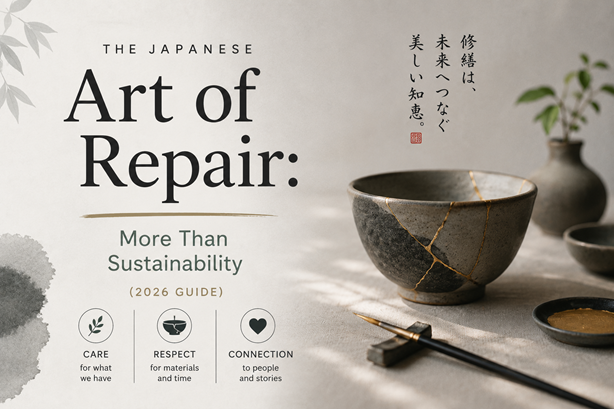
Perhaps no Japanese tradition illustrates this philosophy more beautifully than kintsugi. Around the world, this centuries-old technique has attracted growing attention from artists, designers, and people searching for new ways of thinking about beauty. At first glance, the process seems surprisingly simple. A broken ceramic bowl or cup is carefully repaired using natural lacquer, and the repaired cracks are highlighted with gold, silver, or other precious materials.
What makes kintsugi remarkable is not the technique itself but the idea behind it.
In many situations, repairing something means trying to hide the damage as completely as possible. The ideal repair is often considered invisible, allowing the object to appear exactly as it did before it broke. Kintsugi takes almost the opposite approach. Instead of pretending the accident never happened, it allows the crack to remain visible. More than that, it transforms the crack into the most beautiful part of the object.
The repaired bowl does not return to its original appearance.
It becomes something entirely new.
For many people outside Japan, this philosophy feels surprisingly emotional. A repaired object is not considered imperfect because it carries visible scars. Those marks simply become part of its history. Every crack reminds us that the object has lived a life alongside its owner. Rather than erasing that history, kintsugi quietly celebrates it.
Of course, not every broken plate in Japan is repaired with gold. Most Japanese households simply replace everyday dishes when they break, just as families do elsewhere in the world. Kintsugi is a traditional craft rather than an everyday household practice. Yet the reason it continues to fascinate people around the world is that it expresses an idea extending far beyond ceramics. It suggests that damage does not always diminish value. Sometimes it adds another chapter to the story.
🧵 Clothing That Carries Generations
A similar way of thinking appears in another traditional craft: sashiko. Long before sustainability became a global conversation, people in rural Japan repaired worn clothing because fabric itself was precious. Instead of throwing garments away, families reinforced weak areas using small, carefully stitched patterns of white thread. As repairs accumulated over decades, one layer of cloth was sewn upon another until entirely new textures emerged.
These heavily repaired textiles eventually became known as boro, a word that originally suggested something worn or ragged. Ironically, many of these pieces are now treasured by museums, collectors, and fashion designers around the world. What earlier generations regarded as practical necessity is now admired as remarkable craftsmanship.
Looking closely at a piece of boro, you begin to notice that it records time itself. Every patch tells the story of another winter survived, another harvest completed, another generation deciding that the fabric still deserved another chance. The repairs are visible, but they never seem embarrassing. Instead, they quietly demonstrate care, patience, and resourcefulness.
Modern fashion has rediscovered these ideas in unexpected ways. Designers now create clothing inspired by sashiko stitching, while vintage boro textiles have become highly sought-after works of textile art. What began as ordinary people extending the life of everyday clothing has become an international source of inspiration, reminding us that beauty sometimes emerges through use rather than perfection.
🔪 Repair as an Everyday Skill
While kintsugi and sashiko often appear in museums or art books, the spirit of repair is perhaps most visible in ordinary Japanese neighborhoods. Walk through a traditional shopping street or near an older train station, and you may still find small repair shops quietly serving the local community. A shoe repair specialist carefully replaces worn heels instead of encouraging customers to buy a new pair. An umbrella repair shop gives another season of life to a favorite umbrella after a storm. Watch batteries are replaced, clocks are repaired, and bicycles receive regular maintenance rather than being abandoned at the first mechanical problem. None of these shops attract much attention, yet together they form part of an infrastructure that quietly supports repairing rather than replacing.
One example that has always fascinated me is the Japanese kitchen knife. In many households around the world, a knife that no longer cuts well is simply replaced with a new one. In Japan, however, many people first think about sharpening it. Professional knife sharpeners still work in markets and shopping streets, restoring blades that may have been used for decades. Some knives are even passed from one generation to the next, becoming family tools rather than disposable kitchen equipment.
The knife itself is only part of the story. Sharpening also reflects a different relationship between people and the objects they use every day. Rather than asking whether something is old, the first question often becomes whether it can continue serving its purpose. The goal is not to make the knife look brand new again. Small scratches remain, the handle may show years of use, and the blade slowly changes shape after repeated sharpening. Those marks are accepted because they tell the story of a tool that continues to be useful.
The same quiet philosophy appears throughout Japanese homes. Tatami mats are not necessarily removed and discarded when they begin showing signs of age. Instead, many are turned over or re-covered with new woven surfaces, allowing the room to continue serving another family for many more years. Shoji screens receive fresh paper rather than entirely new wooden frames. Even ordinary objects become part of an ongoing relationship rather than a temporary purchase. Of course, modern Japanese society also buys new products and enjoys the latest technology. Anyone walking through Tokyo’s electronics districts can see that immediately. Yet alongside that enthusiasm for innovation, another tradition quietly survives: if something can continue its life through care and repair, many people still choose that path.
⛩️ Preserving Tradition by Beginning Again
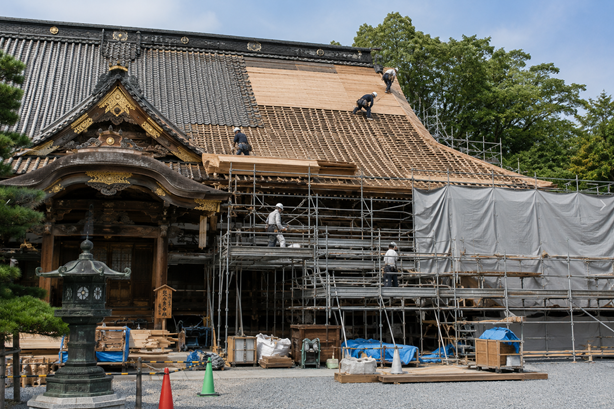
Perhaps the most remarkable example of this way of thinking can be found not inside a home but at one of Japan’s most important sacred sites. At first glance, the idea seems almost contradictory. If a building is historically important, shouldn’t it remain exactly as it is for as long as possible? Many countries answer that question by preserving ancient structures in their original form, carefully protecting every stone for future generations. Japan developed another approach, shaped in part by its long tradition of wooden architecture.
At the Grand Shrine of Ise, one of Japan’s most sacred Shinto sites, the main shrine buildings are reconstructed approximately every twenty years through a tradition known as Shikinen Sengu. To someone hearing about this for the first time, the practice can sound surprising. Why rebuild a historic building instead of simply repairing the existing one?
The answer lies not only in the building itself but in everything surrounding it. Rebuilding allows ancient woodworking techniques to be practiced continuously rather than existing only in old documents. Experienced craftspeople teach younger generations by working together on real buildings. Knowledge is transferred through hands as much as through words. The physical structure may become new, yet the tradition itself remains unbroken.
This is not necessarily better than preserving centuries-old stone cathedrals in Europe, nor is it intended to replace that approach. The two traditions simply reflect different histories, climates, and building materials. Stone naturally encourages one kind of preservation, while wood invites another. What fascinates me is that Japan found a way to protect continuity not by resisting change completely, but by allowing renewal to become part of preservation itself.
Seen from that perspective, rebuilding is not the opposite of conservation.
It is one way of achieving it.
🌍 What Living Overseas Taught Me
Living abroad made me realize that the desire to repair exists almost everywhere, even if it takes different forms. I met people who lovingly restored antique furniture, collected vintage watches, rebuilt classic cars, or spent weekends repairing bicycles. Across Europe and North America, historic buildings are carefully maintained, while local communities have recently embraced repair cafés where volunteers help neighbors fix household items instead of throwing them away. These experiences reminded me that the wish to extend the life of meaningful objects is far from uniquely Japanese.
What felt different when I returned to Japan was how naturally repair still appeared within ordinary daily life. It wasn’t always treated as a special hobby or environmental statement. Instead, it often remained a practical service available just around the corner. A knife sharpener, a shoe repair shop, or a craftsman replacing tatami mats simply continued doing work that had quietly supported local communities for generations.
Perhaps that is why the Japanese word mottainai is so often mentioned in discussions about repair. Although the word is frequently translated as “what a waste,” its meaning reaches further than economics. It expresses a feeling that something still possesses value, usefulness, or dignity even if it has become old or damaged. Repairing an object becomes one way of acknowledging that remaining value rather than ending the relationship too soon.
🌏 Conclusion
It is easy to think of repair simply as the opposite of throwing something away. Yet the more I look at Japanese traditions, the more I feel that repair often represents something much deeper. Kintsugi transforms a broken bowl into a new work of art. Sashiko allows clothing to carry the memories of several generations. A sharpened kitchen knife continues preparing family meals for decades. Fresh tatami gives new life to a familiar room. The rebuilding of Ise Grand Shrine ensures that ancient craftsmanship remains alive by being practiced rather than merely remembered.
None of these traditions suggest that Japan is uniquely virtuous or that other cultures care less about the objects they own. Around the world, people restore antiques, preserve family heirlooms, and repair treasured possessions in ways shaped by their own histories. Japan has simply developed a distinctive language of repair, one that often values continuity as much as restoration and renewal as much as preservation.
Perhaps that is why the Japanese art of repair feels so relevant today. In an age when replacing something is often easier than fixing it, these traditions quietly remind us that a damaged object does not necessarily lose its worth. Sometimes the marks left by time become part of what makes it meaningful.
Perhaps repair is not really about returning something to the way it once was.
Perhaps it is about allowing its story to continue.
🌏 Continue Exploring the Hidden Ideas Behind Japan
If you enjoyed discovering Japan’s culture of repair and renewal, you may also enjoy these articles exploring the deeper philosophies that quietly shape everyday life in Japan.
👉 Space That Speaks: A Hidden Idea in Japanese Culture (2026 Guide)
👉 Why Is Shade So Important in Japan? (2026 Guide)
👉 Why Do Japanese People Give Summer Gifts? The Tradition of Ochugen (2026 Guide)
👉 Why Do Japanese People Queue Even When Nobody Is Watching? (2026 Guide)
👉 Why Are Clothes Often Dried Outside in Japan? (2026 Guide)