
🌏 Introduction
If you’ve ever searched online for travel advice about Japan, you’ve probably seen someone describe Tokyo’s train stations as “a maze.”
After traveling through subway systems in New York, Chicago, Mexico City, Toronto, London, Barcelona, and Bangkok, I understand exactly why so many visitors feel that way. Every city has developed its own transportation system based on its history, geography, and population. Some systems are incredibly old, while others are modern and easy to navigate. Some rely heavily on color-coded lines, while others focus on station names or route numbers.
Japan is different.
Or perhaps more accurately, Japan is incredibly connected.
When many travelers imagine a train station, they picture a platform, a ticket gate, and an exit leading directly to the street. In many Japanese cities, especially Tokyo, that image no longer applies. A single station may connect JR lines, multiple subway companies, private railway lines, underground shopping malls, office buildings, department stores, restaurants, convenience stores, and several city blocks—all without requiring passengers to step outside.
The result is one of the world’s most efficient public transportation networks.
It is also one of the easiest places to become completely disoriented.
Even as a Japanese person, I still occasionally stop inside stations such as Shinjuku, Tokyo, Shibuya, Ikebukuro, or Otemachi, look up at the signs for a moment, and think, “Which way was that exit again?”
If locals sometimes pause to check the signs, visitors should never feel embarrassed about getting lost.
The good news is that navigating Japan’s biggest stations is much easier than it first appears.
You simply need to stop thinking about stations the way you would in most other countries.
🚇 The Biggest Mistake Most Travelers Make
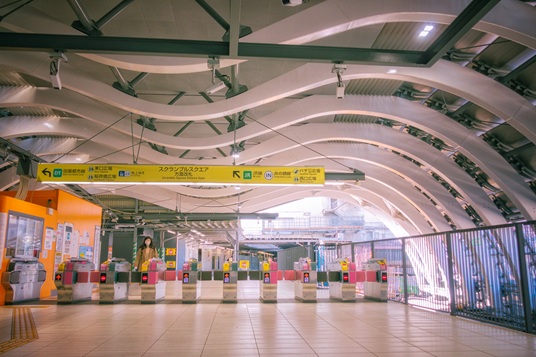
One mistake causes more confusion than almost anything else.
People arrive at a station, leave the train, unlock their phones, open Google Maps, and begin following the blue dot.
Above ground, that usually works perfectly.
Underground, however, things become much more complicated.
GPS signals often struggle to reach deep underground platforms, especially inside stations with several basement levels. Your location may jump from one side of the station to another, point in the wrong direction, or rotate unexpectedly while you are standing completely still.
Many travelers respond by walking toward whichever direction the phone suggests.
Unfortunately, that often leads them farther away from the correct exit.
A few minutes later, they finally reach street level only to discover they have emerged hundreds of meters from their hotel, restaurant, or sightseeing destination.
Now they must walk around several city blocks—or sometimes return underground and start again.
If this has happened to you before, don’t worry.
You’re certainly not alone.
The problem usually isn’t the station.
It’s the strategy.
🟨 Before You Leave the Ticket Gates, Know Your Exit
One simple habit can save an incredible amount of time.
Before you even leave the ticket gates, decide exactly which exit you need.
This sounds obvious, but many visitors skip this step because they assume all station exits are close together.
In Tokyo and other major Japanese cities, they often are not.
One exit may place you directly in front of your hotel.
Another may leave you on the opposite side of a busy intersection several hundred meters away.
Large stations sometimes have dozens of exits spread across multiple city blocks. Walking between two exits outside the station can easily take longer than riding the train itself.
Fortunately, Google Maps usually tells you exactly which exit you should use.
Instead of remembering only the station name, remember something much more important.
The exit number.
Perhaps your destination says Exit A2.
Or maybe it recommends Exit C4.
Some stations use simple numbers, while many subway stations combine a letter with a number.
That small code is one of the most valuable pieces of information you can carry.
It tells you exactly where you want to appear when you finally return to the surface.
🟨 The Yellow Signs Are Better Than Your GPS
One thing I have always appreciated about Japanese stations is that the signs are remarkably consistent.
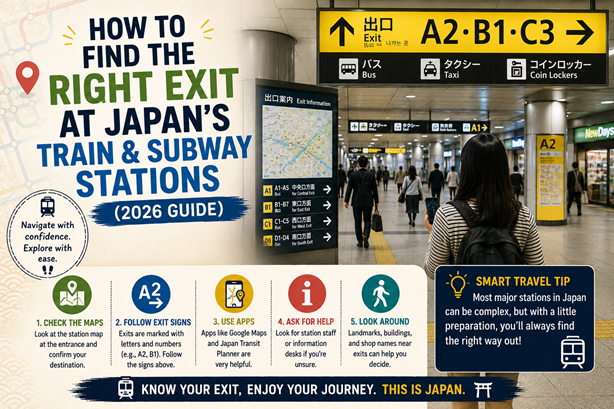
Whether you are using Tokyo Metro, Toei Subway, or many other major railway systems, you will quickly notice bright yellow signs with black lettering hanging from the ceiling.
Once you learn to recognize these signs, your confidence changes almost immediately.
Instead of constantly checking your phone every few seconds, simply look up.
The signs clearly indicate exits, platform directions, connecting railway companies, nearby landmarks, and important facilities. English is widely available, and exit numbers are displayed prominently.
If your destination requires Exit B5, ignore everything else.
Follow B5.
If you need Exit A7, continue following A7.
Think of the exit number as your destination—not the station itself.
Once I started thinking this way, even stations that had previously felt confusing suddenly became much easier to understand.
🚉 One Station Can Be Several Stations at Once
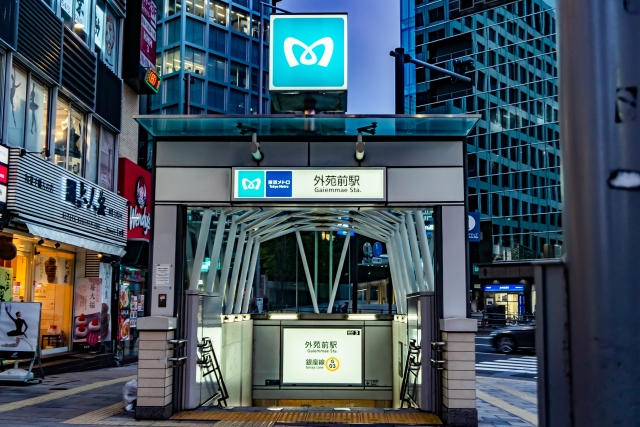
One reason Japanese stations feel so complicated is that what appears to be a single station on a map is often several different stations operating together.
Take Tokyo as an example.
A place simply labeled “Tokyo Station” may actually include JR lines, Tokyo Metro lines, underground shopping malls, department stores, office buildings, restaurants, hotels, and long underground passageways connecting nearby stations. Similar situations can be found at Shinjuku, Shibuya, Ikebukuro, Ueno, and Otemachi, where multiple railway companies share the same underground space while operating independently.
This is one of the reasons many visitors become confused.
After leaving one train, they expect to see the exit immediately.
Instead, they discover another shopping area, another ticket gate, another railway company, or another corridor leading somewhere entirely different.
At first, this can feel overwhelming.
After all, I have ridden trains and subways in New York, Chicago, Mexico City, Toronto, London, Barcelona, and Bangkok, and every city has its own navigation system. Some rely heavily on color-coded subway lines, while others make transfers relatively straightforward because there are fewer railway operators sharing the same space.
Tokyo feels different because everything is connected.
Rather than building completely separate stations, many railway companies have gradually linked their networks together over decades. For local commuters, this creates extraordinary convenience because changing trains, shopping, eating, or entering office buildings often happens without ever stepping outside.
For first-time visitors, however, that convenience can initially feel like an enormous underground maze.
Once you understand that the station itself is designed as a connected network rather than a single building, everything begins to make much more sense.
📍 Think About the Exit Before You Think About the Destination
Whenever friends ask me for advice before visiting Japan, there is one suggestion I always give.
Don’t memorize the station.
Memorize the exit.
Suppose your hotel is closest to Exit C4.
The moment you arrive at the station, forget about your hotel for a while.
Forget about Google Maps.
Forget about the street outside.
Your only objective is reaching Exit C4.
Everything else comes later.
Once you emerge from the correct exit, your phone’s GPS will immediately become much more accurate because it can receive satellite signals again. At that point, finding the hotel usually takes only a minute or two.
Many visitors accidentally reverse this process.
They leave the train, immediately begin following their phone, become confused underground, choose the wrong passageway, and finally emerge several hundred meters from where they intended to be.
The difference between these two approaches is surprisingly small.
Yet it can easily save twenty minutes of unnecessary walking in one of Tokyo’s largest stations.
🗺️ Don’t Be Afraid to Stop and Look Up
Another habit I developed after years of traveling is surprisingly simple.
Whenever I begin feeling lost underground, I stop walking.
Instead of continuing forward while staring at my phone, I look up.
Almost every time, the answer is hanging above me.
Japanese railway stations are filled with clear directional signs because millions of people depend on them every day. Commuters rarely notice how helpful these signs are because they have learned to read them almost unconsciously.
Visitors often do the opposite.
They spend so much time looking down at their phones that they miss the information already surrounding them.
The yellow signs suspended from the ceiling are designed to answer exactly the questions most travelers have.
Which exit?
Which railway company?
Which platform?
Which transfer?
Which street?
Once you begin trusting those signs, stations that once seemed intimidating gradually become much easier to understand.
🌏 Every City Has Its Own Logic
Living overseas taught me something important about transportation.
Every city develops the system that best matches its own history.
New York has its own rhythm.
London has another.
Barcelona feels completely different again.
Bangkok combines elevated trains with underground lines.
Mexico City operates one of the world’s largest metro systems.
Toronto offers a network that is compact and easy to understand.
None of these systems are wrong.
Each simply reflects the city it serves.
Japan is no exception.
The enormous railway network that surprises so many visitors exists because millions of people rely on it every day. Stations have grown together with department stores, office towers, underground shopping streets, hotels, and surrounding neighborhoods over many decades. What feels overwhelming on your first day often becomes surprisingly logical after only a few journeys.
In fact, many travelers tell me that once they understand the exit numbering system, they begin enjoying Japanese stations rather than fearing them.
The station itself becomes part of the adventure.
🇯🇵 Conclusion
Why do so many travelers get lost in Japan’s train and subway stations?
Usually, it isn’t because the stations are poorly designed.
It is because visitors are using the wrong strategy.
Rather than relying entirely on GPS underground, begin by identifying the correct exit before leaving the ticket gates. Follow the yellow directional signs, pay attention to the exit numbers, and think of your destination as Exit A2, Exit B5, or Exit C4 instead of simply “Tokyo Station” or “Shinjuku Station.”
Growing up in Japan, I rarely thought about these signs because I had learned to follow them almost automatically. Only after traveling through subway systems in New York, Chicago, Mexico City, Toronto, London, Barcelona, and Bangkok did I realize how unique Japan’s largest stations really are. They are not confusing because they are badly organized. They feel complicated because they connect an extraordinary number of railway lines, businesses, and neighborhoods into one seamless transportation network.
Once you stop trying to fight that system and instead learn how it is designed to guide you, everything changes.
The station no longer feels like a maze.
It becomes a map.
And once you know that your real destination is the correct exit, not simply the station itself, you’ll discover that navigating Japan’s trains and subways is much easier—and much more enjoyable—than you ever imagined.
🌏 Continue Exploring Life in Japan
If you found this guide helpful, you may also enjoy these practical articles designed to make traveling around Japan smoother and more enjoyable.
👉 Suica vs Welcome Suica vs PASMO: Which IC Card Should Tourists Choose? (2026 Guide)
👉 How to Beat Jet Lag When Traveling to Japan (2026 Guide)
👉 How to Use Japanese Drugstores: Hidden Essentials for Everyday Life (2026 Guide)
👉 How to Use the Shinkansen in Japan: Tickets, JR Pass, Seats & Luggage (2026 Guide)
👉 JR Pass vs IC Card: Which Is Better for Japan Travel?