
🌏 Introduction
One of the first things many visitors notice after spending time in Japan is that food changes with the seasons.
Restaurants update their menus every few months. Supermarkets gradually replace one type of fruit or vegetable with another. Convenience stores introduce limited seasonal sweets, while department store food halls proudly display signs announcing the arrival of the year’s first peaches, chestnuts, mushrooms, or mandarins. Even people who rarely cook often find themselves saying, “It’s finally the season for…” before placing something into their shopping basket.
Growing up in Japan, I never thought much about this.
It simply felt natural.
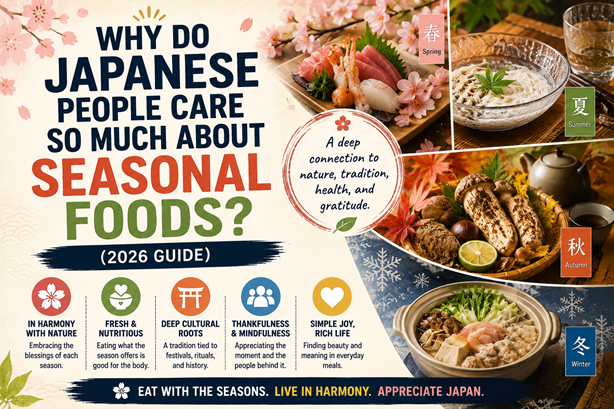
Spring meant bamboo shoots and fresh mountain vegetables. Summer brought tomatoes, cucumbers, corn, watermelon, peaches, and chilled somen noodles. Autumn filled the markets with chestnuts, sweet potatoes, pears, persimmons, mushrooms, and Pacific saury. Winter arrived together with daikon, Chinese cabbage, mandarins, and countless dishes that warmed both the body and the mind.
These foods were never just ingredients.
They were signs that another season had quietly arrived.
Only after living overseas did I realize that not every country experiences food in quite the same way.
While living in Canada and the United States, I could buy strawberries in the middle of winter without giving it a second thought. Imported produce arrived from different parts of the world, frozen foods made almost every ingredient available throughout the year, and supermarkets offered remarkable consistency regardless of the season. That convenience was genuinely impressive. It reflected extraordinary advances in agriculture, transportation, refrigeration, and global logistics.
When I returned to Japan, however, I noticed something I had almost forgotten.
People here still became excited about the arrival of seasonal foods.
Not because strawberries suddenly disappeared during winter.
Not because tomatoes became impossible to find.
But because eating something during its natural season simply felt different.
The first peaches of summer somehow tasted more meaningful than peaches available every month of the year.
The first chestnuts of autumn seemed to announce that cooler days had finally arrived.
The first mandarins of winter somehow made the season feel complete.
That experience made me ask a question I had never considered as a child.
Why do Japanese people care so much about seasonal foods?
The answer has surprisingly little to do with luxury.
Instead, it reflects the relationship between food, nature, and time itself.
🌱 Eating the Season Rather Than Simply Eating Food
In Japanese, there is an important concept called shun, often translated as “seasonality” or “food at its seasonal peak.”
Unlike nutritional labels or calorie counts, shun does not focus primarily on numbers.
Instead, it asks a different question.
When does nature itself tell us this food is ready?
That idea has shaped Japanese cooking for centuries.
Long before refrigeration, air freight, and supermarkets made almost every ingredient available throughout the year, people naturally ate what the land and sea provided during each season. Fish migrated according to changing ocean temperatures. Vegetables appeared when fields were ready for harvest. Fruit ripened under the warmth of the appropriate season. Rather than seeing these natural limitations as inconvenient, people gradually began celebrating them.
The result was a food culture that follows the rhythm of nature instead of trying to ignore it.
Even today, modern Japanese restaurants often change their menus several times each year. Kaiseki cuisine is perhaps the best-known example, but the same philosophy appears everywhere from neighborhood restaurants to convenience stores. Seasonal desserts arrive for only a few weeks before disappearing again. Cafés introduce drinks inspired by peaches, chestnuts, strawberries, or sweet potatoes depending on the time of year. Limited editions become something people genuinely anticipate.
Perhaps that anticipation is part of the enjoyment.
When something is available only briefly, we naturally appreciate it more.
🍑 The Good Fortune of Eating the First Harvest
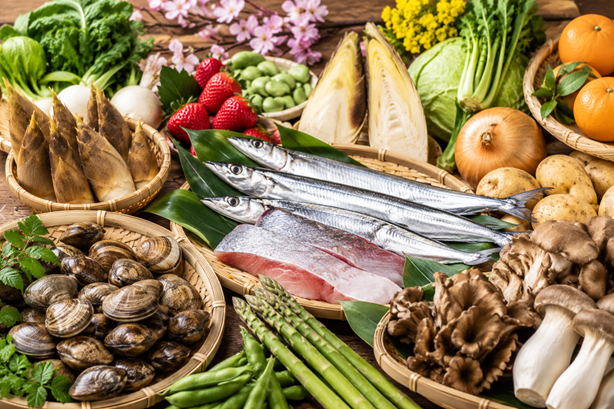
Another fascinating aspect of Japanese food culture is the idea of hatsumono, the first harvest of the season.
For generations, people believed that eating the year’s first seasonal produce brought good fortune. There is even an old saying that eating the first harvest could extend one’s life, not because people understood nutrition in the scientific way we do today, but because freshly harvested ingredients were thought to contain the greatest vitality of the new season.
Looking at this belief through modern eyes, it would be easy to dismiss it as simple folklore.
Yet I think doing so misses something important.
Whether or not anyone’s lifespan actually became longer is not really the point.
The idea encouraged people to pay attention.
Instead of treating food as something endlessly available, they noticed the exact moment when peaches first appeared in the market, when the first mushrooms emerged after summer, or when the earliest mandarins signaled the arrival of winter.
Nature became something to celebrate.
The changing seasons became visible not only through flowers or weather but also through the food placed on the dining table.
Even today, many Japanese people still become excited when they see signs advertising the season’s first harvest.
The fruit itself may not taste dramatically different from what will be available a few weeks later.
Yet eating it feels special.
Perhaps because, for that brief moment, it reminds us that another season has quietly begun.
🌍 Rediscovering Seasonal Eating Through Life Overseas
One of the unexpected things I noticed while living overseas was that many people had begun asking questions that sounded surprisingly familiar.
In Canada and the United States, supermarkets offered an astonishing variety of food throughout the year. Fresh strawberries appeared in winter, asparagus arrived long before local farms could harvest them, and vegetables from the opposite side of the world filled the shelves regardless of the season. As a consumer, it was incredibly convenient. Modern transportation and refrigeration had made it possible to enjoy almost any ingredient almost any time.
At first, I simply accepted that convenience.
Why wait for summer if peaches were already available?
Why wait for autumn if imported mushrooms could be found every month?
Technology had removed many of the limitations that previous generations had simply accepted.
Yet over time, I also noticed another movement quietly growing.
More restaurants began talking about Farm-to-Table dining. Farmers’ markets became increasingly popular. Local ingredients were celebrated, and many chefs proudly introduced the people who had grown the vegetables appearing on their menus. Discussions about food miles, sustainability, and supporting local communities became more common. Rather than asking only whether food was fresh or affordable, people also began asking where it had been grown, how far it had traveled, and whether eating locally might be better both for the environment and for the communities producing it.
Listening to those conversations reminded me of something I had almost taken for granted in Japan.
Although the reasons were not exactly the same, both approaches encouraged people to pay attention to the natural rhythm of food.
The destination was similar, even if the journey had been different.
Japan had long celebrated seasonal ingredients because they reflected the changing seasons and the natural cycle of harvest.
Many Western countries were rediscovering seasonal eating through concerns about sustainability, local agriculture, and environmental responsibility.
Neither way is necessarily better than the other.
Both simply remind us that food has a story before it reaches our plate.
🍽️ Seasonal Food Helps Us Notice Time
Perhaps this is the reason seasonal food remains so important in Japan, even when technology makes it possible to eat almost anything throughout the year.
Modern Japan certainly enjoys all the benefits of global food distribution. Supermarkets are filled with imported fruit, frozen vegetables, and ingredients from around the world. Convenience and variety have become part of everyday life.
Yet people still become excited when they hear that the first peaches have arrived.
Restaurants still advertise limited seasonal menus.
Families still look forward to the first Pacific saury of autumn or the first mandarins of winter.
If taste alone explained everything, this enthusiasm would be difficult to understand.
After all, many foods are available almost year-round.
What changes is not simply the ingredient.
It is the meaning attached to it.
Seasonal food quietly tells us that time is moving forward.
Without checking a calendar, we know autumn has arrived because chestnuts begin appearing in shops. The first bamboo shoots remind us that spring has returned. Sweet potatoes signal the cooling days of autumn, while hot pots filled with winter vegetables tell us that colder evenings are approaching.
Food becomes another way of reading the seasons.
Growing up in Japan, I never realized how naturally this happened.
Only after spending years overseas did I understand that Japanese people often experience the passing of time not only through weather, holidays, or school schedules, but also through what appears on the dinner table.
🌸 Respecting Nature Instead of Controlling It
There is another aspect of seasonal food that I have come to appreciate more as I have grown older.
Modern technology has achieved remarkable things.
It allows us to preserve food longer, transport ingredients across continents, improve nutrition, and reduce shortages that previous generations would have considered unavoidable. These achievements deserve appreciation.
At the same time, Japan has largely kept another idea alive.
Nature still deserves the final say.
Rather than expecting every ingredient to taste identical every month of the year, many Japanese people continue to welcome the fact that certain foods arrive only when nature is ready. There is something refreshing about accepting that strawberries belong to one season, chestnuts to another, and fresh bamboo shoots to yet another.
Instead of trying to erase the seasons, food allows us to experience them more deeply.
Perhaps this is why Japanese cuisine often emphasizes simplicity.
When ingredients are at their seasonal peak, they rarely need complicated preparation. Fresh peaches are enjoyed exactly as they are. Sweet corn needs little more than boiling. Grilled Pacific saury is served with grated daikon because the fish itself is the star. Even a simple bowl of rice accompanied by seasonal vegetables can communicate the arrival of a new season.
The goal is not to transform nature.
It is to appreciate it.
🇯🇵 Conclusion
Why do Japanese people care so much about seasonal foods?
The answer extends far beyond flavor.
Of course, ingredients harvested during their natural season are often fresh and delicious. But the deeper reason lies in the relationship between food and the changing seasons.
For generations, people in Japan have celebrated the arrival of the year’s first harvest, believing that hatsumono, the first produce of the season, carried good fortune and the fresh vitality of nature itself. Whether viewed as tradition, symbolism, or simple appreciation, that idea encouraged people to notice the exact moment when each season quietly arrived.
Living overseas helped me understand this in a new way.
I came to appreciate the extraordinary convenience of being able to buy almost anything at any time of year. At the same time, I also saw growing interest in Farm-to-Table dining, locally produced food, and sustainable agriculture. Different cultures may approach the subject from different directions, but many people ultimately reach the same conclusion: food tastes richer when it connects us to the place, the season, and the people who produced it.
Perhaps that is why seasonal food continues to matter in Japan today.
It reminds us that eating is not only about satisfying hunger or counting calories.
It is also one of the simplest ways to notice that the world around us is constantly changing.
Every peach, every chestnut, every bamboo shoot, and every mandarin quietly reminds us that another season has arrived.
And perhaps that awareness is one of the most nourishing ingredients of all.
🌏 Continue Exploring Japanese Food Culture
If you enjoyed learning why seasonal foods remain so important in Japan, you may also enjoy these articles exploring the stories, traditions, and philosophies behind everyday Japanese cuisine.
👉 What Is Kakuchi? Japan’s Hidden Standing Bar Culture Inside Liquor Stores (2026 Guide)
👉 The Day Japan Eats Unagi: A Summer Tradition Explained (2026 Guide)
👉 Why Does Japanese Food Come With Rice, Soup, and Side Dishes? (2026 Guide)
👉 Why Is Japanese Food Presentation So Beautiful? (2026 Guide)
👉 Why Are Japanese Convenience Store Desserts So Popular? A Sweet Part of Everyday Life (2026 Guide)
👉 What Is an Izakaya? Japan’s Casual Drinking & Food Culture Explained (2026 Guide)
👉 Japanese Curry: Why Everyone in Japan Loves It (and How It’s Different from Indian Curry)
👉 Why Is Japanese Convenience Store Food So Good? More Than Just Quick Snacks (2026 Guide)