
🧠 Introduction
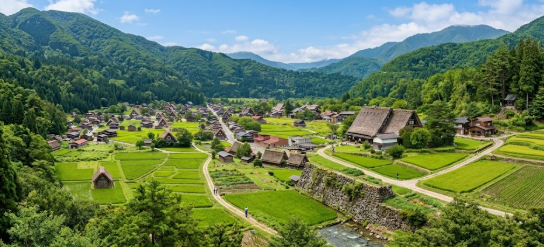
Japan is often described as a country where nature and human life exist in balance. From terraced rice fields to forested hills and quiet rural villages, the landscape itself seems carefully shaped rather than dominated.
Many visitors notice this immediately. Even in densely populated areas, there is a sense that nature is not something separate, but something integrated into daily life.
This relationship is not accidental. It is rooted in a long-standing cultural concept known as satoyama—a way of living that has evolved over more than 2,000 years.
Understanding satoyama helps explain not only Japan’s landscapes, but also its values, behaviors, and approach to sustainability.
🧩 What Is Satoyama?
Satoyama refers to a transitional landscape between mountains and human settlements. It includes forests, farmland, irrigation systems, and villages that are managed together as one interconnected environment.
Rather than leaving nature untouched or fully industrializing it, satoyama represents a middle path:
- people use natural resources
- but also maintain and regenerate them
This creates a continuous cycle in which human activity and ecological balance support each other.
In this system, nature is not something to conquer—it is something to live with.
🌿 1. A System of Mutual Dependence
One of the key ideas behind satoyama is mutual dependence.
Forests provide:
- firewood
- building materials
- water sources
Farmland provides:
- food
- open space
- biodiversity
At the same time, human management—such as controlled harvesting and irrigation—helps maintain these environments.
This relationship is neither purely natural nor purely artificial. It is a carefully maintained balance that has been passed down through generations.
🧠 2. Cultural Roots: Respect for Nature
Satoyama is deeply connected to Japanese spiritual beliefs.
In Shinto, natural elements such as trees, rivers, and mountains are believed to contain kami—spiritual presences. This belief encourages a sense of respect rather than control.
Instead of viewing nature as a resource to exploit, it is seen as something that deserves care and consideration.
This mindset influences everyday behavior in subtle ways, from seasonal awareness to the careful use of materials.
🔄 3. Sustainability Before the Modern Era
Long before the word “sustainability” became popular, satoyama functioned as a sustainable system.
Resources were:
- reused
- recycled
- carefully managed
For example:
- fallen leaves were used as fertilizer
- wood was harvested without destroying forests
- water systems were shared and maintained collectively
Nothing was wasted, and long-term balance was always considered.
🌏 4. Why It Still Matters Today
Modern Japan is highly urbanized, yet the influence of satoyama remains.
You can still see its impact in:
- seasonal foods and traditions
- landscape design
- environmental policies
- community-based resource management
At the same time, satoyama areas face challenges such as aging populations and reduced maintenance. Efforts are now being made to preserve these landscapes, not only for ecological reasons but also for cultural heritage.
⚖️ 5. A Different Model of Human–Nature Relationship
In many parts of the world, the relationship with nature is often framed as a choice between preservation and development.
Satoyama offers a different perspective:
- not untouched wilderness
- not full industrialization
Instead, it shows that coexistence is possible when systems are designed with balance in mind.
This approach does not aim for perfection, but for continuity.
🧭 6. What Travelers Can Learn
Even for visitors, satoyama is not just something to observe—it is something to experience.
You may notice:
- how landscapes are maintained
- how seasons are reflected in food
- how communities interact with their environment
Taking time to recognize these patterns can change the way you see Japan.
It becomes less about sightseeing and more about understanding a way of life.
🇯🇵 Conclusion
Satoyama is more than a rural landscape. It is a philosophy that reflects how Japan has lived with nature for centuries.
It represents a balance between use and preservation, between human needs and environmental continuity.
In a world searching for sustainable solutions, satoyama offers a quiet but powerful idea:
living with nature, rather than against it.
🔥 Go deeper into Japan
・Why Are Japanese Trains So Quiet? The Unspoken Rules Behind the Silence
・Why Do Japanese People Bow? Meaning, Types, and When to Do It (2026 Guide)