
🌏 Introduction
One of the first surprises many visitors experience in Japan has nothing to do with trains, temples, or food.
It is trash.
More specifically, the strange moment when you finish a drink, look around for a trash can, and realize there isn’t one.
Not at the station.
Not on the sidewalk.
Not in the park.
Not where you expected.
For many travelers, this becomes an immediate mystery.
Japan often feels remarkably clean, yet public trash cans seem surprisingly rare.
So where does all the garbage go?
And more importantly—what are you supposed to do with yours?
This is one of the most practical questions foreign visitors ask, and honestly, the confusion makes sense.
In many countries, public trash cans are everywhere. Throw something away, move on, and never think about it.
Japan often works differently.
But the explanation is more practical than mysterious.
And once you understand how daily life handles trash, it becomes much less frustrating.
🎯 Quick Answer
Japan has relatively few public trash cans compared with many countries, especially in busy public spaces.
This is linked to a mix of security concerns, waste management systems, and cultural habits around personal responsibility for trash.
In practical terms, the simplest solution is usually this:
carry a small bag, keep your trash with you temporarily, and dispose of it properly when you return to a station, convenience store, hotel, or home.
It may feel inconvenient at first, but it quickly becomes manageable.
🗑️ Why Are There So Few Trash Cans?
The short answer is that there is no single reason.
Many visitors hear one explanation and assume that is the entire story, but reality is more layered.
One commonly mentioned factor is security.
After the 1995 Tokyo subway sarin gas attack, many public trash cans were removed or reduced in certain places because unattended containers created security concerns.
That historical context still influences infrastructure decisions in some areas.
But that is not the whole explanation.
Japan’s waste disposal systems are also more structured than many visitors expect.
Trash is often carefully sorted.
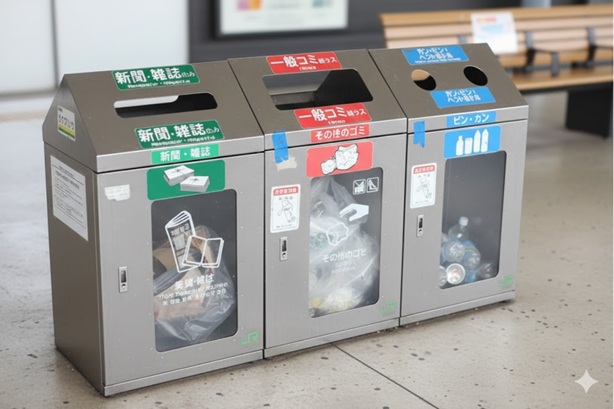
Burnable waste, plastics, bottles, cans, and paper may all be handled differently depending on the area.
Because disposal is more controlled, random public bins are less central to daily life than in some other countries.
There is also a practical cultural habit: many people simply carry small amounts of trash until they find the right place to dispose of it.
That habit can feel strange if you are not used to it.
But for many residents, it is normal.
🇯🇵 How Do Japanese People Handle Trash?
This is the part visitors often wonder about.
If there are so few bins, what does everyone else do?
The simple answer is: they carry it.
A finished drink bottle might stay in a bag until reaching home, work, or a designated recycling point.
Food packaging may be carried temporarily until a proper disposal option appears.
This is not because people enjoy carrying trash around.
It is simply part of everyday life.
From a young age, many people in Japan become used to managing their own waste rather than expecting a public bin to appear immediately.
That does not mean Japan is uniquely disciplined or morally superior.
Different countries simply build different habits around infrastructure.
But if you visit Japan, adapting to this expectation makes life much easier.
🏪 Can You Use Convenience Store Trash Cans?
This is one of the most common practical questions.
The answer is: sometimes, but with context.
Some convenience stores have trash bins, especially near drink areas or exits.
Others do not.
And some stores have reduced access to bins over time.
Generally speaking, if you purchased something at that store, disposing of related trash there is usually understood.
Walking into a convenience store only to dump unrelated garbage from earlier in the day is less ideal.
The key idea is simple courtesy.
Convenience stores are businesses, not public waste disposal centers.
That said, if you bought your coffee or snack there, using the store’s bin is usually normal.
🚉 What About Train Stations?
Stations are another place visitors naturally expect bins.
And sometimes they exist.
But not always where you want them.
Large stations may have trash or recycling bins near vending machines, ticket areas, or specific exits.
Smaller stations may have none.
One important detail: bins near vending machines are often intended only for bottles, cans, or drink containers.
They are not general trash cans.
Trying to stuff food wrappers into them usually creates problems.
So while stations may help, they are not a guaranteed solution.
🥤 Why Are There Bins Next to Vending Machines?
This confuses many visitors.
Japan has vending machines everywhere.
So why are trash cans rare—except right next to drink machines?
The answer is practical.
Those bins exist mainly for containers purchased from that machine or nearby machines.
They are part of beverage recycling systems, not general public trash disposal.
That is why you may see separate openings for cans, bottles, or PET bottles.
Dropping lunch packaging there is not what they are intended for.
🏨 Hotels Are Your Friend
For travelers, the easiest solution is often your hotel.
If you are staying somewhere, this becomes your most reliable disposal point.
Finished shopping packaging, receipts, snack wrappers, and other ordinary waste can usually be handled there appropriately.
This is one reason many experienced travelers stop stressing about finding immediate public bins.
Not every piece of trash must disappear instantly.
Sometimes carrying it for a while is simply easier.
🎒 Carrying a Small Trash Bag Helps
This may be the single most useful habit.
A small plastic bag or reusable pouch makes the whole issue dramatically easier.
Instead of frustration, you simply store:
drink bottles
snack wrappers
tissues
receipts
small packaging
until you find a proper disposal place.
It sounds simple because it is.
Many travelers who struggle with Japan’s trash situation are really struggling with expectation mismatch.
Once expectations adjust, the inconvenience becomes minor.
🌿 Is This Why Japan Feels Clean?
Partly—but not entirely.
It is tempting to assume fewer trash cans somehow directly create cleaner streets.
Reality is more complicated.
Cleanliness reflects many overlapping factors:
social habits
waste systems
private cleaning
business maintenance
community expectations
individual behavior
The absence of public bins alone does not magically create cleanliness.
In fact, in some places, fewer bins could create the opposite.
So the better interpretation is this:
Japan’s approach to waste works because infrastructure and social habits developed together.
😅 What Travelers Usually Get Wrong
The most common mistake is assuming disposal should be immediate.
That expectation creates unnecessary stress.
Another mistake is treating any visible container as a public trash can.
Not all bins are for general waste.
And perhaps the biggest misunderstanding is assuming locals somehow have a secret disposal system visitors do not know about.
They usually do not.
They are simply carrying their trash until later.
Once you realize that, the whole mystery becomes much less mysterious.
🌏 Final Thoughts
Yes, Japan can feel inconvenient when you cannot find a trash can exactly when you want one.
That frustration is understandable.
But once you understand how daily life works, the situation becomes easier to navigate.
The solution is usually simple: carry your trash temporarily, use appropriate disposal points, and adjust expectations.
In a way, this small inconvenience reveals something interesting about everyday life in Japan.
Not a grand philosophy.
Not a national virtue.
Just a slightly different practical habit.
And once you get used to it, it becomes surprisingly normal.
What is public trash disposal like where you live? Are bins everywhere, or do people carry things until later? It would be fascinating to compare how different countries handle such an everyday problem.
🔗Explore more of Japan
・Why Do Adults in Japan Read Manga? More Than Just Entertainment (2026 Guide)
・Why Do Japanese People Wear Masks? The Cultural Meaning Behind It
・Ekiben in Japan: Why Bento on Trains Is Special (Where You Can Eat It)