
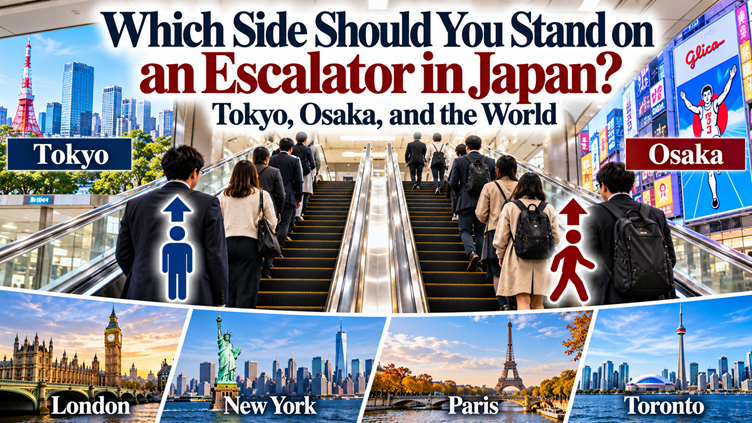
🚇 Japan vs. the World: Which Side Do People Stand On?
| City / Region | Traditional convention |
|---|---|
| 🇯🇵 Tokyo | Stand left, walk right |
| 🇯🇵 Osaka / Kansai | Stand right, walk left |
| 🇬🇧 London | Stand right, walk left |
| 🇺🇸 New York | Stand right, walk left |
| 🇫🇷 Paris | Stand right, walk left |
| 🇨🇦 Toronto | Stand right, walk left |
At first glance, this seems like a simple travel question: which side should you stand on when you ride an escalator in Japan? But the moment you travel beyond Tokyo, the question becomes much more interesting. In Tokyo, people traditionally stand on the left and leave the right side open. In Osaka and much of the Kansai region, the familiar pattern is reversed: people stand on the right and leave the left side open.
Then you travel overseas and discover something even stranger. London, despite having left-hand road traffic, traditionally has people standing on the right. New York, Paris, and Toronto also commonly follow the right-side-standing pattern. So the side of the road is clearly not the whole explanation. And in Japan today, even the old question of “left or right?” is beginning to change, because transport operators and the national government are increasingly asking passengers not to walk on escalators at all, but to stand still in two rows.
That means the escalator is a surprisingly good place to observe everyday social behavior. There are no large signs explaining Japanese society in philosophical terms. People simply get on, look at what everyone else is doing, and position themselves accordingly. Yet that tiny decision reveals regional habits, urban history, ideas about consideration, the influence of crowd behavior, and even the way a social rule can continue long after people have forgotten where it came from. The story of the Japanese escalator is therefore not really about an escalator. It is about how an everyday rule is born, spreads, becomes invisible, and eventually begins to change.
🚶 The First Question: Does Escalator Etiquette Follow Road Traffic?
It is a perfectly reasonable assumption. Japan drives on the left, so perhaps people stand on the left side of escalators for the same reason. Countries that drive on the right might therefore be expected to stand on the right. But London immediately breaks that theory. Britain drives on the left, yet the traditional London Underground practice is to stand on the right and leave the left side for people who want to walk. Transport for London has long used “Stand on the Right” guidance on its escalators.
This simple fact is enough to show that road traffic and escalator positioning are related only loosely, if at all. The two systems developed under different circumstances and for different purposes. An escalator is not a miniature road, and the people using it are not navigating lanes in the same way that cars do.
This is actually useful for understanding Japan. Tokyo’s left-side habit should not be treated as an automatic extension of Japan’s left-hand traffic system. It is better understood as a social convention that developed in particular urban environments and was reinforced by millions of repeated everyday interactions. People stand where other people stand because it makes the flow predictable. Over time, that predictability begins to feel like a rule even if nobody remembers when the rule was invented.
That is one of the most fascinating characteristics of escalator etiquette. It often feels older and more official than it actually is.
🇯🇵 Why Does Tokyo Stand on the Left?
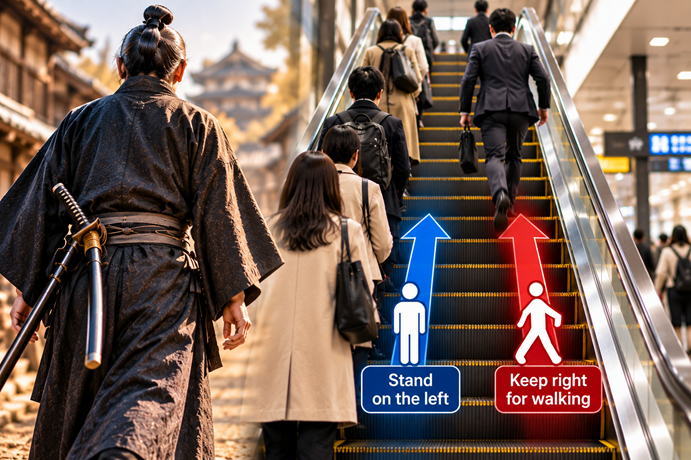
If you ask people why Tokyo stands on the left, one explanation appears again and again: the habit is connected to Japan’s older tradition of keeping to the left when moving through crowded spaces, and a particularly memorable version of the story connects that tradition to samurai carrying swords at their left side. According to this popular explanation, walking on the left reduced the chance of sword scabbards colliding when two warriors passed each other. It is an appealing story because it connects a modern train-station behavior with an instantly recognizable part of Japanese history.
There is just one problem: it is difficult to prove that this is the direct historical origin of Tokyo’s modern escalator etiquette. The samurai explanation has become part of popular storytelling, but the available historical evidence does not establish a clean line from sword-carrying etiquette to people standing on the left side of Tokyo escalators centuries later. Even the development of escalator side-separation in Tokyo appears to be much more recent than the samurai period. Research collected by Japan’s National Diet Library describes the practice of separating one side for walking as something that developed gradually, with Tokyo’s habit becoming common around the late 1980s and 1990s rather than existing unchanged for hundreds of years.
That distinction is important, but it does not make the samurai story useless. In fact, it is interesting precisely because it shows how modern social habits acquire historical explanations. Once people see that Japan traditionally walked on the left in various contexts, it feels natural to connect that behavior with the modern left-side escalator convention. Whether or not the sword story caused the behavior, it provides a memorable cultural narrative for explaining why the left feels intuitively correct in Tokyo.
The more defensible story is therefore two-layered. Japan certainly has a long history of left-side movement in various settings, and Tokyo eventually developed its own left-standing escalator convention. But the direct origin of the modern escalator rule appears to be much more recent and much less dramatic than the samurai story suggests.
🏙️ Tokyo’s Escalator Rule Is Newer Than It Feels
This is one of the most surprising facts about escalator etiquette. Ask a Tokyo commuter and the left-side habit can feel like something that has simply always existed. Yet historical accounts suggest that escalator side separation in Tokyo became common only toward the end of the twentieth century. Earlier photographs and reports do not show the modern left-standing, right-walking pattern as an eternal rule. Instead, the habit seems to have emerged as cities became more crowded, escalators became more common, and people began informally making space for faster passengers.
That makes sense when you think about the practical problem. Imagine a crowded station where most passengers are happy to stand still, but a few people are rushing to catch a train. If everyone spreads randomly across the escalator, passing becomes difficult. If the crowd naturally divides into a standing side and a walking side, movement becomes more predictable. Once enough people follow the pattern, newcomers simply imitate them.
No government needs to pass a law saying, “From today, everyone must stand on the left.”
The behavior becomes a convention because everyone else is already doing it.
This is one reason escalator etiquette is such a useful example of how social rules develop. A behavior can become so common that people eventually believe it must have been deliberately designed, even when it may have emerged gradually from ordinary human behavior.
🇯🇵 Why Does Osaka Stand on the Right?
Now we reach the regional difference that fascinates almost every visitor who spends time in both Tokyo and Osaka. In Tokyo, the traditional pattern is stand left and walk right. In Osaka, the pattern is reversed: stand right and walk left. For someone who has just learned the Tokyo rule, arriving in Osaka can create a moment of confusion. The escalator looks exactly the same, but suddenly everyone seems to be standing on the opposite side.
The most widely repeated explanation connects Osaka’s habit with the 1970 Osaka Expo. The story is that the enormous international event brought visitors from around the world into Osaka, and organizers wanted the city to use a more internationally familiar escalator pattern, with people standing on the right and leaving the left open for those who wanted to pass. The 1970 Expo is therefore often remembered as an important turning point in the development and popularization of Osaka’s right-standing convention.
There is another layer to the story, however. Historical accounts also point to earlier practices in Osaka’s railway system, including guidance associated with Hankyu’s Umeda station, where passengers were encouraged to keep to the right and leave the left side open for people in a hurry. Some accounts place this development around the period before or around the Expo itself. In other words, the Expo may have helped spread or reinforce a rule that was already emerging rather than creating the entire convention from nothing.
That is a much more interesting story than simply saying, “The Osaka Expo invented it.” A huge international event clearly provided an environment in which a particular practice could become highly visible and widely shared, but everyday transport behavior is rarely created by one announcement on one day. Habits need to be repeated before they become culture.
So if you are standing on the right side of an Osaka escalator today, you are participating in a regional convention that has been shaped by railway practice, crowd behavior, urban history, and the huge international visibility of the 1970 Osaka Expo.
🗺️ Tokyo and Osaka Show Something Important About Japan
The Tokyo-Osaka difference is especially revealing because it exists inside the same country. Japan is not divided by an international border at the point where people change from left-standing to right-standing. You do not need a new passport, a new language, or a different currency. You simply travel west, step onto an escalator, and discover that the unwritten rule has changed.
This is a useful reminder that “Japanese culture” is not one uniform thing. Regional habits can become deeply established even when they have no legal status and no nationwide standard. People learn the rule by watching others. The moment they enter a different social environment, the rule changes.
Research observing stations along the route between Osaka and Nagoya has even found that the shift between standing on the right and standing on the left is not a perfectly sharp boundary. The proportion of passengers using one side changes gradually across the region. That is exactly what we would expect if escalator etiquette were a cultural convention carried by local social environments rather than a national law.
The escalator therefore becomes a tiny map of regional culture.
Tokyo says one thing.
Osaka says another.
Neither side necessarily thinks the other side is “wrong” in a serious sense. Each group is simply following the pattern it has learned.
🌍 What Happens in London, New York, Paris, and Toronto?
Once you leave Japan, the right-side pattern becomes much more common. London traditionally asks passengers to stand on the right and leave the left side for those who wish to pass. This is particularly interesting because Britain drives on the left, which immediately destroys the assumption that escalator etiquette simply follows road traffic. New York has a strong social convention of standing to the right and allowing people to pass on the left, particularly in busy subway environments. Paris has also traditionally followed the right-standing, left-passing pattern on escalators, and Toronto has long had a similar convention in its public transit system.
These similarities do not mean that every passenger behaves perfectly or that every station uses exactly the same signage. Urban etiquette is always messier in reality. People stand wherever there is space, groups sometimes occupy the entire width, and tourists often have no idea which side to choose. Yet the broad pattern is recognizable enough that a traveler moving between these cities can usually identify it quickly.
This is why Tokyo is the surprising one for many international visitors. If they have traveled through London, New York, Paris, or Toronto, they may already have developed an expectation that “right is the normal side.” Then they arrive in Tokyo and discover that the crowd has reversed the pattern.
And then they go to Osaka and discover that the Japanese exception has reversed again.
🚇 Escalator Etiquette Is Really About Social Coordination
There is a larger principle behind all of this. Escalators are simple machines, but a crowded escalator is a small social system. Everyone is moving in the same direction, everyone has limited space, and everyone needs to predict what everyone else is going to do. A standing convention reduces uncertainty.
You do not need to ask the person in front of you where they will stand.
You do not need to negotiate with the people behind you.
You look at the crowd and follow the pattern.
This is exactly how many informal social rules work. They are powerful because they do not need to be explained every time. Their value comes from shared expectation.
The problem is that a convention designed for one purpose can eventually create new problems when the environment changes.
That is exactly what is happening with escalators.
⚠️ The Old Rule Is Now Being Questioned
For many years, the practical advice in Japan seemed simple: stand on your regional side and leave the other side open for people who are walking. But Japan is now increasingly questioning whether that convention is actually the safest or most efficient way to use an escalator.
As of 2026, the national government and major transport operators are actively promoting a different approach: stand still and use both sides in two rows. The reason is partly safety. Walking on a moving escalator increases the possibility of losing balance, falling, colliding with another passenger, or causing a chain reaction involving people behind you. It can also create problems for passengers who need to hold the handrail on a particular side, for small children who benefit from standing beside a parent or guardian, and for people with mobility limitations or other physical needs.
The second reason is surprisingly counterintuitive: efficiency.
Many people assume that leaving one side open must move more people because some passengers are walking. But experiments involving escalator traffic have shown that when enough people stand on both sides, the total number of people transported can actually be higher than when half the escalator is left open for walkers. Japanese government materials now cite a London experiment from 2015 in which two-sided standing increased transport efficiency by roughly 30 percent compared with leaving one side open.
That produces a fascinating reversal.
The old rule was based on the intuition that individual speed helps everyone move faster.
The newer approach is based on the idea that collective consistency can move more people overall.
🧍🧍 Why Two Rows Can Be Better Than One Fast Lane
Imagine a wide escalator. In the traditional arrangement, one side fills with stationary passengers while the other becomes a narrow walking lane. The walking lane may contain people moving quickly, but the standing half of the escalator is not being used to its full capacity.
Now imagine both sides filled with people who are standing still.
No one is overtaking.
No one is trying to squeeze past a slower passenger.
No one has to suddenly stop because someone ahead has stopped.
The entire width of the escalator is being used to transport people upward.
This does not mean that the two-row system will feel faster to an individual person who is desperate to reach the platform in the next thirty seconds. That person may still prefer the old system because walking feels faster. The difference is between individual convenience and overall system efficiency.
That distinction is important in many areas of public life. A system can feel faster from the perspective of one person while actually moving fewer people as a whole.
The escalator debate is therefore much bigger than etiquette.
It is a small lesson in how individual behavior and collective efficiency do not always point in the same direction.
🛡️ Safety Changes the Question
The safety issue also makes the old left-versus-right discussion less important. An escalator is not designed to be a staircase. The steps are moving, the space is narrow, and passengers are standing on a moving surface while often carrying bags, luggage, children, or other belongings. If someone loses balance while walking, the consequences can extend beyond that individual.
There is also the issue of people who cannot safely follow the old one-sided pattern. A parent may want to stand beside a young child. Someone with a physical disability may need one particular handrail. A person with limited balance may need the stability of standing without feeling pressured to move aside. A caregiver may need to remain next to the person they are assisting.
The old etiquette assumes that the second lane should be available to someone who wants to walk.
The newer safety approach asks a different question: Should that lane exist at all if it creates pressure for everyone else?
That is why the shift toward two-row standing is more than a new piece of station signage. It represents a reconsideration of what the escalator is supposed to do.
🔄 From “Which Side?” to “Should Anyone Walk?”
This is the part that makes the subject especially interesting in 2026.
For decades, the question in Japan was easy to understand.
Tokyo?
Stand left.
Osaka?
Stand right.
Visitors could memorize the rule and move on.
But increasingly, that is no longer the most useful question.
The more current question is whether passengers should stand on both sides and stop walking altogether.
Tokyo Metro now asks passengers to hold the handrail and remain stationary, and it specifically encourages two-row use to help reduce congestion. In 2026, a national campaign involving railway operators and other organizations has also emphasized standing still rather than walking on escalators.
This creates an unusual situation. A cultural habit that once existed because everyone copied everyone else is now being reconsidered for exactly the same reason.
If enough people continue to walk, an individual who wants to stand still may feel uncomfortable doing so.
If enough people begin standing in two rows, the social pressure reverses.
The behavior of the crowd changes the behavior of the individual.
That is how informal rules are born, and that is also how they disappear.
🧠 Why Travelers Should Not Treat the Old Rule as Absolute
For a foreign visitor, the safest practical approach is not to memorize Tokyo and Osaka as rigid commandments and then become frustrated when reality does not perfectly match the rule. Stations can be crowded, people may stand in the center, groups may block both sides, and the current campaign toward two-row standing is changing expectations. What matters most is to look at the signs and follow the current behavior requested by the station.
If everyone around you is standing still in two rows, do not assume that an empty-looking side automatically means “walking lane.” If the station specifically asks passengers to stand still, follow that instruction. And wherever you are, holding the handrail and avoiding sudden movement is more important than winning the left-versus-right debate.
The old convention is still culturally relevant because it explains why Tokyo and Osaka feel different. But it is no longer the whole story of escalator etiquette in Japan.
🌏 A Tiny Escalator Tells a Bigger Story About Japan
What I find most interesting about this subject is how much history is contained in such a small space. A person steps onto an escalator and moves upward for perhaps thirty seconds. During that short time, they participate in a regional custom that may have emerged from crowded railway stations, been reinforced by millions of commuters, been explained through stories about Japan’s left-side traditions, and been shaped by events such as the 1970 Osaka Expo.
Then, in the present day, the same society begins questioning the convention because new evidence and new concerns change the balance between convenience, safety, accessibility, and efficiency.
The Tokyo-left and Osaka-right distinction is therefore not some eternal rule encoded into Japanese culture. It is a living example of how social behavior develops.
The samurai sword story is memorable.
The Osaka Expo story is memorable.
The railway-station stories are memorable.
But the deeper lesson is simpler: people start doing something because it seems useful, other people copy it, the behavior becomes predictable, predictability turns into etiquette, etiquette becomes culture, and eventually a new generation asks whether the old habit still makes sense.
That process is happening now on Japan’s escalators.
So, which side should you stand on?
The traditional answer depends on where you are.
Tokyo: left.
Osaka: right.
London, New York, Paris, Toronto: traditionally right.
But the increasingly important answer in Japan is becoming much simpler.
Stand still. Hold the handrail. Use both sides when requested. Let the escalator do the moving.
The fascinating part is not that Japan has different escalator rules.
It is that something as ordinary as where you put your feet can reveal how a society creates, follows, and eventually changes its unwritten rules.
🔗 Explore More Everyday Life in Japan
For more practical insights into the small rules and habits that shape everyday life in Japan, explore the Life in Japan series below.
👉 Staying at a Japanese Ryokan: What to Know About Dinner, Yukata, Tatami, and Onsen Etiquette
👉 How Much Japanese Yen Do You Need in Japan? Cash, Cards, and How Much to Carry
👉 Why Is Smoking in Japan So Different? Smoking Areas, Hotels, Restaurants, and City Streets (2026 Guide)
👉 Japanese Hotel Amenities: What Can You Take Home? Amenities, Facilities, and Ryokan vs Hotel (2026 Guide)