
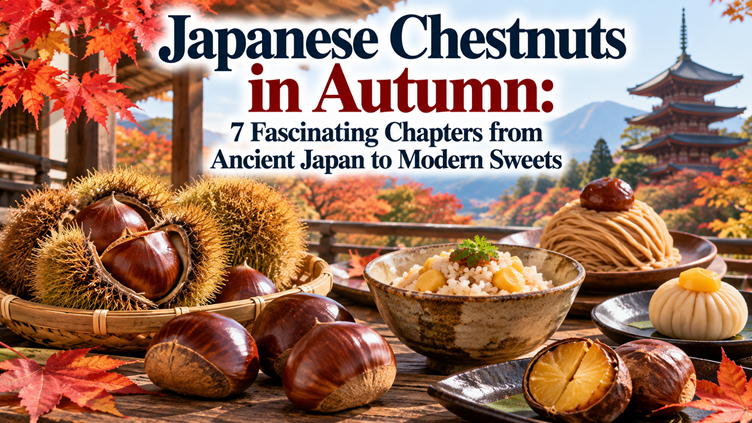
🌰 Introduction: When Chestnuts Mean Autumn
There are certain foods that seem to announce a season before you even think about the calendar. In Japan, chestnuts are one of them. When chestnuts begin appearing in supermarkets, wagashi shops, bakeries, cafés, and autumn menus, something about the atmosphere changes. Their earthy sweetness, rough brown shells, pale yellow flesh, and warm aroma belong so naturally to autumn that it can be difficult to imagine the season without them. Yet chestnuts are far more than a seasonal ingredient that appears for a few weeks each year. The relationship between people in Japan and chestnuts reaches back thousands of years, long before modern Japanese cuisine existed and long before rice became the foundation of the country’s food culture.
Today, chestnuts can appear in an incredibly wide range of forms. They can be boiled or roasted and eaten almost as they are, mixed into rice, added to festive dishes, preserved in syrup, cooked with their inner skin, shaped into traditional sweets, folded into rice cakes, placed inside monaka, incorporated into yokan, or transformed into modern desserts such as chestnut Mont Blanc.
The same ingredient can therefore appear in a very simple home meal and in a highly refined confectionery shop. That continuity is what makes chestnuts especially interesting. They are not simply one more autumn food in Japan. They are part of a very long story connecting ancient food gathering and cultivation, seasonal cooking, regional traditions, family meals, religious and agricultural customs, traditional confectionery, and contemporary Japanese dessert culture.
The story of Japanese chestnuts is therefore not really a story about one ingredient. It is a story about how Japan has repeatedly found new ways to eat, preserve, celebrate, refine, and reinterpret the same seasonal food.
🌳 1. A Relationship That Began Long Before Modern Japanese Cuisine
The history of chestnuts in Japan reaches back into prehistoric times. Archaeological evidence from ancient settlements shows that chestnuts were already an important food resource for people living in the Japanese archipelago thousands of years ago. One of the most famous examples is Sannai Maruyama in present-day Aomori, where large quantities of chestnut remains were discovered alongside evidence suggesting that chestnut trees were deliberately managed and cultivated. Chestnut wood was also useful as a material, which meant that the tree could provide more than food. In other words, chestnuts were part of a broader relationship between people and the landscape rather than simply something collected casually when the season arrived.
This is an important part of the story because it changes the way we think about the phrase “Japanese autumn food.” For a modern consumer, chestnuts can feel like a seasonal luxury that appears in desserts for a limited time. For people living in ancient Japan, chestnuts were connected much more directly with survival, food storage, and the management of useful plant resources.
Archaeological evidence of chestnut storage also suggests that people were not only eating what they gathered immediately. They were finding ways to keep an important food resource available beyond the moment of harvest. That ability to preserve seasonal abundance is one of the themes that continues throughout Japanese food culture. Autumn produces something valuable, and people find ways to carry part of that autumn forward.
The rice-centered image of traditional Japanese food can sometimes make it easy to forget how important other plants were in earlier periods. Chestnuts belonged to a much older layer of food culture, one that existed before the familiar agricultural landscape of modern Japan had fully developed. When you eat chestnut rice today, therefore, you are not simply eating a modern autumn dish. You are participating in a food tradition whose basic relationship with the chestnut has roots that reach far back into the history of the Japanese islands.
🧺 2. Chestnuts Were Not Only Eaten; They Had to Be Managed and Preserved
One of the most interesting things about chestnuts is that they sit between the wild and the cultivated, the seasonal and the stored. A chestnut tree can produce an abundance of food during a relatively limited period, which makes the question of preservation important. Ancient communities needed to understand where useful trees were located, how to manage them, when to gather the nuts, and how to protect part of the harvest for later use. That is why the archaeological evidence surrounding ancient chestnut use is so valuable. It reveals not only what people ate, but how closely human life was organized around the seasonal availability of food.
That pattern survives in much later Japanese food traditions. Chestnuts can be cooked and eaten fresh, but they can also be transformed into preparations that extend their useful life. Sugar became an important preservation method in later confectionery and cooking traditions, while techniques such as simmering and cooking chestnuts in their skins created other ways to enjoy the harvest beyond the moment when the nuts first fall. Modern households can also freeze chestnuts or use processed chestnut products, making it possible to eat them long after the autumn harvest has passed.
This is why chestnuts are particularly interesting when viewed through the idea of seasonality. Seasonal food is often associated with freshness, but Japanese food culture has also developed many ways to preserve the season. Pickling, drying, fermenting, salting, sugaring, and other methods can take something abundant at one point in the year and transform it into something that can be enjoyed later. Chestnuts fit naturally into that broader pattern. The chestnut announces autumn, but human skill allows autumn to remain on the table for much longer.
🍚 3. Chestnut Rice: The Autumn Flavor of the Everyday Japanese Table
Among all the ways of eating Japanese chestnuts, chestnut rice may be one of the clearest expressions of their place in everyday seasonal cooking. Chestnuts are peeled, prepared, and cooked together with rice, usually with a relatively simple seasoning that allows the natural flavor of the chestnut to remain obvious. The combination may include salt, dashi, sake, or small variations depending on the household and region, but the essential idea is remarkably simple: rice and chestnuts are cooked together so that the sweetness and texture of the chestnuts become part of an ordinary meal.
That simplicity is important. Chestnut rice does not need an elaborate sauce or complicated arrangement to make the ingredient feel special. The slightly sweet, starchy chestnut sits among the grains of rice and changes the character of the entire dish. The rice provides a gentle savory foundation, while the chestnut contributes a warm sweetness and a soft, slightly crumbly texture. It feels seasonal without being theatrical. A family does not need to visit a famous restaurant to experience autumn. The season can arrive at the dinner table.
There is also something particularly Japanese about how such a simple dish can carry a strong sense of time. You may eat rice throughout the year, but when chestnuts appear inside it, the meaning of the meal changes. It becomes an autumn meal. The ingredient functions almost like a seasonal marker. This is one of the reasons Japanese food culture is so closely connected with the calendar. A dish does not have to be rare to be meaningful. Sometimes the addition of one seasonal ingredient is enough to make an ordinary dinner feel connected to a particular moment in the year.
🌙 4. Chestnuts and the Autumn Moon
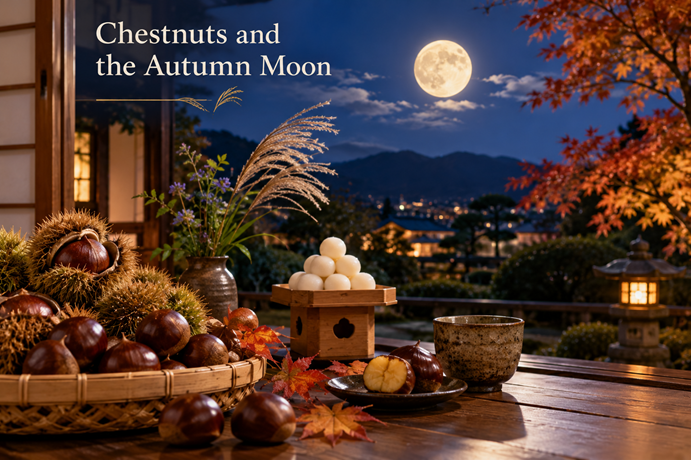
Chestnuts become even more interesting when they are connected to Japan’s traditions of moon viewing. The fifteenth night of the eighth month in the traditional lunar calendar is widely associated with the autumn moon, but there is also the thirteenth night, known as another important autumn moon-viewing occasion. This later autumn observance has traditionally been associated with chestnuts and beans, which is why the night is sometimes called Chestnut Moon in English descriptions.
The important idea here is that the chestnut is no longer simply a food that happens to be available in autumn. It becomes part of the symbolic language of the season. The harvest, the moon, the changing weather, and the foods appearing at the same time of year all reinforce one another. People can look at the autumn sky, eat seasonal foods, and participate in a tradition that connects the present moment with generations before them.
This is one reason seasonal Japanese foods can feel different from foods that are simply “in season.” The ingredient can become connected with a wider cultural atmosphere. A chestnut is still a chestnut, but when it is associated with moon viewing, autumn harvests, seasonal sweets, and family meals, it acquires a cultural meaning that goes beyond nutrition. Food becomes part of the calendar.
🍂 5. From Family Meals to Regional Traditions
Chestnuts have never belonged to one single Japanese cooking tradition. Different regions developed different ways of using them, and local varieties and agricultural conditions helped shape their identity. Today, areas such as Ibaraki, Gifu, Nagano, and Hyogo are strongly associated with chestnuts, but their chestnut cultures are not identical. Some places are known particularly for chestnut production, others for confectionery, and others for dishes and preservation methods that have become associated with local food traditions.
This regional diversity is one of the best ways to understand Japanese food culture. A Japanese food does not necessarily become important because the entire country eats it in exactly the same form. Instead, an ingredient can travel through different regions and acquire different meanings. One region may emphasize the raw ingredient, another may turn it into a confection, and another may associate it with a festival or seasonal household dish.
The story of chestnuts is therefore also a story of local identity. A chestnut from one region can become connected with the name of the place where it is grown, the local variety, the local processing technique, or the sweets traditionally made from it. Food becomes geography. Once people associate a particular flavor with a particular place, the ingredient is no longer just agricultural produce. It becomes part of regional memory.
🌰 6. The World of Traditional Chestnut Sweets
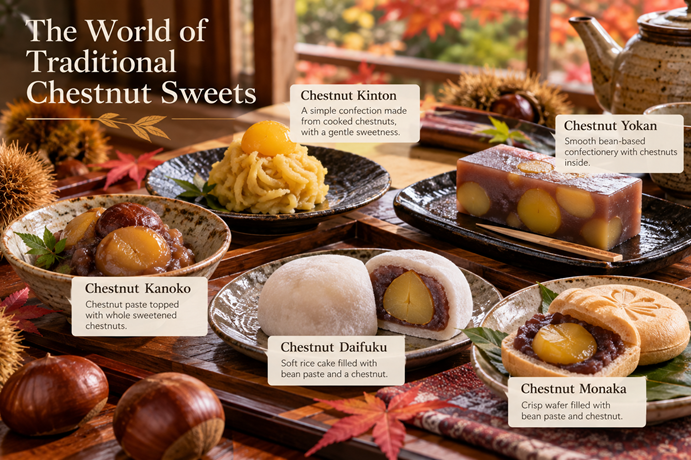
The transition from everyday food to confectionery is where the story of the Japanese chestnut becomes especially rich. Traditional Japanese sweets can transform chestnuts into completely different textures and experiences while still keeping the ingredient recognizable. One of the most distinctive examples is chestnut kinton, a confection made primarily from cooked chestnuts with a relatively small amount of sugar, shaped by hand into a simple form. It is completely different from the sweet chestnut and bean paste commonly associated with New Year food, despite their similar names in English translations.
Other sweets take the chestnut in different directions. Chestnut yokan combines chestnuts with the smooth structure of bean-based confectionery, creating a dessert in which the chestnut is both an ingredient and a visual marker of autumn. Chestnut kanoko, strongly associated with places such as Obuse, can combine chestnut paste with whole sweetened chestnuts, producing a dessert in which the same ingredient appears in several forms at once. Chestnut daifuku and chestnut monaka place chestnuts inside familiar Japanese confectionery structures, allowing the nut to meet soft rice cake, bean paste, or crisp monaka wafers.
What makes these sweets fascinating is not simply their variety. It is the degree to which Japanese confectionery can preserve the identity of a seasonal ingredient while transforming its physical form. The chestnut can be soft, smooth, whole, mashed, sweetened, steamed, wrapped, or compressed, yet the eater is still meant to recognize chestnut. Traditional confectionery therefore becomes a form of culinary interpretation. Instead of hiding the ingredient, the confectioner changes its texture and structure while allowing the ingredient to remain the focus.
🍵 Chestnut Kinton: When Less Can Be More
Chestnut kinton is particularly interesting because its simplicity can seem almost surprising. The basic preparation can be little more than cooked chestnuts and sugar, carefully processed and shaped so that the natural character of the chestnut remains prominent. In a culture of elaborate desserts, the restraint of this confection is part of its appeal.
The difference between chestnut kinton and a heavily flavored Western-style dessert is not that one is objectively more refined. The two simply use different strategies. A modern cake might combine chestnut with chocolate, cream, caramel, alcohol, nuts, spices, and other elements. Chestnut kinton can do almost the opposite. It asks how far the ingredient can carry the dessert on its own.
That idea helps explain why seasonal Japanese sweets can feel so closely tied to the ingredient itself. Autumn arrives, chestnuts appear, and the confectionery changes accordingly. The dessert does not merely have a chestnut flavor. It becomes a way of preserving the identity of the autumn ingredient in a refined form.
🌰 Chestnut Skin, Time, and the Work Behind the Flavor
One reason chestnuts have remained special in Japanese cooking is that they are not always easy to prepare. The hard outer shell has to be removed, and depending on the preparation, the inner skin may also require careful treatment. Techniques such as simmering chestnuts with their skins attached can demand considerable time and patience. These methods are not simply about following a recipe. They represent the transformation of an ingredient that naturally resists quick preparation into something ready to eat.
This helps explain why some traditional chestnut preparations feel associated with luxury or special occasions. The ingredient itself requires work, and traditional methods often ask the cook to invest even more time before the chestnut reaches the table. In earlier periods, sugar was also not the everyday commodity it is today, which made sweetened chestnut preparations particularly special.
Modern technology has changed this relationship. Newer chestnut varieties and improved preparation methods can make peeling easier, and processed or frozen chestnuts reduce some of the labor involved. Yet the older techniques remain culturally meaningful because they preserve a connection between the harvest and the finished dish. A bowl of chestnut rice or a chestnut confection may look simple, but behind it can be hours of peeling, cooking, seasoning, and shaping.
The work is part of the story.
🍱 Chestnut Rice, Chestnut Rice Cakes, and Festival Food
Chestnuts also appear in dishes associated with celebrations and local events. Chestnut rice cakes and chestnut-based rice dishes can be connected with harvest traditions, family celebrations, and local festivals. In some regions, glutinous rice preparations containing chestnuts have been associated with autumn festivities and seasonal offerings, linking food with the agricultural calendar.
This is an important contrast with the way chestnut is often presented in modern sweets. In a fashionable dessert shop, chestnut can seem like a refined luxury ingredient. In a traditional household or local festival, it can have a completely different meaning. It can represent the harvest, the arrival of autumn, gratitude for food, and the continuation of a regional tradition.
The ingredient remains the same, but the social meaning changes.
This is another reason food stories become much more interesting when they move beyond recipes. What people eat tells only part of the story. When they eat it, why they eat it, who prepares it, and what season or event surrounds it can reveal much more about the culture of the food.
🏞️ Chestnut-Producing Regions Give the Ingredient a Sense of Place
Some of Japan’s best-known chestnut regions have built identities around the ingredient. Ibaraki is one of the country’s major chestnut-producing areas, while places such as Obuse in Nagano have become particularly well known for chestnut confectionery. The chestnuts associated with the Tamba region of Hyogo and neighboring areas have also developed a strong reputation for size and quality. These regional differences help prevent the story from becoming a simple “Japan loves chestnuts” narrative.
A visitor to one region may encounter freshly cooked chestnuts and simple seasonal dishes, while another region may be filled with chestnut sweets, chestnut cafés, chestnut pastries, and specialty products. The ingredient is still seasonal, but the local economy and culinary traditions give it a different personality.
This is one of the most interesting characteristics of Japanese food culture more generally. An ingredient can become deeply tied to a particular place without losing its connection to the wider national food calendar. Chestnuts are a good example. They are recognizably Japanese autumn food, but at the same time they can carry the identity of a town, a prefecture, a variety, or a traditional confectionery style.
🍰 7. From Traditional Chestnut Sweets to Modern Japanese Mont Blanc
The story does not end with traditional wagashi. In modern Japan, chestnuts have moved comfortably into Western-style pastry as well. Mont Blanc is one of the clearest examples. The dessert itself is not a Japanese invention, but Japanese pastry culture has developed its own relationship with chestnut cream, and seasonal versions using Japanese chestnuts have become an important part of autumn dessert culture.
What makes the modern Japanese chestnut Mont Blanc interesting is not simply that it tastes good. It demonstrates how an ingredient can move between culinary traditions without losing its connection with the Japanese seasonal calendar. Chestnut cream can be layered with sponge cake, cream, ice cream, meringue, or other ingredients, yet the moment it appears in autumn, it still communicates a strong seasonal message.
Some modern pastry shops emphasize the chestnut itself, using relatively restrained sweetness and freshly prepared chestnut cream. Others turn the dessert into an elaborate performance, piping fine strands of chestnut cream over the dessert just before serving. The experience can be very different from eating a traditional chestnut confection, but the underlying idea is surprisingly familiar: autumn has arrived, and the chestnut should be enjoyed now.
The ingredients have changed.
The techniques have changed.
The setting has changed.
But the seasonal message remains.
🌰 Why Does the Chestnut Continue to Mean Autumn?
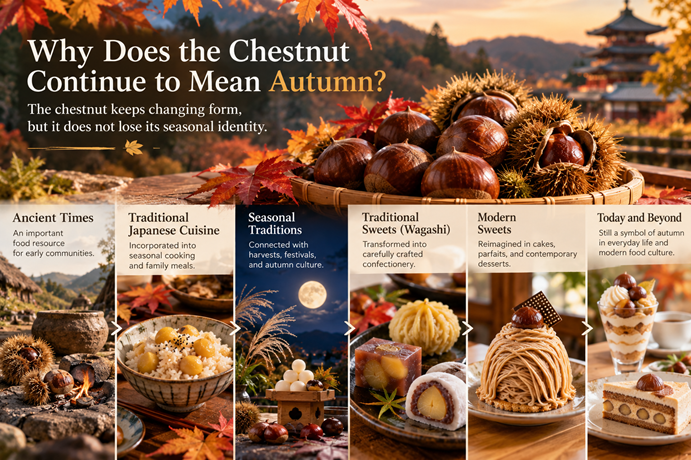
Perhaps the most interesting thing about Japanese chestnuts is that their cultural meaning has survived so many changes. Ancient communities used them as an important food resource. Later generations incorporated them into seasonal cooking and preservation. Families made chestnut rice. Communities associated them with autumn traditions. Confectioners turned them into carefully shaped sweets. Modern pastry chefs transformed them into Mont Blanc, cakes, parfaits, and other contemporary desserts.
The chestnut keeps changing form, but it does not lose its seasonal identity.
That is partly because chestnuts have a very particular physical and sensory character. Their harvest comes at a clear point in the year. Their brown shell and warm color visually suggest autumn. Their aroma, sweetness, and texture work naturally with rice and sweets. They can be eaten simply, but they can also be transformed into sophisticated dishes. That flexibility allows the ingredient to move through different periods of food history without becoming obsolete.
The chestnut is therefore both ancient and modern.
It can belong to an archaeological site and to a fashionable dessert shop.
It can belong to a family dinner and to a carefully presented wagashi.
It can be associated with harvest traditions and with social-media-friendly desserts.
That range is what makes the chestnut such a useful lens through which to understand Japanese food culture.
🍂 The Real Meaning of Japanese Chestnuts in Autumn
When people think of Japanese autumn food, they may first think of grilled fish, mushrooms, sweet potatoes, persimmons, or other seasonal ingredients. Chestnuts deserve a special place in that landscape because they carry such a long history. They are not merely harvested in autumn and eaten because they taste good. Their history connects food gathering, cultivation, preservation, household cooking, seasonal customs, regional identity, traditional confectionery, and modern pastry.
A bowl of chestnut rice is therefore more than a recipe. It connects an ordinary dinner with the arrival of autumn. A chestnut sweet is more than dessert. It preserves a seasonal ingredient in a carefully transformed form. A visit to a chestnut-producing town is more than a food trip. It connects the ingredient with geography and local memory. Even a modern Mont Blanc can participate in this same seasonal story.
Perhaps that is why chestnuts continue to feel so unmistakably like autumn in Japan.
The chestnut has changed many times, but the season has remained.
The ancient food resource became a household ingredient. The household ingredient became an autumn tradition. The tradition became a confectionery culture. The confectionery culture became part of modern Japanese pastry. And through all of those changes, the same small brown nut continued to tell people something simple.
Autumn is here.
🔗 Explore More About Japanese Seasonal Food and Autumn Culture
Discover more about the foods, scents, traditions, and seasonal changes that make autumn in Japan feel different from one month to the next.
👉 What Is Gotouchi Gourmet in Japan? How Food Changes from Region to Region
👉 Japanese University Cafeterias: More Than Lunch for Students
👉 Inside Japan’s Fish Markets: How Seafood Moves from the Sea to Your Table (2026 Guide)
👉 Kanpai in Japan: Why Everyone Raises Their Glass Together Before the Meal Begins (2026 Guide)
👉 Tsukimi Soba in Japan: How the Autumn Moon Became a Bowl of Soba (2026 Guide)