
🌼 When Autumn Begins to Look Like a Chrysanthemum
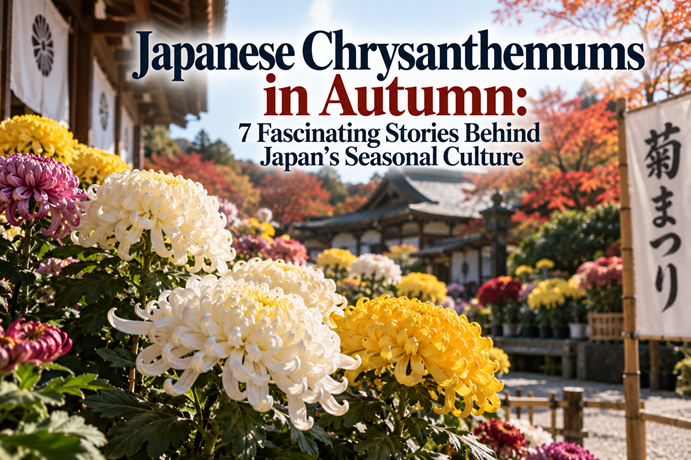
There is a particular moment in Japan when autumn begins to feel unmistakable. The summer heat has finally softened, the evening air is cooler, and chrysanthemums begin appearing in gardens, parks, temples, exhibitions, shops, and seasonal decorations. Their flowers can be yellow, white, pink, red, orange, or purple, and their forms range from simple open blooms to intricate flowers with dozens of tightly arranged petals.
Japanese chrysanthemums are not simply autumn flowers in the botanical sense. Over centuries, they became connected with seasonal change, longevity, art, gardening, court culture, food, and the symbolic world of the Imperial Family. Today, they can appear completely ordinary in a neighborhood garden and deeply ceremonial in another context, which is part of what makes the flower so culturally interesting.
The most interesting part of this story is that the chrysanthemum is not originally from Japan. It is generally understood to have come to Japan from the Asian continent around the eighth or ninth century, and its cultivation then developed extensively in Japan. Over generations, Japanese gardeners created distinctive forms and varieties that became associated with particular regions, artistic traditions, and historical periods. By the time chrysanthemums had become deeply established in Japanese culture, they were no longer simply an imported flower. They had acquired a specifically Japanese cultural history of their own.
That transformation is worth exploring because it explains why chrysanthemums can feel so familiar in Japan. The flower did not become culturally important because it was always native to the Japanese landscape. It became important because Japanese society repeatedly gave it new meanings.
🍂 Why Japanese Chrysanthemums Became an Autumn Symbol
Autumn has long been closely associated with chrysanthemums in Japanese art and seasonal culture. Their flowering period generally runs from September into November, which naturally places them at the heart of the autumn landscape. But seasonality in Japan is not simply a matter of when a flower happens to bloom. Certain plants, foods, insects, weather patterns, and visual motifs gradually become part of a cultural calendar, allowing people to recognize the season through repeated sensory experiences. Chrysanthemums became one of those signals of autumn. Government cultural material notes that chrysanthemums flower through the autumn months and have become associated with chrysanthemum exhibitions and seasonal enjoyment throughout Japan.
That seasonal association also appears strongly in Japanese art. The Metropolitan Museum of Art notes that chrysanthemums, together with other autumn plants, became closely associated with autumn in Japanese painting, reflecting the broader Japanese artistic practice of using particular natural elements as seasonal references. A chrysanthemum in a painting is therefore not necessarily just a flower. It can quietly establish the time of year, just as a snow-covered branch can suggest winter or a flowering tree can suggest spring.
This is why a chrysanthemum can feel almost like a seasonal word written in visual form. You do not have to see a calendar. You see the flower and immediately recognize the season it belongs to.
🏯 How an Imported Flower Became Part of Japanese Culture
The early history of the chrysanthemum in Japan is especially revealing because the flower’s importance grew gradually. Historical research preserved by the National Museum of Japanese History indicates that chrysanthemums were introduced from China by the Ritsuryo period and had already become fashionable at the imperial court by the Heian period, when chrysanthemum flower gatherings were part of elite cultural life. From there, the flower became increasingly connected with poetry, painting, decorative arts, gardening, and ideas of longevity.
The history did not stop with simply admiring imported varieties. Japanese cultivation developed its own distinctive forms. Traditional chrysanthemum varieties associated with places such as Saga and Ise developed particular shapes, while later varieties such as Edo and Higo chrysanthemums reflected different regional approaches to form and cultivation. The National Museum of Japanese History currently continues to preserve and cultivate these traditional chrysanthemums, exhibiting dozens of regional varieties as living examples of this horticultural history.
This is where the cultural story becomes deeper than the familiar claim that “chrysanthemums are important in Japan.” The flower became important partly because Japanese people did something very Japanese in the broad historical sense: they took an imported cultural and natural element and developed it through local aesthetics, cultivation, craftsmanship, and social practice. The result was not a copy of the original flower culture. It became something with its own Japanese history.
🎨 Japanese Chrysanthemums and the Art of Cultivation
One of the most fascinating aspects of Japanese chrysanthemum culture is the degree of attention given to the flower’s form. Some traditional varieties are valued for unusual petal shapes, changing forms as they bloom, or highly controlled arrangements. The goal is not simply to produce as many flowers as possible. The shape itself can become the object of appreciation.
This connects chrysanthemums to a broader Japanese interest in cultivation as an aesthetic practice. A cultivated plant can be admired for the relationship between natural growth and human intervention. The gardener does not simply wait for the plant to bloom. The gardener observes, supports, trains, selects, and preserves particular characteristics across generations. The flower becomes the visible result of accumulated knowledge.
That tradition became particularly elaborate during the early modern period. By the middle of the Edo period and afterward, chrysanthemum gardening became more widely popular among ordinary people, while public exhibitions and forms of chrysanthemum craftsmanship also became fashionable. Traditional varieties such as Edo, Higo, Saga, and Ise chrysanthemums are evidence of that long development.
This is one reason Japanese chrysanthemums can look so different from the generic chrysanthemums many visitors may know from flower shops elsewhere. The word “chrysanthemum” describes a huge range of cultivated forms, and Japan developed its own particularly distinctive traditions.
🌸 The Chrysanthemum Festival and the Meaning of September
The chrysanthemum is also connected with one of Japan’s traditional seasonal festivals. September 9 is the date of the Chrysanthemum Festival, one of the five traditional seasonal festivals that entered Japanese court culture from older Chinese calendrical traditions and later became established in Japan.
The flower’s association with this date was not simply botanical. In East Asian cultural traditions, chrysanthemums were connected with longevity, health, and the wish to avoid misfortune. The seasonal festival therefore brought together the flower, the calendar, ideas about long life, and ceremonial practices involving food and drink. Historical Japanese sources also describe chrysanthemum-infused sake as part of the cultural world surrounding the September festival.
What is especially interesting is that the festival belongs to an older calendrical tradition, while the flower itself developed its own Japanese forms and meanings over time. Japanese chrysanthemum culture is therefore not something that emerged in isolation. It sits at the intersection of imported traditions, Japanese court culture, horticultural innovation, seasonal awareness, and later popular customs.
That layered history is one reason the flower has survived as much more than decoration.
👑 Japanese Chrysanthemums and the Imperial Family
Perhaps nothing demonstrates the special symbolic status of the chrysanthemum more clearly than its association with Japan’s Imperial Family. The chrysanthemum is used as the Imperial Family’s crest, and the motif has become one of the most recognizable symbols associated with the institution. Official Japanese material describes the chrysanthemum specifically as the Imperial Family crest, while government cultural resources also note that the flower came to symbolize dignity, high-mindedness, and longevity in Japanese cultural interpretation.
This connection can make the chrysanthemum seem almost exclusively imperial to foreign visitors, but that would miss an important part of the story. The flower is also widely cultivated, displayed, painted, eaten, and enjoyed by ordinary people. Its imperial association is one layer of its identity, not the whole story.
That layering is particularly interesting because the chrysanthemum gradually moved in both directions. It was once strongly associated with elite and court culture, but it later became popular among ordinary people, with public exhibitions, gardening traditions, decorative arts, and new cultivated forms spreading more widely. The history therefore moves from elite flower culture toward mass participation rather than remaining permanently confined to the court.
A visitor can therefore see the same flower in a formal imperial context, an autumn garden, a neighborhood flower display, or a local chrysanthemum exhibition. The meaning changes according to the setting.
🏮 From Court Culture to Chrysanthemum Exhibitions
One of the most visible modern expressions of chrysanthemum culture is the chrysanthemum exhibition. During autumn, different parts of Japan hold displays in which growers and enthusiasts present carefully cultivated flowers. Some exhibitions emphasize enormous blooms, others traditional forms, regional varieties, or elaborate arrangements.
The tradition has a long history. The National Museum of Japanese History explains that as chrysanthemums became popular among the wider population during the early modern period, chrysanthemum gardens, exhibitions, and decorative works became increasingly fashionable.
This is an important distinction between simply “liking flowers” and having a flower culture. A flower culture creates communities of growers, competitions, exhibitions, specialized knowledge, regional varieties, and shared expectations about what is beautiful. The chrysanthemum became part of that world in Japan.
And because the flower blooms in autumn, these exhibitions naturally became another way to experience the season. Instead of simply noticing that flowers are blooming, people can deliberately go out to see what skilled growers have produced.
👘 Chrysanthemums Are Not Confined to Gardens
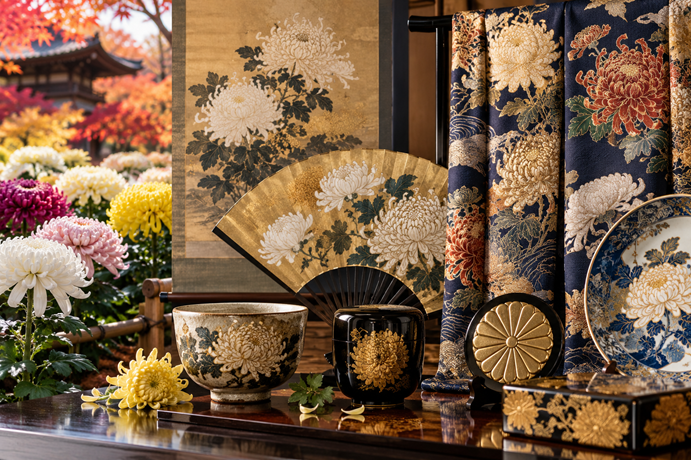
The cultural presence of the chrysanthemum extends far beyond living plants. The flower appears in painting, textiles, ceramics, lacquerware, family crests, decorative patterns, and other forms of Japanese art. The Metropolitan Museum of Art’s collections contain numerous examples of chrysanthemum imagery, including Edo-period paintings and textiles in which the flower carries associations with autumn, longevity, beauty, and literary traditions.
This is where the chrysanthemum becomes particularly interesting as a cultural symbol. A flower does not have to be physically present to create a seasonal atmosphere. A chrysanthemum pattern on a kimono, a fan painting, a tea utensil, or a decorative object can evoke autumn even when the weather outside is completely different.
Japanese art has a long tradition of using seasonal references in this way. The object becomes part of the seasonal calendar. A chrysanthemum motif does not merely decorate a surface; it tells the viewer something about time, atmosphere, and cultural associations.
That is why the flower appears so often in Japanese decorative traditions. It is visually distinctive, historically meaningful, and immediately connected with a particular season.
🍶 The Chrysanthemum Can Also Be Eaten
There is an unexpected side to Japanese chrysanthemum culture: some varieties are food.
In Yamagata Prefecture, edible chrysanthemums have been cultivated and eaten for generations. Their petals can be boiled, dressed, pickled, or fried, and the regional tradition is strongly associated with autumn and early winter. The Ministry of Agriculture, Forestry and Fisheries documents edible chrysanthemum dishes in Yamagata and notes that the custom of eating chrysanthemum petals became popular during the Edo period.
This may surprise visitors who associate chrysanthemums entirely with gardens or floral arrangements. But the edible varieties demonstrate something deeper about Japanese food culture: the boundary between seasonal nature and seasonal food is often very thin. A flower can be admired visually, associated with a festival, appear as a design motif, and also appear on the dinner table.
This does not mean people across Japan routinely eat chrysanthemums today. The practice is particularly associated with certain regions and culinary traditions. But its existence is a reminder that the cultural meaning of a plant can be far more complex than a simple distinction between “flower” and “food.”
🌙 Why Chrysanthemums Fit the Japanese Feeling of Autumn
There is also an emotional reason chrysanthemums became so strongly associated with the season. Autumn in Japanese cultural tradition often carries a sense of refinement and quietness. The air becomes cooler, the summer intensity begins to fade, the days become shorter, and the landscape gradually moves toward winter. The chrysanthemum blooms during this transition, when the garden may already be losing some of the softer abundance of summer.
That gives the flower a slightly different character from flowers associated with spring. Spring often suggests beginnings and sudden renewal. Chrysanthemums appear later, when the year is already moving toward its final months.
Japanese art has repeatedly used autumn imagery to express an awareness of passing time, change, and impermanence, and chrysanthemums became one of the most recognizable visual elements in that seasonal language. The Metropolitan Museum of Art notes that autumnal references in Japanese art often carried emotional associations with time passing and the awareness of change.
The flower therefore fits naturally into the quieter emotional atmosphere of Japanese autumn. It is not a symbol of sadness by itself, but it belongs to a season in which beauty and impermanence are often felt together.
🌼 Why the Chrysanthemum Is Special Without Being “Uniquely Japanese”
It is tempting to describe the chrysanthemum as a flower that exists nowhere else in the cultural imagination. That would be inaccurate. Chrysanthemums have important histories in China, Korea, Europe, and many other places, and their cultivation has become global. Modern varieties found around the world include many forms developed outside Japan as well. Government cultural material explicitly distinguishes traditional Japanese varieties from chrysanthemums improved in Europe and the United States from the late nineteenth century onward.
What makes the Japanese relationship distinctive is not ownership of the flower.
It is the depth and variety of meanings accumulated around it.
The chrysanthemum arrived from abroad but became deeply embedded in Japanese court culture. It became associated with autumn and longevity. It entered painting, poetry, textiles, and decorative arts. It developed regionally distinctive cultivated forms. It became popular beyond the elite. It became part of seasonal festivals and exhibitions. It became associated with the Imperial Family. In some places, particular varieties became food.
The same flower can therefore be read in several cultural languages at once.
That is much more interesting than saying Japan simply “loves chrysanthemums.”
🍁 The Autumn Chrysanthemum as a Cultural Calendar
Perhaps the most useful way to think about Japanese chrysanthemums is as a kind of seasonal calendar.
When chrysanthemums begin appearing in gardens and public displays, autumn has entered a recognizable stage. When traditional varieties are exhibited, centuries of horticultural history become visible. When chrysanthemum motifs appear in art and crafts, the season has been translated into design. When edible varieties arrive in regional cuisine, the flower becomes part of the autumn table. When the chrysanthemum emblem appears in an imperial context, another historical layer becomes visible.
The flower is the same, but the meaning changes with the setting.
This is typical of Japanese seasonal culture more broadly. A single natural object can exist simultaneously as something beautiful, something useful, something symbolic, something edible, and something tied to a particular point in the calendar.
That is why looking at one flower can reveal so much.
🌾 More Than a Flower
The chrysanthemum’s journey through Japanese history is a reminder that cultural symbols are rarely created in a single moment. The flower arrived from China, entered elite court culture, became associated with longevity and autumn, inspired Japanese horticultural innovation, spread into popular culture, appeared in art and clothing, became connected with the Imperial Family, and still appears today in gardens, exhibitions, seasonal foods, and local traditions.
That long history also explains why a simple autumn chrysanthemum can carry more meaning than a visitor might expect. You may see a yellow flower in a garden and think only of autumn. Someone else may see a traditional cultivated variety. An art historian may recognize centuries of chrysanthemum imagery. A gardener may appreciate the difficulty of producing its shape. A person from Yamagata may think of food. And an observer of Japanese history may immediately recognize the Imperial association.
None of these interpretations cancels the others.
They overlap.
🌏 The Chrysanthemum as a Window Into Japanese Autumn
Perhaps that is why the chrysanthemum remains such a powerful symbol of autumn in Japan. It is not merely a pretty flower that happens to bloom when the weather becomes cooler. It is a living connection between nature and culture, between the calendar and the garden, between cultivation and art, between food and seasonal tradition, and between everyday life and institutions that have existed for centuries.
The interesting question is not whether chrysanthemums are more beautiful in Japan than anywhere else. They are not uniquely beautiful, and there is no need to make that claim. What is distinctive is what Japanese society has done with the flower over a very long period of time.
A plant that arrived from elsewhere became deeply rooted in Japanese culture.
An autumn flower became an artistic motif.
A cultivated plant became a regional tradition.
A seasonal symbol became associated with longevity.
A garden flower became food in some communities.
And the same flower became the emblem of the Imperial Family.
That is why Japanese chrysanthemums are so much more than a sign that autumn has arrived. They show how a natural object can gradually become a cultural language. When you see chrysanthemums blooming in Japan in autumn, you are not simply looking at flowers. You are seeing the accumulated layers of history, seasonal awareness, gardening, art, food, and symbolism that have gathered around them.
And perhaps that is the most fascinating thing about the flower: it does not need to announce its importance.
It simply blooms in autumn, carrying centuries of meaning with it.
🌏 Continue Exploring Culture & Mind
Japan’s autumn culture becomes richer when you look at the different sights, sounds, foods, and seasonal traditions that quietly mark the passing of the year.
👉 Christmas in Japan: KFC, Strawberry Cake, Christmas Eve, and the Sudden Switch to New Year
👉 Momijigari in Japan: The Fascinating Culture of Going Out to See Autumn Leaves
👉 Japan’s Rice Harvest: Golden Rice Fields, Autumn Landscapes, and the Culture of Harvest
👉 The Sounds of Autumn in Japan: Bell Crickets, Crickets, and the Season’s Changing Landscape (2026 Guide)
👉 The Scent of Autumn in Japan: How Smells Tell Us the Season Has Changed (2026 Guide)
👉 Tsukimi in Japan: Why the Autumn Moon Became a Seasonal Tradition (2026 Guide)