
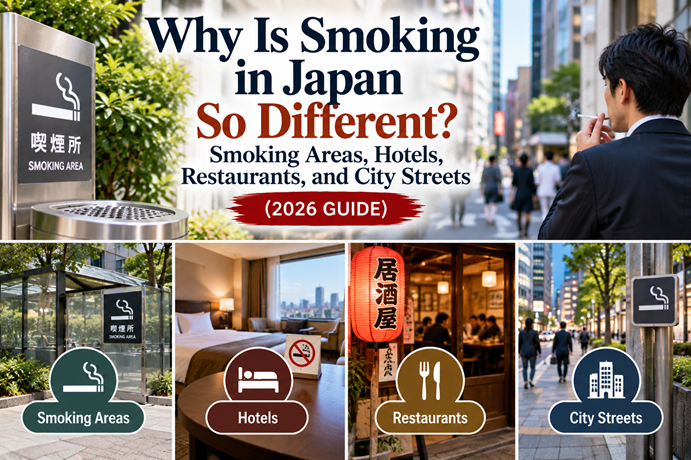
🚭 The First Thing That Can Surprise You About Smoking in Japan
For many foreign visitors, smoking in Japan can be confusing for a very simple reason: the boundary between “smoking” and “non-smoking” does not always look the way they expect.
Someone arriving from North America or Europe may be familiar with a fairly straightforward idea. Smoking is usually prohibited inside public buildings, while designated outdoor areas may be where smokers go. So when they arrive in Japan and see a smoking room inside a building, discover that a restaurant still has a smoking area, or find a covered smoking booth on a city street, they may wonder what the actual rule is.
Then they encounter the opposite situation. They are standing outside, perhaps near a station or in a busy shopping district, and discover that smoking is not allowed there at all. A smoker may think, “But I am outside.” A non-smoker may think, “Good, but where am I actually supposed to walk if there are smokers nearby?” Both reactions make sense until you understand how Japanese smoking rules are structured.
Japan is not simply a country where smoking is allowed indoors, and it is not a country where smoking is forbidden outdoors. Since the full implementation of the revised Health Promotion Act in 2020, indoor smoking is generally prohibited in many facilities, but specific types of compliant smoking rooms can still be provided. At the same time, outdoor smoking is not automatically permitted everywhere; municipalities and property managers can impose additional restrictions, especially in busy public areas.
That is what makes smoking in Japan interesting from a travel and everyday-life perspective. The important question is not simply, “Am I indoors or outdoors?” It is more often, “What kind of place am I in, and what smoking rules apply here?”
For smokers, understanding that distinction helps avoid breaking local rules or creating problems for other people. For non-smokers and families, it helps avoid unpleasant surprises, such as accidentally booking a smoking hotel room or choosing a restaurant where smoking is permitted.
The goal of this article is not to tell smokers what they should or should not do. It is to explain the system so that both smokers and non-smokers can navigate it more comfortably.
🌏 Why Japan Can Feel Different From Other Countries
Every country has its own history of smoking regulation, so it would be too simplistic to say that “the West does this” while “Japan does that.” Laws and customs differ considerably between countries, states, provinces, cities, and individual buildings.
Still, many travelers from North America and Europe are accustomed to strong indoor-smoking restrictions, so certain parts of Japanese life can feel unexpected. One example is the continued existence of designated indoor smoking rooms. Another is the fact that a hotel may offer both smoking and non-smoking guest rooms. A third is that an older small restaurant may still have a smoking-permitted area under specific legal conditions.
At the same time, Japanese cities have become much more restrictive about smoking in public outdoor spaces than many visitors expect. Busy station areas, shopping districts, parks, and other public places can have their own rules, and some municipalities create specific smoking-ban zones where smoking on the street is prohibited even though the location is completely outdoors.
The result is a system with several overlapping layers. National law sets important rules for indoor smoking and passive-smoking prevention, while municipalities and individual facilities can add further restrictions. That is why a smoking sign or designated smoking area can be more useful than trying to apply a simple “inside versus outside” rule.
🏨 The Hotel Mistake Foreign Visitors Should Avoid
Imagine booking a hotel in Japan after a long flight. You are traveling with your family, you do not smoke, and you simply choose a room that looks suitable. You arrive, open the door, put your luggage down, and then notice something unusual: the room smells faintly of tobacco.
You check the reservation.
You booked a smoking room.
For someone used to hotel systems where guest rooms are almost universally non-smoking, this can be a genuine surprise.
Japan still has hotels and inns that offer smoking and non-smoking guest rooms. This is possible because guest rooms in lodging facilities are treated differently under the Health Promotion Act than many other indoor public spaces; the law specifically excludes hotel guest rooms from certain provisions governing smoking bans.
This does not mean that every Japanese hotel has smoking rooms. Many hotels are completely non-smoking, and individual properties have their own policies. It simply means that the option still exists in Japan, so travelers should not assume that “hotel room” automatically means “non-smoking.”
For non-smokers, especially families with children, this is one of the easiest problems to avoid. When making a reservation, look carefully for the room type and choose non-smoking when that is what you want. Do not assume that the hotel will automatically assign you a non-smoking room simply because smoking indoors is restricted in many other parts of Japanese society.
For smokers, the opposite applies. A smoking room can provide a legitimate place to smoke without requiring you to go outside and search for a permitted location. But the hotel’s own rules still matter, and smoking in a non-smoking room is not an acceptable substitute simply because smoking rooms are available elsewhere.
The key lesson is simple: in Japan, the hotel room category itself can be part of the smoking system.
🍽️ What About Japanese Restaurants?
Restaurants create another layer of complexity.
The general rule in Japan is that indoor areas of restaurants are smoke-free. However, the law permits certain types of designated smoking rooms, and specific categories of restaurants can operate smoking-permitted spaces when they meet the relevant conditions.
This means that a visitor may encounter several different situations. A restaurant can be completely non-smoking. It can have a separate smoking-only room. It can have a designated room where heated tobacco products are permitted under the applicable rules. And some smaller restaurants that meet the requirements for an existing establishment can have a smoking-permitted area, including spaces where food and drinks may be served.
This is where families with children should pay particular attention.
Japan’s smoking rules prohibit people under 20 from entering designated smoking areas. The national guidance makes this explicit, regardless of whether the young person is a smoker or simply accompanying an adult.
So if you are traveling with children and see a restaurant that has a smoking room or smoking-permitted environment, the important question is not simply whether the restaurant serves food. You need to understand where smoking is permitted within the premises and whether your children can enter that area.
In practice, the easiest choice for a family that wants to avoid tobacco smoke is to choose a clearly non-smoking restaurant or a restaurant with a physically separated smoking room rather than assuming that every restaurant follows the same arrangement.
🚪 A Smoking Room Is Not Just “A Place Where Smoking Is Allowed”
There is an important detail hidden in the word “smoking room.”
Japan’s legal framework recognizes several kinds of smoking rooms, and they do not all have the same rules. A conventional smoking room can allow smoking but not food or drink. A heated-tobacco-only smoking room can have different conditions, including the possibility of eating and drinking under the applicable framework. Existing qualifying small restaurants may have smoking-permitted rooms in which food service is allowed.
For a visitor, this means that seeing a smoking sign does not necessarily tell you everything. The type of smoking space matters.
The good news is that smoking facilities are required to display designated signage, so visitors can identify them. This is particularly useful for people who do not want to enter a smoking environment by accident.
The visual language of these signs therefore becomes part of everyday life in Japan. Once you recognize the symbols and understand that a smoking area can exist inside an otherwise non-smoking facility, navigating hotels, restaurants, shopping centers, and other buildings becomes much easier.
🏙️ But Then Comes the Strange Part: You Can Be Outside and Still Not Be Allowed to Smoke
This is probably the most surprising part for many visitors.
A smoker leaves a restaurant or hotel, walks onto the street, and thinks, “Now I am outside, so smoking should be allowed.”
Not necessarily.
Japan’s national Health Promotion Act does not generally prohibit all outdoor smoking in public spaces. Instead, it places a duty on smokers to take care not to cause unwanted secondhand smoke, while local governments and property managers can impose additional rules.
This is why cities can create designated smoking-ban areas, particularly around busy railway stations and commercial districts. In these places, the fact that you are outdoors does not give you permission to smoke.
Yokohama is a particularly clear current example. As of 2026, the city has nine designated smoking-ban districts, including areas around Yokohama Station, Minato Mirai, Kannai, Shin-Yokohama, and Hiyoshi Station. Smoking in outdoor public places within these designated areas is prohibited, and the city provides designated smoking locations instead.
More changes are coming there as well. Yokohama plans to prohibit smoking throughout outdoor public places such as roads, rivers, and station plazas from January 2027, while continuing to develop designated smoking facilities.
This illustrates how quickly local rules can evolve.
A traveler cannot assume that a rule they encountered on a previous trip will remain unchanged.
🌆 Why Do Japanese Cities Create Smoking Areas Instead of Simply Banning Smoking Everywhere?
This is an important question because the presence of a smoking booth can look contradictory.
If a city wants less smoking on the street, why provide a smoking area at all?
One reason is practical separation.
Instead of having smokers light cigarettes wherever they happen to be standing, a city can concentrate smoking in specific locations. This can make it easier to identify where smoking is allowed and can reduce exposure to people passing through busy pedestrian spaces.
Yokohama’s current policy provides a clear example of this approach. The city is expanding designated smoking areas while moving toward broader restrictions on smoking in outdoor public spaces. It is also working to convert some open smoking areas into enclosed facilities.
This creates a curious urban landscape. You may see a city street where smoking is prohibited, followed a short distance away by a designated smoking booth. For a visitor, it can look inconsistent until you understand the idea behind it: the goal is not necessarily to make every cigarette impossible; it is to control where smoking occurs.
That distinction is important for both smokers and non-smokers.
The smoker gets a clearly identified place.
The non-smoker gets a clearer idea of where smoke is expected.
🧭 The Roof Is Not the Rule
Another common source of confusion is the idea that a smoker simply needs to find a place “outside.”
The physical appearance of a space is not always enough to determine its legal status.
A covered area may still function as a designated smoking area. Conversely, an open outdoor space may be a smoking-ban area because of municipal rules. A roof by itself therefore does not tell you whether smoking is permitted.
Under the national framework, the distinction between indoor and outdoor spaces depends on the physical characteristics of the place as defined by the law, while designated smoking facilities have their own requirements. In addition, local rules can further restrict outdoor smoking.
This explains the strange experience a foreign visitor may have in Japan: you can see someone smoking under a roof and legitimately assume that the person is in a designated smoking space, while five minutes later you may see a sign saying that smoking is prohibited on the open street.
The important clue is not simply the weather protection overhead.
It is the rule governing that location.
🚉 Stations Are Where the Difference Becomes Very Visible
Railway stations are one of the easiest places to understand this system.
Japanese stations are extremely busy public spaces, with large numbers of people moving through relatively concentrated areas. As a result, smoking is increasingly controlled around station plazas and surrounding streets. Some stations and commercial districts provide designated smoking rooms or booths so that smokers have a specific place to go.
This creates a very different experience from simply walking outside a building and lighting a cigarette.
The city is effectively saying, “This is a place where smoking is permitted; the surrounding public space is not.”
For a traveler, that makes the smoking-area sign almost as important as a train-platform sign or a restroom symbol. Once you recognize it, the environment becomes easier to navigate.
For a non-smoker, it also provides useful information. If you are walking with children, carrying luggage, or simply want to minimize exposure to smoke, knowing where designated smoking spaces are can help you choose your route and where you stop.
👨👩👧 Why This Matters Especially for Families
A family traveling in Japan may not think about smoking rules until they encounter them.
Perhaps you choose an inexpensive hotel and discover that you have booked a smoking room. Perhaps you walk into a small restaurant because it looks interesting and only later notice that smoking is permitted in part of the premises. Perhaps you are waiting near a station and find a smoking area nearby.
None of these situations necessarily means something has gone wrong. They simply mean that Japan’s smoking system is structured differently from what some visitors expect.
The most important information for parents is that people under 20 are prohibited from entering designated smoking areas under the national framework. This applies even when the young person is not smoking and is simply accompanying someone else.
That rule makes the distinction between a restaurant with a separated smoking room and a restaurant where smoking is permitted in the same space especially significant for families.
A non-smoking family does not need to understand every legal category. It is usually enough to pay attention to hotel room labels, restaurant smoking signs, and designated smoking-area signs before entering.
Knowing what to look for can prevent a surprisingly uncomfortable situation.
🌿 What About Non-Smokers Who Simply Don’t Want to Smell Smoke?
Avoiding tobacco smoke in Japan is not always about finding a place that is legally “non-smoking.”
A person can be walking outdoors and still encounter smoke near a building entrance, a smoking booth, or another area where smoking is permitted. This is why Japan’s national framework also emphasizes consideration for unwanted secondhand smoke outside places where smoking is not specifically prohibited.
Some municipalities go further. Yokohama, for example, specifically asks smokers to consider people around them in places with heavy pedestrian traffic and near children, even outside areas that are not yet subject to a blanket outdoor smoking prohibition.
This is important because smoking regulation and everyday consideration are not exactly the same thing.
A smoker may be legally allowed to smoke in a particular location and still need to pay attention to whether smoke is blowing toward people nearby. A non-smoker may legally be allowed to walk through a public area but still encounter smoke.
The practical goal is therefore not just to know where smoking is legal.
It is to understand where smoking is expected to happen and where other people are likely to be affected by it.
🚭 Japan Is Moving Away From the Old Image of Casual Public Smoking
For older visitors who remember Japan from decades ago, today’s environment can feel very different.
The major national change came with the full enforcement of the revised Health Promotion Act in April 2020. The basic principle became that indoor areas of many facilities are non-smoking, with specific exceptions and designated smoking rooms. The purpose was to prevent unwanted secondhand smoke, with particular consideration for children and people who are especially vulnerable to its effects.
Local governments have continued developing their own restrictions, especially in dense urban areas. This means that Japan’s smoking environment is not static.
The direction is toward clearer separation.
Smoking is increasingly concentrated into designated places rather than treated as something that automatically follows a person wherever they go outdoors.
At the same time, Japan has not adopted a single nationwide rule that makes every outdoor public space smoke-free. That is why the system can feel contradictory to a foreign visitor.
It is actually a system in transition.
🌏 The Important Question Is Not “Is Smoking Allowed in Japan?”
That question is too broad to be useful.
A better question is, “Where is smoking allowed here?”
At a hotel, the answer may be determined by the room type and the hotel’s policy. At a restaurant, it may depend on whether there is a designated smoking room or whether the establishment falls under a specific legal category. At a railway station, it may depend on the station’s facilities and the local area. On a city street, it may depend on municipal regulations. At a park, local rules may prohibit smoking even though the location is completely outdoors.
This is why visitors sometimes feel that Japanese smoking rules are complicated.
The rules are not necessarily difficult once you understand the structure. There are simply several layers of responsibility.
National law establishes important indoor restrictions and designated smoking-room rules.
Municipalities can regulate public outdoor spaces.
Property owners and businesses can impose their own additional restrictions.
And smokers are expected to consider people around them.
Once these layers are understood, the apparent contradiction becomes easier to navigate.
🧳 A Better Way to Think About Smoking in Japan
For smokers, the safest habit is not to assume that an outdoor location is automatically acceptable. Look for a clearly marked smoking area, follow the signs, and pay attention to local rules, especially around stations, shopping districts, parks, and other busy public spaces.
For non-smokers, the most useful habit is to check rather than assume. When booking a hotel, select the room type carefully. When choosing a restaurant, look for smoking information before sitting down. When traveling with children, remember that designated smoking areas are off-limits to people under 20.
Neither group needs to understand every detail of Japan’s tobacco legislation before visiting.
The important thing is to recognize the signals.
A smoking sign means something.
A non-smoking sign means something.
A designated smoking booth means something.
And a city street with a smoking-ban sign means something completely different from an ordinary outdoor space.
Learning to read those signals is part of learning how everyday life works in Japan.
🌏 A Different Kind of Smoking Culture
Japan’s smoking environment is sometimes described as contradictory because smoking rooms can still exist inside buildings while outdoor smoking is increasingly restricted in busy public spaces.
But perhaps a better way to understand it is that Japan is trying to separate two different things: the act of smoking and the place where smoking happens.
A smoker may still have somewhere to go.
A hotel can still have smoking rooms.
A qualified restaurant can still provide a designated smoking area.
A city can still provide smoking booths.
But the surrounding environment is becoming more clearly divided into places where smoking is permitted and places where it is not.
That creates a system in which location matters enormously.
And that is the point a foreign visitor needs to understand.
In Japan, being indoors does not automatically tell you everything. Being outdoors does not automatically tell you everything either. The sign on the door, the type of room, the local ordinance, the designated smoking area, and the facility’s own rules may all matter.
Once you understand that, Japanese smoking culture becomes much less mysterious.
You know where to smoke.
You know where not to smoke.
And, just as importantly, you know how to avoid smoke when you do not want it.
That is perhaps the most useful way to look at smoking in Japan in 2026: not as a debate about smokers versus non-smokers, but as a system for deciding where those two experiences should meet, and where they should remain separated.
🌏 Continue Exploring Life in Japan
Everyday life in Japan often becomes easier to understand when you know the small rules and spaces that visitors do not always notice at first.
👉 Japanese Hotel Amenities: What Can You Take Home? Amenities, Facilities, and Ryokan vs Hotel (2026 Guide)
👉 Arriving in Japan Late at Night: How to Make the Most of Your First Night (2026 Guide)
👉 How Sundays Feel Different in Japan: The Rhythm of a Japanese Day Off (2026 Guide)
👉 Do You Need a Plug Adapter in Japan? Power Plugs, Voltage, and Charging Explained (2026 Guide)
👉 International Roaming in Japan: Is It Worth It? Costs, Pros & Cons (2026 Guide)
👉 What Can You Bring Into Japan? Customs Rules Every Traveler Should Know (2026 Guide)