
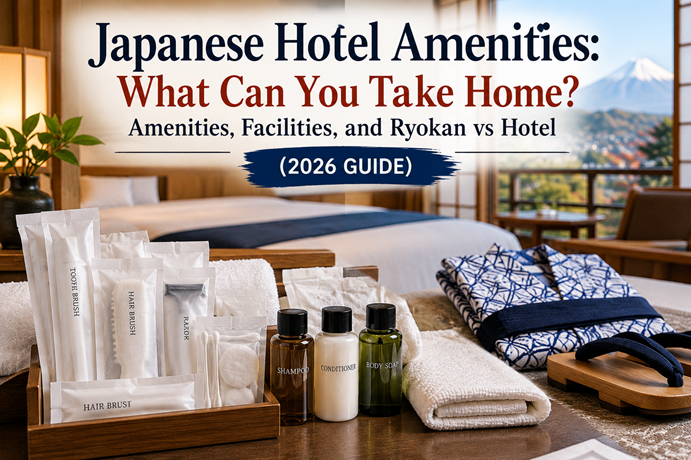
You are checking out of a hotel in Japan.
Before leaving, you look around the room and notice a toothbrush, razor, comb, tea bags, slippers, towels, pajamas, a hairdryer, and perhaps a small bottle of water.
Then you wonder:
Which of these can you take home?
This is a surprisingly common question, especially for first-time visitors to Japan. The answer, however, is not simply based on whether something is free.
A toothbrush and a hairdryer may both be provided at no additional cost, but they clearly do not have the same status. One is a personal-use item that may be disposable. The other is part of the room.
That distinction is the key to understanding Japanese hotel amenities.
There is another reason the question is interesting. A traditional Japanese ryokan, a Japanese hotel, and a typical hotel in North America or Europe may provide similar basic comforts, yet the way those items are selected and used can be very different.
And in 2026, the traditional Japanese hotel amenity model itself is changing, with more hotels moving toward amenity bars, refill systems, reusable slippers, and reduced use of disposable products.
So rather than asking only, “Can I take this home?”, it is worth understanding what the item actually is, why the hotel provides it, and whether the hotel expects to use it again.
Quick Answer: Can You Take Hotel Amenities Home in Japan?
As a general rule, disposable and consumable personal-use items can often be taken home, while reusable hotel property and room equipment should be left behind.
Individually packaged toothbrushes, disposable razors, cotton swabs, shower caps, tea bags, and similar personal-use items are commonly treated differently from towels, yukata, pajamas, bathrobes, hairdryers, kettles, cups, glasses, and other reusable property.
But this is a practical rule, not a universal legal definition.
Hotels have their own policies. Slippers are a good example: some are disposable, while others are washable and specifically intended to be reused. Bottled water may also be complimentary at one property and handled differently at another.
The safest principle is simple:
Free does not automatically mean yours.
Instead, ask:
Was this provided for me to use up, or for me to use during my stay?
That one question will usually tell you where the line is.
Hotel Amenities Comparison
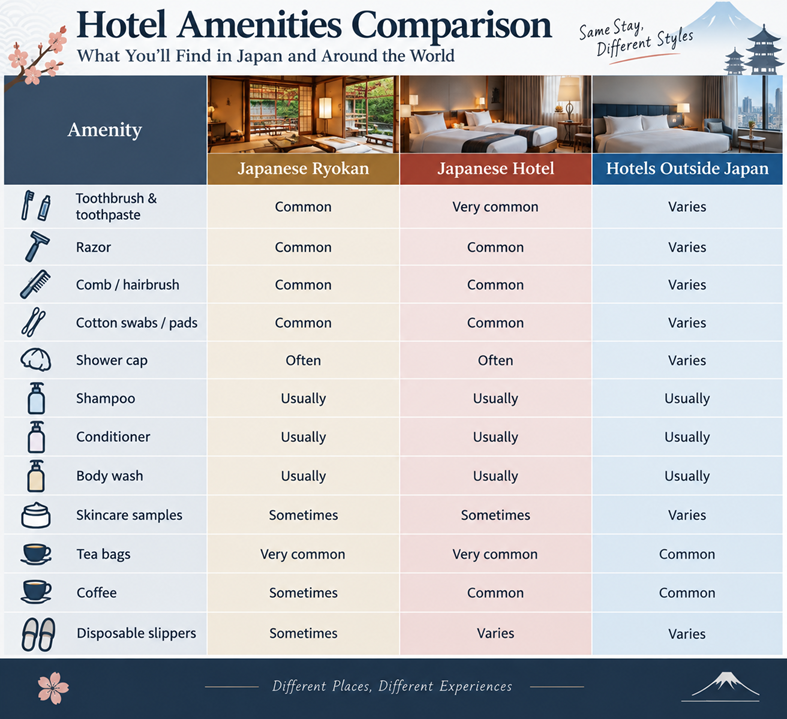
Before talking about taking anything home, it helps to understand what Japanese accommodations commonly provide.
As the comparison above shows, toothbrushes, razors, combs, cotton products, shampoo, conditioner, body wash, tea, and similar items are commonly found in Japanese accommodation, although availability varies by property.
Japanese ryokan can also provide a number of personal-use items, while Japanese hotels often have an extensive selection of practical amenities. Hotels outside Japan vary much more by country, hotel brand, category, and price level, so there is no single “Western hotel” standard.
That is why we use Hotels Outside Japan in the comparison rather than treating all hotels in North America and Europe as identical.
The important point is that the presence of an item does not tell you whether it is yours to keep.
Amenities vs Room Facilities: The Distinction That Makes Everything Clearer
The word amenity is used very broadly in the hotel industry.
For a traveler, though, it is useful to make a practical distinction.
An amenity is generally something provided to improve your personal comfort during the stay. It may be disposable, consumable, or designed for individual use.
A room facility or piece of equipment is something that belongs to the room or is intended to remain available for repeated use.
A toothbrush is a good example of an amenity.
A towel is not a souvenir simply because it is in your room. It is part of the property’s linen system.
The same logic applies to a hairdryer, kettle, cup, glass, hanger, remote control, and telephone.
This is also why the phrase “free hotel amenities” can sometimes cause confusion. “Free” describes the fact that you are not charged separately for the use of an item. It does not necessarily mean that the hotel has transferred ownership of it to you.
Room Facilities & Equipment Comparison
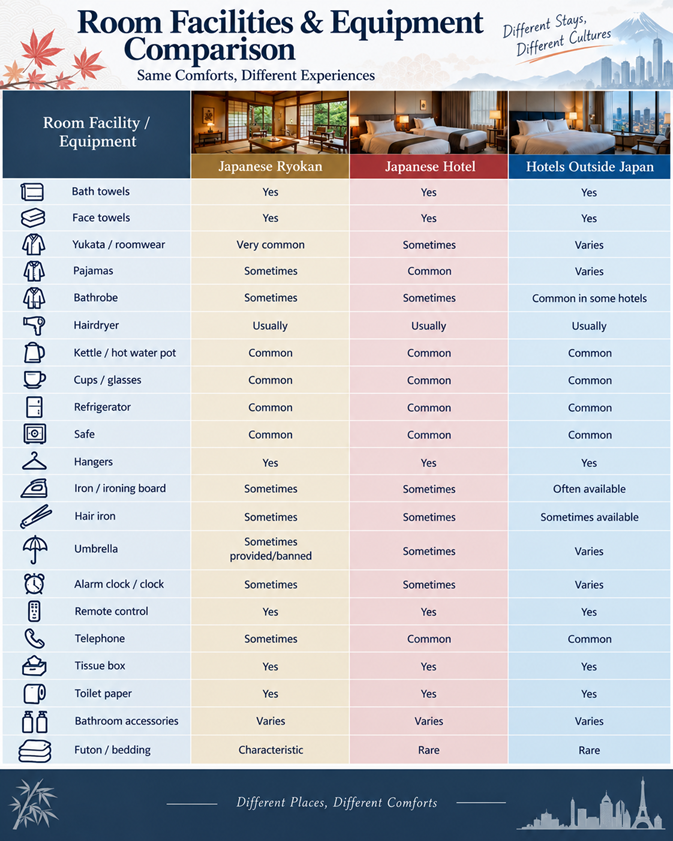
The second comparison makes the difference much easier to see.
Many of the items in a Japanese ryokan or hotel room are not really “amenities” in the sense that a traveler can reasonably take them home.
Towels are there to be washed and reused.
Yukata and pajamas are generally provided for use during the stay.
Hairdryers, kettles, cups, glasses, refrigerators, safes, hangers, and remote controls are all room equipment.
Even something as simple as an umbrella may be a loan item rather than a gift.
The distinction is especially important in a ryokan, where bedding and room furnishings form part of the traditional accommodation experience. In a conventional ryokan room, futons are typically stored in a closet during the day and laid out later, while yukata and towels are provided for use during the stay.
So if something belongs to the room’s reusable infrastructure, leave it where it is.
What Can You Take Home From a Japanese Hotel or Ryokan?
Now we can get to the question most travelers actually have.
Usually Fine to Take
The clearest examples are individually packaged, disposable personal items.
A toothbrush and toothpaste are generally intended for individual guest use. Disposable razors, cotton swabs, cotton pads, shower caps, and small personal-care samples can also fall into this category. Tea bags and individually packaged coffee are consumable items, so unused ones are generally reasonable to take.
The same principle can apply to small hotel-branded stationery or postcards, but those require a little more judgment.
A postcard explicitly offered as a guest amenity is very different from an item that is part of the hotel’s décor or sold in the gift shop.
The important thing is not whether an object looks inexpensive.
It is whether the property appears to have provided it for personal use or consumption.
Check First
Some items sit in the gray area.
Slippers are one of the best examples.
A disposable pair may be intended for individual use. A washable pair is generally meant to remain at the hotel.
This is not just a theoretical distinction. Tokyo Bay Shiomi Prince Hotel, for example, provides washable slippers in guest rooms while moving a range of other disposable amenities to a self-service amenity bar.
Bottled water also varies. Some hotels provide complimentary bottles that guests naturally take when they leave. Others are replacing them with refill stations.
Hotel Hankyu RESPIRE Osaka changed its approach in 2026, replacing bottled mineral water in guest rooms with water dispensers and replacing disposable slippers with sanitized reusable slippers. It also offers take-home slippers separately for purchase.
That is why you should not rely on a blanket rule such as “slippers are OK” or “water is always free to take.”
Leave These Behind
Towels, face towels, yukata, pajamas, bathrobes, reusable slippers, hairdryers, kettles, cups, glasses, refrigerators, safes, hangers, telephones, remote controls, and bedding should stay at the property.
These items are either reusable hotel property or room equipment.
A traditional ryokan may also provide futons, low tables, and other room elements that are central to the stay itself. Those are certainly not guest souvenirs.
Can You Take Hotel Amenities Home?
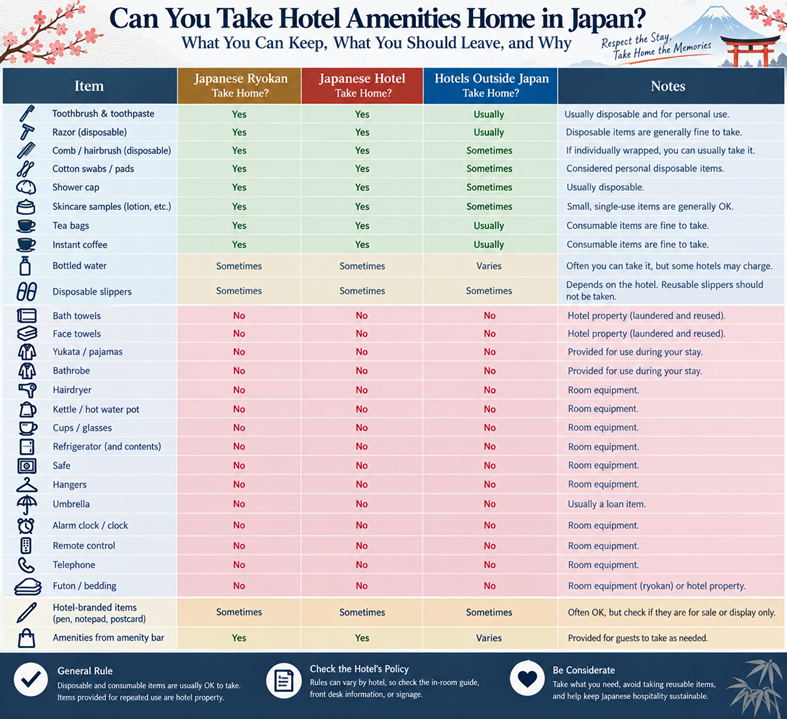
The practical rule is easier to remember when the items are grouped by type.
Disposable and consumable personal-use products are generally the safest category.
Reusable personal items should be checked.
Room equipment and linens should remain in the accommodation.
The most important exception is that hotel policy always comes first.
An amenity bar may explicitly indicate which products are intended for guests to take. A room information card may say that a certain item is reusable. A property may also charge separately for an item that looks like a complimentary amenity.
When there is a clear instruction, follow that instruction rather than relying on a general rule.
Why Do Japanese Hotels Seem to Have So Many Small Amenities?
This is where the topic becomes more interesting than a simple packing question.
Visitors to Japan sometimes notice the large number of small items available in Japanese hotels: toothbrushes, razors, combs, cotton products, tea, skincare samples, shower caps, and other personal conveniences.
It is tempting to explain this by saying that Japanese hotels are simply “more generous.”
That is too simple.
Hotel amenities are shaped by hotel type, business model, local expectations, operating costs, guest habits, and environmental policy.
Japanese business hotels, for example, have traditionally emphasized practical convenience for travelers. Many guests expect to arrive, check in, sleep, shower, and leave again without needing to prepare every small personal item themselves.
Ryokan developed differently.
A traditional ryokan is not simply a hotel room with Japanese furniture. The room, clothing, bathing, meals, bedding, and service can all form part of the accommodation experience. The Japan National Tourism Organization describes common ryokan features such as tatami, futon bedding, yukata, baths, and traditional meals.
That difference matters.
A Japanese hotel may provide a toothbrush because a guest needs one.
A ryokan may provide a yukata because wearing it is part of the way the guest uses the property.
The items may look similar on an amenity list, but their role in the stay is completely different.
Japanese Ryokan vs Japanese Hotel: Two Different Ideas of a Stay
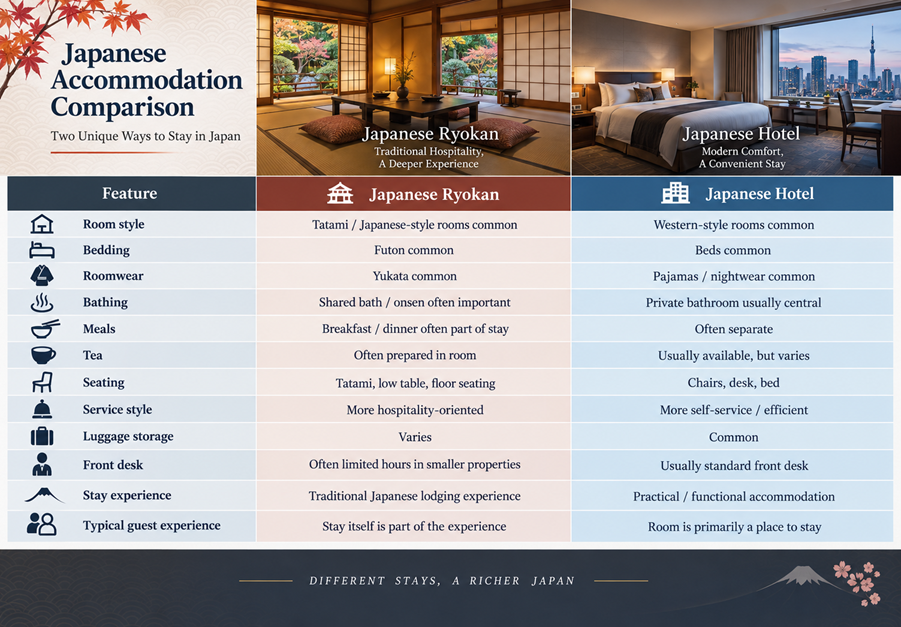
The simplest distinction is not “traditional versus modern.”
It is what the accommodation is trying to provide.
A conventional hotel is usually organized around a private room that serves as a practical base. A bed, bathroom, desk, storage, Wi-Fi, and other facilities allow guests to come and go according to their own schedule.
A traditional ryokan is more likely to make the stay itself part of the experience.
Tatami, futon bedding, yukata, bathing, meals, low seating, seasonal details, and hospitality may all be connected. Traditional ryokan rooms commonly use tatami flooring and futons, with the futon often laid out later rather than left on the floor all day.
This is why comparing a ryokan and a hotel only by the number of amenities misses the bigger picture.
A hotel may give you a room.
A ryokan may give you a way of staying.
That distinction also explains why something like a yukata can feel much more central at a ryokan than pajamas do at a business hotel.
What About Hotels Outside Japan?
It is easy to turn this into a “Japan versus the West” story, but that would not be very accurate.
Hotels in North America and Europe differ enormously by country, category, brand, and price level. A budget hotel, boutique hotel, business hotel, luxury hotel, and resort can all have completely different amenity policies.
International hotel chains operating in Japan can also follow global standards while adapting some practices to the Japanese market.
So there is no single global rule that says, “Japanese hotels provide this, while Western hotels provide that.”
A better conclusion is that different hotel systems developed different patterns of guest service, and those patterns are now evolving.
That is a more useful way to compare them.
Why Japanese Hotel Amenities Are Changing in 2026
One of the most important developments is the move away from automatically placing large numbers of disposable amenities in every room.
Instead, some hotels now use an amenity bar near the front desk.
Guests select what they actually need rather than receiving every item automatically.
Tokyo Bay Shiomi Prince Hotel describes this approach explicitly, moving disposable amenities from guest rooms to a self-service amenity bar and encouraging guests to take only what they need.
This changes the experience in a subtle but important way.
The hotel is no longer saying:
“Here is everything you might possibly need.”
It is increasingly saying:
“Here are the options. Choose what you actually need.”
That approach reduces unnecessary waste and also makes the distinction between the room and the amenity itself clearer.
The Same Trend Explains the Rise of Reusable Slippers and Refill Systems
Single-use packaging is not the only thing changing.
Hotels are also experimenting with refill dispensers and reusable products.
Shampoo, conditioner, and body wash may be supplied through wall-mounted dispensers rather than individual containers. Slippers may be washable rather than disposable. Bottled water may be replaced by refill stations.
These changes do not mean that Japanese hotels are becoming “less hospitable.”
They represent a different understanding of hospitality.
Providing every possible item to every guest is not necessarily the most useful solution when many of those items are never used.
In 2026, convenience and sustainability increasingly have to coexist.
What Should You Still Pack for Japan?
Even when a hotel provides many amenities, it is better not to assume that everything you personally need will be there.
Travelers who use specific skincare products, medications, contact-lens supplies, cosmetics, or other personal-care items should bring their own.
This is especially important because hotel amenity policies are changing.
A property that once placed disposable toothbrushes in every guest room may now put them in a lobby amenity bar. Another may encourage guests to bring their own reusable items. Some may offer certain products only on request.
So the best packing strategy is not to carry your entire bathroom with you.
It is to know what Japanese accommodations commonly provide and bring the things that are genuinely personal to you.
A Simple Rule You Can Remember
When you are unsure whether something in a Japanese hotel room can go into your suitcase, ask two questions.
Is it disposable or consumable?
And:
Would the hotel reasonably expect to clean, refill, or reuse it for the next guest?
If it is a disposable personal-use product, taking it is often fine.
If it is something the hotel will wash, sanitize, refill, maintain, or use again, leave it behind.
And when the answer is still unclear, check the hotel’s instructions or ask the front desk.
That is always better than guessing.
Final Thoughts
Japanese hotel amenities are more interesting than they first appear.
A toothbrush, razor, tea bag, comb, and cotton swab may seem like small conveniences, but they reveal something about how a property thinks about the guest experience.
At the same time, towels, yukata, pajamas, hairdryers, kettles, bedding, and other room equipment belong to a different category. They are there to be used, maintained, and often reused.
The difference becomes even clearer when you compare a Japanese hotel with a traditional ryokan.
A hotel generally provides a functional base for your trip.
A ryokan can make the stay itself part of the experience, with tatami, futon bedding, yukata, bathing, meals, and hospitality working together.
And now both models are changing.
Amenity bars, refill systems, reusable slippers, and reductions in single-use items are becoming part of the modern Japanese accommodation landscape.
So the next time you check out of a hotel in Japan, remember:
Free does not automatically mean yours.
Take what is clearly intended for personal use or consumption.
Leave reusable hotel property and room equipment behind.
That simple distinction will usually keep you on the right side of hotel etiquette—and help you understand a little more about how accommodation in Japan actually works.
Related Articles
For more practical guides to everyday life and travel in Japan:
👉 Arriving in Japan Late at Night: How to Make the Most of Your First Night (2026 Guide)
👉 How to Use Trains in Japan: IC Cards, Shinkansen, and JR Pass Explained
👉 What Should You Do If You Arrive in Japan Early in the Morning? (2026 Guide)
👉 Do You Need a Plug Adapter in Japan? Power Plugs, Voltage, and Charging Explained (2026 Guide)
👉 International Roaming in Japan: Is It Worth It? Costs, Pros & Cons (2026 Guide)
👉 What Can You Bring Into Japan? Customs Rules Every Traveler Should Know (2026 Guide)
👉 How Sundays Feel Different in Japan: The Rhythm of a Japanese Day Off (2026 Guide)