
🌏 Introduction
For many people planning a trip to Japan, one concern comes up again and again: earthquakes.
It is an understandable concern. If you come from a country where earthquakes rarely happen—or have never experienced one at all—the idea of the ground suddenly shaking can feel frightening. News reports showing major earthquakes in Japan often reinforce that image, making some travelers wonder whether Japan is really a safe place to visit.
The truth is more reassuring than many people expect.
Japan is one of the most earthquake-prone countries in the world, but it is also one of the most prepared. Over many decades, Japan has invested heavily in earthquake-resistant buildings, early warning systems, disaster education, and public safety. Millions of people live their daily lives safely because they know what to do before an earthquake happens—not because earthquakes never occur.
Perhaps the most important thing to understand is this: the greatest danger is often panic, not the earthquake itself.
If you know a few basic actions, trust the buildings around you, and stay calm, you will be in a much safer position than someone who reacts instinctively without thinking.
This guide is written for tourists, international students, temporary visitors, and foreign residents alike. Whether you are staying in Japan for a week or for several years, these simple principles will help you feel more confident if the ground begins to shake.
🌏 Earthquakes Are Part of Everyday Life in Japan
One of the biggest surprises for many visitors is how ordinary small earthquakes are in Japan.
Minor earthquakes, often measuring around Shindo 1 to 3 on Japan’s seismic intensity scale, occur regularly throughout the year. Many are so gentle that some people barely notice them. Office workers continue typing on their computers, train passengers calmly look around, and restaurant conversations often continue without interruption.
For someone experiencing an earthquake for the first time, however, the reaction can be very different. Even a small tremor may feel alarming. It is natural to wonder whether the shaking will become stronger or whether you should immediately run outside.
This difference in reaction comes largely from experience. Most Japanese people have lived through dozens—sometimes hundreds—of earthquakes throughout their lives. They have learned that while every earthquake should be taken seriously, remaining calm is one of the most effective forms of protection.
That calmness is not indifference. It is the result of education, preparation, and repeated practice. Children learn earthquake safety from an early age at school. Offices regularly conduct disaster drills. Hotels, shopping centers, and public facilities have emergency procedures ready to follow. Rather than reacting with fear, people are taught to react with purpose.
For visitors, understanding this mindset can make an enormous difference. Seeing everyone around you remain composed may feel surprising at first, but it reflects years of preparation rather than a lack of concern.
🏢 Your First Instinct May Be Wrong
Movies often portray earthquakes in dramatic ways. Characters panic, scream, and rush outside as quickly as possible.
In a modern Japanese city, however, that instinct can actually increase your risk.
When a strong earthquake strikes, the area immediately outside a building can become dangerous. Glass windows may break. Exterior walls can shed pieces of concrete or tiles. Store signs, billboards, lighting fixtures, or decorative materials may fall unexpectedly. If you rush outdoors during the strongest shaking, you could move directly into an area where falling objects pose a greater danger than remaining inside.
This is why Japanese disaster guidance often emphasizes staying where you are until the shaking has stopped, especially if you are already inside a modern, well-built structure such as a hotel, shopping mall, office building, museum, or train station.
Instead of thinking, “I have to get outside immediately,” try to remember a different question:
“Where am I safest right now?”
In many situations throughout Japan, the answer is surprisingly simple.
Stay inside.
Stay calm.
Protect yourself.
These few seconds of thoughtful action can make a significant difference.
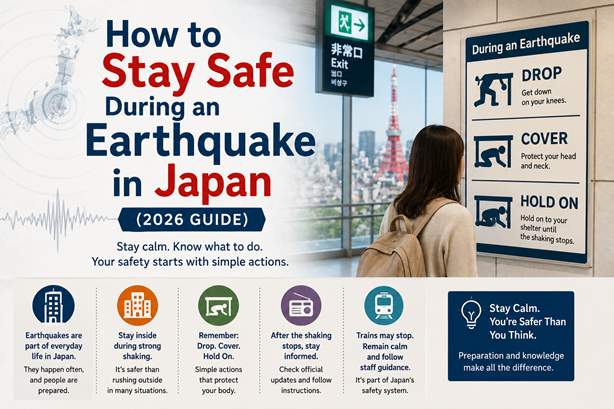
🛡️ Remember Three Simple Words
Around the world, emergency organizations promote a simple response known as ShakeOut. Japan also follows the same basic principles.
If a strong earthquake begins while you are indoors, remember these three words:
Drop. Cover. Hold On.
Lower yourself to the ground so that you do not lose your balance. Protect your head and neck, preferably by taking cover under a sturdy desk or table if one is nearby. Then hold on until the shaking stops, because furniture may move as the earthquake continues.
These actions may appear simple, yet they have been developed through decades of earthquake research and real-world experience. The goal is not to eliminate all danger but to reduce the risk of injury from falling objects, broken glass, or sudden movement.
During the strongest shaking, avoid running through hallways or trying to reach an exit. Moving while the ground is shaking can be much more difficult than people expect. Waiting calmly for those crucial moments to pass is often the safest decision.
Once the shaking has stopped, follow instructions from hotel staff, station employees, or emergency personnel. Japan’s public facilities are well prepared for earthquakes, and employees are trained to guide visitors safely when necessary.
🏨 Trust the Building Around You
For many first-time visitors, one of the biggest fears during an earthquake is the thought that buildings might suddenly collapse.
That fear is understandable, especially if you come from a country where earthquakes are rare. However, understanding how modern buildings in Japan are designed can help replace fear with confidence.
Japan has spent decades improving its building standards after learning from past earthquakes. Today, modern hotels, apartment buildings, shopping malls, office towers, railway stations, and many public facilities are built under some of the world’s strictest earthquake-resistant regulations. Engineers use advanced structural designs that allow buildings to absorb and disperse seismic energy rather than simply resisting it with rigid strength alone.
This does not mean that earthquakes are harmless or that every building is completely risk-free. Large earthquakes can still cause damage, and every situation is different. However, for most visitors staying in modern accommodations or spending time in major cities, the building around you is often one of the safest places to be during the strongest shaking.
This is why emergency experts generally advise people not to rush outside while the ground is still moving. Remaining inside a well-built structure, protecting yourself from falling objects, and waiting until the shaking stops is often much safer than exposing yourself to broken glass, falling signs, or debris outside.
Simply knowing this before an earthquake happens can make an enormous difference. Instead of thinking, “The building is going to collapse,” you can remind yourself that the building was designed with earthquakes in mind.
That knowledge alone often helps prevent panic.
📱 Download These Two Apps Before You Need Them
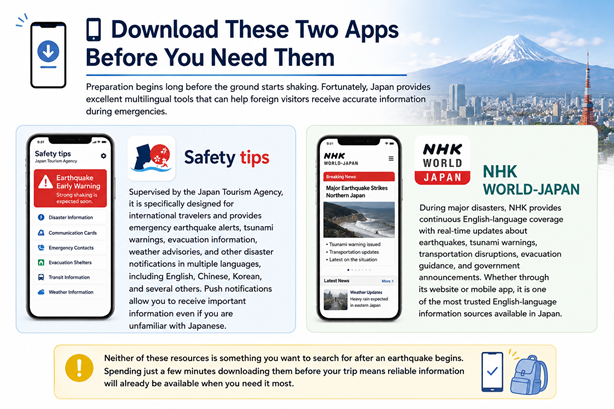
Preparation begins long before the ground starts shaking. Fortunately, Japan provides excellent multilingual tools that can help foreign visitors receive accurate information during emergencies.
The first app every visitor should consider downloading is Safety tips. Supervised by the Japan Tourism Agency, it is specifically designed for international travelers and provides emergency earthquake alerts, tsunami warnings, evacuation information, weather advisories, and other disaster notifications in multiple languages, including English, Chinese, Korean, and several others. Push notifications allow you to receive important information even if you are unfamiliar with Japanese.
Official Safety tips website
The second resource is NHK WORLD-JAPAN. During major disasters, NHK provides continuous English-language coverage with real-time updates about earthquakes, tsunami warnings, transportation disruptions, evacuation guidance, and government announcements. Whether through its website or mobile app, it is one of the most trusted English-language information sources available in Japan.
Official NHK WORLD-JAPAN website
Neither of these resources is something you want to search for after an earthquake begins. Spending just a few minutes downloading them before your trip means reliable information will already be available when you need it most.
🤝 Don’t Be Afraid to Ask Japanese People
Even with preparation, experiencing your first earthquake can be frightening.
If you find yourself unsure of what to do, look around you.
The people nearby have almost certainly experienced earthquakes before.
For most Japanese people, earthquakes have been part of life since childhood. They have participated in school evacuation drills, workplace disaster training, and community emergency exercises. While every earthquake is different, remaining calm and helping those around them has become a natural response for many people.
If you are confused, frightened, or unsure where to go after the shaking stops, do not hesitate to ask someone nearby.
Whether you are in a train station, a shopping mall, a hotel, or simply walking down the street, many Japanese people will gladly help you. Even if there is a language barrier, they will often use gestures, simple English, translation apps, or simply guide you to a safer place.
You are not expected to face the situation alone.
In fact, following the people around you is often one of the safest decisions you can make. They are familiar with local procedures, know where emergency exits and evacuation areas are, and understand how earthquakes are typically handled in Japan.
During difficult moments, kindness often speaks more clearly than words.
🌏 Living With Earthquakes, Not Living in Fear
Many people hesitate to visit Japan because they worry about earthquakes.
That concern is completely understandable.
Earthquakes are powerful natural events, and they deserve respect. But respect is very different from fear.
For generations, Japan has lived alongside earthquakes. Every major earthquake has brought painful lessons, and those lessons have shaped stronger buildings, better warning systems, improved emergency planning, and more effective disaster education. The knowledge passed down from previous generations continues to protect people today.
Japan’s approach is not based on pretending earthquakes will never happen. Instead, it is based on accepting that they can happen and preparing for them before they do.
That preparation is visible everywhere—from earthquake-resistant hotels and railway stations to nationwide emergency drills, multilingual warning systems, and everyday disaster awareness. These are not signs that Japan is dangerous. They are signs of a society that has spent decades learning how to live safely with one of nature’s greatest challenges.
If you remember the basic actions, trust modern buildings, download the right apps, and stay calm, you will already be doing exactly what millions of people in Japan do every year.
Preparation is stronger than panic.
Knowledge is stronger than fear.
And once you understand how Japan approaches earthquakes, you may find that your confidence grows just as much as your sense of safety.
🌏 Continue Exploring Life in Japan
If you found this guide helpful, you may also enjoy these articles to better understand everyday life and practical travel in Japan.
👉 Suica vs Welcome Suica vs PASMO: Which IC Card Should Tourists Choose? (2026 Guide)
👉 How to Use Japanese Laundry Services While Traveling (2026 Guide)
👉 How to Use Japanese Vending Machines: More Than Just Drinks (2026 Guide)
👉 How to Find the Right Exit at Japan’s Train and Subway Stations (2026 Guide)
👉 How to Beat Jet Lag When Traveling to Japan (2026 Guide)