
🌏 Introduction
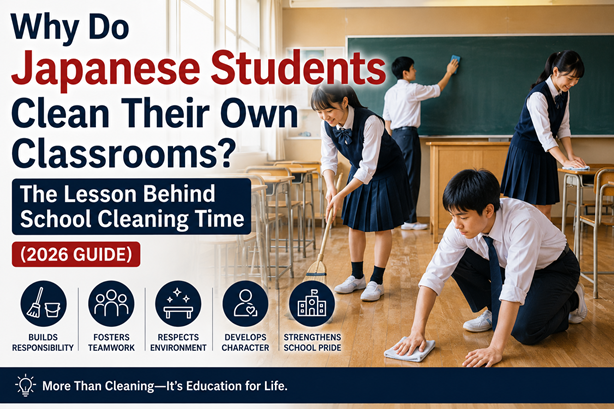
For many visitors, one of the most surprising things about Japanese schools is not the uniforms, school lunches, or even the school clubs. It is the fact that students clean the school themselves.
In many countries, cleaning classrooms, hallways, and restrooms is the responsibility of janitors or maintenance staff. Schools hire professionals to take care of those tasks, allowing students to focus entirely on studying. Because this system is so common around the world, many people are surprised to discover that Japanese students regularly spend part of their school day cleaning.
When I was a child in Japan, I never thought this was unusual. It was simply part of school life. Every year, students were assigned different cleaning areas. Some cleaned classrooms. Others cleaned hallways, staircases, gymnasiums, special classrooms, or restrooms. At the end of the day, everyone knew where they were supposed to go and what they were supposed to do.
To be honest, I never spent much time thinking about why we cleaned. It was just normal. We grabbed brooms, dustpans, and cloths, and cleaned for a short period before going home. It was only after I lived overseas that I realized how unusual this system actually is. When I learned that students in many countries do not clean their schools at all, I was genuinely surprised. At that moment, something I had always considered ordinary suddenly became interesting.
The question is not simply why Japanese students clean their classrooms. The more interesting question is what Japanese society believes students are learning when they do it.
🏫 Cleaning Is Considered Part of Education
One of the biggest misunderstandings about school cleaning in Japan is the idea that students are doing the work of janitors.
Most Japanese people do not see it that way.
Traditionally, school cleaning has been viewed as part of education rather than labor. The goal is not primarily to reduce costs or replace professional staff. The goal is to teach responsibility, cooperation, and respect for shared spaces.
From an early age, Japanese children are taught that schools are not merely buildings where lessons take place. They are communities. Students spend years eating, studying, exercising, and socializing there. Because they share those spaces with others, they are expected to help care for them as well.
This idea may sound simple, but it shapes how many children think about public spaces. If you are responsible for cleaning a classroom floor, you become more aware of what makes it dirty. If you help clean a hallway every day, you become less likely to leave trash behind. The act of cleaning encourages students to think about the consequences of their own behavior.
This does not mean every child suddenly loves cleaning. Most students would probably prefer to go home earlier. I certainly did. Yet even if children complain about cleaning duties, they still absorb the lesson that maintaining a shared environment is everyone’s responsibility.
🧹 Learning Through Experience Rather Than Lectures
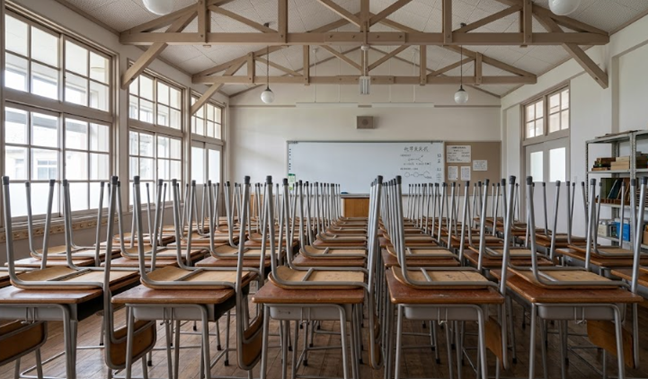
One thing I have noticed throughout Japanese education is that many lessons are taught through experience rather than explanation.
Teachers can explain the importance of cooperation, responsibility, and consideration for others. However, those ideas often become more meaningful when students actually practice them.
Cleaning time is one example.
A teacher can tell students to respect shared spaces, but spending years helping clean those spaces creates a different kind of understanding. Children learn that someone must pick up the trash. Someone must wipe the desks. Someone must sweep the floor.
In Japanese schools, that “someone” is often the students themselves.
The lesson is not delivered through a textbook. It is delivered through daily repetition.
This approach appears elsewhere in Japanese schools as well. Students often help serve school lunches. They participate in group activities. They work together during sports festivals and school trips. The emphasis is frequently placed on shared responsibility and participation.
School cleaning fits naturally into that broader philosophy.
🤝 The Idea of Respecting Shared Spaces
Another reason school cleaning remains important is that it reflects a broader cultural idea about public and shared spaces.
Many Japanese children grow up hearing that they should not make unnecessary work for other people. They are encouraged to clean up after themselves, organize their belongings, and leave places in good condition for the next person.
School cleaning provides a practical opportunity to practice those values.
When students clean a classroom every day, they begin to notice that small actions matter. A piece of paper dropped on the floor does not disappear by itself. Mud tracked into the hallway does not magically clean itself. Someone has to take care of these things.
Over time, this awareness can influence behavior beyond school.
Of course, school cleaning alone does not explain why Japan is clean or why public spaces are often well maintained. Human behavior is far more complicated than that. However, many Japanese people believe that participating in cleaning from a young age helps create awareness of how shared environments function.
The lesson is not that cleaning is enjoyable.
The lesson is that shared spaces belong to everyone.
🌏 My Surprise After Living Overseas
When I first learned that many students overseas never cleaned their classrooms, I remember feeling surprised.
Not because I thought one system was better than the other.
Not because I believed Japanese schools were doing something extraordinary.
I was surprised because it had never occurred to me that there was another way.
As children, we tend to assume our daily routines are normal. We rarely stop and ask why things are done a certain way. It is only when we encounter a different system that we realize our assumptions are not universal.
Living overseas taught me this lesson repeatedly.
There were many things that felt completely ordinary in Japan but unusual elsewhere. School cleaning was one of them.
At the same time, I also learned that different countries have different priorities. In many places, employing professional cleaning staff allows students to focus entirely on academics and extracurricular activities. There are practical reasons why many education systems choose that approach.
The more I traveled, the more I realized that there is rarely a single correct way to organize society.
Different systems reflect different values.
What interested me was not whether Japanese schools were right or wrong. What interested me was understanding what values the practice was trying to teach.
🪣 Cleaning Is Not Always Fun
When people discuss Japanese school cleaning, they sometimes describe it as if children happily spend every afternoon polishing floors with smiles on their faces.
That image is not particularly realistic.
Children are children.
Many students would rather talk with friends, play sports, or go home.
I certainly did not wake up every morning excited about cleaning duties.
Some tasks were more popular than others. Cleaning classrooms was one thing. Cleaning restrooms was something many students hoped to avoid. Yet those assignments still existed, and students generally completed them because they were part of school life.
This is important because the value of school cleaning does not come from children loving it.
The value comes from participating in a shared responsibility even when it is not especially enjoyable.
In some ways, that may be one of the most important lessons of all.
Adult life is filled with responsibilities that are not exciting. Maintaining a home, keeping a workplace organized, and contributing to a community often require effort without immediate rewards.
School cleaning introduces that reality in a small and manageable way.
🎓 More Than Keeping the School Clean
The more I think about it, the more I believe school cleaning is not really about cleaning.
A professional cleaning company could almost certainly clean a school more efficiently.
The deeper purpose lies elsewhere.
School cleaning teaches that the environment people share is also their responsibility. It teaches cooperation because students work together. It teaches awareness because students see firsthand how quickly a space becomes dirty. It teaches respect because they experience the effort required to maintain that space.
Most importantly, it teaches these lessons through action rather than theory.
Students do not spend years discussing responsibility.
They practice it.
Whether those lessons remain with them for life depends on the individual. Some students probably forget them quickly. Others may carry them into adulthood.
But the experience itself becomes a shared memory for millions of Japanese children.
🇯🇵 Conclusion
Why do Japanese students clean their own classrooms?
The answer is not simply that schools want free labor. Traditionally, cleaning has been viewed as part of education rather than maintenance. It is intended to help students develop responsibility, cooperation, and respect for shared spaces.
As a child, I never questioned this system because it was simply part of everyday life. It was only after living overseas that I realized how unusual it appears to many people around the world. That realization made me appreciate the practice in a different way.
Whether one agrees with the system or not, school cleaning offers an interesting window into Japanese education. It reflects the belief that learning is not limited to textbooks and exams. Some lessons are taught through daily habits, shared responsibilities, and ordinary experiences that students may not fully understand until years later.
For many Japanese people, cleaning the classroom was never just about cleaning the classroom.
It was one small lesson about how to live alongside other people.
🌏 Explore More Japanese School Life and Everyday Culture
Many aspects of Japanese school life reveal deeper cultural values about responsibility, cooperation, and community. If you enjoyed this article, explore these related guides to better understand how Japanese children grow up and learn beyond the classroom.
👉 Why Do Japanese Students Spend So Much Time in School Clubs? (2026 Guide)
👉 Why Is Summer Vacation in Japan So Different? School Life, Homework & Cultural Surprises
👉 What Is Japanese School Lunch? Why Kyushoku Is More Than Just Food (2026 Guide)
👉 What Is a Japanese School Trip? Why Shūgaku Ryokō Becomes a Lifetime Memory (2026 Guide)
👉 Why Is Japanese Sports Day Such a Powerful Childhood Memory? Understanding Undokai
🔗Discover more about Japan
👉 Why Does Japan Feel So Clean? The Culture Behind Public Cleanliness (2026 Guide)
👉 How to Use ATMs in Japan: A Complete Guide for Foreign Travelers (2026)