
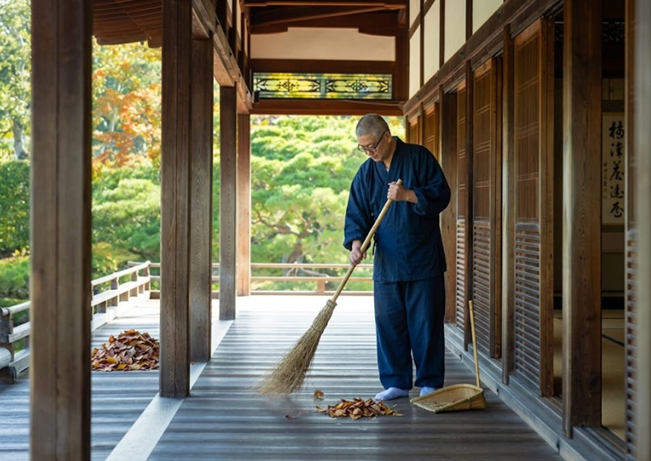
🧠 Introduction
Walk through a street in Japan, and you may notice something immediately.
There is very little trash on the ground. Public spaces feel orderly, quiet, and clean—even in large cities with millions of people.
For many visitors, this raises a simple question:
Why does Japan feel so clean?
At first, it may seem like the result of strict rules or frequent cleaning by staff. However, the reality is more complex. Public cleanliness in Japan is not maintained only by systems or regulations.
👉 It is the result of a long-standing culture shaped by history, belief, and education.
🎯 Quick Answer
Japan feels clean because cleanliness is deeply embedded in everyday behavior.
People are taught from a young age to clean their own spaces, respect shared environments, and see cleaning as a meaningful act rather than a chore.
In short, cleanliness is not enforced—it is practiced.
🧩 1. Cleanliness as a Cultural Value
In Japan, cleaning is not only about removing dirt. It is also connected to a deeper idea of purification.
Historically, influenced by Shinto beliefs, cleaning has been seen as a way to “purify” a space. Sweeping, washing, and organizing are not simply practical actions—they are also symbolic.
A clean space is considered to be:
- orderly
- respectful
- mentally calming
This way of thinking shapes how people interact with their surroundings.
👉 Cleaning is not just physical—it is also psychological.
⛩ 2. Historical and Religious Influence
Shinto, Japan’s indigenous belief system, places importance on purity. Natural elements such as water, trees, and air are seen as sacred, and maintaining cleanliness is part of respecting these elements.
This idea can be seen in many traditional practices:
- washing hands before entering a shrine
- keeping entrances and surroundings tidy
- seasonal cleaning rituals
Over time, these practices influenced daily life beyond religious settings.
Even today, the idea of “cleaning as purification” remains part of the cultural mindset.
🧠 3. Learning to Clean at School
One of the most distinctive aspects of Japanese society is how children learn about cleanliness.
In Japan, cleaning is part of school life.
More than 90% of elementary schools and a large percentage of middle schools have students and teachers clean the school themselves instead of hiring cleaning staff.
This includes:
- classrooms
- hallways
- bathrooms
- shared spaces
Students are assigned specific roles and areas. These roles are rotated regularly to ensure fairness.
I experienced this myself. From elementary school through high school, there was a designated cleaning time after the final class each day. Every student participated, and each person had a specific responsibility—what to clean, where to clean, and how to do it.
Of course, sometimes students joked around or didn’t take it perfectly seriously. But the habit was consistent.
Over time, something important happens:
Cleaning becomes normal.
👉 People grow up understanding that shared spaces are their responsibility.
⚖️ 4. Personal Responsibility in Public Spaces
Because of this early education, people carry the same mindset into adulthood.
In public places, such as parks, streets, and stations, many people feel responsible for maintaining cleanliness—even if they did not create the mess.
This is why:
- people take their trash home
- events often end with participants cleaning the area
- public spaces remain orderly without constant supervision
It is not about being told what to do.
It is about understanding what should be done.
🧹 5. Systems Support, but Do Not Replace Behavior
Japan does have systems in place:
- regular maintenance
- organized waste management
- community rules
However, these systems alone do not explain the level of cleanliness.
In fact, Japan has relatively few public trash bins compared to many countries.
Despite this, streets remain clean.
👉 This shows something important:
👉 systems help—but behavior is what sustains cleanliness.
🤝 6. The Role of Social Awareness
Another key factor is social awareness.
In Japan, people are often mindful of how their actions affect others. Leaving trash behind is not only seen as inconvenient—it is seen as inconsiderate.
This connects to broader cultural ideas:
- do not cause trouble
- respect shared space
- maintain harmony
Cleanliness becomes part of social behavior, not just a personal habit.
🌏 7. Is Japan Perfect?
Japan is not perfectly clean at all times. There are still areas with litter, and challenges exist, especially in busy urban environments.
However, compared to many other countries, the overall level of cleanliness remains consistently high.
What visitors notice is not perfection, but consistency.
🔗 8. Connection to Other Cultural Patterns
Public cleanliness in Japan is closely related to other aspects of society:
- lost items being returned
- quiet behavior in public spaces
- trust-based systems like unmanned shops
These are not separate phenomena.
They are connected through shared values:
- responsibility
- respect
- awareness
👉 Cleanliness is one visible result of these deeper principles.
🧠 Cleaning Is a Shared Responsibility
Japan’s cleanliness is not maintained by individuals alone, but by a shared understanding that public spaces belong to everyone.
🇯🇵 Conclusion
Japan feels clean not because of strict rules or constant enforcement, but because of a deeply rooted cultural mindset.
From religious ideas of purification to everyday habits learned in school, cleanliness is treated as a natural part of life.
People are not simply cleaning spaces.
They are maintaining order, respect, and harmony in shared environments.
👉 In Japan, cleanliness is not just about the environment—it reflects how people think and live.
🔗Go deeper into Japan
・Why Are Lost Items Returned in Japan? The Culture of Honesty Explained (2026 Guide)
・Why Are There So Few Trash Cans in Japan? And What You Should Do Instead
・Umbrella Etiquette in Japan: 7 Essential Rules Every Traveler Should Know (2026 Guide)
・Why Do Japanese Students Clean Their Own Classrooms? The Lesson Behind School Cleaning Time
Understanding everyday habits like this can make your trip to Japan much smoother and more enjoyable.
👉 Essential Travel Guide for Japan