
🌏 Introduction
One phrase that many visitors hear repeatedly in Japan is something that is surprisingly difficult to translate directly into English.
It is the idea of not causing trouble for other people.
Whether it is on trains, in schools, at work, or even among family members, many Japanese people grow up hearing some version of the same message: think about how your actions affect those around you.
For visitors from overseas, this can sometimes feel unusual. Why are people so concerned about making noise on trains? Why do they apologize so frequently? Why do they stand neatly in line even when nobody is watching? Why do people worry so much about inconveniencing strangers they may never meet again?
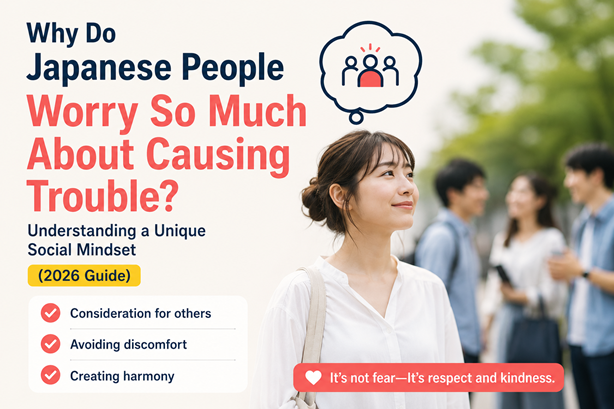
The answer is connected to one of the most important ideas in Japanese society. Many people are taught from a young age to consider not only what they want to do, but also how their actions might affect the group around them.
This mindset influences daily life in countless ways and helps explain many of the behaviors that visitors notice when they come to Japan.
🎯 Quick Answer
Japanese people often try to avoid causing trouble to others because Japanese society places a strong emphasis on social harmony, mutual consideration, and awareness of how individual actions affect the community. This mindset contributes to many positive aspects of daily life, but it also comes with certain challenges and trade-offs.
🤝 Thinking About Others Before Yourself
In many parts of the world, children are encouraged to express themselves clearly, defend their opinions, and communicate their needs confidently. These are valuable skills, and societies that encourage them often produce people who are comfortable speaking up and advocating for themselves.
Japan emphasizes something slightly different.
From an early age, many children are taught to think about the people around them. Before acting, speaking, or making a decision, they are often encouraged to consider how their behavior might affect others.
This does not mean Japanese people never express opinions or disagree with one another. Rather, there is often a stronger tendency to consider the impact of those opinions on the surrounding group.
The goal is not simply personal freedom. It is maintaining relationships and avoiding unnecessary friction whenever possible.
🌾 The Historical Roots of Cooperation
Part of this mindset can be traced back to Japan’s history.
For much of Japanese history, communities depended heavily on cooperation. Farming villages shared water sources, worked together during planting and harvesting seasons, and relied on neighbors during natural disasters. Living on islands frequently affected by earthquakes, typhoons, floods, and other natural challenges reinforced the importance of mutual support.
Over generations, cooperation became more than a practical necessity. It became a social value.
People learned that functioning smoothly as a group often benefited everyone involved. While modern Japan is very different from those historical communities, some of those attitudes remain visible today.
The idea of considering the group before acting purely as an individual continues to influence everyday behavior.
🚆 How This Appears in Daily Life
Visitors often notice this mindset without realizing it.
It appears in the quiet atmosphere on trains. It appears when people line up patiently. It appears when someone takes a phone call outside rather than speaking loudly in a crowded space. It appears when students clean their classrooms together. It appears when commuters arrive early rather than risk making others wait.
Even the concept of punctuality is often connected to this way of thinking. Being late is not only viewed as a personal inconvenience. It can also affect the schedules of other people.
Similarly, many aspects of Japanese cleanliness are connected to social consideration. People may clean shared spaces not because they are legally required to do so, but because they feel some responsibility toward the community that uses those spaces.
Many visitors experience these habits as signs of politeness. Underneath them lies a deeper awareness of how individual actions affect the wider group.
🌏 What I Learned While Living Abroad
Having lived in and traveled through many countries, I do not believe Japan is uniquely kind, uniquely clean, or uniquely considerate.
I have encountered incredible generosity, hospitality, and kindness in many parts of the world. I have visited cities that were clean, safe, and welcoming. Some of the most memorable acts of kindness I have ever experienced happened outside Japan.
At the same time, there was something I often admired while living abroad.
People were often more comfortable expressing their opinions directly.
They could disagree openly, communicate their needs clearly, and advocate for themselves without feeling guilty about it. Speaking confidently is not always easy. It requires communication skills, self-confidence, and practice. There were many moments when I found myself wishing more Japanese people felt comfortable doing the same.
The ability to express yourself honestly can be incredibly valuable.
In that sense, every culture has something worth learning from.
⚖️ The Strengths and Trade-Offs
The Japanese tendency to avoid causing trouble creates many benefits.
It contributes to orderly public spaces, smooth daily interactions, strong social trust, and a generally predictable environment. It is one reason many visitors describe Japan as safe, comfortable, and easy to navigate.
At the same time, every cultural value comes with trade-offs.
When people become highly concerned about inconveniencing others, they may hesitate to express disagreement, share unpopular opinions, or stand out from the group. In some situations, individuals may prioritize harmony even when speaking openly might be more helpful.
Neither approach is perfect.
Societies that emphasize individual expression face their own challenges. Societies that emphasize group harmony face different ones.
Understanding Japan requires recognizing both the strengths and the limitations of this mindset.
🌏 Why Understanding This Helps You Understand Japan
Many aspects of Japanese culture become easier to understand once you recognize the importance of considering others.
The quiet trains, the orderly lines, the cleanliness of public spaces, the emphasis on punctuality, and even certain communication styles are often connected by the same underlying idea.
It is not simply about following rules.
It is about recognizing that we share spaces, communities, and experiences with other people.
For many Japanese people, avoiding unnecessary inconvenience to others is one way of showing respect.
🇯🇵 Conclusion
One of the most important cultural ideas in Japan is the awareness that our actions affect the people around us.
This mindset has helped shape a society known for trust, order, cleanliness, and cooperation. At the same time, it can sometimes make self-expression more difficult and create pressure to conform to group expectations.
Neither perspective is completely right or wrong. Different cultures prioritize different values.
But understanding why Japanese people often worry about causing trouble helps explain countless aspects of everyday life in Japan. It reveals a society that places great importance on consideration, relationships, and the invisible connections between individuals and the communities they share.
And perhaps that is why so many visitors leave Japan feeling that people seem to be quietly looking out for one another, even when nobody says a word.
🌏 Want to Understand Japan More Deeply?
Many aspects of Japanese life—from quiet trains and punctuality to cleanliness and social harmony—are connected by shared cultural values. Explore these related articles to discover the deeper ideas that shape everyday life in Japan.
・Why Do Japanese People Value Harmony So Much? The Hidden Logic of “Wa”
・Why Is Being On Time So Important in Japan? Understanding Japanese Punctuality
・Why Are Japanese Trains So Quiet? The Unspoken Rules Behind the Silence
・Why Does Japan Feel So Clean? The Culture Behind Public Cleanliness
・Why Are Lost Items Returned in Japan? The Culture of Honesty Explained